
Table of Contents
As filed with the Securities and Exchange Commission on February 20, 2024.
Registration No. 333-
UNITED STATES
SECURITIES AND EXCHANGE COMMISSION
WASHINGTON, D.C. 20549
FORM S-1
REGISTRATION STATEMENT
UNDER
THE SECURITIES ACT OF 1933
Astera Labs, Inc.
(Exact Name of Registrant as Specified in Its Charter)
| Delaware | 3674 | 82-3437062 | ||
| (State or Other Jurisdiction of Incorporation or Organization) |
(Primary Standard Industrial Classification Code Number) |
(I.R.S. Employer Identification Number) |
2901 Tasman Drive, Suite 205
Santa Clara, CA 95054
(408) 337-9056
(Address, Including Zip Code, and Telephone Number, Including Area Code, of Registrant’s Principal Executive Offices)
Jitendra Mohan
Co-Founder and Chief Executive Officer
Astera Labs, Inc.
2901 Tasman Drive, Suite 205
Santa Clara, CA 95054
(408) 337-9056
(Name, Address, Including Zip Code, and Telephone Number, Including Area Code, of Agent for Service)
Copies to:
| Bradley C. Weber Julia R. White John Hutar Goodwin Procter LLP 601 Marshall Street Redwood City, CA 94063 (650) 752-3100 |
Philip T. Mazzara General Counsel & Secretary Astera Labs, Inc. 2901 Tasman Drive, Suite 205 Santa Clara, CA 95054 (408) 337-9056 |
Heidi E. Mayon Simpson Thacher & Bartlett LLP 2475 Hanover Street Palo Alto, CA 94304 (650) 251-5000 |
Approximate date of commencement of proposed sale to the public: As soon as practicable after this registration statement becomes effective.
If any of the securities being registered on this Form are to be offered on a delayed or continuous basis pursuant to Rule 415 under the Securities Act, check the following box: ☐
If this Form is filed to register additional securities for an offering pursuant to Rule 462(b) under the Securities Act, please check the following box and list the Securities Act registration statement number of the earlier effective registration statement for the same offering. ☐
If this Form is a post-effective amendment filed pursuant to Rule 462(c) under the Securities Act, check the following box and list the Securities Act registration statement number of the earlier effective registration statement for the same offering. ☐
If this Form is a post-effective amendment filed pursuant to Rule 462(d) under the Securities Act, check the following box and list the Securities Act registration statement number of the earlier effective registration statement for the same offering. ☐
Indicate by check mark whether the registrant is a large accelerated filer, an accelerated filer, a non-accelerated filer, smaller reporting company, or an emerging growth company. See the definitions of “large accelerated filer,” “accelerated filer,” “smaller reporting company,” and “emerging growth company” in Rule 12b-2 of the Exchange Act.
| Large accelerated filer |
☐ |
Accelerated filer |
☐ | |||
| Non-accelerated filer |
☒ |
Smaller reporting company |
☐ | |||
| Emerging growth company |
☒ | |||||
If an emerging growth company, indicate by check mark if the registrant has elected not to use the extended transition period for complying with any new or revised financial accounting standards provided to Section 7(a)(2)(B) of the Securities Act. ☐
The registrant hereby amends this registration statement on such date or dates as may be necessary to delay its effective date until the registrant shall file a further amendment which specifically states that this registration statement shall thereafter become effective in accordance with Section 8(a) of the Securities Act of 1933 or until the registration statement shall become effective on such date as the Commission, acting pursuant to said Section 8(a), may determine.
Table of Contents
The information in this preliminary prospectus is not complete and may be changed. These securities may not be sold until the registration statement filed with the Securities and Exchange Commission is effective. This preliminary prospectus is not an offer to sell, nor does it seek an offer to buy these securities if any jurisdiction where the offer or sale is not permitted. Subject to Completion, dated , 2024. Shares Astera Labs, Inc. Common Stock This is an initial public offering of shares of common stock of Astera Labs, Inc. We are offering shares of our common stock. Prior to this offering, there has been no public market for our common stock. It is currently estimated that the initial public offering price will be between $ and $per share. We intend to apply to list our common stock on the Nasdaq Global Select Market under the symbol“.” We are an “emerging growth company” as defined under Section 2(a)(19) of the Securities Act of 1933, as amended, and, as such, we have elected to comply with certain reduced reporting requirements for this prospectus and may elect to do so in future filings. See “Prospectus Summary— Emerging Growth Company.” Investing in our common stock involves a high degree of risk. See the section titled “Risk Factors” beginning on page 16 to read about factors you should consider before buying our common stock. Neither the Securities and Exchange Commission nor any other regulatory body has approved or disapproved of these securities or passed upon the accuracy or adequacy of this prospectus. Any representation to the contrary is a criminal offense. Initial public offering price Underwriting discount(1) Proceeds, before expenses, to us Per Share Total $ $ $ $ $ $ (1) See the section titled “Underwriting” for additional information regarding compensation payable to the underwriters. At our request, the underwriters have reserved up to shares of common stock, or up to % of the shares offered by this prospectus, for sale at the initial public offering price through a directed share program to our directors, business partners, and friends and family. See the section titled “Underwriting—Directed Share Program.” shares of common The underwriters have the option to purchase up to an additional stock from us at the initial public offering price, less the underwriting discount, for 30 days after the date of this prospectus. The underwriters expect to deliver the shares against payment in New York, New York on or about ,2024. MORGAN STANLEY J.P. MORGAN BARCLAYS DEUTSCHE BANK SECURITIES EVERCORE ISI JEFFERIES NEEDHAM & COMPANY STIFEL CRAIG-HALLUM CAPITAL GROUP ROTH CAPITAL PARTNERS The date of this prospectus is , 2024
Table of Contents
Astera at a Glance Shipping to All Major Hyperscalers and Al Platform Providers $116MM 2023 Revenue Millions of Devices Shipped Across Multiple Form Factors 3 Product Families Generating Revenue 265+ Employees Across 5 Countries Globally
Table of Contents
| Page | ||||
| 1 | ||||
| 17 | ||||
| 54 | ||||
| 56 | ||||
| 57 | ||||
| 58 | ||||
| 59 | ||||
| 61 | ||||
| MANAGEMENT’S DISCUSSION AND ANALYSIS OF FINANCIAL CONDITION AND RESULTS OF OPERATIONS |
64 | |||
| 86 | ||||
| 88 | ||||
| 115 | ||||
| 122 | ||||
| Page | ||||
| 132 | ||||
| 137 | ||||
| 140 | ||||
| 146 | ||||
| MATERIAL U.S. FEDERAL INCOME TAX CONSEQUENCES TO NON-U.S. HOLDERS OF OUR COMMON STOCK |
149 | |||
| 154 | ||||
| 162 | ||||
| 162 | ||||
| 162 | ||||
| F-1 | ||||
Through and including , 2024 (the 25th day after the date of this prospectus), all dealers effecting transactions in these securities, whether or not participating in this offering, may be required to deliver a prospectus. This is in addition to the dealers’ obligation to deliver a prospectus when acting as underwriters and with respect to their unsold allotments or subscriptions.
You should rely only on the information contained in this prospectus, any amendment or supplement to this prospectus, or contained in any free writing prospectus filed by us with the Securities and Exchange Commission (the “SEC”). Neither we, the selling stockholders, nor any of the underwriters have authorized anyone to provide any information or make any representations other than those contained in this prospectus, any amendment or supplement to this prospectus, or in any free writing prospectus we have prepared. We, the selling stockholders, and the underwriters take no responsibility for, and can provide no assurance as to the reliability of, any other information that others may give you. We and the selling stockholders are offering to sell, and seeking offers to buy, shares of our common stock only in jurisdictions where offers and sales are permitted. The information contained in this prospectus, any amendment or supplement to this prospectus, or any free writing prospectus, is accurate only as of the date of this prospectus, regardless of the time of delivery of this prospectus, any amendment or supplement to this prospectus, or any applicable free writing prospectus, as the case may be, or of any sale of our common stock. Our business, financial condition, results of operations, and prospects may have changed since that date.
For investors outside of the United States: we are offering to sell, and seeking offers to buy, shares of our common stock only in jurisdictions where offers and sales are permitted. Neither we, the selling stockholders, nor any of the underwriters have done anything that would permit this offering or possession or distribution of this prospectus, any amendment or supplement to this prospectus, or any applicable free writing prospectus in any jurisdiction where action for that purpose is required, other than in the United States. Persons outside of the United States who come into possession of this prospectus, any amendment or supplement to this prospectus, or any applicable free writing prospectus must inform themselves about, and observe any restrictions relating to, the offering of the shares of our common stock and the distribution of this prospectus, any amendment or supplement to this prospectus, or any applicable free writing prospectus outside of the United States.
i
Table of Contents
NON-GAAP FINANCIAL MEASURES
This prospectus contains certain financial measures that are not presented in accordance with generally accepted accounting principles in the United States (“GAAP”), including non-GAAP operating (loss) income and non-GAAP net (loss) income, that are not required by, or prepared in accordance with, GAAP. We refer to these measures as “non-GAAP financial measures.” See the section titled “Management’s Discussion and Analysis of Financial Condition and Results of Operations—Non-GAAP Financial Measures” for our definitions of these non-GAAP financial measures, information about how and why we use these non-GAAP financial measures and a reconciliation of each of these non-GAAP financial measures to its most directly comparable financial measure calculated in accordance with GAAP.
ii
Table of Contents
GLOSSARY OF CERTAIN TERMS
The following are abbreviations, acronyms, and definitions of certain terms used in this prospectus:
| • | “ASICs” means Application-Specific Integrated Circuits, custom-designed ICs for a specific purpose, offering better performance and efficiency compared to general-purpose ICs. ASICs are widely used in electronic devices, including smartphones, computers, and networking equipment. Hyperscalers have adopted custom ASICs to address the performance and scalability requirements of cloud and Artificial Intelligence (“AI”) applications. |
| • | “BIOS” means Basic Input/Output System, a system software that initializes hardware and loads the operating system when a computer is turned on. It acts as an intermediary between the operating system and the computer’s hardware components. |
| • | “BMC” means Baseboard Management Controller, a specialized processor located on a computer’s motherboard that provides management capabilities, allowing remote monitoring, configuration, and troubleshooting of the system even if the operating system is unavailable. With BMCs, system administrators can monitor the hardware in a data center without physically being located or connected to the system. |
| • | “CPU” means Central Processing Unit, the brain of a computer, responsible for executing instructions and carrying out computations. It is a complex IC that fetches, decodes, and executes instructions, typically from main memory under the control of software programs. |
| • | “customers” refers to our end customers, our end customers’ manufacturing partners, and our distributors. When the context requires, we may use “end customers,” which are primarily hyperscalers and System OEMs, to distinguish from our end customers’ manufacturing partners and our distributors. When used in our audited consolidated financial statements included elsewhere in this prospectus, “customers” refers to parties we directly invoice for products or services, which primarily include our end customers’ manufacturing partners and our distributors. |
| • | “CXL” means Compute Express Link, an industry standard interconnect that offers high-bandwidth, low-latency connectivity between a host processor and other ICs such as AI accelerators, memory expansion, and smart I/O devices. CXL maintains memory coherency between a processor’s memory and all attached devices, providing higher performance, lowering system costs and helping overcome memory-storage bottlenecks. |
| • | “DDR5” means Double Data Rate 5 Synchronous Dynamic Random-Access Memory (“DRAM”), the latest generation of memory focused on increasing the density and capacity of Random-Access-Memory (“RAM”). DDR5 is designed to reduce power consumption while doubling bandwidth relative to its predecessor, DDR4. It is commonly used in the latest high-performance computers and servers. |
| • | “DSP” means Digital Signal Processor, a specialized IC that uses digital algorithms to perform functions that were traditionally performed by analog circuits, such as filtering, amplification, and modulation. Due to their digital nature, DSPs provide more robust and advanced signal processing power necessary for many applications such as video processing, imaging, and communications. |
| • | “Ethernet” refers to a standardized network protocol used in a data center for connecting servers and switches together in a Local Area Network (“LAN”) over copper and optical cables. Ethernet cables support longer reach and can add security and diagnostic capabilities. |
| • | “FPGAs” means Field Programmable Gate Arrays, a type of ICs that can be programmed and reconfigured by the customer after the manufacturing process. This allows designers to customize the ICs to meet specific use case requirements. FPGAs, due to their customizability, enable many cloud and AI use cases. |
| • | “Gbps” means gigabits per second. |
| • | “GPU” means Graphic Processing Unit, a specialized IC with a high degree of parallelism used to accelerate the rendering of complex graphics onto a screen. Due to their ability to perform a large |
iii
Table of Contents
| number of computations in parallel, GPUs often outperform CPUs and are increasingly being used for scientific computing, and for accelerating AI workloads such as training of large language models (“LLMs”). |
| • | “GT/s” means giga transfers per second. |
| • | “HBM” means High Bandwidth Memory, a type of computer memory designed to provide high bandwidth and low latency for GPUs, other AI accelerators, and CPUs. HBM is significantly faster and more expensive than traditional DRAM memory and is typically integrated within the IC package, allowing for shorter signal paths and faster data transfer rates. |
| • | “Hyperscalers” refers to large technology companies that provide cloud computing services on a massive scale. They offer a wide range of services that are dynamically provisioned by their users on an as-needed basis using software. The services include, but are not limited to, computing infrastructure, software platforms, and, increasingly, AI model training and inferencing. |
| • | “IC” means an Integrated Circuit, a miniaturized electronic circuit that combines multiple transistor components and other elements into a single small package. ICs are the fundamental building blocks of modern electronics, and they are used in a wide variety of applications, including computers, servers, networking equipment, smartphones, automobiles, and medical devices. |
| • | “Mask” refers to a template typically etched in glass or quartz, used in the IC manufacturing process to transfer a complex pattern of shapes onto a semiconductor wafer. |
| • | “NIC” means Network Interface Card, a hardware component that connects computers and servers to a network. NICs typically connect to the local server using PCIe protocol and convert data received from the server to Ethernet or another suitable protocol to be sent over a network. |
| • | “PCB” means Printed Circuit Board, a board made of insulating material with layers of conducting copper tracks used to connect components, including ICs, to one another forming an electronic circuit. PCBs offer a compact solution for containing and connecting all the necessary parts of electronic devices. |
| • | “PCIe” means Peripheral Component Interconnect Express, a high-speed serial electronic data transfer technology widely used in servers. PCIe protocol is frequently used in several types of server interconnects in a data center including interconnects between CPUs, GPUs, other AI accelerators, storage devices, and NICs. |
| • | “Server Rack” refers to an open-frame cabinet of standard dimensions used to organize and house servers, networking equipment, power supplies, and other information technology (“IT”) hardware. A data center typically houses thousands of server racks interconnected by networking switches typically using Ethernet protocol. |
| • | “Signal integrity” refers to the measure of how accurately and reliably a signal can be transmitted from one point to another without distortion or corruption. It is a critical factor in the design and operation of electronic systems that operate at high speeds or over long distances. Electrical characteristics of high-speed signals may degrade due to channel insertion losses in PCBs or cables, reflections, crosstalk, and noise. ICs with specialized hardware and DSP techniques are used to restore the signal quality. |
| • | “SKU” means Stock-Keeping Unit, a unique identifier for a product, typically assigned by a manufacturer. It is used as a unique identifier for a specific product. |
| • | “SMC” means System Management Controller, typically a microcontroller or an FPGA that is responsible for managing low-level system functions. These functions include power management, thermal management, and hardware management. |
| • | “SSD” means Solid State Drive, a type of storage device that uses ICs to store data persistently. SSDs contain no moving parts and can access large files quickly. |
iv
Table of Contents
| • | “System OEM” means a system Original Equipment Manufacturer, a company that produces finished products for resale, using parts or components from other companies. System OEMs play an important role in the supply chain and are one of our important customers. |
| • | “Tapeout” refers to the completion of the design phase of an IC and transfer of the design into a digital format suitable for creation of “Masks” used in the semiconductor wafer manufacturing process. |
| • | “ToR” means Top-of-Rack, a type of network switch that is typically installed at the top of a server rack in a data center. ToR switches are used to connect the servers in the rack to each other and to the rest of the network. They are typically high-performance switches that can handle significant data traffic. |
| • | “TPU” means Tensor Processing Unit, a custom accelerator designed and developed by Google. TPUs are optimized for AI applications and address the performance and scalability requirements of training and inference of large AI models. |
v
Table of Contents
This summary highlights selected information that is presented in greater detail elsewhere in this prospectus. This summary does not contain all of the information you should consider before investing in our common stock. You should read this entire prospectus carefully, including the sections titled “Risk Factors” and “Management’s Discussion and Analysis of Financial Condition and Results of Operations” and our consolidated financial statements and the related notes included elsewhere in this prospectus, before making an investment decision. This summary contains forward-looking statements that involve risks and uncertainties. Unless the context otherwise requires, the terms “Astera,” “the Company,” “we,” “us,” and “our” in this prospectus refer to Astera Labs, Inc. and its consolidated subsidiaries.
ASTERA LABS, INC.
Mission Statement
Our mission is to innovate, design, and deliver semiconductor-based connectivity solutions that are purpose-built to unleash the full potential of cloud and AI infrastructure.
Overview
Building on years of experience with a singular focus on addressing connectivity challenges in data-centric systems, we have developed and deployed our leading Intelligent Connectivity Platform built from the ground up for cloud and AI infrastructure. Our Intelligent Connectivity Platform comprises:
i) Semiconductor-based, high-speed, mixed-signal connectivity products that integrate a matrix of microcontrollers and sensors; and
ii) COSMOS, our software suite which is embedded in our connectivity products and integrated into our customers’ systems.
Our Intelligent Connectivity Platform provides our customers with the ability to deploy and operate high-performance cloud and AI infrastructure at scale, addressing an increasingly diverse set of requirements. We provide our connectivity products in various form factors including ICs, boards, and modules.
AI touches many aspects of our daily lives today, from vision processing for autonomous vehicles to speech recognition systems for chatbots. According to IDC, by 2025, the Global 2000 organizations will allocate over 40% of their core IT spend to AI-related initiatives, leading to a double-digit increase in the rate of product and process innovations. The shift towards the cloud from on-premise computing is rapidly accelerating due to increasing demand for compute-intensive AI workloads that are truly optimized when deployed at cloud scale.
To address the performance and scalability requirements of AI and other compute-intensive applications, hyperscalers have adopted heterogeneous, “accelerated computing” system architectures within their data centers, which include GPUs and other AI accelerators, such as TPUs, AI processors, custom ASICs, and FPGAs, to target specific workloads. These new system architectures require a connectivity backbone that is significantly faster, has lower latency, is robust, and supports cloud scale deployment.
Our patented software-defined platform approach delivers critical connectivity performance, enables flexibility and customization, and supports observability and predictive analytics. This approach efficiently addresses the data, network, and memory bottlenecks, scalability, and other unique infrastructure requirements of our hyperscaler and system OEM customers.
Based on trusted relationships with the leading hyperscalers and collaboration with data center infrastructure suppliers such as NVIDIA, Advanced Micro Devices, Intel, and many others, our platform is designed to meet our customers’ unique cloud scale requirements. Our COSMOS software suite is foundational to our Intelligent
1
Table of Contents
Connectivity Platform and is designed to enable our customers to seamlessly configure, manage, monitor, optimize, troubleshoot, and customize functions in our IC, board, and module products.
We believe that our Intelligent Connectivity Platform addresses a large and growing total addressable market (“TAM”) of $17.2 billion. Specifically, our technology and product portfolios target the global wired connectivity market, including PCIe and Ethernet, and the CXL memory connectivity controller market. We believe that our TAM will grow to $27.4 billion by 2027, and we expect to address an increasing share of this TAM as we expand the breadth and depth of our product portfolio. See the section titled “Business—Our Market Opportunity” for additional information on how we calculate our TAM.
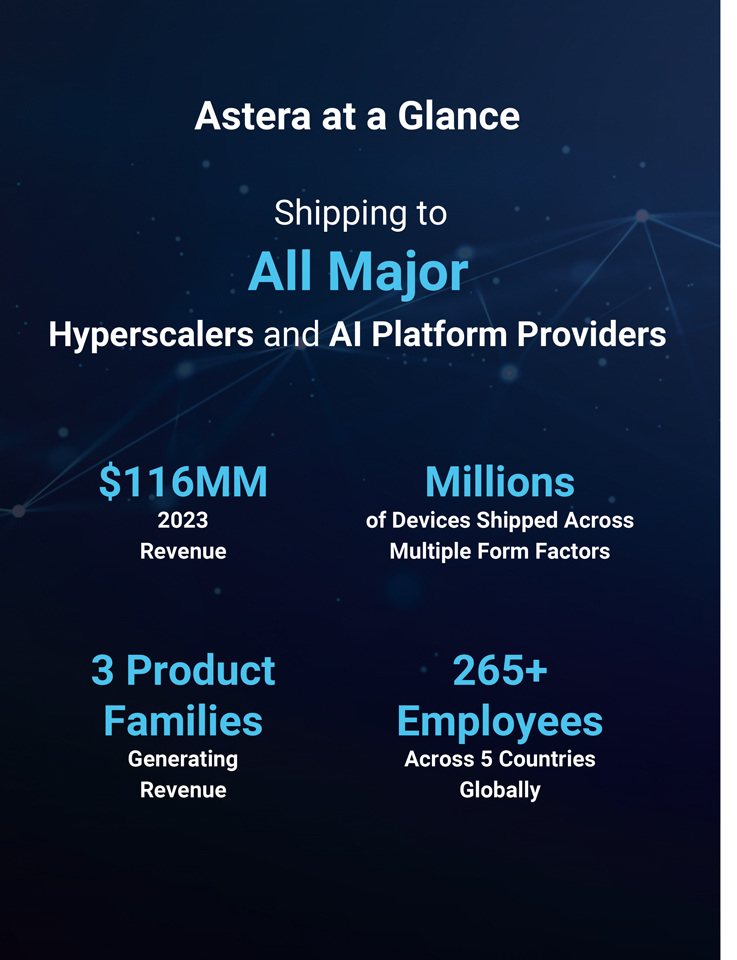
Today, our connectivity solutions are at the heart of major AI platforms deployed worldwide featuring both commercially available GPUs and proprietary AI accelerators. In the last four years, we have successfully introduced three revenue-generating product families across multiple form factors including ICs, boards, and modules, shipping millions of devices across all of the major hyperscalers. Our products, which include Aries PCIe®/CXL™ Smart DSP Retimers (“Aries”), Taurus Ethernet Smart Cable Modules™ (“Taurus”), and Leo CXL Memory Connectivity Controllers (“Leo”), leverage our ICs that are built upon industry standard connectivity protocols such as PCIe, Ethernet, and CXL to address the growing demand for purpose-built connectivity solutions that solve critical data, network, and memory bottlenecks inherent in cloud and AI infrastructure.
Since our inception, we have created and commercialized first-to-market PCIe, Ethernet, and CXL products, and, with more than 300 design wins, we have become a trusted partner and a proven supplier to our hyperscaler and system OEM customers. We have experienced strong growth since our founding in October 2017, and particularly since the commercial launch of Aries in 2020. Our revenue grew from $79.9 million in 2022 to $115.8 million in 2023, driven by a significant increase in demand for our products. We have made significant investments in the design and development of new products and platform enhancements, and, as a result, we have a history of net losses and have not yet achieved profitability on an annual basis. We incurred net losses of $58.3 million in 2022 and $26.3 million in 2023. As of December 31, 2022 and 2023, we had an accumulated deficit of $99.1 million and $125.4 million, respectively. During the years ended December 31, 2022 and 2023, our cash used in operating activities was $35.9 million and $12.7 million, respectively.
Industry Background
The Proliferation of Cloud Computing
Over the past decade, we have witnessed the rapid global adoption of cloud computing. This shift towards the cloud is rapidly accelerating due to increasing demand for compute-intensive AI workloads that are truly optimized only when deployed at cloud scale. The transition to the cloud has been fueled by the unparalleled ease, flexibility, and security of deploying computing resources at scale, with minimal upfront required capital investment by users.
Cloud infrastructure requires highly customized integration. Hyperscalers, which include public cloud service providers such as Amazon Web Services (“AWS”), Google Cloud Platform (“GCP”), and Microsoft Azure, are diverse and complex. Hyperscalers also include large organizations, such as Meta, and their infrastructure is highly optimized for proprietary workloads that run in their private clouds.
The proliferation of cloud computing has resulted in several important changes in the semiconductor ecosystem as hyperscalers seek to provide differentiated solutions to their users.
As such, hyperscalers are:
| • | differentiating with custom hardware and processors; |
| • | redefining the technology roadmaps and supply chain requirements of their semiconductor suppliers; |
2
Table of Contents
| • | laser-focused on server uptime, scaling, and fleet reliability; and |
| • | committed to green data centers and environmental sustainability. |
Artificial Intelligence is the Era-Defining Technology Driving the Next Generation of Cloud Infrastructure
AI touches many aspects of our daily lives today. According to IDC, by 2025, the Global 2000 organizations will allocate over 40% of their core IT spend to AI-related initiatives, leading to a double-digit increase in the rate of product and process innovations.
Recent Generative AI (“GenAI”) advances, as demonstrated by the launch of ChatGPT by OpenAI in late 2022, have shown the unprecedented capabilities and immense potential for training LLMs to enhance applications across industries. However, these AI models continue to increase in size and complexity. Given their massive need for computing, GenAI is only practical at cloud scale.
To address the performance and scalability requirements of AI and other compute-intensive applications, hyperscalers have adopted heterogeneous, “accelerated computing” architectures to target specific workloads. AI accelerators such as GPUs, TPUs, and FPGAs, with their massively parallel compute engines and high bandwidth connectivity to memory and data, are foundational to the AI infrastructure. To address increasingly larger and more complex AI workloads, hyperscalers interconnect tens of thousands of GPUs and other AI accelerators that process workloads in parallel across thousands of servers to increase system compute capacity.
Existing Connectivity Solutions are Inadequate to Deploy AI Infrastructure at Cloud Scale
GPUs and other AI accelerators are often the most expensive and scarce part of data centers. AI accelerators are efficient at computing, challenging the rest of the cloud and AI infrastructure to effectively transport data to and from them to maximize their utilization. However, GPUs and other AI accelerators often sit idle waiting for data to become available. Increasing the utilization of AI hardware presents a large challenge as well as a massive opportunity for connectivity suppliers.
Purpose-built connectivity solutions that connect GPUs and other AI accelerators with each other directly or between servers are required to unleash AI accelerators’ full potential at cloud scale and solve the following critical data, network, and memory bottlenecks:
Data and network bandwidth bottlenecks. The connectivity between GPUs, other AI accelerators, CPUs, storage devices, and networking subsystems in an AI platform must deliver ever-increasing bandwidth.
Exploding signal integrity challenges. Data transfer rates across all protocols have been rapidly growing to support compute-intensive workloads, and the physical size of AI server clusters has grown as well, compounding the signal integrity problem.
Memory wall. CPU performance has outpaced the ability for memory subsystems to provide CPUs with data and memory access, thereby limiting computing performance. Memory-intensive applications, such as AI, require ultra-fast memory bandwidth and significant memory capacity that must be simultaneously accessible by other AI accelerators in a cluster.
Interconnect reliability and observability. When a single server or a single AI accelerator fails, or the network connecting them does not transfer data reliably, the entire AI server cluster will typically stop, re-synchronize, and restart, reducing infrastructure utilization, and increasing the time and cost required to train AI models.
Cloud and AI infrastructure diversity drives connectivity solution complexity. Hyperscalers optimize their cloud infrastructure to meet the unique requirements of their users and internal business models. This requires customization and flexibility to support a wide range of use cases.
3
Table of Contents
The bottleneck for AI deployments in the cloud has shifted from computing performance to connectivity. We believe a new approach for connectivity is required to address the data, network, and memory bottlenecks in a reliable, scalable, customizable, and interoperable manner for cloud and AI infrastructure.
Our Solution
Our patented software-defined Intelligent Connectivity Platform delivers critical connectivity performance, enables flexibility and customization, and supports observability and predictive analytics. We enhance the value of our platform with our Interoperability Lab (“Interop Lab”), where we validate performance and interoperability between our connectivity products and other data center infrastructure suppliers’ products in real-world scenarios.
Our Products
In the last four years, we have successfully introduced three revenue-generating product families across multiple form factors including ICs, boards, and modules that are built upon our software-defined IC architecture:
Aries PCIe®/CXL™ Smart DSP Retimers. Our Aries products, which include our COSMOS software suite, are essential to enable higher PCIe/CXL data bandwidth and lower latency interconnectivity between various heterogeneous compute processors, storage, and network controllers. Aries digitally recovers degraded high-speed signals and retransmits a clean copy of the data, thereby extending the reach of existing cost-effective interconnects, while enabling higher data bandwidth.
Taurus Ethernet Smart Cable Modules™. Our Taurus products are hardware modules based on our Taurus ICs that increase network connectivity bandwidth between servers and switches over copper media. Taurus modules incorporate our COSMOS software suite and extend Ethernet signaling reach at higher data rates, providing cost-effective, rack-level network connectivity for cloud and AI infrastructure, removing rack-level Ethernet connectivity bottlenecks.
Leo CXL Memory Connectivity Controllers. Our Leo products allow our customers to overcome processor memory bandwidth bottlenecks and capacity limitations, while leveraging our COSMOS software suite’s built-in memory management and deep diagnostic capabilities. Leo ICs and boards enable expanding, sharing, and pooling of industry standard DRAM memory over high-speed serial links to support memory-intensive workloads running on AI accelerators and CPUs.
COSMOS Software Suite
Our COnnectivity System Management and Optimization Software, or COSMOS software suite, is foundational to our Intelligent Connectivity Platform. COSMOS is designed to enable our hyperscaler customers to seamlessly configure, manage, monitor, optimize, troubleshoot, and customize functions in our IC, board, and module products. COSMOS has a software component that operates on our customers’ BMC, SMC, BIOS, and/or operating system, and interfaces with other COSMOS software components running on microcontrollers integrated into our ICs, boards, and modules.
Our software suite provides three distinct capabilities to our customers:
Link Management. A critical purpose of COSMOS is to ensure secure and robust data link communication between devices in a computing system.
Fleet Management. COSMOS allows real-time monitoring of and predictive maintenance for server fleets. Data from device-level software components is communicated to platform-level software to provide fleet-level insights and analytics.
4
Table of Contents
Reliability, Availability, Serviceability (“RAS”). COSMOS enables RAS capabilities by detecting, reporting, and testing the data, network, and memory links supported by our product families. Software components on our ICs report telemetry data to allow for performance monitoring, error detection, and correction.
COSMOS improves our products over time by giving our customers new features, enhancements, and critical updates.
Industry-Trusted Cloud Scale Interoperability Lab
We have built and deployed our industry-trusted cloud scale Interop Lab and developed comprehensive interoperability test suites. These tests validate performance and interoperability between our connectivity products and other data center infrastructure suppliers’ products in real-world scenarios to minimize interoperation risk, reduce system development costs, lower unplanned downtime, and accelerate time-to-market.
Our leading Intelligent Connectivity Platform is performant for the most demanding cloud and AI applications, provides customizable products for different hyperscalers, is reliable at cloud scale, and we believe it increases value to our customers over time.
Key Customer Benefits of Our Intelligent Connectivity Platform
Our Intelligent Connectivity Platform provides our customers with the ability to deploy and operate high-performance cloud and AI infrastructure at scale, addressing an increasingly diverse set of requirements.
Superior connectivity performance critical for the next generation of cloud and AI infrastructure. We developed our purpose-built Intelligent Connectivity Platform to deliver high bandwidth and low latency connectivity at significant scale, enabling the deployment of the next generation of cloud infrastructure critical for data-centric workloads such as AI.
Seamless deployment through customizable products, utilizing our customer Platform Specific Standard Product (“PSSP”) model. Our software-defined connectivity platform is highly customizable to address the unique needs of each hyperscaler, which enables our hyperscaler customers to seamlessly provide differentiated solutions to their users without compromising on performance, features, or cost.
Robust reliability, quality-of-service (“QoS”), and software management capabilities facilitate deployment at scale. Our platform provides (i) robust signal integrity to overcome increasing channel insertion loss as connectivity speeds increase, (ii) server-grade RAS support, and (iii) sophisticated link telemetry features that enable signal monitoring for QoS.
Real-time link monitoring for fleet health management and improved user experience. Link health monitors embedded in our products and software algorithms implemented in our COSMOS software suite provide rich insights into the health, performance, and utilization of interconnects for predictive maintenance, as well as for the reassignment of user workloads to healthy hardware for improved user experience.
Platform optionality and supply chain flexibility. Our Intelligent Connectivity Platform supports multiple cloud and AI compute platforms, which incorporate a mix of GPUs, other AI accelerators, and CPUs. This enables our customers to seamlessly port their connectivity architectures across multiple system platforms featuring processors from different suppliers, including proprietary in-house processors from hyperscalers.
Multiple form factors expand deployment options and accelerate time-to-market. We provide our connectivity products in various form factors including ICs, boards, and modules. We strive to ensure that our products optimally perform across form factors, which enables our customers to adapt their product sourcing plans with us to support their dynamic system requirements and quickly deploy multiple architectural topologies across their infrastructure.
5
Table of Contents
Accelerated time-to-market improves return-on-investment (“ROI”) for hyperscalers. We believe we enable our hyperscaler customers to offer the latest and largest AI models to their users faster than their peers, which is critical for hyperscalers to retain and grow their user bases.
Improved utilization of cloud and AI infrastructure lowers total cost of ownership (“TCO”). Our Intelligent Connectivity Platform enables increased utilization of expensive GPUs and other AI accelerators, unlocks scalable memory expansion, and provides greater system uptime to lower the total cost of system ownership for hyperscalers, improving the value proposition that they can provide for their users.
Green data centers and environmental sustainability. Our Intelligent Connectivity Platform increases power efficiency by increasing bandwidth over existing interconnects such as copper cables thereby reducing energy requirements compared to optical cables. We further enable environmental sustainability by extending the useful life and reuse of our customers’ existing hardware, which includes copper media.
Our Customer Flywheel
We use our deep technical expertise and ability to innovate and tailor our products to meet each hyperscalers’ exacting needs. As a result, our business sees a powerful flywheel effect, which creates additional demand for existing products and enables us to bring additional new products to market in close relationships with our customers.
Our customer PSSP business model enables symbiotic customer relationships. Based on the unique requirements of each customer, our software-defined platform architecture allows us to rapidly develop our standard products and gives us the flexibility to make modifications, customizations, and upgrades, even after deployment.
Our cloud scale Interop Lab enables rigorous testing for interoperability within the data center infrastructure ecosystem. Our focus on ensuring interoperability for our products allows our customers to deploy them with confidence and elevates our position as a trusted partner.
Our deep system level visibility into critical components in the data center. Our COSMOS software suite enables deep visibility into the performance and limitations of cloud and AI infrastructure, providing us with a pathway to continuously improve our products and increase the value that they provide to our customers.
Natural partner for implementing generational upgrades. Our COSMOS software suite allows customizations through link management, fleet management, and RAS to meet unique customer requirements. When coupled with our leading connectivity products, this makes us a trusted partner for hyperscalers when they need to implement generational upgrades.
Our customer flywheel creates a virtuous cycle where we gain more insight from existing deployments and translate them into hardware and software feature upgrades for our product families, thereby continuously improving our Intelligent Connectivity Platform.
We sell our products both through distributors and directly to end customers and their manufacturing partners. We are the primary interface with our hyperscaler, system OEM customers and their manufacturing partners whose requirements help drive the design of our solutions. Presently most of our direct revenue comes from distributors who operate as logistics and order fulfillment service providers to our customers.
Our Competitive Strengths
We believe our singular focus on cloud and AI connectivity, our software-defined platform architecture, and our system-level approach fortify our customer relationships, which are reinforced with each generational
6
Table of Contents
upgrade and new product family introduction, creating our durable competitive moat. Our competitive strengths include:
Singular focus on cloud and AI connectivity. Our comprehensive suite of PCIe, Ethernet, and CXL products are built from the ground-up to address the data, network, and memory bottlenecks of accelerated computing at cloud scale. Our singular focus on cloud and AI infrastructure provides us with a deep understanding of our customers’ needs and our products deliver optimal performance essential for their deployment.
Software-defined IC architecture and COSMOS software suite underpins our connectivity products. Our software-defined platform architecture, which extends from our IC designs to our COSMOS software suite, optimizes time-to-market and allows us to easily customize our products to match the unique performance and functional requirements of our customers. This approach allows for an accelerated design process, with faster time-to-sample, and greater levels of flexibility and customization compared to traditional hardware-centric approaches. This makes us an ideal partner for hyperscalers when they need to implement generational upgrades, fortifying our position and strengthening our competitive moat.
System-level approach to purpose-built product families. We provide a complete platform consisting of ICs, boards, and modules coupled with software and interoperability reports that ensure ease of integration and customer adoption.
First mover advantage provides early insight into evolving customer needs. We have created and commercialized first-to-market PCIe, Ethernet, and CXL products, and with more than 300 design wins, we have become a trusted partner and a proven supplier to our hyperscaler and system OEM customers. As a result, we gain extensive insight from existing deployments and translate them into new product opportunities.
Cloud-based IC research and development fuels our continued innovation. We were “born in the cloud,” with our research and development located in the public cloud. By harnessing the scale of cloud computing, we believe we improve quality, reduce development costs, and accelerate speed of execution, which allows us to get to market faster than traditional semiconductor companies.
Broad and deep relationships across the entire data center infrastructure ecosystem. We have developed deep relationships through our Interop Lab as well as from our products being integrated into reference and/or commercial designs provided by industry leaders within the data center infrastructure ecosystem.
Robust supply chain designed to serve hyperscaler customers. We believe we have built a robust and resilient supply chain that will meet the demand profile of hyperscalers. We have a strong manufacturing relationship with Taiwan Semiconductor Manufacturing Company Limited (“TSMC”), and we qualify multiple suppliers and vendors, enabling us to better weather potential unforeseen supply chain disruptions.
Experienced management team with a proven track record of execution and innovation. Our founding team has spent the last three decades developing and commercializing connectivity products. Over the last four years, we have introduced products at a steady cadence with leading PCIe, Ethernet, and CXL solutions.
Growth Strategies
Today, our connectivity solutions are at the heart of major AI platforms deployed worldwide, featuring both commercially available GPUs and proprietary AI accelerators. We have become a trusted partner and a proven supplier to our hyperscaler and system OEM customers. Building on this foundation, the strategic tenets of our growth strategy include:
Increase sales to our existing customers as cloud and AI workloads continue to grow exponentially. We have established a leading market position with Aries, which is deployed across all of the major hyperscalers’ and system OEMs’ platforms, and we expect to drive future growth as our customers ramp up their platform deployments. Our Taurus and Leo product families are expected to further expand sales to our current customers as they complete technical qualification and are deployed across our customers’ cloud and AI infrastructure.
7
Table of Contents
Increase our revenue-per-server-rack with generational upgrades and new products. We continue to invest in the development of new products and technologies that will address new types of functionalities, and span additional form factors across new types of media:
| • | Generational upgrades drive increasing value for our product families – As the industry deploys next-generation protocols, we will provide updates to our product families, which we expect will drive an increase in our value proposition and enhance our revenue on a like-for-like basis compared to prior product generations. |
| • | Increase in attach rates – We anticipate an increase in attach rates for our product families in next-generation system topologies due to higher data rates, larger physical system footprints, and greater memory bandwidth and capacity requirements. |
| • | Develop new products to service emerging opportunities – As cloud and AI infrastructure requirements scale, we foresee emerging use cases that require new functionalities, which we plan to address with additional product families. |
Shape emerging connectivity standards to drive future product adoption. As generational advancements in standard connectivity protocols emerge, we believe our proactive involvement with data center infrastructure ecosystem participants will enable us to grow our product offerings, ensuring sustained and robust growth.
Attract and acquire new and emerging customers focused on AI. We foresee emerging demand from companies that provide infrastructure for AI use cases, AI-dedicated data centers, and larger enterprises, as they begin to build systems to meet their unique requirements.
Leverage our differentiated products and technologies into new data intensive end-markets. We believe that the products and technologies that we have developed can be leveraged for different use cases in adjacent growth markets for data-intensive applications such as wireless communications infrastructure and automotive.
Selectively pursue strategic investments or acquisitions to enhance our competitive positioning. Although we expect to focus our growth strategies on organic expansion, we may pursue future investments or acquisitions that complement our Intelligent Connectivity Platform.
Risk Factors Summary
Our business is subject to numerous risks and uncertainties that you should consider before investing in our common stock. These risks are described more fully in the section titled “Risk Factors” immediately following this prospectus summary. These risks include, but are not limited to, the following:
| • | We may not sustain our growth rate, and we may not be able to manage future growth effectively; |
| • | We have a history of generating net losses, and if we are unable to achieve adequate revenue growth while our expenses increase, we may not maintain profitability in the future; |
| • | We have a limited operating history, and we may have difficulty accurately predicting our future revenue for the purpose of appropriately budgeting and adjusting our expenses; |
| • | We may be unsuccessful in anticipating and responding to new market trends and evolving industry standards, developing and selling new products, or penetrating new markets; |
| • | A substantial portion of our revenue is driven by a limited number of our end customers, and the loss of, or a significant reduction in, demand from one or a few of our top end customers would adversely affect our operations and financial condition; |
| • | If we fail to achieve design wins for our products, we may lose the opportunity for sales to customers for a significant period of time and be unable to recoup our investments in our products; |
| • | Pricing for the current generation of our existing products often decreases over time, which could negatively impact our revenue and gross margins; |
8
Table of Contents
| • | We generally do not maintain long-term supply contracts with our third-party manufacturing partners, and any disruption in our supply of products could have a material adverse effect on our business, financial condition, and results of operations; |
| • | We rely on our relationships with leaders in the data center infrastructure ecosystem to test and validate our products at a system level and our inability to continue to develop or maintain such relationships in the future would harm our ability to remain competitive; |
| • | We have identified material weaknesses in our internal control over financial reporting and may identify additional material weaknesses in the future or fail to maintain an effective system of internal control over financial reporting. If our remediation of the material weaknesses is not effective, or we fail to develop and maintain effective internal control over financial reporting, our ability to produce timely and accurate financial statements or comply with applicable laws and regulations could be impaired, which could harm our business and negatively impact the value of our common stock; |
| • | If we are unable to attract, train, and retain qualified personnel, particularly our design and technical personnel, we may not be able to execute our business strategy effectively; |
| • | Cybersecurity risks, including cyber-attacks, data breaches, and system vulnerabilities could adversely affect our business and disrupt our operations; |
| • | Our business, financial condition, and results of operations could be adversely affected by worldwide economic conditions, as well as political and economic conditions in the countries in which we conduct business; |
| • | We may pursue acquisitions, investments, joint ventures, and dispositions, which could adversely affect our results of operations, and any acquisitions we do make could disrupt our business and harm our financial condition; |
| • | We operate in intensely competitive markets. Our failure to compete effectively, including as a result of industry consolidation, would harm our results of operations; |
| • | Unfavorable or uncertain conditions in the cloud market, as well as for AI infrastructures, may cause fluctuations in our rate of revenue growth or financial results; |
| • | Our failure to protect our intellectual property rights adequately could impair our ability to compete effectively or to defend ourselves from litigation, which could harm our business, financial condition, and results of operations; and |
| • | There has been no prior public market for our common stock and an active, liquid, and orderly trading market may not develop or be sustained following this offering, which could harm the market price of our common stock. |
If we are unable to adequately address these and other risks we face, our business, results of operations, financial condition, and prospects may be harmed, the trading price of our common stock could decline, and you could lose all or part of your investment.
Channels for Disclosure of Information
Following the completion of this offering, we intend to announce material information to the public through filings with the SEC, the investor relations page on our website, blog posts on our website, press releases, public conference calls, webcasts, our X (f/k/a Twitter) feed (@AsteraLabs), YouTube channel, and our LinkedIn page.
The information disclosed through the foregoing channels could be deemed to be material information. As such, we encourage investors, the media, and others to follow the channels listed above and to review the information disclosed through such channels.
9
Table of Contents
Any updates to the list of disclosure channels through which we will announce information will be posted on the investor relations page on our website. Information contained on or accessible through any of the foregoing channels is not incorporated by reference into this prospectus.
Corporate Information
We were incorporated in Delaware in October 2017 under the name Astera Labs, Inc. Our principal executive offices are located at 2901 Tasman Drive, Suite 205, Santa Clara, CA 95054, and our telephone number is (408) 337-9056. Our website address is www.asteralabs.com. Information contained on or that can be accessed through our website does not constitute part of this prospectus and the inclusion of our website address in this prospectus is intended to be an inactive textual reference only. You should not consider information contained on our website to be part of this prospectus or in deciding whether to purchase shares of our common stock.
We use various trademarks and trade names in connection with the operation of our business, including, without limitation, our corporate name and logo. This prospectus may also contain trademarks, service marks, and trade names of third parties, which are the property of their respective owners. Our use or display of third parties’ trademarks, service marks, trade names, or products in this prospectus is not intended to, and does not imply, a relationship with, or endorsement or sponsorship by us. Solely for convenience, the trademarks, service marks, and trade names referred to in this prospectus may appear without the ®, ™, or SM symbols, but the omission of such references is not intended to indicate, in any way, that we will not assert, to the fullest extent under applicable law, our rights, or the right of the applicable owner of these trademarks, service marks, and trade names.
Emerging Growth Company
We are an emerging growth company within the meaning of the Jumpstart Our Business Startups Act of 2012 (the “JOBS Act”). As an emerging growth company, we may take advantage of certain exemptions from various public reporting requirements, including the requirement that our internal control over financial reporting be audited by our independent registered public accounting firm pursuant to Section 404 of the Sarbanes-Oxley Act of 2002 (the “Sarbanes-Oxley Act”), certain requirements related to the disclosure of executive compensation in this prospectus and in our periodic reports and proxy statements, and the requirement that we hold a non-binding advisory vote on executive compensation and any golden parachute payments. We may choose to take advantage of some but not all of these exemptions. We have taken advantage of reduced reporting requirements in this prospectus. Accordingly, the information contained herein may be different from the information you receive from other public companies in which you hold stock.
We may take advantage of these exemptions for up to five years or such earlier time that we are no longer an emerging growth company. We will remain an emerging growth company until the earliest to occur of (i) the last day of the fiscal year in which we have more than $1.235 billion in annual revenue; (ii) the date we qualify as a “large accelerated filer,” with at least $700 million of equity securities held by non-affiliates; (iii) the date on which we have issued, in any three-year period, more than $1.0 billion in non-convertible debt securities; and (iv) the last day of the fiscal year ending after the fifth anniversary of the completion of this offering.
In addition, under the JOBS Act, emerging growth companies can delay adopting new or revised accounting standards until such time as those standards apply to private companies. We have elected to use this extended transition period until we are no longer an emerging growth company or until we affirmatively and irrevocably opt out of the extended transition period. Accordingly, our financial statements may not be comparable to companies that comply with new or revised accounting pronouncements as of public company effective dates.
For certain risks related to our status as an emerging growth company, see the section titled “Risk Factors—We are an emerging growth company, and any decision on our part to comply only with certain reduced reporting and disclosure requirements applicable to emerging growth companies could make our common stock less attractive to investors.”
10
Table of Contents
THE OFFERING
| Common stock offered by us |
shares. |
| Common stock offered by the selling stockholders |
shares. |
| Option to purchase additional shares of common stock from us |
We have granted the underwriters an option, exercisable for 30 days after the date of this prospectus, to purchase up to an additional shares of common stock. |
| Common stock to be outstanding immediately after this offering |
shares (or shares if the underwriters’ option to purchase additional shares in this offering is exercised in full). |
| Use of proceeds |
We estimate that the net proceeds from the sale of shares of our common stock that we are selling in this offering will be approximately $ million (or approximately $ million if the underwriters’ option to purchase additional shares is exercised in full), based upon an assumed initial public offering price of $ per share, which is the midpoint of the estimated offering price range set forth on the cover page of this prospectus, after deducting estimated underwriting discounts and commissions and estimated offering expenses payable by us. We will not receive any proceeds from the sale of the shares of common stock being offered by the selling stockholders. |
| We currently intend to use the net proceeds of this offering for working capital and other general corporate purposes. We may also use a portion of the net proceeds to acquire or invest in complementary businesses, products, services, technologies, or other assets. We do not, however, have agreements or commitments to enter into any acquisitions or investments at this time. We also intend to use a portion of the net proceeds we receive from this offering to satisfy the anticipated tax withholding and remittance obligations of approximately $ million related to the settlement of our outstanding restricted stock units (“RSUs”) in connection with this offering. |
| See the section titled “Use of Proceeds” for additional information. |
| Directed share program |
At our request, the underwriters have reserved up to shares of our common stock, or 2% of the shares offered by this prospectus, for sale at the initial public offering price through a directed share program to certain directors, business partners, and friends and family. Any reserved shares not so purchased will be offered by the underwriters to the general public on the same basis as the other shares offered by this prospectus. Morgan Stanley & Co. LLC will administer our directed share program. See “Underwriting—Directed Share Program” for additional information. |
11
Table of Contents
| Risk factors |
See the section titled “Risk Factors” for a discussion of factors you should carefully consider before deciding to invest in our common stock. |
| Proposed Nasdaq trading symbol |
“ .” |
The number of shares of our common stock that will be outstanding after this offering is based on shares of our common stock outstanding as of December 31, 2023, and excludes:
| • | 10,058,536 shares of our common stock issuable upon the exercise of options to purchase shares of our common stock that were outstanding as of December 31, 2023, with a weighted-average exercise price of $0.84 per share; |
| • | 5,761,737 shares of our common stock that are issuable in connection with the settlement of RSUs upon satisfaction of both a time condition and a liquidity event condition, for which the time condition has not yet been satisfied as of December 31, 2023 (the time condition for certain of these RSUs was satisfied as of February 15, 2024, which we expect will result in the net issuance of shares of our common stock in connection with this offering, after withholding an aggregate of shares of common stock to satisfy associated estimated income tax obligations (based on an assumed initial public offering price of $ per share, which is the midpoint of the price range set forth on the cover page of this prospectus, and an assumed % tax withholding rate)), that were granted prior to December 31, 2023; |
| • | 7,534,358 shares of our common stock that are issuable in connection with the settlement of RSUs upon satisfaction of both a time condition and a liquidity event condition, for which the time condition has not yet been satisfied as of December 31, 2023 and that were granted after December 31, 2023; |
| • | 2,442,360 shares of our common stock issuable upon the exercise of warrants to purchase shares of our common stock outstanding as of December 31, 2023, with a weighted-average exercise price of $19.30 per share; |
| • | 1,888,466 shares of our common stock reserved for future issuance pursuant to our 2018 Equity Incentive Plan, as amended as of February 15, 2024 (“2018 Plan”), which shares will be added to the shares of our common stock reserved for future issuance under our 2024 Stock Option and Incentive Plan (“2024 Plan”), which we intend to adopt in connection with this offering; |
| • | shares of our common stock reserved for future issuance under our 2024 Plan; and |
| • | shares of our common stock reserved for future issuance under our 2024 Employee Stock Purchase Plan (“ESPP”), which we intend to adopt in connection with this offering. |
Each of our 2024 Plan and our ESPP provide for annual automatic increases in the number of shares of our common stock reserved thereunder, and our 2024 Plan provides for increases to the number of shares of our common stock that may be granted thereunder based on shares underlying any awards under our 2018 Plan that expire, are forfeited, or are otherwise terminated, as more fully described in the section titled “Executive Compensation—Employee Benefit and Equity Compensation Plans.”
Except as otherwise indicated, all information in this prospectus assumes:
| • | a two-for-one reverse split of our capital stock, which was effected on February 12, 2024; |
| • | the filing and effectiveness of our amended and restated certificate of incorporation in Delaware and the adoption of our second amended and restated bylaws, each of which will occur immediately prior to the completion of this offering; |
12
Table of Contents
| • | the automatic conversion of 90,890,650 shares of our convertible preferred stock outstanding as of December 31, 2023 into an equal number of shares of our common stock, the conversion of which will occur immediately prior to the completion of this offering; |
| • | the net issuance of shares of our common stock issuable pursuant to the vesting and settlement of 2,821,234 RSUs outstanding as of December 31, 2023 for which the time condition was satisfied as of December 31, 2023, and for which the liquidity event condition will be satisfied upon completion of this offering, after withholding an aggregate of shares of common stock to satisfy associated estimated income tax obligations (based on the assumed initial public offering price of $ per share, which is the midpoint of the price range set forth on the cover page of this prospectus, and an assumed % tax withholding rate); |
| • | no exercise by the underwriters of their option to purchase up to an additional shares of common stock from us in this offering; and |
| • | no exercise of outstanding stock options or warrants or settlement of outstanding RSUs subsequent to December 31, 2023, except as described above. |
13
Table of Contents
SUMMARY CONSOLIDATED FINANCIAL AND OTHER DATA
The following tables summarize our historical consolidated financial and other data for the periods and dates indicated. We derived the summary historical consolidated statements of operations and comprehensive loss data for the years ended December 31, 2022 and 2023, and the consolidated balance sheet data as of December 31, 2023, from our audited consolidated financial statements included elsewhere in this prospectus. Our historical results are not necessarily indicative of the results that may be expected in the future. You should read the following summary consolidated financial and other data below in conjunction with the sections titled “Risk Factors,” “Capitalization,” “Management’s Discussion and Analysis of Financial Condition and Results of Operations” and our consolidated financial statements and related notes included elsewhere in this prospectus.
| Years Ended December 31, |
||||||||
| 2022 | 2023 | |||||||
| (in thousands, except per share amounts) |
||||||||
| Consolidated Statement of Operations and Comprehensive Loss: |
||||||||
| Revenue |
$ | 79,872 | $ | 115,794 | ||||
| Cost of revenue(1) |
21,191 | 35,967 | ||||||
|
|
|
|
|
|||||
| Gross profit |
58,681 | 79,827 | ||||||
|
|
|
|
|
|||||
| Operating expenses: |
||||||||
| Research and development(1) |
73,711 | 73,407 | ||||||
| Sales and marketing(1) |
24,407 | 19,992 | ||||||
| General and administrative(1) |
20,757 | 15,925 | ||||||
|
|
|
|
|
|||||
| Total operating expenses |
118,875 | 109,324 | ||||||
|
|
|
|
|
|||||
| Operating loss |
(60,194 | ) | (29,497 | ) | ||||
|
|
|
|
|
|||||
| Interest income |
2,613 | 6,549 | ||||||
| Loss before income taxes |
(57,581 | ) | (22,948 | ) | ||||
| Income tax provision |
764 | 3,309 | ||||||
|
|
|
|
|
|||||
| Net loss |
$ | (58,345 | ) | (26,257 | ) | |||
|
|
|
|
|
|||||
| Net loss per share attributable to common stockholders, basic and diluted(2) |
$ | (1.71 | ) | $ | (0.71 | ) | ||
|
|
|
|
|
|||||
| Weighted-average shares used in calculating net loss per share attributable to common stockholders, basic and diluted(2) |
34,171 | 37,131 | ||||||
|
|
|
|
|
|||||
| Pro forma net loss per share attributable to common stockholders, basic and diluted(3) |
$ | |||||||
|
|
|
|||||||
| Weighted-average shares used in calculating pro forma net loss per share attributable to common stockholders, basic and diluted(3) |
||||||||
|
|
|
|||||||
| (1) | Includes stock-based compensation expense as follows (in thousands): |
| Years Ended December 31, |
||||||||
| 2022 | 2023 | |||||||
| Cost of revenue |
$ | 10 | $ | 24 | ||||
| Research and development |
11,223 | 7,360 | ||||||
| Sales and marketing |
10,148 | 2,067 | ||||||
| General and administrative |
8,854 | 1,228 | ||||||
|
|
|
|
|
|||||
| Total stock-based compensation |
$ | 30,235 | $ | 10,679 | ||||
|
|
|
|
|
|||||
14
Table of Contents
Stock-based compensation for the year ended December 31, 2022 includes $17.7 million related to secondary transactions for the quarter ended June 30, 2022. See Note 9 to our consolidated financial statements included elsewhere in this prospectus for additional details on the secondary transactions.
| (2) | See Note 10 to our consolidated financial statements included elsewhere in this prospectus for an explanation of the method used to calculate our basic and diluted net loss per share and the weighted average number of shares used in the computation of per share amounts. |
| (3) | The pro forma weighted-average shares used in computing pro forma net loss per share for the year ended December 31, 2023 assumes (i) the net issuance of shares of our common stock pursuant to the vesting and settlement of RSUs for which the time condition was satisfied as of December 31, 2023, and for which the liquidity event vesting condition was satisfied upon completion of this offering, after withholding shares to satisfy the associated estimated income tax obligations, and (ii) the automatic conversion of all outstanding shares of redeemable convertible preferred stock into an aggregate of shares of common stock as if the conversion occurred on January 1, 2023. The pro forma net loss used to calculate pro forma net loss per share reflects the cumulative stock-based compensation expense related to RSUs for which the time condition was satisfied as of year ended December 31, 2023. For the purposes of the pro forma calculation, we assumed the liquidity event vesting condition occurred as of January 1, 2023. |
| As of December 31, 2023 | ||||||||||||
| Actual | Pro Forma(1) |
Pro Forma, As Adjusted(2) |
||||||||||
| (in thousands) | ||||||||||||
| Consolidated Balance Sheet Data: |
||||||||||||
| Cash and cash equivalents |
$ | 45,098 | $ | $ | ||||||||
| Working capital(3) |
150,728 | |||||||||||
| Total assets |
196,292 | |||||||||||
| Total liabilities |
38,866 | |||||||||||
| Total stockholders’ deficit |
$ | (97,701 | ) | |||||||||
| (1) | The pro forma column above gives effect to (i) the filing and effectiveness of our amended and restated certificate of incorporation in Delaware and the adoption of our second amended and restated bylaws, which will occur immediately prior to the completion of this offering; (ii) the automatic conversion of all of our outstanding convertible preferred stock into an equal number of shares of common stock; (iii) the net issuance of shares of our common stock issuable pursuant to the vesting and settlement of RSUs for which the time condition was satisfied as of December 31, 2023, and for which the liquidity event condition will be satisfied upon completion of this offering, after withholding an aggregate of shares to satisfy associated estimated income tax obligations (based upon the assumed initial public offering price of $ per share, which is the midpoint of the estimated offering price range set forth on the cover page of this prospectus, and an assumed % tax withholding rate); (iv) the increase in other accrued liabilities and an equivalent decrease in additional paid-in capital in connection with tax withholding and remittance obligations related to such RSUs, based upon an assumed initial public offering price of $ per share, which is the midpoint of the estimated offering price range set forth on the cover page of this prospectus, all of which will occur immediately prior to the completion of this offering, as if such actions had occurred on December 31, 2023; and (v) $62.3 million of cumulative stock-based compensation expense related to the RSUs for which the time condition was satisfied as of December 31, 2023, which expense was unrecognized as of December 31, 2023, and for which the liquidity event condition will be satisfied upon completion of this offering. |
| (2) | The pro forma as adjusted column above gives further effect to (i) the pro forma adjustments set forth above and (ii) the sale of shares of common stock in this offering at an assumed initial public offering price of $ per share, which is the midpoint of the price range set forth on the cover page of this |
15
Table of Contents
| prospectus, after deducting estimated underwriting fees and commissions and estimated offering expenses payable by us. This pro forma as adjusted information is illustrative only and will depend on the actual initial public offering price and other terms of this offering determined at pricing. Each $1.00 increase or decrease in the assumed initial public offering price of $ per share, which is the midpoint of the price range set forth on the cover page of this prospectus, would increase or decrease the pro forma as adjusted amount of each of cash and cash equivalents, working capital, total assets, and total stockholders’ deficit by $ , assuming that the number of shares offered by us, as set forth on the cover page of this prospectus, remains the same and after deducting the estimated underwriting discounts and commissions and estimated offering expenses payable by us. Each increase or decrease of 1.0 million in the number of shares we are offering would increase or decrease the pro forma as adjusted amount of each of cash and cash equivalents, working capital, total assets, and stockholders’ deficit by $ , assuming no change in the assumed initial public offering price per share and after deducting the estimated underwriting discounts and commissions and estimated offering expenses payable by us. |
| (3) | Working capital is defined as total current assets less total current liabilities. See our consolidated financial statements and the related notes thereto included elsewhere in this prospectus for further details regarding our current assets and current liabilities. |
16
Table of Contents
Investing in our common stock involves a high degree of risk. You should carefully consider the risks and uncertainties described below, together with all of the other information in this prospectus, before making a decision to invest in our common stock. If any of these risks actually occur, our business, results of operations, financial condition, and prospects could be materially adversely affected. In that event, the trading price of our common stock could decline, and you could lose part or all of your investment. Certain statements contained in the risk factors described below are forward-looking statements. See the section titled “Special Note Regarding Forward-Looking Statements” for more information.
Risks Related to Our Business
We may not sustain our growth rate, and we may not be able to manage future growth effectively.
We have experienced significant growth in a short period of time. Our revenue increased from $79.9 million for the year ended December 31, 2022 to $115.8 million for the year ended December 31, 2023. We may not achieve similar growth rates in future periods. You should not rely on our operating results for any prior quarterly or annual periods as an indication of our future operating performance. If we are unable to maintain adequate revenue growth, our financial results could suffer, and our stock price could decline.
To manage our growth successfully and handle the responsibilities of being a public company, we believe we must effectively, among other things:
| • | recruit, hire, train, and manage additional qualified personnel for our research and development activities; |
| • | continue to make significant investments in our new and existing products; |
| • | add additional sales personnel; and |
| • | implement and improve our administrative, financial and operational systems, procedures, and controls. |
If we are unable to manage our growth effectively, we may not be able to take advantage of market opportunities or develop new products, and we may fail to satisfy customer requirements, maintain product quality, execute our business plan, or respond to competitive pressures.
We have a history of generating net losses, and if we are unable to achieve adequate revenue growth while our expenses increase, we may not maintain profitability in the future.
We have a history of generating net losses. We incurred net losses of $58.3 million and $26.3 million for the years ended December 31, 2022 and 2023, respectively. As of December 31, 2022 and 2023, we had an accumulated deficit of $99.1 million and $125.4 million, respectively. These losses and our accumulated deficit are a result of the substantial investments we have made to grow our business. We expect our costs will increase over time and our losses may continue if such increases in costs are not more than fully offset by increases in our revenue. We expect to continue to invest significant additional funds in expanding our business and research and development activities as we continue to develop new products. We also expect to incur additional general and administrative expenses as a result of our growth and expect our costs to increase to support our operations as a public company. Historically, our costs have increased over the years due to these factors, and we expect to continue to incur increasing costs to support our anticipated future growth.
Following the completion of this offering, the stock-based compensation expense related to our RSUs will result in increases in our expenses in future periods, in particular in the quarter in which this offering is completed for RSUs for which the time condition will be satisfied and for which the liquidity event condition will be satisfied upon completion of this offering. Additionally, we may expend substantial funds in connection with the tax withholding and remittance obligations that arise upon the initial settlement of certain of our RSUs.
17
Table of Contents
If our revenue or revenue growth rate declines or our operating expenses exceed our expectations, our financial performance will be adversely affected. We will need to generate and sustain increased revenue levels in future periods in order to maintain profitability. If we cannot successfully grow our revenue at a rate that exceeds the costs associated with our business, we will not be able to maintain profitability, and the trading price of our common stock could decline.
We have a limited operating history, and we may have difficulty accurately predicting our future revenue for the purpose of appropriately budgeting and adjusting our expenses.
We were established in October 2017. Our limited operating experience, a dynamic and rapidly evolving market in which we sell our products, our dependence on a limited number of customers, as well as numerous other factors beyond our control, could impede our ability to forecast quarterly and annual revenue accurately. As a result, we could experience budgeting and cash flow management problems, unexpected fluctuations in our results of operations and other challenges, any of which could make it difficult for us to maintain profitability and could increase the volatility of the market price of our common stock.
We may be unsuccessful in anticipating and responding to new market trends and evolving industry standards, developing and selling new products, or penetrating new markets.
We operate in an industry characterized by rapidly changing technologies and evolving industry standards. We believe that our future success depends on our ability to develop and introduce new technologies and products that generate new sources of revenue to replace, or build upon, existing product revenue streams. If we are not able to repeatedly introduce, in successive years, new products or new generations of existing products that ship in volume and meet customer demands, our revenue will likely not grow and may decline significantly and rapidly.
To compete successfully, we must design, develop, market, and sell new products or new generations of existing products that provide increasingly higher levels of performance while meeting evolving industry standards, and the cost and quality expectations, of our customers. The introduction of new products by our competitors, the delay or cancellation of a system for which any of our products are designed in, the market acceptance of products based on new or alternative technologies, or the emergence of new industry standards could render our existing or future products uncompetitive, obsolete, or otherwise unmarketable.
Our failure to anticipate or timely develop new products or new generations of existing products in response to technological shifts or evolving industry standards could result in decreased revenue and our competitors securing a competitive advantage. In particular, we may experience difficulties with product design, manufacturing, assembly, test, and qualification or marketing that could delay or prevent our development, introduction, or marketing of new or enhanced products. Although we believe our products comply with applicable industry standards, our existing and new products may not fully conform under all circumstances, and we are unable to guarantee that proprietary enhancements in the future will fully conform with applicable industry standards under all circumstances as industry standards evolve and change.
Products for our target markets are based on industry standards that are continually evolving, and industry standards are often developed and promoted by larger companies who are industry leaders and provide other components of the systems into which our products are incorporated. In choosing products to develop, we also make certain assumptions about which industry standards we believe will be adopted by industry leaders. For example, CXL connectivity solutions are in the early stages of market adoption. If our assumptions are incorrect, and larger companies do not support the same industry standards that we do, or if competing standards emerge, it could be difficult for our products to meet the requirements of certain customers. As a result, if we fail to introduce new products or new generations of our existing products that meet prevailing industry standards and the needs of our customers, or penetrate new markets in a timely fashion, and our designs do not gain acceptance, we will likely lose market share and our competitive position, potentially on an extended basis, and our operating results will be adversely affected.
18
Table of Contents
Our competitiveness and future success depend on our and our third-party manufacturing partners’ ability, as applicable, to design, develop, manufacture, assemble, and test new products and product enhancements on a timely and cost-effective basis. Our failure to anticipate fundamental shifts in technologies in any of our product markets, to develop new technologies or to react to changes in existing technologies could materially delay our development of new products or new generations of our existing products. For example, we anticipate that our customers will continue to have increasing needs for connectivity and memory products as a result of the increased adoption of the cloud and AI infrastructure, and if we are unable to successfully design and produce products that our customers can incorporate into their cloud and AI systems, we expect that our competitive positioning and financial performance would be harmed as our competitors more effectively help our customers scale into these developing sectors.
We believe the success of new products depends on accurate forecasts of long-term market demand and future technological developments, as well as on a variety of specific implementation factors, including:
| • | timely and efficient completion of our design and transfer to manufacturing, assembly, and test processes; |
| • | the quality, performance, and reliability of our products; and |
| • | effective marketing, sales, and service. |
If we fail to introduce new products or new generations of existing products that meet the demand of our customers or penetrate new markets that we have targeted, our revenue will likely decrease over time and our financial condition could suffer.
A substantial portion of our revenue is driven by a limited number of our end customers, and the loss of, or a significant reduction in, demand from one or a few of our top end customers would adversely affect our operations and financial condition.
A substantial portion of our revenue is driven by a limited number of end customers. We recognized (in most cases through distributors, rather than directly from end customers) an aggregate of approximately 89% of our revenue from our top three end customers for the year ended December 31, 2022. In 2022, a majority of our revenue was derived from one end customer. In 2023, no end customer represented more than one third of our revenue; the top three end customers represented an aggregate of approximately 70%, of our revenue. Our distributors and end customers’ manufacturing partners provide us with information in their purchase orders about which end customer will receive the products purchased. This data allows us to estimate the portion of our revenue that is due to specific end customer demand. We anticipate that we will continue to be dependent on a limited number of end customers for a significant portion of our revenue in the future, and in some cases, the portion of our revenue attributable to certain end customers may increase in the future. However, we may not be able to maintain or increase sales to certain of our top end customers for a variety of reasons, including the following:
| • | our master agreements with our end customers generally do not require them to purchase a minimum quantity of our products and our end customers’ demand for our products may be volatile; |
| • | some of our end customers may redesign their systems to use fewer or none of our products with limited notice to us; and |
| • | many of our end customers have pre-existing or concurrent relationships with our current or potential competitors that may affect such end customers’ decisions to purchase our products. |
End customer relationships often require us to develop new products that may involve significant technological and design challenges, and our end customers frequently place considerable pressure on us to meet tight development schedules. Accordingly, we may have to devote a substantial amount of our resources to our strategic relationships, which could detract from or delay our completion of other important development projects. Delays in development could impair our relationships with our end customers and negatively impact forecasted sales of the products under development. Moreover, it is possible that our end customers may develop their own products that may compete with our solutions, or adopt a competitor’s solution for products that they currently buy from us. If that happens, our sales would be adversely impacted and our business, financial condition, and results of operations would be materially and adversely affected.
19
Table of Contents
In addition, to attract new customers or retain existing end customers, we may offer (in some cases through distributors) certain customers favorable prices for our products. In that event, our revenue and gross margins may decline. The loss of a top end customer, a reduction in sales to any top end customer, or our inability to attract new end customers could impact our revenue and materially and adversely affect our results of operations.
If we fail to achieve design wins for our products, we may lose the opportunity for sales to customers for a significant period of time and be unable to recoup our investments in our products.
Our business is dependent on design wins. Design wins occur once a customer has validated and placed an order for our product(s). We often incur significant expenditures in the development of a new product or new generation of an existing product without any assurance that our customers will select our product for use in their systems. Additionally, we are often required to anticipate which product designs will generate demand in advance of our customers expressly indicating a need for that particular design. Even if our customers select our products, a substantial period of time will elapse before we generate revenue related to the significant expenses we have incurred. The reasons for this delay generally include the following elements of our product sales and development cycle timeline and related influences:
| • | our customers usually require a comprehensive technical evaluation of our products before they incorporate them into their designs; |
| • | it can take up to two years from the time a design win is secured to commencement of volume commercial shipments (assuming no changes in market conditions or customer development schedules); and |
| • | our customers may be impacted by changing market conditions, product development issues of their own, or choose to delay their system designs. |
The resources devoted to product development and sales and marketing may not generate material revenue for us, and we have needed in the past, and may need in the future, to write off excess and obsolete inventory if we have produced a product in excess of forecasted demand which does not materialize. If we incur significant expenses and investments in inventory in the future that we are not able to recover, and we are not able to compensate for those expenses, our operating results could be adversely affected.
A design win does not guarantee sales to a customer. A delay or cancellation of a customer’s plans could materially and adversely affect our financial results, as we incur significant expense in the design process and may generate little or no revenue from it. In addition, the timing of design wins is unpredictable and supporting production for a major design win, or multiple design wins at the same time, may strain our resources. In such event, we may be forced to dedicate significant additional resources and incur additional costs and expenses. Customers could also choose at any time to stop using our products, or could fail to successfully market and sell their products, either of which could reduce demand for our products.
Once a customer designs a product into its systems, the same product or enhanced versions of that product from the same supplier is likely to be used across a number of similar and successor products. This can be for a lengthy period of time due to the significant costs associated with qualifying a new supplier and potentially redesigning the product to incorporate a different solution. If a customer initially chooses a competitor’s product, it becomes more difficult for us to sell our products for use in that system because changing suppliers can involve significant cost, time, effort, and risk for our customers, and additional design opportunities may be infrequent or delayed. Thus, our failure to obtain a design win can result in our foregoing revenue from a given customer’s system for the life of that system. Our ability to compete in the future will depend, in large part, on our ability to develop products that comply with our customers’ and potential customers’ system specifications. However, even if our customers use our products in their systems, these customers may not deploy their systems in volume and we may not receive significant revenue from the sales of our products for those systems. As a result, we may be unable to accurately forecast the volume and timing of our orders and revenue associated with any new product introductions.
20
Table of Contents
We may experience difficulties demonstrating to customers the value of our new products or newer generations of our existing products.
As we develop and introduce new products or new generations of our existing products, we face the risk that customers may not value or be willing to bear the cost of incorporating these newer products into their systems, and may forego adopting one or more newer generations of our existing products. Regardless of the improved features or superior performance of the newer products, customers may be unwilling to adopt our new products due to design or pricing constraints, among other reasons. Even if customers choose to adopt our new products or new generations of our existing products, they may be slow to do so, which may result in certain of our products selling more frequently than other products for sustained periods of time. For example, most of our historical sales have been for our Aries product family. Because of the extensive time and resources that we invest in researching and developing new products and new generations of our existing products, if we are unable to sell new products or new generations of our existing products, our revenue could decline and our business, financial condition, and results of operations would be negatively affected.
We rely on a limited number of third-party manufacturing partners for our manufacturing and supply chain services, and the failure to manage our relationships successfully with our third-party manufacturing partners in order to obtain adequate services and supplies could adversely affect our ability to market and sell our products and our reputation.
We operate an outsourced manufacturing business model. We currently partner with TSMC to manufacture our integrated circuits. TSMC is our sole manufacturing partner for our integrated circuits and we currently have not qualified another source. We also use Advanced Semiconductor Engineering and Amkor Technologies to assemble, package, and test our integrated circuits. We also rely on a small, limited number of other manufacturing partners for our modules, boards, and integrated circuit substrates. Relying on third-party manufacturing partners presents significant risks, including:
| • | failure by us, our customers, or their customers to qualify a selected supplier; |
| • | capacity shortages during periods of high demand; |
| • | reduced control over delivery schedules and quality; |
| • | shortages of materials; |
| • | third parties infringing, misappropriating, or otherwise violating our intellectual property rights; |
| • | impairment of the operation of our products if errors or other defects occur in the third-party technologies we use, and difficulties correcting such errors or defects because the development and maintenance of those technologies is not within our control; |
| • | limited warranties on products supplied to us; and |
| • | potential increases in prices or reduced yields. |
The ability and willingness of our third-party manufacturing partners to perform is largely outside of our control. If one or more of our third-party manufacturing partners or other outsourcers fails to perform its obligations in a timely manner or at satisfactory quality levels, our ability to bring products to market and our reputation could suffer. In particular, if TSMC is unable to supply us with sufficient quantities of wafers to meet all of our requirements, we could have difficulties fulfilling our customer orders and our revenue could decline. In addition, if our third-party manufacturing partners fail to deliver quality services, products, and components on time and at reasonable prices, we could have difficulties fulfilling our customer orders, which would materially and adversely affect our business, financial condition, and results of operations.
21
Table of Contents
Our third-party manufacturing partners and distributors, and the majority of our revenue, are concentrated primarily in Taiwan, China, and South Korea, areas that are or may be subject to geopolitical uncertainty, trade disputes and restrictions, environmental disasters, and other risks. Any disruption to the operations of these manufacturing partners or distributors could cause significant delays in the production or shipment of our products and impact our financial condition.
Our success depends in part on the uninterrupted and reliable operation of our business, including the operation of our day-to-day business operations, or manufacturing, assembly, and testing done by our third-party manufacturing partners and other vendors. Unforeseen disruption of the production or distribution of our products could be caused by a number of events, including a maintenance outage, systems outage or other disruption, power or equipment failure, fires, floods, earthquakes or other natural disasters, social unrest or terrorist activity, work stoppages, public health concerns (including pandemics), regulatory measures, or other operational problems. For example, the foundry used by our primary manufacturer, TSMC, as well as our primary distributor, is located in Taiwan. The risk of an earthquake in Taiwan and elsewhere in the Pacific Rim region on our business is significant due to the proximity of major earthquake fault lines to the foundry’s facilities. Any disruption resulting from such events could cause significant delays in the production or shipment of our products until we are able to shift our manufacturing from the affected location to another location. We may not be able to obtain alternate capacity on favorable terms, if at all.
In addition, our dependence on our relationship with our third-party manufacturing partners or distributors may be affected by changes in governmental policies, taxation, rising inflation or interest rates, social instability, geopolitical conflicts and tensions, and diplomatic and social developments which are outside of our control. The occurrence of such events may have an adverse impact because the majority of our revenue derives from sales into East Asia, including our largest distributor which accounted for approximately 82% and 37% of our revenue, respectively, for the years ended December 31, 2022 and 2023. For example, since 1949, Taiwan and mainland China have been separately governed. Although significant economic and cultural relations have been established between Taiwan and mainland China in the past few years, past developments in relations between Taiwan and mainland China have on occasion depressed the market prices of the securities of companies doing business in Taiwan, and may depress the price of our common stock. Additionally, trade tensions between the United States and China may lead to restrictions on our ability to use our third-party manufacturing partners or distributors located in China or may impose restrictions such that our use of such manufacturing partners or distributors may no longer be practical or on terms favorable to us. Further, continued or heightened tension between South Korea and North Korea, an outbreak in military hostilities, or other actions or occurrences could cause significant delays in the production or shipment of our products until we are able to shift our manufacturing, assembling, testing, or distribution from the affected contractor to another third-party.
Furthermore, our industry generally relies on a limited number of manufacturers whose operations tend to be concentrated in Taiwan and other parts of East Asia, which makes us especially susceptible to adverse developments in these regions’ economic and political conditions, particularly to the extent that such developments create an unfavorable business environment that significantly affects our and our customers’ operations. Although the governments of certain countries, including the United States, have taken actions to make their countries more attractive for chip manufacturing operations, there can be no assurances that the current geographic concentration of chip manufacturing will be meaningfully changed in the near term or at all.
If any of these events, or other macroeconomic trends, should cause a prolonged disruption of operations that impact our third-party manufacturing partners, we may see operational downtimes or operation at reduced capacities, preventing us from completing our operations or production in a timely manner, leading to loss of business volume and reduced productivity or profitability which could have a material adverse effect on our business, financial conditions, and results of operations. Given the concentration of chip manufacturing in Taiwan and other parts of East Asia, as well as the other risks described herein, we may not be able to obtain alternate service or materials quickly and on favorable terms, if at all. Any unplanned production downtime or other operational problems and delays, if significant, could have a material adverse effect on our business, financial condition, and results of operations.
22
Table of Contents
Our customers require our products and our third-party manufacturing partners to undergo a lengthy and expensive qualification process which does not assure volume product sales. If we are unsuccessful or delayed in qualifying any of our products with a customer, our business and operating results would suffer.
Prior to purchasing our products and deploying them in volume in their systems, our customers require that our products and our third-party manufacturing partners undergo extensive qualification processes, which involve testing of our products in our customers’ systems, as well as testing for reliability. This qualification process may continue for several months or more. Moreover, qualification of a product by a customer does not assure any sales of the product to that customer. Further, even after successful qualification and sales of a product to a customer, a subsequent revision in our third-party contractors’ manufacturing process or our selection of a new supplier may require a new qualification process by our customers, which may result in delays and in our holding excess or obsolete inventory. After our products are qualified, it can take several months or more before the customer commences volume deployment of our products in their systems. Despite these uncertainties, we devote substantial resources, including design, engineering, sales, marketing, technical support, and management efforts, to qualify our products with customers in anticipation of sales. If we are unsuccessful or delayed in qualifying any of our products with a customer, sales of those products to the customer may be precluded or delayed, which may impede our growth and materially and adversely affect our business, financial condition, and results of operations.
We make substantial investments in research and development, and unsuccessful investments could materially adversely affect our business, financial condition, and results of operations.
The industry in which we compete is characterized by rapid technological change, changes in customer requirements, frequent new product introductions and enhancements, short product cycles and evolving industry standards, and new delivery methods. In addition, the fabrication of semiconductor products has transitioned over time to increasingly smaller line width geometries, and failure to successfully transition to product designs utilizing smaller geometry process nodes could impair our competitive position. In order to remain competitive, we have made, and expect to continue to make, significant investments in research and development. For the years ended December 31, 2022 and 2023, research and developments expenses were $73.7 million and $73.4 million, respectively. If we fail to develop new and enhanced products and technologies, if we focus on technologies that do not become widely adopted, or if new competitive technologies or industry standards that we do not support become widely accepted, demand for our products may be reduced. Increased investments in research and development or unsuccessful research and development efforts could cause our cost structure to fall out of alignment with demand for our products, which would have a negative impact on our financial results.
Our future success will depend in large part on our ability to successfully execute our strategy.
Our business strategy is to maximize our return on investment by aligning with our customers to address high-value problem sets. We are still in the process of implementing our strategy to align with this select customer group, and we cannot be certain that this strategy will succeed. To succeed, we will need to significantly increase sales to our existing customers in the cloud and AI markets, continue to pursue adoption of our PCIe, Ethernet, and CXL connectivity solutions, increase our value-per-product and leverage our differentiated product families to grow with our customers into new data intensive end-markets, including developing, introducing, and marketing new products and technologies on a timely basis.
Our gross margins may decline due to a variety of factors, which could negatively impact our results of operations and our financial condition.
Our gross margins may decline due to a number of factors, including customer and product mix, revenue mix between various offerings, market acceptance of our new products, yield, pricing, packaging and testing costs, competitive pricing dynamics, and geographic and market pricing strategies. Increases in gross margins over certain periods may be a result of individual changes in customer need or market shifts, and may not be indicative of future results.
23
Table of Contents
To attract new customers or retain existing customers, we have in the past and will in the future offer certain customers favorable prices, which would decrease the prices that we receive for our products and likely impact our gross margins. Further, we may also offer pricing incentives to our customers on earlier generations of products that inherently have a higher cost structure, which would negatively affect our gross margins. In addition, in the event our customers, including our larger customers, exert more pressure with respect to pricing and other terms with us, it could put downward pressure on our margins.
In addition, we maintain an inventory of our products at various stages of production and in finished goods inventory. We hold these inventories in anticipation of customer orders. If those customer orders do not materialize in a timely manner, we may have excess or obsolete inventory which we would have to reserve or write-down, and our gross margins would be adversely affected.
Pricing for the current generation of our existing products often decreases over time, which could negatively impact our revenue and gross margins.
Our operating results may be impacted by a decline in the pricing for the current generation of our existing products. If competition increases in our target markets, we may need to reduce the prices of our existing products in anticipation of competitive pricing pressures, new product introductions by us or our competitors, new generations of such existing products, or for other reasons. If we are unable to offset any reductions in pricing for existing products by increasing our sales volumes or introducing new products or new product generations of such existing products with higher margins, our revenue and gross margins will suffer. To maintain our revenue and gross margins, we must develop and introduce new products, next-generation products, and product enhancements on a timely basis and continually reduce our costs as well as our customers’ costs. Failure to do so may cause our revenue and gross margins to decline.
Fluctuations in the mix of products sold may materially adversely affect our gross margins and financial results.
Price differences among our products and the mix and types of products sold, including from a features and form factor perspective, may affect the pricing of our products and have a substantial impact on our revenue. Fluctuations in the mix and types of our products may also affect the extent to which we are able to recover our fixed costs and investments that are associated with a particular product, and as a result may negatively and materially impact our financial results.
If we are unable to accurately predict end customer demand, or if our distributors or end customers’ manufacturing partners cancel or change their orders, we may hold excess or obsolete inventory, which would reduce our gross margins and may damage our relationships with our customers.
Our revenue and operating results could fluctuate materially and could be materially and disproportionately impacted by the purchasing decisions of our end customers. Due to the inability to predict demand or other reasons, some of our distributors and end customers’ manufacturing partners may accumulate excess inventories and, as a consequence, defer purchases of our products. For example, in the first quarter of 2023 we had a $9.7 million charge to write down inventory in excess of our sales forecast for a legacy customer system. Anticipating demand is difficult because our end customers face unpredictable demand for their own products and/or deployment of their own systems. If we overestimate end customer demand, or end customer demand is otherwise impacted by other factors impacting our assumptions, we might produce significant excess inventory, which would reduce our gross margin and adversely affect our financial results. Conversely, if we underestimate customer demand or if insufficient manufacturing capacity is available, we may miss revenue opportunities, potentially lose market share and damage our customer relationships. In addition, as an increasing number of our products are being incorporated into end customer systems, we anticipate greater fluctuations in demand for our products, which makes it more difficult to forecast end customer demand.
24
Table of Contents
We generally do not maintain long-term supply contracts with our third-party manufacturing partners, and any disruption in our supply of products could have a material adverse effect on our business, financial condition, and results of operations.
We generally do not have long-term contracts with our third-party manufacturing partners that require them to supply manufacturing capacity, materials, or services, and substantially all of our purchases are on a purchase order basis. We place orders with our third-party manufacturing partners for manufacturing, assembling, and testing our products and purchasing components that are integrated into our products according to our estimates of customer demand many months prior to the anticipated delivery date to our customer. This process requires us to make multiple demand forecast assumptions with respect to our customers’ demands in advance of actual purchase orders, each of which may introduce error into our estimates. In addition, while many of our customers are subject to purchase orders or other agreements that do not allow for cancellation without penalty within a certain number of days before the estimated ship date, there can be no assurance that these customers will honor these contract terms, and any cancellation of these orders may adversely affect our business operations and demand forecast which is the basis for us to have products made.
Our third-party manufacturing partners may also extend lead times, limit supplies, place products on allocation, or increase prices that could lead to interruption of supply or increased demand in the industry. For example, the supply of these materials may be negatively impacted by increased trade tensions between the United States and its trading partners, particularly the People’s Republic of China. Moreover, TSMC increased the wafer prices we pay in both 2022 and 2023. Our products are incorporated into complex devices and systems, which creates supply chain cross-dependencies. Due to these cross dependencies, any supply chain disruptions could impact the demand for our products in the short term. In the event that we cannot obtain sufficient quantities of materials in a timely manner or at reasonable prices from third-party manufacturing partners, the quality of the material deteriorates or we are not able to pass on higher manufacturing costs to our customers, our business, financial condition, and results of operations could be adversely impacted.
We rely on our relationships with leaders in the data center infrastructure ecosystem to test and validate our products at a system level and our inability to continue to develop or maintain such relationships in the future would harm our ability to remain competitive.
We develop many of our products for systems that interoperate with other products sold by leaders in the data center infrastructure ecosystem. We work closely with these industry and technology partners to test and validate our products at a system level. We believe these relationships enhance our ability to achieve market acceptance and widespread adoption of our products. If we are unable to continue to develop or maintain these relationships, or if our products test negatively with these leaders in the data center infrastructure ecosystem, our products may become less desirable to our customers, which would cause our sales to suffer and our competitive position to be harmed.
The complexity of our products could result in unforeseen delays or expense or undetected defects, bugs, or security vulnerabilities, which could adversely affect the market acceptance of new products, damage our reputation with current or prospective customers, and materially and adversely affect our operating costs.
Our products may contain defects when they are first introduced or as new versions or enhancements are released, or their release may be delayed due to unforeseen difficulties during product development. If any of our products or third-party components used in our products, contain defects, bugs, vulnerabilities, or have reliability, quality, or compatibility problems, we may not be able to successfully design workarounds or resolve the issues in a timely manner. Furthermore, if any of these problems are not discovered until after we have commenced commercial production or deployment of a new product, we may be required to incur additional development costs, as well as costs to repair or replace our products, and expense previously capitalized production mask costs, all of which could materially adversely affect our reputation, business, results of operations, and/or financial condition.
25
Table of Contents
Our customers integrate our products with their products, which may also be further integrated with a number of other third-party applications. As a result, if there is an actual or perceived breach of information integrity, security, or availability in one of our customers’ systems, it can be difficult to determine which product is at fault and we could ultimately be harmed by the failure of a third-party supplier’s product. Consequently, our reputation may be damaged, and customers may be reluctant to buy our products, which could materially and adversely affect our ability to retain existing customers and attract new customers. To resolve these problems, we may have to invest significant capital and other resources and we would likely lose, or experience a delay in, market acceptance of the affected product or products. These and similar problems may also result in claims against us by our customers or others, any of which could materially adversely affect our reputation, business, results of operations, and/or financial condition.
The adoption, use, and commercialization of AI technology, and the continued rapid pace of developments in the AI field, are inherently uncertain. Failure by our customers to continue to adopt infrastructure to support AI use cases in their systems, or our ability to keep up with evolving AI infrastructure requirements, could have a material adverse effect on our business, financial condition, and results of operations.
As part of our growth strategy, we seek to attract and acquire customers focused on AI. We foresee emerging demand from companies that are dedicated to providing infrastructure for AI use cases, AI-dedicated data centers, and larger enterprises, as they begin to build systems to meet their unique requirements. However, AI has been developing at a rapid pace, and continues to evolve and change. If we are unable to keep up with the changing AI landscape or in developing products to meet our customers’ evolving AI needs, or if the AI landscape does not develop to the extent we or our customers expect, our business, and financial results may be adversely impacted.
Additionally, our efforts in developing new AI infrastructure technology solutions are inherently risky and may not always succeed. We may incur significant costs and expect significant delays in developing new products or new generations of existing products to adapt to the changing AI landscape, and may not achieve a return on investment or capitalize on the opportunities presented by demand for AI solutions. Moreover, while AI-adoption is likely to continue and may accelerate, the long-term trajectory of this technological trend is uncertain.
Furthermore, the rapid pace of innovation in the field of AI has led to developing and evolving regulatory frameworks globally, which are expected to become increasingly complex as AI continues to evolve. Regulators and lawmakers around the world have started proposing and adopting regulations and guidance specifically on the use of AI. For example, in December 2023, the EU reached a provisional agreement on the EU AI Act, which will establish a regulatory framework to handle various risks related to AI. While the final text of the EU AI Act has not yet been published, official statements from European lawmakers suggest it will impose material requirements on both the providers and deployers of certain AI technologies, including generative AI models, and that infringement will be punishable by sanctions including fines of up to 7% of total annual worldwide turnover. Once effective, the EU AI Act and other AI regulations could have a material impact on planned business activities involving the development and/or use of AI technologies and/or increase compliance costs. Our customers may become subject to such upcoming AI regulations, which could cause a delay or impediment to the commercialization of AI technology and could lead to a decrease in demand for our customers’ AI systems, and may adversely affect our business, financial condition, and results of operations.
Adverse changes in the political, regulatory, and economic policies of governments in connection with trade with China and Chinese customers have reduced the demand for our products and damaged our business.
Regulatory activity, such as tariffs, export controls, economic sanctions, and vigorous enforcement of U.S. export controls and economic sanctions laws have in the past and may continue to materially limit our ability to
26
Table of Contents
make sales to our customers in China, which has in the past and may continue to harm our results of operations, reputation, and financial condition. Due to the U.S. government restricting sales to certain customers in China, sales to some of our customers may require licenses in order for us to export our products; however, there can be no assurances that requests for licenses will be approved by the U.S. government. Moreover, concerns that U.S. companies may not be reliable suppliers as a result of these and other actions has caused, and may in the future cause, some of our customers in China to amass large inventories of our products well in advance of need or caused some of our customers to replace our products in favor of products from other suppliers. Additionally, the Chinese government adopted a law with respect to unreliable suppliers. Any designation as an unreliable supplier may have an adverse impact on our business and operations. In addition, there may be indirect impacts to our business that we cannot easily quantify such as the fact that some of our other customers’ systems may also be impacted by export restrictions.
Any customers in China that are subject to trade restrictions or tariffs, may develop their own products instead of purchasing from us or they may acquire products from our competitors or other third-party sources that are not subject to the U.S. tariffs and trade restrictions. Some customers in China may be able to cancel or defer purchase orders on short notice without incurring a penalty and, therefore, they may be more likely to do so while the tariffs and trade restrictions are in effect. If export restrictions related to Chinese customers are sustained for a long period of time, or increased, or if other export restrictions are imposed, including restrictions on trade with other countries, it will have an adverse impact on our revenue and results of operations.
If the third-party manufacturing partners, including manufacturers and assembly and test providers, with which we contract, or any additional third-party manufacturing partners with which we may contract in the future, do not achieve satisfactory yields or quality, our reputation and customer relationships could be harmed.
We depend on satisfactory manufacturing capacity, prices, and production yields, as well as timely delivery to meet customer demand and enable us to maintain gross margins. The fabrication of our products is a complex and technically demanding process. Minor deviations in the manufacturing process can cause substantial decreases in yields and, in some cases, cause production to be suspended. Manufacturers with which we contract now or in the future may experience manufacturing defects and reduced manufacturing yields from time to time. If these third-party manufacturing partners were to extend lead times, limit supplies or the types of capacity we require, or increase prices due to capacity constraints or other factors, our revenue and gross margin may materially decline. Any new third-party manufacturing partners we work with may present additional and unexpected manufacturing challenges that could require significant management time and focus.
Changes in manufacturing processes or the inadvertent use of defective or contaminated materials by the manufacturers that we work with could result in lower than anticipated production yields or unacceptable performance of our devices. Many of these problems are difficult to detect at an early stage of the manufacturing process and may be time-consuming and expensive to correct. Poor production yields or defects, integration issues or other performance problems in our products could significantly harm our customer relationships and financial results, and give rise to financial or other damages to our customers. Any product liability claim brought against us, even if unsuccessful, would likely be time-consuming and costly to defend.
Manufacturing yields for new products initially tend to be lower as we complete product development and commence volume manufacturing, and typically increase as we bring the product to full production. Our business model includes the assumption of improving manufacturing yields and, as a result, material variances between projected and actual manufacturing yields will have a direct effect on our gross margin and profitability. The difficulty of accurately forecasting manufacturing yields and maintaining cost competitiveness through improving manufacturing yields will continue to be magnified by the increasing process complexity of manufacturing semiconductor products.
27
Table of Contents
Our operating results are impacted by wide fluctuations of supply and demand in the industry.
The semiconductor industry is highly cyclical and subject to wide fluctuations of supply and demand as a result of rapid technological change, rapid product obsolescence and price erosion, evolving standards, and frequent new product introductions. The industry has experienced significant downturns during recent global recessions, characterized by diminished product demand, production overcapacity, and high inventory levels. During these periods, our customers may overstock our products, which would lead to inflated demand for the given period.
Further, any upturn in the semiconductor industry could result in increased competition for access to third-party manufacturing partners. We are dependent on the availability of this capacity to manufacture and assemble our products, and our third-party manufacturing partners have not provided assurances that adequate capacity will be available to us in the future.
In periods when broad fluctuations or changes in business conditions occur, it is difficult to assess the impact on our business. We have sought to reduce our exposure to these fluctuations in our industry by ensuring we have adequate inventory during periods of high demand, including having sufficient supply of components needed to produce more of our products. However, we have experienced substantial period-to-period fluctuations in operating results and expect, in the future, to experience period-to-period fluctuations in operating results due to these changes in business conditions.
We have identified material weaknesses in our internal control over financial reporting and may identify additional material weaknesses in the future or fail to maintain an effective system of internal control over financial reporting. If our remediation of the material weaknesses is not effective, or we fail to develop and maintain effective internal control over financial reporting, our ability to produce timely and accurate financial statements or comply with applicable laws and regulations could be impaired, which could harm our business and negatively impact the value of our common stock.
A material weakness is a deficiency, or a combination of deficiencies, in internal control over financial reporting, such that there is a reasonable possibility that a material misstatement of a company’s annual or interim financial statements will not be prevented or detected on a timely basis. We have identified material weaknesses in our internal control over financial reporting.
We did not adequately design and maintain an effective risk assessment process at a sufficient precision level to identify risks of material misstatement in our consolidated financial statements. Specifically, the implementation of controls was not sufficient to respond to risks of material misstatement to financial reporting, including a lack of effectively designed controls over segregation of duties, particularly over the preparation and review of journal entries and account reconciliations.
This material weakness could result in a misstatement of substantially all of the financial statement accounts and disclosures that would result in a material misstatement to our annual or interim consolidated financial statements that would not be prevented or detected.
We did not design and maintain effective IT general controls for information systems that are relevant to the preparation of its financial statements. Specifically, we did not design and maintain: (i) program change management controls to ensure that program and data changes are identified, tested, authorized, and implemented appropriately; (ii) user access controls to ensure appropriate segregation of duties and to adequately restrict user and privileged access to appropriate personnel; (iii) computer operations controls to ensure that processing and transfer of data, and data backups and recovery are monitored; and (iv) program development controls to ensure that new software development is tested, authorized, and implemented appropriately.
These IT deficiencies did not result in a material misstatement to our consolidated financial statements, however, the deficiencies, when aggregated, could impact maintaining effective segregation of duties, as well as
28
Table of Contents
the effectiveness of IT-dependent controls (such as automated controls that address the risk of material misstatement to one or more assertions, along with the IT controls and underlying data that support the effectiveness of system-generated data and reports) that could result in misstatements potentially impacting all financial statement accounts and disclosures that would not be prevented or detected. Accordingly, we have determined these deficiencies in the aggregate constitute a material weakness.
We are taking steps to remediate these material weaknesses through the implementation of business process and IT general controls. We plan to review business processes and IT processes and design and implement internal controls consistent with the principles of the Committee of Sponsoring Organizations of the Treadway Commission (“COSO”) framework to address the risks of material misstatement. Such activities may include designing and implementing new business processes, enhancing information and communication processes, assessing risk, improvements to control documentation, enhancements to segregation of duties and access rights, and deployment of new IT systems and system functionalities as necessary. We also plan to establish a monitoring function over internal control over financial reporting, including internal audit, to evaluate and enhance internal controls consistent with the COSO framework and the requirements of a public company. We further plan to implement and operate an appropriate set of IT general controls covering all financially significant systems, which includes controls covering security administration, segregation of duties, computer operations, system implementations, change management, complementary user controls for hosted systems, oversight activities for significant third-party vendors and others. In order to maintain and improve the effectiveness of our internal control over financial reporting as a public company, and once our material weaknesses have been remediated, we anticipate that we will continue to expend significant resources, including accounting-related costs and significant management oversight. Our current controls and any new controls that we develop may become inadequate because of changes in conditions in our business.
In addition, we have limited experience with implementing the systems and controls that will be necessary to operate as a public company. If these new systems or controls and the associated process changes do not give rise to the benefits that we expect or do not operate as intended, it could adversely affect our financial reporting systems and processes, our ability to produce timely and accurate financial reports or the effectiveness of internal control over financial reporting. Moreover, our business may be harmed if we experience problems with any new systems and controls that result in delays in their implementation or increased costs to correct any post-implementation issues that may arise.
While we are designing and implementing new controls and measures to remediate these material weaknesses, the measures we are taking may not be sufficient to remediate the material weaknesses or avoid the identification of additional material weaknesses in the future. Any failure to remediate our material weaknesses and to implement and maintain effective internal control over financial reporting also could adversely affect the results of periodic management evaluations and annual independent registered public accounting firm attestation reports regarding the effectiveness of our internal control over financial reporting that we will eventually be required to include in our periodic reports that will be filed with the SEC. Ineffective disclosure controls and procedures and internal control over financial reporting could also result in errors in our consolidated financial statements that could result in a restatement of our financial statements and could cause us to fail to meet our periodic reporting obligations, any of which could diminish investor confidence in us and cause a decline in the price of our common stock. In addition, if we are unable to continue to meet these requirements, we may not be able to remain listed on the Nasdaq Global Select Market (“Nasdaq”).
We are not currently required to comply with the SEC rules that implement Section 404 of the Sarbanes-Oxley Act and are therefore not required to make a formal assessment of the effectiveness of our internal control over financial reporting for that purpose. As a public company, we will be required to provide an annual management report on the effectiveness of our internal control over financial reporting commencing with our second annual report on Form 10-K. Our independent registered public accounting firm is not required to formally attest to the effectiveness of our internal control over financial reporting until we are no longer considered an emerging growth company. At such time, our independent registered public accounting firm may
29
Table of Contents
issue a report that is adverse in the event it is not satisfied with the level at which our internal control over financial reporting is documented, designed or operating. Any failure to maintain effective disclosure controls and internal control over financial reporting could harm our business and could cause a decline in the trading price of our common stock.
We may experience difficulties in transitioning to smaller geometry process nodes, and tapeouts in smaller nodes are more expensive.
In order to remain competitive, we have transitioned, and expect to continue to transition, our semiconductor products to be manufactured in accordance with increasingly smaller line width geometries. We periodically evaluate the benefits, on a product-by-product basis, of migrating our product designs to smaller geometry process nodes. We also evaluate the costs of migrating to smaller geometry process nodes, including both actual costs and opportunity costs related to the technologies we choose to forego. These complex transitions are imperative for us to remain competitive with the rest of the industry.
We have been, and may continue to be, dependent on our relationships with our manufacturers to transition to smaller geometry processes successfully. We cannot ensure that the third parties we use will be able to effectively manage any future transitions. If we or any of our partners experience significant delays in a future transition or fail to efficiently implement a transition, we could experience reduced manufacturing yields, delays in product deliveries, and increased expenses, all of which could harm our relationships with our customers and our results of operations.
If we are unable to attract, train, and retain qualified personnel, particularly our design and technical personnel, we may not be able to execute our business strategy effectively.
Our future success depends on our ability to attract and retain qualified personnel, including our management, sales and marketing, and finance, and particularly our design and technical personnel. In addition, partially in response to the novel coronavirus (“COVID-19”) pandemic, we have a hybrid office structure where certain of our employees work remotely, which adds to the complexity of our business operations. We do not know whether we will be able to retain all of these personnel as we continue to pursue our business strategy.
Historically, we have encountered difficulties in hiring qualified engineers because there is a limited pool of engineers with the expertise required in our field and competition for these personnel is intense in our industry. In addition, competition for these personnel in the San Francisco Bay Area, where our headquarters are located, and in other locations where we maintain offices, is intense. We have from time to time experienced, and we expect to continue to experience, difficulty in hiring and retaining employees with appropriate qualifications. As the source of our technological and product innovations, our design and technical personnel represent a significant asset. The loss of the services of one or more of our key employees, especially our key design and technical personnel, or our inability to attract and retain qualified design and technical personnel, could harm our business, financial condition, and results of operations.
Many of our key personnel are, or will soon be, vested in a substantial amount of shares of our common stock, RSUs, or stock options. Employees may be more likely to terminate their employment with us if the shares they own or the shares underlying their vested RSUs or options have significantly appreciated in value relative to the original purchase prices of the shares or the exercise price of the options or grant date values of the RSUs, or, conversely, if the exercise price of the options that they hold are significantly above the trading price of our common stock. In addition, job candidates and existing employees often consider the value of the stock awards they receive in connection with their employment. If the perceived value of our stock awards declines, it may adversely affect our ability to recruit and retain highly skilled employees.
30
Table of Contents
Our business would be adversely affected by the departure of existing members of our senior management team.
Our success depends, in large part, on the continued contributions of our senior management team, and in particular, the services of Jitendra Mohan, our Co-Founder and Chief Executive Officer, and Sanjay Gajendra, our Co-Founder, President, and Chief Operating Officer. Effective succession planning is also important for our long-term success. Failure to ensure effective transfers of knowledge and smooth transitions involving senior management could hinder our strategic planning and execution. We do not maintain key person life insurance policies, so the loss of one or more of our executive officers or key employees (including any limitation on the performance of their duties or short-term or long-term absences as a result of illness or disability) could adversely affect our business.
Cybersecurity risks, including cyber-attacks, data breaches, and system vulnerabilities could adversely affect our business and disrupt our operations.
We depend heavily on our technology infrastructure and cloud partners and maintain and rely upon certain critical information systems for the effective operation of our business. We routinely collect, receive, process, and store personal information (which may also be referred to as “personal data” or “personally identifiable data”) and sensitive data via our information systems, including intellectual property and other proprietary information about our business and that of our customers, employees, suppliers, business partners, and others. These information technology systems are subject to damage or interruption from a number of potential sources, including, but not limited to, natural disasters, destructive or inadequate code, malware, bugs, viruses, system vulnerabilities, power failures, phishing attacks, denial-of-service attacks, cyber-attacks, internal negligence, malfeasance, or other events.
Cyber-attacks are increasing in number and sophistication, are well-financed, in some cases supported by state actors, and are designed to not only attack, but also to evade detection. Since the techniques used to obtain unauthorized access to systems and data, or to otherwise sabotage them, change frequently and are often not recognized until launched against a target, we may be unable to anticipate these techniques or to implement adequate preventative measures. Geopolitical instability, such as the Israel-Hamas war or Russia’s invasion of Ukraine, may increase the likelihood that we will experience direct or collateral consequences from cyber conflicts between nation-states or other politically motivated actors targeting critical technology infrastructure. Accidental or willful security breaches or other unauthorized access to our information systems or the systems of our third-party service providers, or the existence of computer viruses, malware (such as ransomware), or vulnerabilities in our or their data or software could expose us to a risk of information loss, business disruption, or misappropriation of proprietary and confidential information, including information relating to our products or customers or the personal information of our employees or third parties. Despite our internal controls and investment in security measures, we have in the past, and may again in the future, be subject to cyber-attacks or unauthorized network intrusions. These events, should they occur, could disrupt our business and result in, among other things, unfavorable publicity, damage to our reputation, loss of our trade secrets and other competitive information, litigation by affected parties and possible financial obligations for liabilities and damages related to the theft or misuse of such information, significant remediation costs, disruption of key business operations, and significant diversion of our resources, as well as fines and other sanctions resulting from any related breaches of data privacy laws and regulations (such as the CCPA), any of which could have a material adverse effect on our business, profitability, and financial condition. In addition, despite our internal controls and processes, malicious code, and cybersecurity vulnerabilities in our products and services may expose our customers to cyberattacks and other security risks, which may result in claims, regulatory action, or reputational damage. While we may be entitled to damages if an adverse event arises from our third-party service providers’ failure to perform under their agreements with us, any award may be insufficient to cover the actual costs incurred by us and, as a result of a service provider’s failure to perform, we may be unable to collect any damages. Although to date no such cyber security incidents have had a material adverse impact on our business, we cannot guarantee that future incidents or breaches will not have a materially adverse impact on our business.
31
Table of Contents
Further, we continue to devote resources to protect our systems and data from unauthorized access or misuse, and we will likely be required to expend greater resources in the future.
U.S. and foreign regulators have also increased their focus on cybersecurity vulnerabilities and risks. Compliance with laws and regulations concerning privacy, cybersecurity, data governance, and data protection could result in significant expense, and any failure to comply could result in proceedings against us by regulatory authorities or other third parties. Such proceedings could result in (among other things) unfavorable publicity, damage to our reputation, possible financial obligations for liabilities, and government orders to implement additional protective measures or adopt new protocols, which could result in additional material expense. Further, customers and third-party manufacturing partners increasingly demand rigorous contractual, certification, and audit provisions regarding privacy, cybersecurity, data governance, data protection, confidentiality, and intellectual property, which may also increase our overall compliance burden.
We have incurred and may in the future incur significant costs in order to implement, maintain, and/or update security systems that are designed to protect our information systems and the design of our products and services, and we may miscalculate the level of investment necessary to protect our systems adequately. Since the techniques used to obtain unauthorized access or to sabotage systems change frequently and are often not recognized until launched against a target, we may be unable to anticipate these techniques or to implement adequate preventive measures.
Our board of directors is responsible for overseeing management’s identification, monitoring, and management of risk. See “Management—Role of Board of Directors in Risk Oversight Process.” In particular, our board of directors, through its audit committee, is responsible for oversight of cybersecurity risks, including with respect to the Company’s supply chain, suppliers, and service providers, and our management is responsible for day-to-day risk management processes. Our board of directors, through its audit committee, receives reports from management on material cybersecurity risks and the degree of the Company’s exposure to those risks. Management has worked, and expects to continue to work, with third-party service providers, as appropriate, to monitor and, as appropriate, respond to cybersecurity risks. However, we cannot guarantee that these risk management processes will be effective at mitigating the risk to our information technology systems described above.
To the extent that any system failure, known or unknown vulnerability, incident or security breach results in material disruptions or interruptions to our operations or the theft, loss, unauthorized access or disclosure of, or damage to our data (including personal information) or confidential information, including our intellectual property, or exposes our customers to cybersecurity threats and attacks, our reputation, business, results of operations, and/or financial condition could be materially adversely affected.
An impairment of the confidentiality, integrity, or availability of our IT systems, or those of one or more of our IT vendors could have a material adverse effect on our business.
Our business depends on various internally managed IT systems and outsourced IT services, including cloud-based infrastructure services, to support, among other things, the design and simulation of our products, financial reporting, product orders and shipping, human resources, benefit plan administration, IT network development, network monitoring, productivity tools, and electronic communication services. Our operations are dependent upon our and our IT vendors’ ability to protect our respective IT infrastructure against damage from business continuity events that could have a significant disruptive effect. Although these systems and services are designed to protect and secure our customers’, suppliers’, and employees’ confidential information, as well as our own proprietary information, we are dependent on our vendors and providers to adequately address cybersecurity threats to their systems and services. Any failure of these internal or third-party systems and services to operate effectively or any breach of such systems or services could disrupt our operations and could have a material adverse effect on our business, financial condition, and results of operations.
32
Table of Contents
Our business is subject to complex and evolving laws and regulations regarding privacy, data protection, and cybersecurity, any actual or perceived failure to comply with such laws and regulations could have a material adverse effect on our business.
There are numerous U.S. federal, state, local, and international laws and regulations regarding privacy, data protection, and cybersecurity that govern the collection, receipt, processing, and storage of personal information and other information. The scope of these laws and regulations is expanding and evolving, subject to differing interpretations, may be inconsistent among jurisdictions, or conflict with other rules. We are also subject to the terms of our privacy policies and obligations to third parties, including our customers, related to privacy, data protection, and cybersecurity.
For example, the California Consumer Privacy Act of 2018 (the “CCPA”) as amended by the California Privacy Rights and Enforcement Act of 2020, originally took effect on January 1, 2020, affords California residents broad privacy rights and protections, and provides for civil penalties for certain violations. Additional states have passed and may in the future pass comprehensive state privacy laws that may impose additional obligations on our business. Data privacy laws and regulations are constantly evolving and can be subject to significant change and/or interpretive application. Varying and evolving jurisdictional requirements could increase the costs and complexity of our compliance efforts and require changes to how we conduct our business. Violations of applicable data privacy laws can result in significant penalties. Any failure, or perceived failure, by us to comply with applicable data protection or other laws could result in proceedings, or actions against us by governmental entities or others, subject us to significant fines, penalties, judgments, and negative publicity, require us to change our business practices, increase the costs and complexity of compliance, and could have a material adverse effect on our business, financial condition, and results of operations.
We may be subject to warranty claims and product liability.
From time to time, we may be subject to warranty or product liability claims arising from defects or perceived defects in our products or in third-party components that we integrate into our products, which may lead to significant expenses. Our customer contracts typically contain warranty provisions relating to product quality issues. While we generally seek to limit our liability to the replacement of the part or to the revenue received for the product in our agreements, these limitations on liability may not be effective or sufficient in scope in all cases. If a customer’s equipment fails in use, the customer may incur significant monetary damages including an equipment recall or associated replacement expenses, as well as lost revenue. The customer may claim that a defect in our product caused the equipment failure and assert a claim against us to recover monetary damages. The process of identifying a defective or potentially defective product in systems that have been widely distributed may be lengthy and require significant resources, and we may incur significant replacement costs and contract damage claims from our customers. In certain situations, we may consider incurring the costs or expenses related to a recall of one of our products in order to avoid the potential claims that may be raised should customer suffer a failure due to a design or manufacturing process defect. Any such liabilities may greatly exceed any revenue we receive from the relevant products. Costs, payments, or damages incurred or paid by us in connection with warranty and product liability claims could materially adversely affect our financial condition and results of operations. We may also be exposed to such claims as a result of any acquisition we may undertake in the future.
Litigation and other legal proceedings may adversely affect our business.
From time to time we may become involved in legal proceedings relating to patent and other intellectual property matters, product liability claims, employee claims, including wrongful termination, tort, or contract claims, federal regulatory investigations, securities class action, and other legal proceedings or investigations, which could have an adverse impact on our business, financial condition, and results of operations and divert the attention of our management from the operation of our business. Litigation is inherently unpredictable and can result in excessive or unanticipated verdicts and/or injunctive relief that affect how we operate our business. We
33
Table of Contents
could incur judgments or enter into settlements of claims for monetary damages or for agreements to change the way we operate our business, or both. There may be an increase in the scope of these matters or there may be additional lawsuits, claims, proceedings, or investigations in the future, which could have a material adverse effect on our business, financial condition, and results of operations. Adverse publicity about regulatory or legal action against us could damage our reputation and brand image, undermine our customers’ confidence, and reduce long-term demand for our products, even if the regulatory or legal action is unfounded or not material to our operations.
The occurrence of events for which we are self-insured, or which exceed our insurance limits, may adversely affect our profitability and liquidity.
We have insurance coverage related to many different types of risk; however, we self-insure for some potentially significant risks and obligations, including those that may exceed policy limits. The risks and exposures that we self-insure include, but are not limited to, employee health matters, business interruption, natural disasters, war and terrorism, certain property matters, product defects, cybersecurity matters, employment risks, environmental matters, political risks, and intellectual property matters. Although we believe we have sufficient capital to satisfy a potential loss, should there be a loss or adverse judgment in an area for which we are self-insured, our financial condition, results of operations, and liquidity may be materially adversely affected.
Our business, financial condition, and results of operations could be adversely affected by worldwide economic conditions, as well as political and economic conditions in the countries in which we conduct business.
Our business, financial condition, and results of operations may vary based on changes in our industry, as well as the impact of the global economy on our third-party manufacturing partners and customers. Our results of operations currently depend, in part, on the demand for our products, which in turn are influenced by the amount of business that our customers conduct. To the extent that weak or volatile economic conditions, including due to the pandemics or health epidemics, labor shortages, supply chain disruptions, inflation, geopolitical developments (such as the war in Ukraine, the Israel-Hamas war and the implementation of, or changes to or further expansions of, trade sanctions, export restrictions, tariffs, and embargoes), deterioration of the financial services industry, and other events outside of our control, result in a reduced volume of business for our customers and prospective customers, demand for, and use of, our products may decline.
Furthermore, weak economic conditions may make it more difficult to collect on outstanding accounts receivable and increase our expenses. Specifically, our distributors or customers may fail to make payments when due, default under their agreements with us, or become insolvent or declare bankruptcy, or a supplier may determine that it will no longer do business with us as a customer. Additionally, a distributor, customer or supplier could be adversely affected by any of the liquidity or other risks that are described above as factors that could result in material adverse impacts on us, including but not limited to delayed access or loss of access to uninsured deposits or loss of the ability to draw on existing credit facilities involving a troubled or failed financial institution. Further, in the last year as a result of increasing inflation, we have seen labor costs, product supply costs, and other operating expenses rise due to high rates of inflation, but have not been able to offset these costs with higher prices of our products. If customers or prospective customers elect not to purchase our products, as a result of a weak economy or rising inflation and increased costs or otherwise, or our distributors are unable to continue to distribute our products, our business, results of operations, and financial condition could be adversely affected.
Our products are manufactured, assembled, and tested outside the United States. Any conflict or uncertainty in these countries, including due to political unrest or safety concerns, could harm our business, financial condition, and results of operations. In addition, if the government of any country in which our products are manufactured or sold sets technical standards for products manufactured in or imported into their country that are not widely shared, it may lead some of our customers to suspend imports of their products into that country,
34
Table of Contents
require manufacturers in that country to manufacture products with different technical standards and disrupt cross-border manufacturing relationships which, in each case, could harm our business.
We may pursue acquisitions, investments, joint ventures, and dispositions, which could adversely affect our results of operations, and any acquisitions we do make could disrupt our business and harm our financial condition.
Our growth strategy includes acquiring or investing in businesses that offer complementary products, services, and technologies, enhance our market coverage or technological capabilities or enables us to increase the number of engineering employees.
In the future, we may choose to acquire companies that are complementary to our business, including for the purpose of expanding our new product design capacity, introducing new design, market, or application skills, enhancing, and expanding our existing product lines or grow the number of engineers. We cannot forecast the number, timing or size of future acquisitions, or the effect that any such acquisitions might have on our operating or financial results.
Any acquisitions we may undertake and their integration involve risks and uncertainties, such as:
| • | unexpected delays, challenges and related expenses, and disruption of our business; |
| • | diversion of management’s attention from daily operations and the pursuit of other opportunities; |
| • | incurring significant restructuring charges and amortization expense, assuming liabilities (some of which may be unexpected) and ongoing or new lawsuits, potential impairment of acquired goodwill, acquired in-process research and development charges and other intangible assets, amortization expense, and increasing our expenses and working capital requirements; |
| • | the potential for deficiencies in internal controls at the acquired business, or other security vulnerabilities or issues, as well as implementing our own management information systems, operating systems, and internal controls for the acquired operations; |
| • | our due diligence process may fail to identify significant issues with the acquired business’ products, financial disclosures, accounting practices, legal, tax, and other contingencies, intellectual property rights, compliance with local laws and regulations (and interpretations thereof) in the United States, and multiple international jurisdictions; |
| • | additional acquisition-related debt and contingent liabilities, which could increase our leverage and potentially negatively affect our credit ratings resulting in more restrictive borrowing terms or increased borrowing costs thereby limiting our ability to borrow; |
| • | the use of a significant portion of our available cash; |
| • | dilution of stock ownership of existing stockholders; |
| • | difficulties integrating the acquired business or company and in managing and retaining acquired employees, third-party manufacturing partners, and customers; and |
| • | inaccuracies in our original estimates and assumptions used to assess a transaction, which may result in us not realizing the expected financial or strategic benefits of any such transaction. |
In addition, current and future changes to the U.S. and foreign regulatory approval process and requirements related to acquisitions may cause approvals to take longer than anticipated, not be forthcoming or contain burdensome conditions, which may prevent the transaction or jeopardize, delay or reduce the anticipated benefits of the transaction, and impede the execution of our business strategy.
From time to time, we may also seek to divest or wind down portions of our business, either acquired or otherwise, or we may exit minority investments, any of which could materially affect our cash flows and results
35
Table of Contents
of operations. Such dispositions involve risks and uncertainties, including our ability to sell such businesses on terms acceptable to us, or at all, disruption to other parts of our business, potential loss of employees or customers, or exposure to unanticipated liabilities or ongoing obligations to us following any such dispositions. In addition, dispositions may include the transfer of technology and/or the licensing of certain intellectual property rights to third parties, which could limit our ability to utilize such intellectual property rights or assert these rights against such third parties.
We may not be able to accurately predict our future capital needs, and we may not be able to obtain additional financing to fund our operations.
We may need to raise additional funds in the future. Any required additional financing may not be available on terms acceptable to us, or at all. If we raise additional funds by issuing equity securities or convertible debt, investors may experience significant dilution of their ownership interest, and the newly-issued securities may have rights senior to those of the holders of our common stock. If we raise additional funds by obtaining loans from third parties, the terms of those financing arrangements may include negative covenants or other restrictions on our business that could impair our operational flexibility and would also require us to incur additional interest expense. If additional financing is not available when required or is not available on acceptable terms, we may have to scale back our operations or limit our production activities, and we may not be able to expand our business, develop or enhance our products, take advantage of business opportunities or respond to competitive pressures, which could negatively impact our business, financial condition, and results of operations.
If our estimates or judgments relating to our critical accounting policies are based on assumptions that change or prove to be incorrect, our results of operations could fall below expectations of securities analysts and investors, resulting in a decline in the market price of our common stock.
The preparation of financial statements in conformity with GAAP requires management to make estimates and assumptions that affect the amounts reported in the consolidated financial statements and accompanying notes. We base our estimates on historical experience and on various other assumptions that we believe to be reasonable under the circumstances, as described in the section entitled “Management’s Discussion and Analysis of Financial Condition and Results of Operations,” the results of which form the basis for making judgments about the carrying values of assets, liabilities, equity, revenue, and expenses that are not readily apparent from other sources. Significant assumptions and estimates used in preparing our consolidated financial statements include those listed in our consolidated financial statements. If our assumptions change or if actual circumstances differ from those in our assumptions, our results of operations may be adversely affected and may fall below the expectations of securities analysts and investors, resulting in a decline in the market price of our common stock.
Our reported financial results may be adversely affected by new accounting pronouncements or changes in existing accounting standards and practices.
We prepare our financial statements in conformity with GAAP. These accounting principles are subject to interpretation or changes by the Financial Accounting Standards Board and the SEC. New accounting pronouncements and interpretations of accounting standards and practices have occurred in the past and are expected to occur in the future. New accounting pronouncements or a change in the interpretation of accounting standards or practices may have a significant effect on our reported financial results and may affect our reporting of transactions completed before the change is effective.
A pandemic, epidemic, or outbreak of an infectious disease may materially and adversely affect our business and our financial results.
Our business could be adversely affected by health crises in regions where we operate or otherwise do business. For example, the policies and regulations implemented in response to the outbreak of COVID-19 have had a significant impact, both directly and indirectly, on businesses and commerce and the global supply chain
36
Table of Contents
for semiconductors. Although restrictions have generally been lifted, additional indirect effects such as supply shortages continue to impact segments of the global economy. Other global health concerns could also result in social, economic, and labor instability in the countries in which we or the third parties with whom we engage operate. The conditions caused by the COVID-19 pandemic and its aftermath as well as macroeconomic conditions have caused diminished liquidity and credit availability, declines in customer confidence, declines in economic growth, increases in unemployment rates and uncertainty about economic stability, and any future health crisis may have a similar impact.
Our operations have in the past been negatively affected by a range of external factors related to the effects of the COVID-19 pandemic that are not within our control. We may also be negatively affected by a future pandemic, epidemic, outbreak of an infectious disease or public health crisis. In the past many cities, counties, states, and even countries have previously imposed or may impose a wide range of restrictions on the physical movement of our employees, partners, and customers to limit the spread of COVID-19, including physical distancing, travel bans and restrictions, closure of non-essential business, quarantines, work-from-home directives, and shelter-in-place orders. These measures have previously caused, and may cause in the future, business slowdowns or shutdowns in affected areas, both regionally and worldwide. If future pandemics, epidemics or other global health crises have a substantial impact on the productivity of our employees and partners, or a continued substantial impact on the ability of our employees to execute responsibilities, or a continued and substantial impact on the ability of our customers to purchase our products, our results of operations, and overall financial performance may be harmed.
To the extent future pandemics, epidemics, outbreaks of infectious diseases, or public health crisis adversely affect our business and financial results, it may also have the effect of heightening many of the other risks described herein.
Changes in current or future laws or regulations or the imposition of new laws or regulations by federal or state agencies or foreign governments could impair our ability to compete in international markets, or subject us to criminal penalties or significant fines which may adversely affect our business and reputation.
Changes in current laws or regulations applicable to us or the imposition of new laws and regulations in the United States or other jurisdictions in which we do business, such as Canada, China, Israel, and Taiwan, could materially and adversely affect our business, financial condition, and results of operations. See “Business—Facilities” for a description of how our facilities are used in these various jurisdictions. For example, we are subject to export control laws, regulations, and requirements that limit which products we sell and where and to whom we sell our products. In some cases, it is possible that export licenses would be required from U.S. government agencies for some of our products in accordance with the Export Administration Regulations and the International Traffic in Arms Regulations. We may not be successful in obtaining the necessary export licenses in all instances. Any limitation on our ability to export or sell our products imposed by these laws would adversely affect our business, financial condition, and results of operations. In addition, changes in our products or changes in export and import laws and implementing regulations may create delays in the introduction of new products in international markets, prevent our customers from deploying our products internationally or, in some cases, prevent the export or import of our products to certain countries altogether.
We are also subject to anti-corruption and anti-bribery and similar laws, such as the Foreign Corrupt Practices Act (the “FCPA”), the U.S. domestic bribery statute contained in 18 U.S.C. § 201, the U.S. Travel Act, the USA PATRIOT Act, the U.K. Bribery Act, and other anti-corruption, anti-bribery, and anti-money laundering laws in countries where we conduct activities. Anti-corruption and anti-bribery laws have been interpreted broadly and enforced aggressively in recent years, and prohibit companies and their employees and agents from promising, authorizing, making, or offering improper payments or other benefits to government officials and others in the private sector to influence official action, direct business to any person, gain any improper advantage, or obtain or retain business. As we increase our international sales and business, our risks under these laws may increase.
37
Table of Contents
In addition, in the future we may use third parties to conduct business on our behalf abroad. We or such future third-party intermediaries may have direct or indirect interactions with officials and employees of government agencies or state-owned or affiliated entities, and we can be held liable for the corrupt or other illegal activities of such future third-party intermediaries and our employees, representatives, contractors, partners, and agents, even if we do not explicitly authorize such activities. We have implemented an anti-corruption compliance program, but cannot guarantee that all our employees and agents, as well as those companies we outsource certain of our business operations to, will not take actions in violation of our policies and applicable law, for which we may be ultimately held responsible. Any violation of the FCPA, other applicable anti-corruption laws, or anti-money laundering laws could result in whistleblower complaints, adverse media coverage, investigations, prosecutions, loss of export privileges, suspension or debarment from U.S. government contracts, substantial diversion of management’s attention, significant legal fees and fines, settlements, damages, severe criminal or civil sanctions, penalties or injunctions against us, our officers, or our employees, disgorgement of profits, and other sanctions, enforcement actions, and remedial measures, and prohibitions on the conduct of our business, any of which could have a materially adverse effect on our reputation, business, trading price, results of operations, financial condition, and prospects.
Our global operations expose us to numerous legal and regulatory requirements and failure to comply with such requirements, including unexpected changes to such requirements, could adversely affect our results of operations.
We service our customers around the world. We are subject to numerous, and sometimes conflicting, legal regimes of the United States and foreign national, state, and provincial authorities on matters as diverse as anti-corruption, trade restrictions, tariffs, taxation, sanctions, anti-competition, data security, and privacy. U.S. laws may be different in significant respects from the laws of the PRC or Taiwan, where we utilize a significant portion of our third-party manufacturing partners, and jurisdictions where we seek to expand. U.S. laws could also directly conflict with PRC laws, forcing businesses to choose between compliance with conflicting legal regimes. We also may seek to expand operations in emerging market jurisdictions where legal systems are less developed or familiar to us.
In addition, there can be no assurance that the laws or administrative practices relating to taxation (including the current position as to income and withholding taxes), foreign exchange, export controls, economic sanctions, or otherwise in the jurisdictions where we have operations will not change. Changes in tax laws in some jurisdictions may also have a retroactive effect and we may be found to have paid less tax than required in such jurisdictions. Compliance with diverse legal requirements is costly, time consuming and requires significant resources. Violations of one or more of these regulations in the conduct of our business could result in significant fines, criminal sanctions against us or our officers, prohibitions on doing business and damage to our reputation. Violations of these regulations in connection with the performance of our obligations to our customers also could result in liability for significant monetary damages, fines or criminal prosecution, unfavorable publicity and other reputational damage, and allegations by our customers that we have not performed our contractual obligations. Due to the varying degrees of development of the legal systems of the countries in which we operate, local laws might be insufficient to protect our rights.
Regulatory authorities in jurisdictions into or from which we ship our products or import supplies could levy fines, restrict or delay our ability to export products or import supplies, or increase costs associated with the manufacture or transfer of products.
A significant portion of our sales require export and import activities. Our products are subject to laws and regulations that govern international trade, including but not limited to the FCPA, Export Administration Regulations, International Traffic in Arms Regulations and trade sanctions against embargoed countries and restricted parties, including those administered by the U.S. Departments of State, Commerce, and Treasury. Licenses or license exceptions may be required for the shipment of certain products to certain countries. Regulations and laws regarding licensing may also change in the future, requiring us to obtain licenses for
38
Table of Contents
products that we have not previously been required to license. Any changes in laws or regulations around license requirements may delay scheduled shipments, which could have a material adverse impact on our revenue within the quarter of a shutdown.
Further, determination by a government that we have failed to comply with trade regulations or anti-bribery regulations can result in penalties which may include denial of export privileges, fines, penalties, and seizure of products, or loss of reputation, any of which could have a material adverse effect on our business, sales, and earnings. A change in laws and regulations could restrict our ability to transfer product to previously permitted countries, customers, distributors or others. For example, in October 2022, the U.S. Commerce Department published an interim final rule entitled “Implementation of Additional Export Controls: Certain Advanced Computing and Semiconductor Manufacturing Items; Supercomputer and Semiconductor End Use; Entity List Modification.” This regulation imposes restrictions on advanced computing ICs, computer commodities that contain such ICs, as well as on certain semiconductor manufacturing items, and expands controls on transactions involving items for supercomputer and semiconductor manufacturing end-uses. In October 2023, the U.S. Commerce Department issued proposed rules updating the October 2022 rule to seek additional export restrictions for certain semiconductors and related manufacturing equipment, and it is expected the U.S. Commerce Department will continue to revise such regulations in the future. The Export Administration Regulations also effectively prohibits sales of items for a “military end use,” to a “military end-user,” or for a “military intelligence end-user,” or end-use to certain countries, such as Belarus, Burma, Cambodia, Cuba, China, Iran, North Korea, Russia, Syria, and Venezuela. Any of the foregoing changes could adversely impact our operational costs due to the administrative impacts of complying with these regulations and may limit those with whom we conduct business. Any one or more of these sanctions, future sanctions, a change in laws or regulations, or a prohibition on shipment of our products to significant customers could have a material adverse effect on our business, financial condition, and results of operations.
The United States and other countries have levied tariffs and taxes on certain goods, implemented trade restrictions, and introduced national security protection policies. Trade tensions between the United States and China, which escalated in 2018, have continued and include the United States increasing tariffs on Chinese origin goods and China increasing tariffs on U.S. origin goods. Increased tariffs on our customers’ systems could adversely impact their sales, and increased tariffs on our products in comparison to those of our competitors could each result in lower demand for our products.
Further changes in trade or national security protection policy, tariffs, additional taxes, restrictions on exports or other trade barriers, including those taken against the United States in retaliation for U.S. policies, may limit our ability to obtain equipment, components or raw materials (including rare earth minerals), limit our ability to produce products, increase our selling and/or manufacturing costs, decrease margins, reduce the competitiveness of our products, reduce our ability to sell products, or reduce our ability to have mergers and acquisitions approved by governmental agencies, any of which could have a material adverse effect on our business, results of operations, or financial conditions.
Customer demands for us to implement business practices that are more stringent than legal requirements may reduce our revenue opportunities or cause us to incur higher costs.
Some of our customers may require that we implement practices that are more stringent than those required by applicable laws with respect to labor requirements, the materials contained in our products, energy efficiency, environmental matters, or other items. To comply with such requirements, we may also require our third-party manufacturing partners to adopt such practices, as needed. Our third-party manufacturing partners may in the future refuse to implement these practices or may charge us more for complying with them. If certain of our third-party manufacturing partners refuse to implement the practices, we may be forced to source from alternate third-party manufacturing partners. The cost to implement such practices may cause us to incur higher costs and reduce our profitability, and if we do not implement such practices, such customers may disqualify us as a supplier, resulting in decreased revenue opportunities. Developing, enforcing, and auditing customer-requested practices at our own sites and in our supply chain will increase our costs and may require more personnel.
39
Table of Contents
Changes in existing tax laws, tax rules, or tax practices may adversely affect our financial results.
The rules governing U.S. federal, state, and local and non-U.S. taxation are constantly under review by persons involved in the legislative process, the Internal Revenue Service, the U.S. Treasury Department, and other taxing authorities. Changes to tax laws or tax rulings, or changes in interpretations of existing laws (which changes may have retroactive application), could adversely affect us or holders of our common stock. These changes could subject us to additional income-based taxes and non-income taxes (such as payroll, sales, use, value-added, digital tax, net worth, property, and goods and services taxes), which in turn could materially affect our financial position and results of operations. Additionally, new, changed, modified, or newly interpreted or applied tax laws could increase our customers’ and our compliance, operating, and other costs, as well as the costs of our products. In recent years, many such changes have been made, and changes are likely to continue to occur in the future. As we expand the scale of our business activities, any changes in the U.S. and non-U.S. taxation of such activities may increase our effective tax rate and harm our business, financial condition, and results of operations.
Risks Related to Our Industry
We operate in intensely competitive markets. Our failure to compete effectively, including as a result of industry consolidation, would harm our results of operations.
The semiconductor industry is extremely competitive. We currently compete with a number of large domestic and international companies, some of which have greater financial, technical, and management resources than us. For example, we are facing, and expect we will continue to face, significant competition in the cloud data center infrastructure market. Our Aries product family primarily competes with products offered by Montage Technology and Parade Technologies, Ltd. Our Taurus product family primarily competes with products offered by Broadcom Inc., Credo Technology Group Holding Ltd., and Marvell Technology, Inc. Our Leo product family primarily competes with products offered by Marvell Technology, Inc., Microchip Technology Inc., Montage Technology, and Rambus Inc. Our efforts to introduce new products into markets with entrenched competitors will expose us to additional competitive pressures. In addition, many of our competitors have longer operating histories, greater name recognition, larger customer bases, and greater sales, marketing, and distribution resources than we do and some operate and maintain their own fabrication facilities.
Additionally, customer expectations and requirements have been evolving rapidly. As a result, some of our competitors may be better situated to meet changing customer needs and secure design wins. Increasing competition in the markets in which we operate may negatively impact our revenue and gross margins. For example, competitors with greater financial resources may be able to offer lower prices than us, or they may offer additional products, services or other incentives that we may be unable to match.
We also may experience discriminatory or anti-competitive practices by our competitors that could impede our growth, cause us to incur additional expense or otherwise negatively affect our business. In addition, some of these competitors may use their market power to dissuade our customers from purchasing from us. The semiconductor industry has experienced significant consolidation in recent years which has resulted in several of our competitors becoming much larger in terms of revenue, product offerings, and scale. Our competitors may also establish cooperative relationships among themselves or with third parties or may acquire companies that provide similar products to ours. We expect this trend to continue as companies attempt to improve the leverage of growing research and development costs, strengthen or hold their market positions in an evolving industry, or are unable to continue operations. Companies that are strategic partners in some areas of our business may acquire or form alliances with our competitors, thereby reducing their business with us. We believe that industry consolidation may result in stronger competitors that are better able to compete as sole-source vendors for customers. This could lead to more variability in our operating results. Any of these factors, alone or in combination with others, could harm our business, financial condition, and results of operations and result in a loss of market share and an increase in pricing pressure.
40
Table of Contents
Unfavorable or uncertain conditions in the cloud market, as well as for AI infrastructures, may cause fluctuations in our rate of revenue growth or financial results.
Our solutions are intended to address infrastructure needs for our hyperscaler customers, specifically to support their cloud and AI infrastructure needs. If domestic and global economic conditions worsen, or adoption, use, and commercialization of AI technology does not progress as expected overall spending may be reduced, which would adversely impact demand for our solutions in these cloud and AI infrastructure market. In addition, unfavorable developments with evolving laws and regulations worldwide related to AI, such as those laws that may pause or inhibit continued adoption of AI, including GenAI, may limit global adoption, impede our strategy, and negatively impact our long-term expectations in this area. For example, in light of recent Congressional hearings in the United States, we anticipate that there will continue to be significant developing laws and regulations with respect to AI as the AI industry continues to develop. Even if the demand for cloud and AI compute infrastructure develop in the manner or in the time periods we anticipate, if we do not have timely, competitively priced, market-accepted solutions available to meet our customers’ planned roll-out of their systems, particularly as they offer new AI infrastructure offerings, we may miss a significant opportunity and our business, financial condition, results of operations, and cash flows could be materially and adversely affected.
Raw material price fluctuations or decreased availability of certain raw materials can increase the cost of our products, impact our ability to meet customer commitments, and may adversely affect our business, financial condition, and results of operations.
The cost of raw materials is a key element in the cost of our products. Our inability to offset material price inflation could adversely affect our business, financial condition, and results of operations. Many major components, product equipment items, and raw materials are procured or subcontracted on a single or sole-source basis. Although we maintain a qualification and performance surveillance process and we believe that sources of supply for raw materials and components are generally adequate, it is difficult to predict what effects shortages or price increases may have in the future. Our inability to meet our supply needs would jeopardize our ability to fulfill obligations under our contracts, which could, in turn, result in reduced sales and profits, contract penalties or terminations, and damage to our customer relationships.
Furthermore, increases in the price of certain raw materials may result in increased production costs and may result in a decrease in our gross margins. For example, in the past the industry has seen shortages of packaging materials, including substrates, and also experienced silicon wafer capacity constraints. If these shortages or other shortages of raw materials are to occur in the future, it may cause delays in our ability to produce our products if we are unable to secure adequate supply. Moreover, our third-party manufacturing partners may pass the increase in raw materials and commodity costs onto us, which would further reduce the gross margin of our products. To the extent that we are able to pass along raw material price increases to some of our customers, there is often a delay between the time we are required to pay the increased price and the time we are able to pass these increases along. In addition, because we are a fabless company, global market trends such as shortage of capacity to fulfill our fabrication needs also may increase our raw material costs and thus decrease our gross margins.
Our customers rely on many different service providers and component suppliers to build their systems, and the frequency at which our products are purchased by our customers and incorporated into their systems may vary.
The success of our products is heavily dependent on the timely introduction, quality, and evolving technical requirements for our customers’ systems incorporating our products, which are impacted by factors beyond our control. Our customers’ systems are often very complex and require very specific components, and as a result our customers’ systems could be delayed due to incompatible deliverables from other service providers. Our customers may experience other difficulties with the supply of the various components of their products or testing and manufacturing of their products that are outside of our control. We incur significant design and
41
Table of Contents
development costs in connection with designing our products for customers’ systems that may not ultimately achieve market acceptance. If our customers experience changing market requirements, failed evaluations or field trials or incompatible deliverables from other service providers, they may delay, change or cancel a project, and we may have incurred significant additional development costs and may not be able to recoup our costs, which in turn would adversely affect our business, financial condition, and results of operations.
Risks Related to our Intellectual Property
Our failure to protect our intellectual property rights adequately could impair our ability to compete effectively or to defend ourselves from litigation, which could harm our business, financial condition, and results of operations.
Our success depends in part upon protecting our intellectual property. We rely primarily on patent, copyright, trademark, and trade secret laws, as well as intellectual property assignment and confidentiality and non-disclosure agreements and other methods, to protect and establish our rights in our proprietary technologies and know-how. As of February 1, 2024 we have been issued eight patents in the United States and have an additional 24 patent applications pending in the United States. We cannot guarantee that any pending or future patent applications will be issued to have the coverage originally sought, and even if the pending patent applications are granted, the rights granted to us may not be meaningful or provide us with any commercial advantage. Additionally, our patents could be opposed, contested, narrowed, circumvented, challenged, abandoned, or designed around by our competitors or be declared invalid or unenforceable in judicial or administrative proceedings. The patent prosecution process is expensive, time-consuming, and complex, and we may not be able to file, prosecute, maintain, enforce, or license all necessary or desirable patent applications at a reasonable cost or in a timely manner. It is also possible that we will fail to identify patentable aspects of our research and development output in time to obtain patent protection. Failure to timely seek patent protection on products or technologies generally precludes us from seeking future patent protection on these products or technologies. Even if we do timely seek patent protection, the coverage claimed in a patent application can be significantly reduced before a patent is issued, and its scope can be reinterpreted after issuance, and as a result we can give no assurance that any patents that have issued to may issue in the future will protect our current and future products, will provide us with any competitive advantage, or will not be challenged, invalidated or circumvented in the future.
The failure of our patents to adequately protect our products might make it easier for our competitors to offer similar products or technologies. To the extent we pursue any foreign patent protection, it is unlikely that such protection would be as comprehensive as our U.S. patent protection and may not protect our intellectual property in some countries where our products are sold or may be sold in the future. Many U.S.-based companies have encountered substantial intellectual property infringement in foreign countries, including countries where we sell products. Even if foreign patents are granted, effective protection and enforcement in foreign countries may not be available.
Monitoring unauthorized use of our intellectual property is difficult and costly. Although we are not aware of any material instances of unauthorized use of our intellectual property in the past, it is possible that unauthorized use of our intellectual property may have occurred or may occur in the future without our knowledge. Despite our efforts, our failure to effectively protect our intellectual property could reduce the value of our solutions, and could harm our business, results of operations, and financial condition. Further, we may in the future need to initiate infringement claims or litigation against third parties. Litigation, whether we are a plaintiff or a defendant, can be expensive, time-consuming, and may divert the efforts of our executives, technical staff, and managerial personnel, which could harm our business, whether or not such litigation results in a determination favorable to us.
Some of the software used within our products, as well as that of some of our customers, may be derived from and/or incorporate so-called “open source” software that is generally made available to the public by its
42
Table of Contents
authors and/or other third parties under open source licenses, which in some instances may subject us to certain unfavorable conditions, including requirements that we offer our proprietary software, which incorporates or links to such open source software, for no cost or that we make such proprietary software publicly available for free.
On occasion, companies that use open source software have faced claims challenging their use of open source software or compliance with open source license terms. There is evolving legal precedent for interpreting the terms of certain open source licenses, including the determination of which works are subject to the terms of such licenses. While we believe we have complied with our obligations under the various applicable licenses for open source software, in the event the copyright holder of any open source software were to successfully establish in court that we had or have not complied with the terms of a license for a particular work, we could be required to release the source code of that work to the public for free and/or stop distribution of that work. Any requirement to disclose our proprietary source code could have a material adverse effect on our business, financial condition, and results of operations, could result in negative publicity and could help our competitors develop products that are similar to or better than ours.
We utilize a significant amount of intellectual property in our business. If we are unable or fail to protect our intellectual property, our business could be adversely affected.
We rely on a combination of intellectual property rights, including patents, copyrights, trademarks, and trade secrets, as well as customary contractual protections with our customers, third-party manufacturing partners, employees, and consultants to protect our intellectual property rights. We spend significant resources to monitor and protect our intellectual property rights, including the unauthorized use of our products, usage rates of the software seat licenses and subscriptions that we sell, but even with significant expenditures, we may not be able to protect the intellectual property rights that are valuable to our business. In particular, we are unable to predict or assure that:
| • | our intellectual property rights will not lapse or be invalidated, circumvented, challenged, or, in the case of third-party intellectual property rights licensed to us, be licensed to others; |
| • | our intellectual property rights will provide competitive advantages to us; |
| • | rights previously granted by third parties to intellectual property licensed or assigned to us, including portfolio cross-licenses, will not hamper our ability to assert our intellectual property rights or hinder the settlement of currently pending or future disputes; |
| • | any of our pending or future patent, copyright, or trademark applications will be issued or have the coverage originally sought; |
| • | we will be able to enforce our intellectual property rights in certain jurisdictions where competition is intense or where legal protection may be weak; or |
| • | we have sufficient intellectual property rights to protect our products or our business. |
Effective intellectual property protection may not be available in every country in which we offer our products. The laws of certain jurisdictions where we do business or may do business in the future may not recognize intellectual property rights or protect them to the same extent as do the laws of the United States. Any changes in, or unexpected interpretations of, intellectual property laws may compromise our ability to enforce our trade secret and intellectual property rights. In addition, when patents expire, we lose the protection and competitive advantages they originally provided to us. Failure to obtain or maintain protection of our trade secrets or other intellectual property could harm our competitive position and could have a material adverse effect on our business, financial condition, and results of operations.
Further, we may acquire companies with intellectual property that is subject to licensing obligations to other third parties. These licensing obligations may extend to our own intellectual property following any such
43
Table of Contents
potential acquisition and may limit our ability to assert our intellectual property rights. From time to time, we may pursue litigation to assert our intellectual property rights, including, in some cases, against our customers and third-party manufacturing partners where we believe they have infringed, violated, or misappropriated our intellectual property. Claims of this sort could also harm our relationships with our customers and might deter future customers from doing business with us. Conversely, third parties have and may in the future pursue intellectual property litigation against us. An adverse decision in such types of legal action could result in material expense and limit our ability to assert our intellectual property rights and limit the value of our platform, which could otherwise negatively impact our business, financial condition, and results of operations.
We rely on third-party technologies for the development of our products and our inability to use such technologies in the future would harm our ability to remain competitive.
We rely on third parties for technologies that are integrated into our products. If we are unable to continue to use or license these technologies on reasonable terms, or if these technologies become unreliable, unavailable or fail to operate properly, we may not be able to secure adequate alternatives in a timely manner or at all, and our ability to offer our products and remain competitive in our market would be harmed. In addition, even if we are unable to successfully license technology from third-parties to develop future products, we may not be able to develop such products in a timely manner or at all. The operation or security of our products could be impaired if errors or other defects occur in the third-party technologies we use, and it may be more difficult for us to correct any such errors and defects in a timely manner, if at all, because the development and maintenance of these technologies is not within our control. Any impairment of the technologies or of our relationship with these third parties could harm our business.
We may face claims of intellectual property infringement, misappropriation or other violations, which could be time-consuming or costly to defend or settle, result in the loss of significant rights or harm our relationships with our customers or reputation in the industry.
From time to time, third parties may assert against us and our customers their patent and other intellectual property rights to technologies that are used in or are important to our business, which may be time consuming and costly to defend or settle. We may in the future, particularly as a public company with an increased profile and visibility, receive communications from others alleging our infringement, misappropriation or other violation of patents, trade secrets or other intellectual property rights. In addition, in the event that we recruit employees or contractors from other companies, including certain potential competitors, and these employees or contractors are involved in the development of products that are similar to the products they assisted in developing for their former employers, we may become subject to claims that such employees or contractors have improperly used or disclosed trade secrets or other proprietary information. We may also in the future be subject to claims by our third-party manufacturing partners, employees, or contractors asserting an ownership right in our patents, patent applications or other intellectual property, as a result of the work they performed on our behalf.
Claims that our products or processes infringe, misappropriate, or otherwise violate third-party intellectual property rights, regardless of their merit or resolution, could be time-consuming or costly to defend or settle and could divert the efforts and attention of our management and technical personnel. Infringement claims also could harm our relationships with our customers and might deter future customers from doing business with us. We do not know whether we will prevail in these proceedings given the complex technical issues and inherent uncertainties in intellectual property litigation. If any pending or future proceedings result in an adverse outcome, we could be required to:
| • | cease the manufacture, use or sale of the infringing products or processes; |
| • | pay substantial damages for infringement, misappropriation or other violation; |
| • | expend significant resources to develop non-infringing products or processes, which may not be successful; |
44
Table of Contents
| • | license certain components from the third-party claiming infringement, which license may not be available on commercially reasonable terms, or at all; |
| • | cross-license our products to a competitor to resolve an infringement claim, which could weaken our ability to compete with that competitor; or |
| • | pay substantial damages to our customers or end-users to discontinue their use of or to replace infringing product or process sold to them with non-infringing products or processes, if available. |
Additionally, even if successful in such proceedings, our rights in our products or processes may be invalidated, or narrowed. Moreover, there could be public announcements of the results of hearings, motions or other interim proceedings or developments, and if securities analysts or investors perceive these results to be negative, it could have a substantial adverse effect on the price of our common stock. Any of the foregoing results could have a material adverse effect on our business, financial condition, and results of operations.
Any potential dispute involving patents or other intellectual property could affect our customers, which could trigger our indemnification obligations to them and result in substantial expense to us.
In any potential dispute involving patents or other intellectual property, our customers could also become the target of litigation. Our agreements with customers generally include indemnification or other provisions under which we agree to indemnify or otherwise be liable to them for losses suffered or incurred as a result of third-party claims of intellectual property infringement. Large indemnity payments could harm our business, financial condition, and results of operations. From time to time, customers require us to indemnify or otherwise be liable to them for breach of confidentiality or failure to implement adequate security measures with respect to their intellectual property and trade secrets. Although we normally contractually limit our liability with respect to such obligations, certain of our customer agreements may not include maximum loss clauses, which may result in substantial liability. Any litigation against our customers could trigger indemnification obligations under some of our agreements, which could result in substantial expense to us, and which could materially and adversely affect our financial results.
Risks Related to the Ownership of Our Common Stock and this Offering
There has been no prior public market for our common stock and an active, liquid, and orderly trading market may not develop or be sustained following this offering, which could harm the market price of our common stock.
Prior to this offering, there was no public trading market for our common stock. Although our shares of common stock are expected to be listed on Nasdaq, an active trading market for our common stock may never develop or be sustained following this offering. You may not be able to sell your shares of common stock quickly or at the then-current market price if trading in our common stock is not active. The initial public offering price will be determined by negotiations among the lead underwriters and us. Among the factors to be considered in determining the initial public offering price will be our future prospects and the prospects of our industry in general, our revenue and certain other financial and operating information in recent periods, and the market prices of securities and certain financial and operating information of our competitors. However, there can be no assurance that, following the completion of this offering, our common stock will trade at a price equal to or greater than the public offering price.
The market price of our common stock may be volatile, which could cause the value of your investment to decline, and we may not be able to meet investor or analyst expectations.
Prior to this offering, our common stock has not been traded in a public market. We cannot predict the extent to which a trading market will develop or how liquid that market might become. The initial public offering price may not be indicative of prices that will prevail in the trading market. The trading price of our common
45
Table of Contents
stock following this offering is therefore likely to be highly volatile and could be subject to wide fluctuations in price in response to various factors, some of which are beyond our control. These factors include:
| • | actual or anticipated changes in our results of operations, and variations between our actual results of operations and the expectations of securities analysts, investors, and the financial community; |
| • | any forward-looking financial or operating information we may provide to the public or securities analysts, any changes in this information, or our failure to meet expectations based on this information; |
| • | actions of securities analysts who initiate or maintain coverage of us, changes in financial estimates by any securities analysts who follow our company or our failure to meet these estimates, or the expectations of investors; |
| • | changes in operating the performance and stock market valuations of companies in our industry, including our competitors; |
| • | general economic conditions and slow or negative growth of related markets; |
| • | announcements by us or our competitors of design wins, acquisitions, new products, significant contracts, commercial relationships, or capital commitments; |
| • | our ability to develop and market new and enhanced products on a timely basis; |
| • | commencement of, or our involvement in, litigation; |
| • | disruption to our operations; |
| • | the emergence of new sales channels in which we are unable to compete effectively; |
| • | any major change in our board of directors or management; |
| • | changes in governmental regulations; and |
| • | other events or factors, including those resulting from political conditions, election cycles, war or incidents of terrorism, or responses to these events. |
In addition, the stock market in general has experienced extreme price and volume fluctuations. Such fluctuations may be even more pronounced in the trading market shortly following this offering. These broad market and industry factors may seriously harm the market price of our common stock, regardless of our actual operating performance. This variability and unpredictability could also result in our failure to meet the expectations of industry or financial analysts or investors for any period. If our revenue or results of operations fall below the expectations of analysts or investors or below any forecasts we may provide to the market, or if the forecasts we provide to the market are below the expectations of analysts or investors, the price of our common stock could decline substantially. Such a stock price decline could occur even when we have met any previously publicly stated revenue or earnings forecasts that we may provide.
Trading price fluctuations may also make it more difficult for us to use our common stock as a means to make acquisitions or to use options to purchase our common stock to attract and retain employees. In addition, in the past, following periods of volatility in the overall market and the market price of a company’s securities, securities class action litigation has often been instituted against these companies. This litigation, if instituted against us, could result in substantial costs and a diversion of our management’s attention and resources.
Our revenue and operating results can fluctuate from period to period, which could cause our share price to fluctuate.
Our revenue and operating results have fluctuated in the past and may fluctuate from period to period in the future due to a variety of factors, many of which are beyond our control. Factors relating to our business that may contribute to these fluctuations include the following factors, as well as other factors described elsewhere in this prospectus:
| • | the receipt, reduction or cancellation of orders by customers; |
46
Table of Contents
| • | the gain or loss of significant customers; |
| • | market acceptance of our products and our customers’ systems; |
| • | our ability to develop, introduce and market new products and technologies on a timely basis; |
| • | the timing and extent of product development costs; |
| • | new product announcements and introductions by us or our competitors; |
| • | incurrence of research and development and related new product expenditures; |
| • | cyclical fluctuations in our markets; |
| • | significant warranty claims, including those not covered by our third-party manufacturing partners; |
| • | changes in our product mix or customer mix; |
| • | intellectual property disputes; and |
| • | loss of key personnel or the inability to attract qualified personnel. |
As a result of these and other factors, the results of any prior quarterly or annual periods should not be relied upon as indications of our future revenue or operating performance. Fluctuations in our revenue and operating results could cause our share price to decline. You should not rely on our past results as an indication of our future performance.
As a new investor, you will experience immediate and substantial dilution.
Purchasers in this offering will immediately experience substantial dilution in net tangible book value. Because our common stock has in the past been sold at prices substantially lower than the initial public offering price that you will pay, you will suffer immediate dilution of $ per share in net tangible book value. The exercise of outstanding options warrants or settlement of RSUs in shares upon vesting may result in further dilution.
Sales of substantial amounts of our common stock in the public markets, such as when lock-up restrictions in connection with this offering are released, or the perception that sales might occur, could cause the trading price of our common stock to decline.
Sales of a substantial number of shares of our common stock into the public market, particularly sales by our directors, executive officers, and stockholders, or the perception that these sales might occur, could cause the trading price of our common stock to decline. Based on the total number of outstanding shares of our common stock as of December 31, 2023, including the conversion of our outstanding preferred stock into an equal number of shares of common stock, upon completion of this offering we will have outstanding a total of shares of common stock. This assumes no exercise of outstanding options and gives effect to the net issuance of common stock issuable pursuant to the vesting and settlement of RSUs for which the time condition was satisfied as of December 31, 2023, and the issuance of shares of common stock on the completion of this offering.
Substantially all of our securities outstanding prior to the completion of this offering are currently restricted from resale as a result of lock-up and market standoff agreements. See the section titled “Shares Eligible for Future Sale” for additional information. These securities will become available to be sold, subject to earlier release of shares from the restrictions contained in such agreements, on the earlier of (i) the second trading day after the date that we publicly announce earnings for the second quarter following the most recent period for which financial statements are included in this prospectus, and (ii) 180 days after the date of this prospectus. In addition, as further described and subject to the conditions set forth in “Shares Eligible for Future Sale” and “Underwriting,” at the commencement of the second trading day after the date that we publicly announce earnings for the first quarter following the most recent period for which financial statements are included in this prospectus (the “Initial Post-Offering Earnings Release Date”), if the closing price per share of our common
47
Table of Contents
stock on Nasdaq for any five trading days out of the ten consecutive trading day period ending on, and including, the Initial Post-Offering Earnings Release Date is at least 25% greater than the initial public offering price of our common stock set forth on the cover of this prospectus, up to approximately million shares of common stock held by our current employees and service providers (excluding officers and directors, including our founders) will be immediately available for sale in the public market.
Morgan Stanley and J.P. Morgan may, in their discretion, permit our security holders to sell shares prior to the expiration of the restrictive provisions contained in the lock-up agreements. Sales of a substantial number of these shares upon expiration of the lock-up and market standoff agreements, the perception that such sales may occur or early release of these agreements could cause the trading price of our common stock to fall or make it more difficult for you to sell your shares of common stock at a time and price that you deem appropriate. Shares held by directors, executive officers, and other affiliates will also be subject to volume limitations under Rule 144 under the Securities Act, and various vesting agreements.
In addition, as of December 31, 2023, we had 10,058,536 options outstanding that, if fully exercised, would result in the issuance of 10,058,536 shares of common stock, as well as 8,582,971 shares of common stock issuable upon the settlement of 8,582,971 RSU awards outstanding. All of the shares of common stock issuable upon the exercise of stock options, subject to RSU awards and the shares reserved for future issuance under our equity incentive plans will be registered for public resale under the Securities Act. Accordingly, these shares will be able to be freely sold in the public market upon issuance, subject to existing lock-up or market standoff agreements, volume limitations under Rule 144 for our executive officers and directors and applicable vesting requirements. In addition, we intend to file one or more registration statements covering shares of our common stock issued pursuant to our equity incentive plans permitting the resale of such shares by non-affiliates in the public market without restriction under the Securities Act and the sale by affiliates in the public market subject to compliance with the resale provisions of Rule 144.
Following this offering, the holders of up to shares of our common stock will have rights, subject to some conditions, to require us to file registration statements for the public resale of the common stock issuable upon conversion of such shares or to include such shares in registration statements that we may file for us or other stockholders. Any registration statement we file to register additional shares, whether as a result of registration rights or otherwise, could cause the trading price of our common stock to decline or be volatile.
We anticipate spending substantial funds in connection with the tax liabilities that arise upon the initial settlement of RSUs in connection with this offering and following this offering. The manner in which we fund these expenditures may have an adverse effect on our financial condition.
We anticipate that we will spend substantial funds to satisfy certain income tax withholding and remittance obligations when we settle our RSUs granted prior to the date of this prospectus, as well as those granted after the date of this prospectus. As of December 31, 2023, 8,582,971 RSUs are outstanding that vest upon the satisfaction of both a time and a liquidity event condition prior to the expiration date applicable to the RSU. The time condition for the majority of our outstanding RSUs is typically satisfied over a period of four years. The liquidity event condition will be satisfied upon the completion of this offering. The RSUs vest on the first date upon which both the time condition and the liquidity event condition are satisfied, and upon vesting we anticipate withholding shares and remitting income taxes on behalf of the holders at the applicable statutory rates, which we refer to as net settlement. Based on the number of RSUs outstanding as of December 31, 2023, for which the time condition has been satisfied on that date, and assuming the liquidity event condition had been satisfied on that date, we estimate that these income tax withholding and remittance obligations would be approximately $ in the aggregate. We currently expect that the average of these withholding tax rates will be approximately %, based on an assumed initial public offering price of $ per share, the midpoint of the price range set forth on the cover page of this prospectus, and the income taxes due would be based on the then-current value of the underlying shares of our common stock. The amount of these obligations could be higher or lower, depending on the price of shares of our common stock and the actual number of RSUs outstanding for which the time condition has been satisfied on the initial settlement date for those RSUs. To
48
Table of Contents
settle these RSUs on the initial settlement date, we would expect to deliver an aggregate of approximately shares of our common stock to the RSU holders after withholding an aggregate of approximately shares of our common stock. In order to fund certain tax withholding and remittance obligations on behalf of our RSU holders, we expect to use a portion of the net proceeds from this offering.
Our management will have broad discretion in the use of proceeds from this offering and may not use them effectively.
Our management will have broad discretion in the application of the net proceeds to us from this offering, including for any of the purposes described in “Use of Proceeds” and you will not have the opportunity as part of your investment decision to assess whether the net proceeds are being used appropriately. Due to the number and variability of factors that will determine our use of the net proceeds from this offering, their ultimate use may vary substantially from their currently intended use. The failure by our management to apply these funds effectively could adversely affect our business. Pending their use, we may invest the net proceeds from this offering in short-term, investment-grade interest-bearing securities such as money market accounts, certificates of deposit, commercial paper, and guaranteed obligations of the U.S. government. Our investments may not yield a favorable return to our investors. If we do not use the net proceeds that we receive in this offering effectively, our business, results of operations, and financial condition could be adversely affected.
Our issuance of additional capital stock in connection with financings, acquisitions, investments, our stock incentive plans, or otherwise will dilute all other stockholders and could negatively affect our results of operations.
We expect to issue additional capital stock in the future that will result in dilution to all other stockholders. We expect to grant equity awards to employees, directors, consultants, and advisors under our stock incentive plans. We may also raise capital through equity financings in the future. As part of our business strategy, we may acquire or make investments in complementary companies, products, or technologies and issue equity securities to pay for any such acquisition or investment. Any such issuances of additional capital stock may cause stockholders to experience significant dilution of their ownership interests and the per share value of our common stock to decline. Any additional grants of equity awards under our stock incentive plans will also increase stock-based compensation expense and negatively affect our results of operations. Commencing in June 2022, we began granting RSUs to employees. These RSUs vest upon the satisfaction of both a time condition and a liquidity event condition. In the quarter that we complete this initial public offering, we will record stock-based compensation expense for all RSUs that have met the time condition to date. As of December 31, 2023, no stock-based compensation expense had been recognized for RSUs because the liquidity event condition had not occurred. If our initial public offering had occurred on December 31, 2023, we would have recognized $62.3 million of cumulative stock-based compensation expense on that date. Furthermore, assuming our initial public offering had occurred on December 31, 2023, on that date we would have had an additional unrecognized stock-based compensation expense of $51.2 million relating to these RSUs. As a public company, our RSUs will only be subject to time-based vesting, and accordingly we expect to continue to incur stock-based compensation expense as these RSUs vest.
After this offering, our executive officers, directors, and stockholders, if they choose to act together, will continue to have the ability to control or significantly influence all matters submitted to shareholders for approval.
Following the completion of this offering, and without giving effect to any purchases that may be made in this offering, our executive officers, directors, and greater than 5% stockholders, in the aggregate, will beneficially own approximately % of our outstanding common stock (assuming no exercise of the underwriters’ option to purchase additional shares of common stock and no exercise of outstanding options warrants or settlement of RSUs in shares upon vesting). As a result, such persons, acting together, will have the ability to control or significantly influence all matters submitted to our board of directors or shareholders for
49
Table of Contents
approval, including the appointment of our management, the election and removal of directors and approval of any significant transaction, as well as our management and business affairs. In addition, if any of our executive officers, directors, and greater than 5% stockholders were to purchase shares in this offering, or if any of our other current investors were to purchase shares in this offering and become greater than 5% stockholders as a result, the ability of such persons, acting together, to control or significantly influence such matters will increase. This concentration of ownership may have the effect of delaying, deferring, or preventing a change in control, impeding a merger, consolidation, takeover or other business combination involving us, or discouraging a potential acquiror from making a tender offer or otherwise attempting to obtain control of our business, even if such a transaction would benefit other shareholders.
We are an emerging growth company, and any decision on our part to comply only with certain reduced reporting and disclosure requirements applicable to emerging growth companies could make our common stock less attractive to investors.
We are an “emerging growth company” within the meaning of the Securities Act, as modified by the JOBS Act, and we may take advantage of certain exemptions from various reporting requirements that are applicable to other public companies that are not emerging growth companies including, but not limited to, not being required to comply with the auditor attestation requirements of Section 404 of the Sarbanes-Oxley Act, reduced disclosure obligations regarding executive compensation in our periodic reports and proxy statements, and exemptions from the requirements of holding a nonbinding advisory vote on executive compensation and stockholder approval of any golden parachute payments not previously approved. As a result, our stockholders may not have access to certain information they may deem important. We could be an emerging growth company for up to five years or the earlier of, (i) the last day of the fiscal year in which we have total annual gross revenue of $1.235 billion or more, (ii) the date on which we have issued more than $1.0 billion in non-convertible debt during the previous three years, or (iii) the date on which we are deemed to be a large accelerated filer under the rules of the SEC. We cannot predict whether investors will find our securities less attractive because we will rely on these exemptions. If some investors find our securities less attractive as a result of our reliance on these exemptions, the trading prices of our securities may be lower than they otherwise would be, there may be a less active trading market for our securities, and the trading prices of our securities may be more volatile.
Further, Section 102(b)(1) of the JOBS Act exempts emerging growth companies from being required to comply with new or revised financial accounting standards until private companies (that is, those that have not had a Securities Act registration statement declared effective or do not have a class or series of securities registered under the Exchange Act) are required to comply with the new or revised financial accounting standards. The JOBS Act provides that a company can elect to opt out of the extended transition period and comply with the requirements that apply to non-emerging growth companies but any such election to opt out is irrevocable. We have elected not to opt out of such extended transition period, which means that when a standard is issued or revised and it has different application dates for public or private companies, we, as an emerging growth company, can adopt the new or revised standard at the time private companies adopt the new or revised standard. This may make it difficult or impossible to compare our financial results with the financial results of another public company that is either not an emerging growth company or is an emerging growth company that has chosen not to take advantage of the extended transition period exemptions because of the potential differences in accounting standards used.
Provisions in our charter documents and under Delaware law could make an acquisition of our company more difficult, limit attempts by our stockholders to replace or remove our current board of directors, and limit the trading price of our common stock.
Provisions in our amended and restated certificate of incorporation and amended and restated bylaws may have the effect of delaying or preventing a change of control or changes in our management. Our amended and restated certificate of incorporation and our second amended and restated bylaws, which will become effective immediately prior to the completion of this offering, will include provisions that:
50
Table of Contents
| • | provide that our board of directors will be classified into three classes of directors with staggered three-year terms; |
| • | permit our board of directors to establish the number of directors and fill any vacancies and newly-created directorships; |
| • | require super-majority voting to amend our second amended and restated bylaws; provided, however, that majority voting shall be required to amend our second amended and restated bylaws if our board of directors recommends that the stockholders approve such amendment; |
| • | authorize the issuance of “blank check” preferred stock that our board of directors could use to implement a stockholder rights plan; |
| • | prohibit stockholder action by written consent; |
| • | provide that only our board of directors will be authorized to call a special meeting of stockholders; |
| • | provide that the board of directors is expressly authorized to alter or repeal our second amended and restated bylaws; and |
| • | contain advance notice requirements for nominations for election to our board of directors or for proposing matters that can be acted upon by stockholders at annual stockholder meetings. |
Moreover, Section 203 of the Delaware General Corporation Law (“DGCL”) may discourage, delay, or prevent a change in control of our company. Section 203 imposes certain restrictions on mergers, business combinations, and other transactions between us and holders of 15% or more of our common stock. See the section titled “Description of Capital Stock” for additional information.
If securities or industry analysts do not publish research, or publish inaccurate or unfavorable research, about our business, the trading price of our common stock and trading volume could be adversely affected.
The trading market for our common stock will depend in part on the research and reports that securities or industry analysts publish about us or our business. Securities and industry analysts do not currently, and may never, publish research on our company. If few securities analysts commence coverage of us, or if industry analysts cease coverage of us, the trading price for our common stock would be negatively affected. If one or more of the analysts who cover us downgrade our common stock or publish inaccurate or unfavorable research about our business, our common stock trading price would likely decline. If one or more of these analysts cease coverage of us or fail to publish reports on us on a regular basis, demand for our common stock could decrease, potentially causing our common stock trading price and trading volume to decline.
We do not expect to declare or pay any dividends on our common stock for the foreseeable future.
We do not intend to pay cash dividends on our common stock for the foreseeable future. Consequently, investors must rely on sales of their common stock after price appreciation, which may never occur, as the only way to realize any future gains on their investment. Investors seeking dividends should not purchase our common stock. Any future determination to pay dividends will be at the discretion of our board of directors and subject to, among other things, our compliance with applicable law, and depending on, among other things, our business prospects, financial condition, results of operations, cash requirements and availability, capital expenditure needs, the terms of any preferred equity securities we may issue in the future, covenants in the agreements governing any future indebtedness, other contractual restrictions, industry trends, and any other factors or considerations our board of directors may regard as relevant.
Our second amended and restated bylaws to be adopted immediately following the completion of this offering designate specific courts as the sole and exclusive forum for certain disputes that may be initiated by our
51
Table of Contents
stockholders, which could limit our stockholders’ ability to obtain a favorable judicial forum for disputes with us or our directors, officers, or employees.
Pursuant to our second amended and restated bylaws that will be adopted immediately following the completion of this offering, unless we consent in writing to the selection of an alternative forum, the Court of Chancery of the State of Delaware will be the sole and exclusive forum for state law claims for (i) any derivative action or proceeding brought on our behalf; (ii) any action asserting a claim of, or a claim based on, a breach of a fiduciary duty owed by any current or former director, officer or other employee of ours to us or our stockholders; (iii) any action asserting a claim pursuant to any provision of the DGCL, our amended and restated certificate of incorporation or our second amended and restated bylaws or as to which the DGCL confers jurisdiction on the Court of Chancery of the State of Delaware; (iv) any action to interpret, apply, enforce, or determine the validity of our amended and restated certificate of incorporation or our second amended and restated bylaws; or (v) any action asserting a claim governed by the internal affairs doctrine (collectively, the “Delaware Forum Provision”). The Delaware Forum Provision does not apply to any causes of action arising under the Securities Act or the Securities Exchange Act of 1934, as amended (the “Exchange Act”). Our second amended and restated bylaws will further provide that unless we consent in writing to the selection of an alternative forum, the federal district courts of the United States will be the sole and exclusive forum for resolving any complaint asserting a cause of action arising under the Securities Act or the Exchange Act and the respective rules and regulations promulgated thereunder (the “Federal Forum Provision”). In addition, our second amended and restated bylaws will provide that any person or entity purchasing or otherwise acquiring any interest in shares of our common stock is deemed to have notice of and consented to the Delaware Forum Provision and the Federal Forum Provision; provided, however, that stockholders cannot and will not be deemed to have waived our compliance with the federal securities laws and the rules and regulations thereunder.
We recognize that the Delaware Forum Provision and the Federal Forum Provision in our second amended and restated bylaws may impose additional litigation costs on stockholders in pursuing any such claims. Additionally, the forum selection clauses in our second amended and restated bylaws may limit our stockholders’ ability to bring a claim in a judicial forum that they find favorable for disputes with us or our directors, officers or employees, which may discourage the filing of lawsuits against us and our directors, officers, and employees, even though an action, if successful, might benefit our stockholders. In addition, Section 22 of the Securities Act creates concurrent jurisdiction for federal and state courts over all suits brought to enforce any duty or liability created by the Securities Act or the rules and regulations thereunder. While the Delaware Supreme Court and other state courts have upheld the validity of the federal forum selection provisions purporting to require claims under the Securities Act be brought in federal court, there is uncertainty as to whether courts in other states will enforce our Federal Forum Provision. If the Federal Forum Provision is found to be unenforceable in an action, we may incur additional costs associated with resolving such an action. The Federal Forum Provision may also impose additional litigation costs on stockholders who assert that the provision is not enforceable or invalid. The Court of Chancery of the State of Delaware and the federal district courts of the United States may also reach different judgments or results than would other courts, including courts where a stockholder considering an action may be located or would otherwise choose to bring the action, and such judgments may be more or less favorable to us than our stockholders.
General Risk Factors
We will incur increased costs as a result of operating as a public company, and our management will be required to devote substantial time to support compliance with our public company responsibilities and corporate governance practices.
As a public company, we will incur significant finance, legal, accounting, and other expenses, including director and officer liability insurance, that we did not incur as a private company, and which we expect to further increase after we are no longer an “emerging growth company.” The Sarbanes-Oxley Act, the Dodd-
52
Table of Contents
Frank Act, stock exchange listing requirements, and other applicable securities rules and regulations impose various requirements on public companies in the United States. Our management and other personnel are expected to devote a substantial amount of time to support compliance with these requirements. Moreover, these rules and regulations will increase our legal and financial compliance costs and will make some activities more time-consuming and costly. We cannot predict or estimate the amount of additional costs we will incur as a public company or the specific timing of such costs.
The estimates of market opportunity and forecasts of market growth included in this prospectus may prove to be inaccurate, and even if the markets in which we compete achieve the forecasted growth, our business may not grow at similar rates, or at all.
Market opportunity estimates and growth forecasts included in this prospectus are subject to significant uncertainty and are based on assumptions and estimates which may not prove to be accurate, including third-party market research and internal estimates. The estimates and forecasts included in this prospectus relating to size and expected growth of our target markets, as well as our assumptions incorporated in such estimates and forecasts, may prove to be inaccurate. While we believe the information on which we base our market opportunity estimates and forecasts is generally reliable, such information is inherently imprecise. Furthermore, even if the markets in which we compete meet the size estimates and growth forecasts included in this prospectus, our business may not grow at similar rates, or at all. Our growth is subject to many factors, including our success in implementing our business strategy, which is subject to many risks and uncertainties, including those described herein. If our market opportunity estimates or growth forecasts prove to be inaccurate, our future growth opportunities may be limited and there could be a material adverse effect on our prospects, business, financial condition and results of operations.
53
Table of Contents
SPECIAL NOTE REGARDING FORWARD-LOOKING STATEMENTS
This prospectus contains forward-looking statements within the meaning of the federal securities laws, which are statements that involve substantial risks and uncertainties. Forward-looking statements generally relate to future events or our future financial or operating performance. All statements other than statements of historical fact included in this prospectus, including statements regarding our strategy, future operations, financial position, estimated revenue and losses, projected costs, prospects, plans, and objectives of management are forward-looking statements. In some cases, you can identify forward-looking statements because they contain words such as “may,” “will,” “shall,” “should,” “expects,” “plans,” “anticipates,” “could,” “intends,” “target,” “projects,” “contemplates,” “believes,” “estimates,” “predicts,” “potential,” or “continue” or the negative of these words or other similar terms or expressions that concern our expectations, strategy, plans or intentions. Forward-looking statements contained in this prospectus include, but are not limited to, statements about:
| • | our expectations regarding our revenue, expenses, and other operating results; |
| • | our ability to acquire new customers and grow our customer base; |
| • | our ability to successfully retain existing customers and expand sales within our existing customer base; |
| • | launching new products and adding new product capabilities; |
| • | future investments in developing and enhancing our business; |
| • | our expectations regarding our ability to expand; |
| • | our anticipated capital expenditures and our estimates regarding our capital requirements; |
| • | the estimated size of our TAM opportunity; |
| • | investments in our selling and marketing efforts; |
| • | our ability to compete effectively with existing competitors and new market entrants; |
| • | our reliance on our senior management team and our ability to identify, recruit, and retain skilled personnel; |
| • | our ability to effectively manage our growth; |
| • | economic and industry trends and other macroeconomic factors, such as fluctuating interest rates and rising inflation; and |
| • | the impact of global pandemics, health crises, political conflicts and other global financial, economic, and political events on our industry, business, and results of operations. |
We caution you that the foregoing list may not contain all of the forward-looking statements made in this prospectus.
We have based the forward-looking statements contained in this prospectus primarily on management’s current beliefs and our current expectations and projections about future events and trends that we believe may affect our business, results of operations, financial condition, and prospects. The outcome of the events described in these forward-looking statements is subject to risks, uncertainties, and other factors described in the section titled “Risk Factors” and elsewhere in this prospectus. Moreover, we operate in a very competitive and rapidly changing environment. New risks and uncertainties emerge from time to time, and it is not possible for us to predict all risks and uncertainties that could have an impact on the forward-looking statements contained in this prospectus. The results, events, and circumstances reflected in the forward-looking statements may not be achieved or occur, and actual results, events, or circumstances could differ materially from those described in the forward-looking statements.
The forward-looking statements made in this prospectus relate only to events as of the date on which the statements are made. We undertake no obligation to update any forward-looking statements made in this
54
Table of Contents
prospectus to reflect events or circumstances after the date of this prospectus or to reflect new information or the occurrence of unanticipated events, except as required by law. We may not actually achieve the plans, intentions, or expectations disclosed in our forward-looking statements and you should not place undue reliance on our forward-looking statements. Our forward-looking statements do not reflect the potential impact of any future acquisitions, mergers, dispositions, joint ventures, or investments we may make.
In addition, statements that “we believe” and similar statements reflect our beliefs and opinions on the relevant subject. These statements are based upon information available to us as of the date of this prospectus, and while we believe such information forms a reasonable basis for such statements, such information may be limited or incomplete, and our statements should not be read to indicate that we have conducted an exhaustive inquiry into, or review of, all potentially available relevant information. These statements are inherently uncertain, and you are cautioned not to unduly rely upon these statements.
55
Table of Contents
This prospectus contains statistical data, estimates, and forecasts regarding our industry that are based on various sources, including independent industry publications and other publicly available information, as well as other information based on our internal sources. Some data and other information contained in this prospectus are also based on management’s estimates and calculations, which are derived from our review and interpretation of internal and independent sources. Data regarding the industries in which we compete and our market position and market share within these industries are inherently imprecise and are subject to significant business, economic, and competitive uncertainties beyond our control, but we believe they generally indicate size, position, and market share within this industry. While we believe such information is reliable, we have not independently verified any third-party information. While we believe our internal company research and estimates are reliable, such research and estimates have not been verified by any independent source. In addition, assumptions and estimates of our and our industry’s future performance are necessarily subject to a high degree of uncertainty and risk due to a variety of factors, including those described in the section titled “Risk Factors.” These and other factors could cause our future performance to differ materially from our assumptions and estimates, and you are cautioned not to give undue weight to these estimates. As a result, you should be aware that market, ranking, and other similar industry data included in this prospectus, and estimates and beliefs based on that data, may not be reliable. Neither we nor the underwriters can guarantee the accuracy or completeness of any such information contained in this prospectus. The content of the below sources, except to the extent specifically set forth in this prospectus, does not constitute a portion of this prospectus and is not incorporated herein.
Certain information in the text of this prospectus is contained in independent industry publications and publicly-available reports. The sources of these independent industry publications and publicly-available reports are provided below:
| • | IDC, IDC FutureScape: Artificial Intelligence Will Reshape the IT Industry and the Way Businesses Operate (IDC #US51335823) – October 2023; |
| • | IDC, Revelations in the Global StorageSphere (IDC #US49346223) – July 2023; |
| • | *Gartner, Inc., Strategic Roadmap for Migrating Data Management Solutions to the Cloud – September 2023; |
| • | *Gartner, Inc., Semiconductors and Electronics Forecast Database, Worldwide, 3Q23 Update – October 2023; |
| • | IDC, Generative Artificial Intelligence: A New Chapter for Enterprise Business Applications (IDC # US50471523) – March 2023; |
| • | SemiAnalysis, AI Server Cost Analysis – Memory Is The Biggest Loser – May 2023; |
| • | Dell’Oro Group, Data Center IT Capex Five Year Forecast Report 2023-2027 – July 2023; |
| • | Yole Intelligence, Memory-Processor Interface 2023 – Focus on Compute Express Link (CXL) – September 2023; |
| • | ABI Research, PCI Express Market Vertical Opportunity – April 2023; |
| • | 650 Group, LLC, Interconnect Functionality – Evolution or Revolution to Support AI and ML Workloads? Forecast and Report – November 2022; and |
| • | 650 Group, LLC, Active Electrical Cables (AEC) Quarterly Market and Long-Term Forecast Report, Q2 2023 – August 2023. |
*The Gartner Report(s) described herein, (the “Gartner Report(s)”) represent(s) research opinion or viewpoints published, as part of a syndicated subscription service, by Gartner, Inc. (“Gartner”), and are not representations of fact. Each Gartner Report speaks as of its original publication date (and not as of the date of this Prospectus) and the opinions expressed in the Gartner Report(s) are subject to change without notice.
GARTNER is a registered trademark and service mark of Gartner, Inc. and/or its affiliates in the U.S. and internationally and is used herein with permission. All rights reserved.
56
Table of Contents
We estimate that the net proceeds from the sale of shares of our common stock that we are selling in this offering will be approximately $ million (or approximately $ million if the underwriters’ option to purchase additional shares is exercised in full), based upon an assumed initial public offering price of $ per share, which is the midpoint of the estimated offering price range set forth on the cover page of this prospectus, and after deducting estimated underwriting discounts and commissions and estimated offering expenses payable by us. We will not receive any proceeds from the sale of the shares of common stock being offered by the selling stockholders.
Each $1.00 increase or decrease in the assumed initial public offering price of $ per share, which is the midpoint of the estimated offering price range set forth on the cover page of this prospectus, would increase or decrease, as applicable, the net proceeds that we receive from this offering by approximately $ million, assuming that the number of shares of common stock offered by us, as set forth on the cover page of this prospectus, remains the same and after deducting the estimated underwriting discounts and commissions and estimated offering expenses payable by us. Similarly, each increase or decrease of million in the number of shares of our common stock offered by us would increase or decrease the net proceeds that we receive from this offering by approximately $ million, assuming the assumed initial public offering price remains the same and after deducting the estimated underwriting discounts and commissions and estimated offering expenses payable by us.
We currently intend to use the net proceeds that we will receive from this offering for working capital and other general corporate purposes. We may also use a portion of the net proceeds that we receive to acquire or invest in complementary businesses, products, services, technologies, or other assets. We do not, however, have any agreements or commitments to enter into any acquisitions or investments at this time.
We also intend to use a portion of the net proceeds we receive from this offering to satisfy the anticipated tax withholding and remittance obligations of approximately $ million related to the settlement of our outstanding RSUs in connection with this offering, based on 2,821,234 RSUs outstanding as of December 31, 2023 for which the time vesting condition has been satisfied as of December 31, 2023, and an additional 501,440 RSUs for which the time vesting condition has been satisfied as of February 15, 2024, and for which the liquidity event condition will be satisfied upon the completion of this offering, the assumed initial public offering price of $ per share, which is the midpoint of the estimated offering price range set forth on the cover page of this prospectus, and an assumed % tax withholding rate. Each $1.00 increase or decrease in the assumed initial public offering of $ price per share, which is the midpoint of the estimated offering price range set forth on the cover page of this prospectus, would increase or decrease the amount we would be required to pay to satisfy our tax withholding and remittance obligations related to the RSU settlement by approximately $ million. In addition, a 1% increase or decrease in the tax withholding rate would increase or decrease the amount of tax withholding and remittance obligations related to the RSU settlement by $ million.
The expected use of net proceeds from this offering represents our intentions based upon our present plans and business conditions. We cannot specify with certainty the particular uses of the net proceeds that we will receive from this offering or the amounts we actually spend on the uses set forth above. The timing and amount of our actual expenditures will be based on many factors, including cash flows from operations and the anticipated growth of our business. Pending the use of proceeds from this offering as described above, we plan to invest a portion of the net proceeds that we receive in this offering in short-term and intermediate-term interest-bearing obligations, investment-grade investments, certificates of deposit, or direct or guaranteed obligations of the U.S. government. Our management will have broad discretion in the application of the net proceeds from this offering and investors will be relying on the judgment of our management regarding the application of the proceeds.
57
Table of Contents
We have never declared or paid any cash dividend on our capital stock. We currently intend to retain any future earnings, if any, to fund the development and expansion of our business and do not expect to pay any dividends in the foreseeable future. Any future determination to declare cash dividends will be made at the discretion of our board of directors, subject to applicable laws, and will depend on a number of factors, including our financial condition, results of operations, capital requirements, any contractual restrictions, general business conditions, and other factors that our board of directors may deem relevant.
58
Table of Contents
The following table sets forth cash and restricted cash, as well as our capitalization, as of December 31, 2023 as follows:
| • | on an actual basis; |
| • | on a pro forma basis, giving effect to (i) the filing and effectiveness of our amended and restated certificate of incorporation and the adoption of our second amended and restated bylaws; (ii) the automatic conversion of all of our outstanding convertible preferred stock into an equal number of shares of our common stock; (iii) the net issuance of shares of our common stock issuable pursuant to the vesting and settlement of RSUs for which the time condition was satisfied as of December 31, 2023, and for which the liquidity event condition will be satisfied upon completion of this offering, after withholding an aggregate of shares to satisfy associated estimated income tax obligations (based on an assumed % tax withholding rate); (iv) the increase in other accrued liabilities and an equivalent decrease in additional paid-in capital in connection with tax withholding and remittance obligations related to such RSUs, based upon an assumed initial public offering price of $ per share, which is the midpoint of the estimated offering price range set forth on the cover page of this prospectus, all of which will occur immediately prior to the completion of this offering, as if such actions had occurred on December 31, 2023; and (v) $62.3 million of cumulative stock-based compensation expense related to the RSUs for which the time condition was satisfied as of December 31, 2023, which expense was unrecognized as of December 31, 2023, and for which the liquidity event condition will be satisfied upon completion of this offering; and |
| • | on a pro forma as adjusted basis, giving effect to (i) the pro forma adjustments set forth above and (ii) the sale and issuance by us of shares of our common stock in this offering, based on an assumed initial public offering price of $ per share, which is the midpoint of the estimated offering price range set forth on the cover page of this prospectus, after deducting the estimated underwriting discounts and commissions and estimated offering expenses payable by us. |
The pro forma as adjusted information set forth in the table below is illustrative only and will be adjusted based on the actual initial public offering price and other final terms of this offering. You should read this table together with our consolidated financial statements and related notes, and the section titled “Management’s Discussion and Analysis of Financial Condition and Results of Operations” that are included elsewhere in this prospectus.
| As of December 31, 2023 | ||||||||||||
| Actual | Pro Forma | Pro Forma as Adjusted |
||||||||||
| (in thousands, except per share data) | ||||||||||||
| Cash and cash equivalents |
$ | 45,098 | $ | $ | ||||||||
|
|
|
|
|
|
|
|||||||
| Redeemable convertible preferred stock, par value $0.0001 per share: 91,131 shares authorized and 90,891 shares issued and outstanding, actual; no shares authorized, issued and outstanding, pro forma and pro forma as adjusted |
255,127 | |||||||||||
| Stockholders’ equity (deficit): |
||||||||||||
| Common stock, $ 0.0001 par value; 162,641 shares authorized, 42,046 shares issued and outstanding, actual; 1,000,000 shares authorized, shares issued and outstanding, pro forma; 1,000,000 shares authorized, shares issued and outstanding, pro forma as adjusted |
4 | |||||||||||
| Preferred stock, par value $ 0.0001 per share: no shares authorized, issued and outstanding, actual; 100,000 shares authorized, no shares issued and outstanding, pro forma and pro forma as adjusted |
— | |||||||||||
| Additional paid-in capital |
27,411 | |||||||||||
| Accumulated deficit |
(125,375 | ) | ||||||||||
|
|
|
|
|
|
|
|||||||
| Total stockholders’ equity (deficit): |
$ | (97,960 | ) | |||||||||
|
|
|
|
|
|
|
|||||||
| Total capitalization |
$ | 157,167 | $ | $ | ||||||||
|
|
|
|
|
|
|
|||||||
59
Table of Contents
Each $1.00 increase or decrease in the assumed initial public offering price of $ per share, which is the midpoint of the estimated offering price range set forth on the cover page of this prospectus, would increase or decrease, as applicable, our cash and cash equivalents, additional paid-in capital, total stockholders’ equity (deficit), and total capitalization by approximately $ million, assuming that the number of shares offered by us, as set forth on the cover page of this prospectus, remains the same and after deducting the estimated underwriting discounts and commissions and estimated offering expenses payable by us. Similarly, each increase or decrease of 1.0 million shares in the number of shares of our common stock offered by us would increase or decrease, as applicable, our cash and cash equivalents, additional paid-in capital, total stockholders’ equity (deficit), and total capitalization by approximately $ million, assuming the assumed initial public offering price remains the same, and after deducting underwriting discounts and commissions and estimated offering expenses payable by us.
The pro forma column in the table above is based on shares of our common stock outstanding as of December 31, 2023, and excludes:
| • | 10,058,536 shares of our common stock issuable upon the exercise of options to purchase shares of our common stock that were outstanding as of December 31, 2023, with a weighted-average exercise price of $0.84 per share; |
| • | 5,761,737 shares of our common stock that are issuable in connection with the settlement of RSUs upon satisfaction of both a time condition and a liquidity event condition, for which the time condition has not yet been satisfied as of December 31, 2023 (the time condition for certain of these RSUs was satisfied as of February 15, 2024, which we expect will result in the net issuance of shares of our common stock in connection with this offering, after withholding an aggregate of shares of common stock to satisfy associated estimated income tax obligations (based on an assumed initial public offering price of $ per share, which is the midpoint of the price range set forth on the cover page of this prospectus, and an assumed % tax withholding rate)), that were granted prior to December 31, 2023; |
| • | 7,534,358 shares of our common stock that are issuable in connection with the settlement of RSUs upon satisfaction of both a time condition and a liquidity event condition, for which the time condition has not yet been satisfied as of December 31, 2023 and that were granted after December 31, 2023; |
| • | 2,442,360 shares of our common stock issuable upon the exercise of warrants to purchase shares of our common stock outstanding as of December 31, 2023, with a weighted-average exercise price of $19.30 per share; |
| • | 1,888,466 shares of our common stock reserved for future issuance pursuant to our 2018 Plan, which shares will be added to the shares of our common stock reserved for future issuance under our 2024 Plan; |
| • | shares of our common stock reserved for future issuance under our 2024 Plan; and |
| • | shares of our common stock reserved for future issuance under our ESPP. |
Each of our 2024 Plan and our ESPP provide for annual automatic increases in the number of shares of our common stock reserved thereunder, and our 2024 Plan provides for increases to the number of shares of our common stock that may be granted thereunder based on shares underlying any awards under our 2018 Plan that expire, are forfeited or are otherwise terminated, as more fully described in the section titled “Executive Compensation—Employee Benefit and Equity Compensation Plans.”
60
Table of Contents
If you invest in our common stock in this offering, your ownership interest will be diluted to the extent of the difference between the initial public offering price per share of our common stock and the pro forma as adjusted net tangible book value per share of our common stock immediately after this offering. Net tangible book value dilution per share to new investors represents the difference between the amount per share paid by purchasers of shares of common stock in this offering and the pro forma as adjusted net tangible book value per share of common stock immediately after completion of this offering.
Our pro forma net tangible book value as of December 31, 2023 was $ million, or $ per share, based on the total number of shares of our common stock outstanding as of December 31, 2023, after giving effect to (i) the filing and effectiveness of our amended and restated certificate of incorporation and the adoption of our second amended and restated bylaws; (ii) the conversion of all of our outstanding convertible preferred stock into an equal number of shares of our common stock; (iii) the net issuance of shares of our common stock issuable pursuant to the vesting and settlement of RSUs for which the time condition was satisfied as of December 31, 2023, and for which the liquidity event condition will be satisfied upon completion of this offering, after withholding an aggregate of shares to satisfy associated estimated income tax obligations (based on an assumed % tax withholding rate); (iv) the increase in other accrued liabilities and an equivalent decrease in additional paid-in capital in connection with tax withholding and remittance obligations related to such RSUs, based upon an assumed initial public offering price of $ per share, which is the midpoint of the estimated offering price range set forth on the cover page of this prospectus, all of which will occur immediately prior to the completion of this offering, as if such actions had occurred on December 31, 2023; and (v) $62.3 million of cumulative stock-based compensation expense related to the RSUs for which the time condition was satisfied as of December 31, 2023, which expense was unrecognized as of December 31, 2023, and for which the liquidity event condition will be satisfied upon completion of this offering.
After giving effect to the sale by us of shares of our common stock in this offering at an assumed initial public offering price of $ per share, which is the midpoint of the estimated offering price range set forth on the cover page of this prospectus, after deducting estimated underwriting discounts and commissions and estimated offering expenses payable by us, our pro forma as adjusted net tangible book value as of December 31, 2023 would have been $ million, or $ per share. This represents an immediate increase in pro forma net tangible book value of $ per share to our existing stockholders and immediate dilution of $ per share to investors purchasing shares of our common stock in this offering. There is no impact on dilution per share to investors participating in this offering as a result of the sale of shares of common stock by the selling stockholders. The following table illustrates this dilution:
| Assumed initial public offering price per share |
$ | |||||||
| Pro forma net tangible book value per share as of December 31, 2023 |
$ | |||||||
| Increase in pro forma net tangible book value per share attributable to new investors in this offering |
||||||||
|
|
|
|||||||
| Pro forma as adjusted net tangible book value per share immediately after this offering |
||||||||
|
|
|
|||||||
| Dilution in pro forma net tangible book value per share to new investors in this offering |
$ | |||||||
|
|
|
Each $1.00 increase or decrease in the assumed initial public offering price of $ per share, which is the midpoint of the estimated offering price range set forth on the cover page of this prospectus, would increase or decrease, as applicable, our pro forma as adjusted net tangible book value per share to new investors by $ , and would increase or decrease, as applicable, dilution per share to new investors in this offering by $ , assuming that the number of shares of our common stock offered by us, as set forth on the cover page of this prospectus, remains the same and after deducting estimated underwriting discounts and commissions and estimated offering expenses payable by us and tax withholdings related to the settlement of RSUs.
In addition, to the extent any outstanding options to purchase common stock are exercised, new investors would experience further dilution. If the underwriters exercise their option to purchase additional shares of our
61
Table of Contents
common stock from us in full, the pro forma as adjusted net tangible book value per share of our common stock immediately after this offering would be $ per share, and the dilution in pro forma net tangible book value per share to new investors in this offering would be $ per share.
The following table presents, on a pro forma as adjusted basis as of December 31, 2023, the differences between the existing stockholders and the new investors purchasing shares of our common stock in this offering with respect to the number of shares purchased from us, the total consideration paid or to be paid to us, which includes net proceeds received from the issuance of common stock, and the average price per share paid or to be paid to us at an assumed initial public offering price of $ per share, which is the midpoint of the estimated offering price range set forth on the cover page of this prospectus, before deducting estimated underwriting discounts and commissions and estimated offering expenses payable by us:
| Shares Purchased | Total Consideration | Average Price per Share |
||||||||||||||||||
| Number | Percent | Amount | Percent | |||||||||||||||||
| (dollars in thousands) |
||||||||||||||||||||
| Existing stockholders |
% | $ | % | $ | ||||||||||||||||
| Investors purchasing shares of our common stock in this offering |
||||||||||||||||||||
|
|
|
|
|
|
|
|
|
|||||||||||||
| Total |
|
100 | % | $ | 100 | % | ||||||||||||||
|
|
|
|
|
|
|
|
|
|||||||||||||
Each $1.00 increase or decrease in the assumed initial public offering price of $ per share, which is the midpoint of the estimated offering price range set forth on the cover page of this prospectus, would increase or decrease, as applicable, the total consideration paid by new investors and total consideration paid by all stockholders by approximately $ million, assuming that the number of shares of common stock offered by us, as set forth on the cover page of this prospectus, remains the same and after deducting estimated underwriting discounts and commissions and estimated offering expenses payable by us. In addition, to the extent any outstanding options to purchase common stock are exercised, new investors will experience further dilution.
Except as otherwise indicated, the above discussion and tables assume no exercise of the underwriters’ option to purchase additional shares of common stock. If the underwriters exercise their option to purchase additional shares of common stock in full from us, our existing stockholders will own % and our new investors would own % of the total number of shares of our common stock outstanding upon the completion of this offering.
The number of shares of our common stock that will be outstanding after this offering is based on shares of our common stock outstanding as of December 31, 2023, and excludes:
| • | 10,058,536 shares of our common stock issuable upon the exercise of options to purchase shares of our common stock that were outstanding as of December 31, 2023, with a weighted-average exercise price of $0.84 per share; |
| • | 5,761,737 shares of our common stock that are issuable in connection with the settlement of RSUs upon satisfaction of both a time condition and a liquidity event condition, for which the time condition has not yet been satisfied as of December 31, 2023 (the time condition for certain of these RSUs was satisfied as of February 15, 2024, which we expect will result in the net issuance of shares of our common stock in connection with this offering, after withholding an aggregate of shares of common stock to satisfy associated estimated income tax obligations (based on an assumed initial public offering price of $ per share, which is the midpoint of the price range set forth on the cover page of this prospectus, and an assumed % tax withholding rate)), that were granted prior to December 31, 2023; |
| • | 7,534,358 shares of our common stock that are issuable in connection with the settlement of RSUs upon satisfaction of both a time condition and a liquidity event condition, for which the time condition has not yet been satisfied as of December 31, 2023 and that were granted after December 31, 2023; |
62
Table of Contents
| • | 2,442,360 shares of our common stock issuable upon the exercise of warrants to purchase shares of our common stock outstanding as of December 31, 2023, with a weighted-average exercise price of $19.30 per share; |
| • | 1,888,466 shares of our common stock reserved for future issuance pursuant to our 2018 Plan, which shares will be added to the shares of our common stock reserved for future issuance under our 2024 Plan; |
| • | shares of our common stock reserved for future issuance under our 2024 Plan; and |
| • | shares of our common stock reserved for future issuance under our ESPP. |
Each of our 2024 Plan and our ESPP provide for annual automatic increases in the number of shares of our common stock reserved thereunder, and our 2024 Plan provides for increases to the number of shares of our common stock that may be granted thereunder based on shares underlying any awards under our 2018 Plan that expire, are forfeited or are otherwise terminated, as more fully described in the section titled “Executive Compensation—Employee Benefit and Equity Compensation Plans.”
To the extent that any outstanding options or warrants to purchase our common stock are exercised, outstanding RSUs vest or new awards are granted under our equity compensation plans, or we issue any securities or convertible debt in the future, there will be further dilution to investors participating in this offering.
63
Table of Contents
MANAGEMENT’S DISCUSSION AND ANALYSIS OF FINANCIAL CONDITION AND RESULTS OF OPERATIONS
The following discussion and analysis of our financial condition and results of operations should be read in conjunction with the consolidated financial statements and related notes included elsewhere in this prospectus. This discussion contains forward-looking statements that involve risks and uncertainties. Our actual results could differ materially from those discussed in these forward-looking statements. Factors that could cause or contribute to such differences include, but are not limited to, those identified below and those discussed in the section titled “Risk Factors” and included elsewhere in this prospectus.
Overview
Our mission is to innovate, design, and deliver semiconductor-based connectivity solutions that are purpose-built to unleash the full potential of cloud and AI infrastructure.
Building on years of experience with a singular focus on addressing connectivity challenges in data-centric systems, we have developed and deployed our leading Intelligent Connectivity Platform built from the ground up for cloud and AI infrastructure. Our Intelligent Connectivity Platform comprises:
i) Semiconductor-based, high-speed, mixed-signal connectivity products that integrate a matrix of microcontrollers and sensors; and
ii) COSMOS, our software suite, which is embedded in our connectivity products and integrated into our customers’ systems.
Our Intelligent Connectivity Platform provides our customers with the ability to deploy and operate high-performance cloud and AI infrastructure at scale, addressing an increasingly diverse set of requirements. We provide our connectivity products in various form factors including ICs, boards, and modules.
Our patented software-defined platform approach delivers critical connectivity performance, enables flexibility and customization, and supports observability and predictive analytics. This approach efficiently addresses the data, network, and memory bottlenecks, scalability, and other unique infrastructure requirements of our hyperscaler and system OEM customers.
Based on trusted relationships with the leading hyperscalers and collaboration with data center infrastructure suppliers such as NVIDIA, Advanced Micro Devices, Intel, and many others, our platform is designed to meet our customers’ unique cloud scale requirements. Our COSMOS software suite is foundational to our Intelligent Connectivity Platform and is designed to enable our customers to seamlessly configure, manage, monitor, optimize, troubleshoot, and customize functions in our IC, board, and module products.
Today, our connectivity solutions are at the heart of major AI platforms deployed worldwide featuring both commercially available GPUs and proprietary AI accelerators. In the last four years, we have successfully introduced three revenue-generating product families across multiple form factors including ICs, boards, and modules, shipping millions of devices across all of the major hyperscalers. Our products, which include Aries PCIe®/CXL™ Smart DSP Retimers, Taurus Ethernet Smart Cable Modules™, and Leo CXL Memory Connectivity Controllers, leverage our ICs which are built upon industry standard connectivity protocols such as PCIe, Ethernet, and CXL, to address the growing demand for purpose-built connectivity solutions that solve critical data, network, and memory bottlenecks inherent in cloud and AI infrastructure.
Since our inception, we have created and commercialized first-to-market PCIe, Ethernet, and CXL products, and with more than 300 design wins, we have become a trusted partner and a proven supplier to our hyperscaler and system OEM customers. We have experienced strong growth since our founding in October 2017, and particularly since the commercial launch of Aries in 2020. Our revenue grew from $34.8 million in 2021 and $79.9 million in 2022 to $115.8 million in 2023, driven by a significant increase in demand for our products. We have made significant investments in the design and development of new products and platform enhancements, and, as a result, we have not yet achieved profitability on an annual basis. Our gross profit was $27.5 million in 2021, $58.7 million in 2022 and $79.8 million in 2023. We incurred net losses of $15.4 million in 2021, $58.3 million in 2022 and $26.3 million in 2023.
64
Table of Contents
Our Business Model
Our Intelligent Connectivity Platform provides our customers with the ability to deploy and operate high-performance cloud and AI infrastructure at scale, addressing an increasingly diverse set of requirements. Our singular focus on cloud and AI infrastructure provides us with a deep understanding of our customers’ needs that has enabled us to develop a portfolio of high value-added solutions that meet their exacting, complex, and diverse cloud and AI infrastructure requirements.
We provide a complete and differentiated platform consisting of ICs, boards, and modules coupled with our COSMOS software suite and interoperability reports that ensure ease of integration and customer adoption. Our patented software-defined IC architecture utilizes multiple microcontrollers, sensors, and embedded microcode, which enables efficient product development, low latency, and seamless integration with our customers’ systems.
In the last four years, we have successfully introduced three revenue-generating product families across multiple form factors including ICs, boards, and modules that are built upon our software-defined architecture:
Aries PCIe®/CXL™ Smart DSP Retimers. Our Aries products, which include our COSMOS software suite, are essential to enable higher PCIe/CXL data bandwidth and lower latency interconnectivity between various heterogeneous compute processors, storage, and network controllers. Aries digitally recovers degraded high-speed signals and retransmits a clean copy of the data, thereby extending the reach of existing cost-effective interconnects, while enabling higher data bandwidth.
Taurus Ethernet Smart Cable Modules™. Our Taurus products are hardware modules based on our Taurus ICs that increase network connectivity bandwidth between servers and switches over copper media. Taurus modules incorporate our COSMOS software suite and extend Ethernet signaling reach at higher data rates, providing cost-effective, rack-level network connectivity for cloud and AI infrastructure, removing rack-level Ethernet connectivity bottlenecks.
Leo CXL Memory Connectivity Controllers. Our Leo products allow our customers to overcome processor memory bandwidth bottlenecks and capacity limitations, while leveraging our COSMOS software suite’s built-in memory management and deep diagnostic capabilities. Leo ICs and boards enable expanding, sharing, and pooling of industry standard DRAM memory over high-speed serial links to support memory-intensive workloads running on AI accelerators and CPUs.
We invest significant time and resources in engaging with our hyperscaler and system OEM customers, as well as data center infrastructure suppliers to develop products to meet our customers’ specific cloud platform requirements. Through our customer PSSP model, which includes software and hardware customizations, our products meet our hyperscaler customers’ specific platform, fleet management, and RAS requirements. Our products feature a powerful array of extensive diagnostics, sophisticated link management, and link telemetry features, which are powered by our COnnectivity System Management and Optimization Software, or COSMOS software suite, enabling our customers to optimize the utilization of their infrastructure, improve their total cost of ownership, and increase their infrastructure resilience through predictive analytics.
We price our products based on their features and capabilities and the value that they provide to our customers. The value that we provide to our customers has increased with successive generations of our product families. To date, the sale of our Aries products has generated the majority of our revenue. Over time, we expect our Taurus and Leo product families to contribute an increasing proportion of our revenue. We expect that the growth of Taurus will be driven by increasing AI server deployment and increasing network connectivity requirements over time. We target adoption of Leo in the fast-moving, large CXL market, which is driven by the increasing adoption of cloud computing.
We have built and deployed our industry-trusted cloud scale Interop Lab and developed comprehensive interoperability test suites. These tests validate performance and interoperability between our connectivity products and other data center infrastructure suppliers’ products in real-world scenarios to minimize interoperation risk, reduce system development costs, lower unplanned downtime, and accelerate time-to-market.
65
Table of Contents
We were “born in the cloud”, with our research and development located in the public cloud. This significantly improves the speed of our product design and time-to-market through faster and higher quality tapeouts, and reduces our capital requirements. We also partner with EDA tool providers to run physical design and development flows at cloud scale – thousands of regressions in parallel – allowing for significantly more design iterations and much faster refinements, resulting in faster and higher quality tapeouts.
We use third parties to manufacture our products which include ICs, boards, and modules. The manufacturing process is subject to extensive testing and verification. We use a fabless manufacturing model and partner with TSMC to fabricate all of our ICs. We use Advanced Semiconductor Engineering and Amkor Technologies to assemble, package, and test our ICs. We also rely on a number of other manufacturing partners for our IC substrates, boards, and modules. Importantly, we have built a robust supply chain to meet the exacting demand profile of our hyperscaler and system OEM customers, enabling us to ship millions of units with competitive lead times.
Key Factors Affecting Our Performance
We believe there are several important factors that have affected and that we expect to continue to affect our results of operations:
Global demand for accelerated computing and cloud infrastructure. Accelerated computing is being increasingly deployed through cloud infrastructure, and a significant amount of our product sales is for cloud infrastructure. Our financial performance is heavily influenced by the pace and level of deployment of current and next generation technologies that enable cloud computing. As a result, global demand for cloud computing has a broad impact on our growth. We expect to continue to capitalize on our strong and collaborative relationships with our customers to expand our presence in their cloud platforms and capture the long-term growth opportunity in cloud infrastructure.
AI adoption and development of increasingly complex models. We expect to benefit from the growth of the nascent AI industry, which is driving increasing demand for accelerated computing. Recent AI advances, as demonstrated by the launch of ChatGPT by OpenAI in late 2022 and other models, have shown the unprecedented capabilities of GenAI. Given its massive need for computing power, GenAI is only practical at cloud scale, which our products are purpose-built to address. Our Intelligent Connectivity Platform enables and enhances cloud and AI workloads for our customers and their users.
However, AI adoption and usage is still in the early stages. Our financial performance and growth will be driven, in large part, by the demand for AI workloads. As a result, demand for AI technologies will heavily influence our financial performance. We believe that our leadership position in connectivity for AI infrastructure positions us to successfully compete in the market for data, network, and memory connectivity products.
Introduction of new ecosystem technologies, products, and connectivity standards drives demand for our solutions. We benefit from the refresh cycles in the data center infrastructure ecosystem, including new releases of GPUs, other AI accelerators, CPUs, storage devices, and networking subsystems, and the adoption of new connectivity standards such as PCIe, Ethernet, and CXL. These advancements generally bring enhanced or new capabilities such as higher computing performance, driving demand for our products.
New releases of ecosystem technologies and standard connectivity protocols impact architecture choices made by hyperscalers and system OEMs. The chosen system topology determines whether our products will be required. New computing products and standards adopted by hyperscalers and system OEMs typically call for high performance architectures, thereby generating more demand for our products. Nevertheless, the state of readiness within the broader data center infrastructure ecosystem may impact the demand for our products, which could be limited if certain ecosystem products do not readily support the new standard connectivity protocols.
We believe our market-leading technology, which is foundational to our Intelligent Connectivity Platform, will allow us to win new and incremental high-volume designs based on our products for cloud and AI
66
Table of Contents
infrastructure. We anticipate synergistic benefits for revenue generation across our existing and future product families.
Design wins with new and existing customers. We work closely with our customers to develop intelligent connectivity products to meet their specific requirements and have secured more than 300 design wins since our founding. We count a design win as occurring when a customer validates and places an order for our products. We consider design wins important to our future success. Our development process is typically lengthy and may require us to incur significant expenditures in pursuit of a design win with no assurance that our products will be selected. Importantly, to achieve design wins, we must deliver differentiated products and maintain our technological leadership through significant investment in research and development.
In addition, some design wins result in significant revenue and some do not. The timing of such revenue is difficult to predict as it depends on capital expenditure by our customers. Our customers’ capital expenditure levels are often not fully known when we are developing products. Some design wins result in orders and significant revenue shortly after the design win while others do not result in significant orders and revenue for many months or longer after the initial design win. As a result, the degree to which we are successful in achieving design wins, and the speed and level at which customers purchase equipment into which our products are designed, impacts our success and financial results. Our customer PSSP approach, which enables symbiotic customer relationships, provides us with differentiated and significant visibility into customer requirements and new content opportunities that strongly positions us for future design wins.
Product mix, pricing, and product costs. Our product mix plays an important role in our financial performance, as our prices and margins vary across our products. The pricing of our products is based on their features and capabilities, their form factors, and the value that they provide to our customers. The value we provide to our customers through additional capabilities has increased with successive generations of our product families.
As a particular product matures and unit volumes increase, we expect its pricing to decline, because there are generally step-downs in pricing as production volumes ramp up. While individual product selling prices may decline, we seek to offer new features and functionality to increase the value of our products through generational upgrades. We believe our differentiated products enable us to maintain or increase pricing over time.
Our products have different margin profiles, which are mainly dependent on their form factor. Our ICs carry a higher margin profile than our boards or modules. For example, our gross margins typically decrease on a percentage basis when we incorporate greater third-party hardware content, but our revenue and gross profit per unit increase on a dollar basis. As we design and sell higher-end products, and release generational upgrades to existing products, we expect that our revenue and gross profit per unit will continue to increase with the improved features and capabilities of our products.
Investment in technology leadership and product development. We believe our ability to continue to develop and design highly advanced intelligent connectivity products plays a large role in our ability to extend our technology leadership and enable our customers to unleash the full potential of cloud and AI infrastructure. We operate in an industry characterized by changing technologies and connectivity protocols. We work closely with our customers to develop products alongside their product roadmaps and to identify next generation solutions to meet their future needs.
Our revenue growth is dependent on our ability to continually develop and introduce new products and generational upgrades to meet the changing technology and performance requirements of our customers. Our growth also depends on our ability to build upon the success of previously introduced products. In order to remain competitive, we have made, and expect to continue to make, significant investments in research and development. Our research and development expenses in a particular period may be significantly impacted by specific product or engineering initiatives that we undertake to maintain our competitiveness and expand our product portfolio. By harnessing the scale of cloud computing and performing our research and development in the public cloud, we believe we improve quality, reduce development costs, and
67
Table of Contents
accelerate speed of execution, which allows us to get to market faster than traditional semiconductor companies. While our investments in new products and generational upgrades may not result in revenue in the near term, we believe these investments will position us for revenue growth over time.
Supply chain, manufacturing capacity, and customer inventories. Our product deliveries are dependent on the global semiconductor supply chain. The continued and timely supply of input materials and the availability of manufacturing capacity and packaging and testing services impact our ability to meet customer demand. Supply chain disruptions, shortages of raw material, and manufacturing limitations could limit our ability to meet customer demand and result in delayed, reduced, or canceled orders. We have established relationships with leading suppliers and partners such as TSMC, Advanced Semiconductor Engineering, and Amkor, and we believe these relationships increase the resiliency of our supply chain for our customers. From time to time, subject to inventory disruptions, our customers may buy and hold excess inventories. Consequently, we may be subject to resulting fluctuations in the demand for our products. We maintain a disciplined approach to pricing, characterized by a balance between cost considerations, market dynamics, and customer value.
Key Components of Results of Operations
Revenue
The vast majority of our revenue consists of product sales and a small portion is currently derived from engineering services. Product sales consists primarily of shipments of our Intelligent Connectivity Platform solution. We sell to distributors who resell our products as well as contract manufacturers and design partners who manufacture products for our customers. Engineering services revenue consists of engineering fees associated with the development of certain custom features for some of our products. Engineering services revenue accounted for a small percentage of total revenue for the years ended December 31, 2022 and 2023. We have not provided engineering services since the second quarter of 2023.
For product sales, we transact with customers primarily pursuant to standard purchase orders for delivery of products and generally do not allow customers to cancel or change purchase orders within limited notice periods. We recognize product sales when control transfers to the customer, generally at the time of product shipment from our facilities or at the time when products are received by customers depending on the shipping terms with our customers, in an amount that reflects the consideration we expect to receive in exchange for those goods, net of estimated sales returns, distributor price adjustments, rebates, and other customer incentives. Revenue is also recognized net of any taxes collected, which are subsequently remitted to governmental authorities.
Cost of Revenue
Cost of revenue includes cost of product sales revenue and cost of engineering services revenue. Cost of product sales revenue includes the cost of materials, such as wafers processed by third-party foundries, cost associated with packaging, assembly, shipping, depreciation of equipment associated with manufacturing, cost of logistics and quality assurance, warranty cost, amortization of capitalized production masks, cost of personnel including salaries, stock-based compensation, and employee benefits, write-down of inventories, and allocation of general corporate expenses including allocated facilities expenses.
While amortization of capitalized production masks has not been historically material, we expect to incur more significant costs in the future as we continue to increase the number of additional products.
Gross Profit and Gross Margin
Gross profit represents revenue less cost of revenue. Gross margin is gross profit expressed as a percentage of revenue. Our gross profit has been, and may in the future be, influenced by several factors, including sales volume and pricing of our products and services, changes in product costs, contract manufacturing, and supplier pricing, personnel costs, shipping, and logistics costs.
68
Table of Contents
Operating Expenses
Our operating expenses consist of research and development, sales and marketing, and general and administrative expenses. Personnel costs are the most significant component of operating expenses and consist of salaries, stock-based compensation expense, employee benefits, and bonuses. Operating expenses also include software license costs, pre-production engineering mask costs, professional and consulting services, and overhead costs for facilities and other shared expenses, including depreciation expense.
Research and Development
Research and development expenses consist of costs incurred in performing research and development activities and include salaries, stock-based compensation expense, employee benefits, bonuses, pre-production engineering mask costs, prototype wafer, packaging and test costs, and allocated facilities expenses. Research and development costs are expensed as incurred.
Pre-production engineering mask costs are expensed. We capitalize the costs of production masks with alternative future use. To determine if a production mask has alternative future use or benefits, we evaluate risks associated with developing new technologies and capabilities, and the related risks associated with entering new markets. Production masks that do not meet the criteria for capitalization will be expensed as research and development costs.
We believe that continued investments in our products are important to our future growth and, as a result, we expect our research and development expenses to continue to increase in absolute dollars. We expect our research and development expenses to increase in absolute dollars and moderately decline as a percentage of revenue over time if our revenue increases.
Sales and Marketing
Sales and marketing expenses consist of personnel costs including salaries, stock-based compensation expense, employee benefits, bonuses, samples to potential customers, travel and entertainment costs, and allocated facilities expenses.
We expect that our sales and marketing expenses will increase in absolute dollars as we increase our sales and marketing personnel and continue to expand our customer engagement with more design activities and increased product offerings. We expect our sales and marketing expenses to increase in absolute dollars and moderately decline as a percentage of revenue over time if our revenue increases.
General and Administrative
General and administrative expenses consist primarily of personnel costs including salaries, stock-based compensation expense, employee benefits and bonuses related to corporate, finance, legal and human resource functions, professional services fees, audit and compliance expenses, insurance costs, and general corporate expenses including allocated facilities expenses.
We expect general and administrative expenses to increase in absolute dollars as we grow our operations and incur additional expenses associated with operating as a public company. These expenses as a result of operating as a public company include expenses necessary to comply with the rules and regulations applicable to companies listed on a national securities exchange and related compliance and reporting obligations pursuant to the rules and regulations of the SEC, as well as higher expenses for general and director and officer insurance, investor relations and other professional services. We expect our general and administrative expenses to increase in absolute dollars and moderately decline as a percentage of revenue over time if our revenue increases.
69
Table of Contents
Interest Income
Interest income consists of income earned on our short-term investments included in cash and cash equivalents and marketable securities.
Income Tax Provision
Income tax provision consists primarily of U.S. federal, state, and foreign income taxes. We maintain a full valuation allowance on our federal and state deferred tax assets as we have concluded that it is not more likely than not that the deferred tax assets will be realized. The Tax Cuts and Jobs Act (“TCJA”) requires taxpayers to capitalize and amortize research and development expenditures under Internal Revenue Code Section 174 for tax years beginning after December 31, 2021. The rule became effective for us during the year ended December 31, 2022 and resulted in the capitalization of research and development costs which was offset by a valuation allowance. We will amortize these costs for tax purposes over 5 years for research and development performed in the U.S., and over 15 years for research and development performed outside of United States. The effect of the TCJA has resulted in us reporting taxable income in 2022 and 2023 despite incurring a pre-tax loss.
We account for uncertain tax positions in accordance with Accounting Standards Codification (“ASC”) 740-10, Accounting for Uncertainty in Income Taxes. We recognize the tax effects of an uncertain tax position only if it is more likely than not to be sustained based solely on its technical merits as of the reporting date and only in an amount more likely than not to be sustained upon review by the tax authorities. Interest and penalties related to uncertain tax positions are classified in the consolidated financial statements as income tax expense.
Results of Operations
The following table sets forth information derived from our statements of operations for each of the periods presented (in thousands):
| Years Ended December 31, |
||||||||
| 2022 | 2023 | |||||||
| Revenue |
$ | 79,872 | $ | 115,794 | ||||
| Cost of revenue(1) |
21,191 | 35,967 | ||||||
|
|
|
|
|
|||||
| Gross profit |
58,681 | 79,827 | ||||||
|
|
|
|
|
|||||
| Operating expenses |
||||||||
| Research and development(1) |
73,711 | 73,407 | ||||||
| Sales and marketing(1) |
24,407 | 19,992 | ||||||
| General and administrative(1) |
20,757 | 15,925 | ||||||
|
|
|
|
|
|||||
| Total operating expenses |
118,875 | 109,324 | ||||||
|
|
|
|
|
|||||
| Operating loss |
(60,194 | ) | (29,497 | ) | ||||
|
|
|
|
|
|||||
| Interest income |
2,613 | 6,549 | ||||||
|
|
|
|
|
|||||
| Loss before income taxes |
(57,581 | ) | (22,948 | ) | ||||
| Income tax provision |
764 | 3,309 | ||||||
|
|
|
|
|
|||||
| Net loss |
$ | (58,345 | ) | $ | (26,257 | ) | ||
|
|
|
|
|
|||||
| (1) | Includes stock-based compensation expense as follows (in thousands): |
70
Table of Contents
| Years Ended December 31, |
||||||||
| 2022 | 2023 | |||||||
| Cost of revenue |
$ | 10 | $ | 24 | ||||
| Research and development |
11,223 | 7,360 | ||||||
| Sales and marketing |
10,148 | 2,067 | ||||||
| General and administrative |
8,854 | 1,228 | ||||||
|
|
|
|
|
|||||
| Total stock-based compensation |
$ | 30,235 | $ | 10,679 | ||||
|
|
|
|
|
|||||
Stock-based compensation for the year ended December 31, 2022 includes $17.7 million related to secondary transactions for the quarter ended June 30, 2022. See Note 9 to our consolidated financial statements included elsewhere in this prospectus for additional details on the secondary transactions.
If we had determined the liquidity event condition of our RSUs was probable of achievement as of December 31, 2023, we would have recognized $62.3 million of cumulative stock-based compensation expense as of that date and would have $51.2 million of unrecognized compensation cost that represents the RSUs that have not satisfied the time condition for vesting.
The following table sets forth our consolidated statements of operations data expressed as a percentage of revenue:
| Years Ended December 31, |
||||||||
| 2022 | 2023 | |||||||
| (as a percentage of revenue)(1) |
||||||||
| Revenue |
100 | % | 100 | % | ||||
| Cost of revenue |
27 | 31 | ||||||
|
|
|
|
|
|||||
| Gross profit |
73 | 69 | ||||||
|
|
|
|
|
|||||
| Operating expenses |
||||||||
| Research and development |
92 | 63 | ||||||
| Sales and marketing |
31 | 17 | ||||||
| General and administrative |
26 | 14 | ||||||
|
|
|
|
|
|||||
| Total operating expenses |
149 | 94 | ||||||
|
|
|
|
|
|||||
| Operating loss |
(75 | ) | (25 | ) | ||||
|
|
|
|
|
|||||
| Interest income |
3 | 6 | ||||||
|
|
|
|
|
|||||
| Loss before income taxes |
(72 | ) | (20 | ) | ||||
| Income tax provision |
1 | 3 | ||||||
|
|
|
|
|
|||||
| Net loss |
(73 | )% | (23 | )% | ||||
|
|
|
|
|
|||||
| (1) | Totals of percentage of revenue may not sum due to rounding. |
Comparison of Years Ended December 31, 2022 and 2023
Revenue
| Years Ended December 31, |
||||||||||||||||
| 2022 | 2023 | Change | % Change | |||||||||||||
| (dollars in thousands) | ||||||||||||||||
| Revenue |
$ | 79,872 | $ | 115,794 | $ | 35,922 | 45 | % | ||||||||
Total revenue increased $35.9 million, or 45%, for the year ended December 31, 2023 compared to the year ended December 31, 2022, primarily due to a 22% increase in the number of Aries retimers shipped, which was driven
71
Table of Contents
by higher demand in our Aries product and a 14% increase in the overall average selling prices. The increase in overall average selling price during the year ended December 31, 2023 was primarily due to a higher mix of our current generation Aries retimers and an increased mix of Taurus and Leo products, all of which have higher average selling prices than our previous generation of Aries retimers.
Cost of Revenue
| Years Ended December 31, |
||||||||||||||||
| 2022 | 2023 | Change | % Change | |||||||||||||
| (dollars in thousands) | ||||||||||||||||
| Cost of revenue |
$ | 21,191 | $ | 35,967 | $ | 14,776 | 70 | % | ||||||||
Total cost of revenue increased $14.8 million, or 70%, for the year ended December 31, 2023 compared to the year ended December 31, 2022. The increase was primarily due to a 25% increase in overall shipments, a 13% increase in average unit cost, and a $9.7 million write down of inventory in excess of our sales forecast for a legacy customer system. The average unit cost increase was due primarily to product mix, as our current generation of Aries retimers, Taurus, and Leo products all of which have higher average unit costs than the previous generation of our Aries retimers.
Gross Profit and Gross Margin
| Years Ended December 31, |
||||||||||||||||
| 2022 | 2023 | Change | % Change | |||||||||||||
| (dollars in thousands) | ||||||||||||||||
| Gross profit |
$ | 58,681 | $ | 79,827 | $ | 21,146 | 36 | % | ||||||||
| Gross margin |
73 | % | 69 | % | ||||||||||||
Gross profit increased $21.1 million, or 36%, from $58.7 million for the year ended December 31, 2022 to $79.8 million for the year ended December 31, 2023. The increase was primarily due to a 25% increase in product shipments and 14% higher average selling prices as a result of product mix partially offset by a $9.7 million write down of inventory in excess of our sales forecast for a legacy customer system.
Gross margin decreased 400 basis points from 73% for the year ended December 31, 2022 to 69% for the year ended December 31, 2023. The decrease was primarily due to a $9.7 million write down of inventory in excess of our sales forecast for a legacy customer system, partially offset by an increase in the overall average selling prices.
Research and Development
| Years Ended December 31, |
||||||||||||||||
| 2022 | 2023 | Change | % Change | |||||||||||||
| (dollars in thousands) | ||||||||||||||||
| Research and development |
$ | 73,711 | $ | 73,407 | $ | (304 | ) | 0 | % | |||||||
| Percentage of revenue |
92 | % | 63 | % | ||||||||||||
Research and development expense decreased $0.3 million for the year ended December 31, 2023 compared to the year ended December 31, 2022. The decrease was primarily due to a $11.3 million decrease in pre-production engineering mask costs, a $3.7 million decrease in software license costs, and a $3.9 million decrease in stock-based compensation expense driven by higher secondary stock sales transactions for the year ended December 31, 2022. This decrease was partially offset by an increase of $15.8 million in personnel-related expenses and $2.3 million in allocated facilities expenses as a result of a 60% increase in research and development headcount to support our growth.
72
Table of Contents
Sales and Marketing
| Years Ended December 31, |
||||||||||||||||
| 2022 | 2023 | Change | % Change | |||||||||||||
| (dollars in thousands) | ||||||||||||||||
| Sales and marketing |
$ | 24,407 | $ | 19,992 | $ | (4,415 | ) | (18 | )% | |||||||
| Percentage of revenue |
31 | % | 17 | % | ||||||||||||
Sales and marketing expense decreased $4.4 million, or 18%, for the year ended December 31, 2023 compared to the year ended December 31, 2022. The decrease was primarily due to a $8.1 million decrease in stock-based compensation expense driven by higher secondary stock sales transactions for the year ended December 31, 2022. The decrease was partially offset by a $3.6 million increase in personnel-related expenses as a result of a 7% increase in headcount to support our growth.
General and Administrative
| Years Ended December 31, |
||||||||||||||||
| 2022 | 2023 | Change | % Change | |||||||||||||
| (dollars in thousands) | ||||||||||||||||
| General and administrative |
$ | 20,757 | $ | 15,925 | $ | (4,832 | ) | (23 | )% | |||||||
| Percentage of revenue |
26 | % | 14 | % | ||||||||||||
General and administrative expense decreased $4.8 million, or 23%, for the year ended December 31, 2023 compared to the year ended December 31, 2022. The decrease was primarily due to a $7.6 million decrease in stock-based compensation expense driven by higher secondary stock sales transactions for the year ended December 31, 2022. The decrease was partially offset by a $2.2 million increase in personnel-related expenses as a result of a 24% increase in headcount, a $1.6 million increase in professional services spending to support our growth, and $0.8 million in allocated facilities expenses.
Interest Income
| Years Ended December 31, |
||||||||||||||||
| 2022 | 2023 | Change | % Change | |||||||||||||
| (dollars in thousands) | ||||||||||||||||
| Interest income |
$ | 2,613 | $ | 6,549 | $ | 3,936 | 151 | % | ||||||||
Interest income increased $3.9 million, or 151%, for the year ended December 31, 2023 compared to the year ended December 31, 2022. The increase was primarily due to a higher average short-term investments and cash equivalents balances and higher interest rate.
Income Tax Provision
| Years Ended December 31, |
||||||||||||||||
| 2022 | 2023 | Change | % Change | |||||||||||||
| (dollars in thousands) | ||||||||||||||||
| Income tax provision |
$ | 764 | $ | 3,309 | $ | 2,545 | 333 | % | ||||||||
Income tax provision increased $2.5 million, or 333%, for the year ended December 31, 2023 compared to the year ended December 31, 2022 due to an increase in U.S. taxable income related to an increase in revenue and capitalized research and development expenditures in accordance with Section 174 of the Internal Revenue Code.
73
Table of Contents
Non-GAAP Financial Measures
We use certain non-GAAP financial measures to supplement the performance measures in our consolidated financial statements, which are presented in accordance with GAAP. These non-GAAP financial measures include non-GAAP operating (loss) income and non-GAAP net (loss) income. We use these non-GAAP financial measures for financial and operational decision-making and as a means to assist us in evaluating period-to-period comparisons. By excluding certain items that may not be indicative of our recurring core operating results, we believe that non-GAAP operating (loss) income and non-GAAP net (loss) income provide meaningful supplemental information regarding our performance. Accordingly, we believe these non-GAAP financial measures are useful to investors and others because they allow for additional information with respect to financial measures used by management in its financial and operational decision-making and they may be used by our institutional investors and the analyst community to help them analyze the health of our business. However, there are a number of limitations related to the use of non-GAAP financial measures, and these non-GAAP measures should be considered in addition to, not as a substitute for or in isolation from, our financial results prepared in accordance with GAAP. Other companies, including companies in our industry, may calculate these non-GAAP financial measures differently or not at all, which reduces their usefulness as comparative measures.
Non-GAAP Operating (Loss) Income
We define non-GAAP operating (loss) income as operating loss presented in accordance with GAAP, adjusted to exclude stock-based compensation expenses. We have presented non-GAAP operating (loss) income because we consider non-GAAP operating (loss) income to be a useful metric for investors and other users of our financial information in evaluating our operating performance because it excludes the impact of stock-based compensation, a non-cash charge that can vary from period to period for reasons that are unrelated to our core operating performance. This metric also provides investors and other users of our financial information with an additional tool to compare business performance across companies and periods, while eliminating the effects of items that may vary for different companies for reasons unrelated to core operating performance.
A reconciliation of our GAAP operating loss, the most directly comparable GAAP financial measure, to non-GAAP operating loss is presented below:
| Years Ended December 31, | ||||||||
| 2022 | 2023 | |||||||
| (in thousands) | ||||||||
| GAAP operating loss |
$ | (60,194 | ) | $ | (29,497 | ) | ||
| Stock-based compensation expense |
30,235 | 10,679 | ||||||
|
|
|
|
|
|||||
| Non-GAAP operating loss |
$ | (29,959 | ) | $ | (18,818 | ) | ||
|
|
|
|
|
|||||
Non-GAAP Net (Loss) Income
We monitor non-GAAP net (loss) income for planning and performance measurement purposes. We define non-GAAP net (loss) income as net (loss) income reported on our consolidated statements of operations, excluding the impact of stock-based compensation expenses. We have presented non-GAAP net (loss) income because we believe that the exclusion of these charges allows for a more relevant comparison of our results of operations to other companies in our industry and facilitates period-to-period comparisons as it eliminates the effect of certain factors unrelated to our overall operating performance. Our calculation of non-GAAP net (loss) income does not currently include the tax effects of the stock-based compensation expense adjustment because such tax effects have not been material to date.
74
Table of Contents
A reconciliation of our GAAP net loss, the most directly comparable GAAP financial measure, to our non-GAAP net loss is presented below:
| Years Ended December 31, | ||||||||
| 2022 | 2023 | |||||||
| (in thousands) | ||||||||
| GAAP net loss |
$ | (58,345 | ) | $ | (26,257 | ) | ||
| Stock-based compensation expense(1) |
30,235 | 10,679 | ||||||
|
|
|
|
|
|||||
| Non-GAAP net loss |
$ | (28,110 | ) | $ | (15,578 | ) | ||
|
|
|
|
|
|||||
| (1) | Non-GAAP net loss does not include the tax effects of the stock-based compensation expense adjustment because such tax effects were not material during the periods presented. |
Customer Warrant
In October 2022, we issued a warrant to Amazon NV Investment Holdings LLC (“Holder”) to purchase an aggregate of up to 1,484,230 shares of common stock at an exercise price of $20.34 per share (the “Customer Warrant”). The exercise period of the Customer Warrant is through the seventh anniversary of the issue date. As of December 31, 2023, 232,608 shares underlying the Customer Warrant were vested. The remainder of the shares issuable may vest and become exercisable contingent upon the specified tranches of global payments related to the purchase of a certain amount of each of our Aries, Taurus, and Leo products, up to an aggregate of $400.0 million, by Holder, Amazon.com, Inc. and/or its affiliates (collectively, “Amazon”), or its authorized buyers.
In October 2023, we amended the warrant agreement and issued an additional warrant to purchase an aggregate of up to 831,945 shares of common stock at an exercise price of $20.34 per share (the “2023 Warrant”) with the same exercise period as the Customer Warrant originally issued. The shares issuable under the 2023 Warrant vest and become exercisable based upon the specified tranches of global payments of a future product development initiative, up to an additional $250.0 million in aggregate global payments. As of December 31, 2023, no shares underlying the 2023 Warrant were vested.
The Customer Warrant and the 2023 Warrant are subject to performance-based vesting conditions and are accounted for as consideration payable to a customer as we did not receive a distinct good or service in exchange for the warrants. When we determine whether and which of the performance-based vesting conditions (the specified tranches of global payments) underlying the warrants are probable of being achieved, we recognize the associated grant date fair value of the warrants as a reduction of revenue for each sales transaction in proportion to total expected cumulative sales volume resulting in achievement of the vesting conditions.
75
Table of Contents
Quarterly Results of Operations
The following table sets forth selected unaudited quarterly consolidated statements of operations data for each of the eight quarters ended December 31, 2023. The information for each of these quarters has been prepared on the same basis as our audited consolidated financial statements and reflect, in the opinion of management, all adjustments, consisting of normal, recurring adjustments that are necessary for a fair statement of this information. These quarterly operating results are not necessarily indicative of the results that may be expected for a full year or any other fiscal period. This information should be read in conjunction with our audited consolidated financial statements and related notes included elsewhere in the prospectus.
| Three Months Ended | ||||||||||||||||||||||||||||||||
| March 31, 2022 |
June 30, 2022 |
Sep. 30, 2022 |
Dec. 31, 2022 |
March 31, 2023 |
June 30, 2023 |
Sep. 30, 2023 |
Dec. 31, 2023 |
|||||||||||||||||||||||||
| (in thousands) | ||||||||||||||||||||||||||||||||
| Revenue |
$ | 15,018 | $ | 21,396 | $ | 23,103 | $ | 20,355 | $ | 17,664 | $ | 10,688 | $ | 36,928 | $ | 50,514 | ||||||||||||||||
| Cost of revenue(1) |
4,208 | 5,359 | 5,906 | 5,718 | 13,406 | 2,249 | 8,823 | 11,489 | ||||||||||||||||||||||||
|
|
|
|
|
|
|
|
|
|
|
|
|
|
|
|
|
|||||||||||||||||
| Gross profit |
10,810 | 16,037 | 17,197 | 14,637 | 4,258 | 8,439 | 28,105 | 39,025 | ||||||||||||||||||||||||
|
|
|
|
|
|
|
|
|
|
|
|
|
|
|
|
|
|||||||||||||||||
| Operating expenses |
||||||||||||||||||||||||||||||||
| Research and development(1) |
9,275 | 22,431 | 14,240 | 27,765 | 15,267 | 17,860 | 20,626 | 19,654 | ||||||||||||||||||||||||
| Sales and marketing(1) |
3,039 | 10,962 | 5,356 | 5,050 | 4,393 | 5,097 | 5,507 | 4,995 | ||||||||||||||||||||||||
| General and administrative(1) |
2,681 | 10,716 | 3,700 | 3,660 | 3,525 | 3,095 | 3,949 | 5,356 | ||||||||||||||||||||||||
|
|
|
|
|
|
|
|
|
|
|
|
|
|
|
|
|
|||||||||||||||||
| Total operating expenses |
14,995 | 44,109 | 23,296 | 36,475 | 23,185 | 26,052 | 30,082 | 30,005 | ||||||||||||||||||||||||
|
|
|
|
|
|
|
|
|
|
|
|
|
|
|
|
|
|||||||||||||||||
| Operating (loss) income |
(4,185 | ) | (28,072 | ) | (6,099 | ) | (21,838 | ) | (18,927 | ) | (17,613 | ) | (1,977 | ) | 9,020 | |||||||||||||||||
|
|
|
|
|
|
|
|
|
|
|
|
|
|
|
|
|
|||||||||||||||||
| Interest income |
— | 215 | 901 | 1,497 | 1,596 | 1,555 | 1,724 | 1,674 | ||||||||||||||||||||||||
|
|
|
|
|
|
|
|
|
|
|
|
|
|
|
|
|
|||||||||||||||||
| (Loss) income before income taxes |
(4,185 | ) | (27,857 | ) | (5,198 | ) | (20,341 | ) | (17,331 | ) | (16,058 | ) | (253 | ) | 10,694 | |||||||||||||||||
| Income tax provision (benefit) |
1,387 | (523 | ) | 144 | (244 | ) | 123 | 3,946 | 2,871 | (3,631 | ) | |||||||||||||||||||||
|
|
|
|
|
|
|
|
|
|
|
|
|
|
|
|
|
|||||||||||||||||
| Net (loss) income |
$ | (5,572 | ) | $ | (27,334 | ) | $ | (5,342 | ) | $ | (20,097 | ) | $ | (17,454 | ) | $ | (20,004 | ) | $ | (3,124 | ) | $ | 14,325 | |||||||||
|
|
|
|
|
|
|
|
|
|
|
|
|
|
|
|
|
|||||||||||||||||
| (1) | Includes stock-based compensation expense as follows: |
| Three Months Ended | ||||||||||||||||||||||||||||||||
| March 31, 2022 |
June 30, 2022 |
Sep. 30, 2022 |
Dec. 31, 2022 |
March 31, 2023 |
June 30, 2023 |
Sep. 30, 2023 |
Dec. 31, 2023 |
|||||||||||||||||||||||||
| (in thousands) | ||||||||||||||||||||||||||||||||
| Cost of revenue |
$ | 4 | $ | 2 | $ | 3 | $ | 1 | $ | 5 | $ | 2 | $ | 9 | $ | 8 | ||||||||||||||||
| Research and development |
1,836 | 5,779 | 1,857 | 1,751 | 1,679 | 1,672 | 1,706 | 2,303 | ||||||||||||||||||||||||
| Sales and marketing |
619 | 7,450 | 1,089 | 990 | 1 | 694 | 691 | 681 | ||||||||||||||||||||||||
| General and administrative |
198 | 8,006 | 341 | 309 | 312 | 304 | 305 | 307 | ||||||||||||||||||||||||
|
|
|
|
|
|
|
|
|
|
|
|
|
|
|
|
|
|||||||||||||||||
| Total stock-based compensation expense |
$ | 2,657 | $ | 21,237 | $ | 3,290 | $ | 3,051 | $ | 1,997 | $ | 2,672 | $ | 2,711 | $ | 3,299 | ||||||||||||||||
|
|
|
|
|
|
|
|
|
|
|
|
|
|
|
|
|
|||||||||||||||||
Stock-based compensation expense for the year ended December 31, 2022, includes $17.7 million related to secondary transactions for the quarter ended June 30, 2022. See Note 9 of the Notes to Consolidated Financial Statements included elsewhere in this prospectus for additional details on the secondary transactions.
76
Table of Contents
The following table summarizes our quarterly results of operations as a percentage of revenue for each of the periods presented:
| Three Months Ended | ||||||||||||||||||||||||||||||||
| March 31, 2022 |
June 30, 2022 |
Sep. 30, 2022 |
Dec. 31, 2022 |
March 31, 2023 |
June 30, 2023 |
Sep. 30, 2023 |
Dec. 31, 2023 |
|||||||||||||||||||||||||
| (as a percentage of revenue)(1) | ||||||||||||||||||||||||||||||||
| Revenue |
100 | % | 100 | % | 100 | % | 100 | % | 100 | % | 100 | % | 100 | % | 100 | % | ||||||||||||||||
| Cost of revenue |
28 | 25 | 26 | 28 | 76 | 21 | 24 | 23 | ||||||||||||||||||||||||
|
|
|
|
|
|
|
|
|
|
|
|
|
|
|
|
|
|||||||||||||||||
| Gross profit |
72 | % | 75 | % | 74 | % | 72 | % | 24 | % | 79 | % | 76 | % | 77 | % | ||||||||||||||||
|
|
|
|
|
|
|
|
|
|
|
|
|
|
|
|
|
|||||||||||||||||
| Operating expenses |
||||||||||||||||||||||||||||||||
| Research and development |
62 | 105 | 62 | 136 | 86 | 167 | 56 | 39 | ||||||||||||||||||||||||
| Sales and marketing |
20 | 51 | 23 | 25 | 25 | 48 | 15 | 10 | ||||||||||||||||||||||||
| General and administrative |
18 | 50 | 16 | 18 | 20 | 29 | 11 | 11 | ||||||||||||||||||||||||
|
|
|
|
|
|
|
|
|
|
|
|
|
|
|
|
|
|||||||||||||||||
| Total operating expenses |
100 | 206 | 101 | 179 | 131 | 244 | 81 | 59 | ||||||||||||||||||||||||
|
|
|
|
|
|
|
|
|
|
|
|
|
|
|
|
|
|||||||||||||||||
| Operating (loss) income |
(28 | ) | (131 | ) | (26 | ) | (107 | ) | (107 | ) | (165 | ) | (5 | ) | 18 | |||||||||||||||||
|
|
|
|
|
|
|
|
|
|
|
|
|
|
|
|
|
|||||||||||||||||
| Interest income |
— | 1 | 4 | 7 | 9 | 15 | 5 | 3 | ||||||||||||||||||||||||
|
|
|
|
|
|
|
|
|
|
|
|
|
|
|
|
|
|||||||||||||||||
| (Loss) income before income taxes |
(28 | ) | (130 | ) | (22 | ) | (100 | ) | (98 | ) | (150 | ) | (1 | ) | 21 | |||||||||||||||||
| Income tax provision (benefit) |
9 | (2 | ) | 1 | (1 | ) | 1 | 37 | 8 | (7 | ) | |||||||||||||||||||||
|
|
|
|
|
|
|
|
|
|
|
|
|
|
|
|
|
|||||||||||||||||
| Net (loss) income |
(37 | )% | (128 | )% | (23 | )% | (99 | )% | (99 | )% | (187 | )% | (8 | )% | 28 | % | ||||||||||||||||
|
|
|
|
|
|
|
|
|
|
|
|
|
|
|
|
|
|||||||||||||||||
| (1) | Totals of percentage of revenue may not sum due to rounding. |
Quarterly Trends
Revenue
Our quarterly revenue increased sequentially through the third quarter of 2022, decreased sequentially in the fourth quarter of 2022 through the second quarter of 2023, and increased in the third quarter and fourth quarters of 2023. The increase in revenue through the third quarter of 2022 was driven primarily by increases in total product sales from both expansion within our existing customer base and sales to new customers. Starting in the fourth quarter of 2022, we experienced sequential decreases in revenue largely due to excess inventory accumulated across many of our customer’s supply chains. In 2021 and first half of 2022, the overall semiconductor industry experienced a shortage of supply and extended delivery times. As a result of this supply shortage, many of our customers accumulated higher levels of inventory than normal in order to help minimize potential negative impacts from supply shortages. In the second half of 2022, the industry supply shortages started to improve, and in response, some of our customers significantly decreased their ordering levels to lower their inventory balances resulting in lower product sales revenue in the fourth quarter of 2022 through the second quarter of 2023. The increase in the third and fourth quarters of 2023 was driven primarily by an increase in product shipments.
Cost of Revenue and Gross Profit
Cost of revenue generally increased consistent with the increase in revenue through the third quarter of 2022, and then decreased consistent with the decrease in revenue in the fourth quarter of 2022. In the first quarter of 2023, the large increase in cost of revenue was driven by a $9.7 million write down of inventory in excess of our sales forecast for a legacy customer system. In the second quarter of 2023, cost of revenue continued to decrease consistent with the decrease in revenue. In the third and fourth quarters of 2023, cost of revenue increased consistent with the increase in revenue and revenue mix. Our cost of revenue as a percentage of revenue will vary based on product mix in a given period.
Our gross margin fluctuated on a quarterly basis in each of the quarters in 2022 largely due to changes in the revenue mix from quarter to quarter and the fluctuation in revenue earned and cost of revenue incurred, as
77
Table of Contents
discussed above. In the first quarter of 2023, the large decrease in gross margins was driven by a write down of inventory in excess of our sales forecast for a legacy customer system. Beginning in the second quarter of 2023, gross margins returned to more normalized levels. Our products have different gross margin profiles, which are mainly dependent on their form factor. Accordingly, we expect our gross margins to decline in future periods as we expect our product mix of modules to increase.
Operating Expenses
Our operating expenses fluctuated on a quarterly basis primarily due to the timing of research and development activities and stock-based compensation related to secondary sales.
Our research and development expenses increased sequentially for all periods presented, except for the third quarter of 2022 and the first and fourth quarters of 2023. For all quarters presented, employee costs such as salaries, benefits, and bonuses increased sequentially due to increases in headcount. In addition, the increase in research and development expenses in the second quarter of 2022 and corresponding decrease in the third quarter of 2022 was due to $3.9 million of higher stock-based compensation expense related to secondary sales in the second quarter of 2022. The increase in the fourth quarter of 2022 and corresponding decrease in the first quarter of 2023 was due to higher pre-production engineering mask and software license costs in the fourth quarter of 2022. The decrease in the fourth quarter of 2023 was primarily due to a decrease in pre-production engineering mask costs, partially offset by an increase in software license costs and stock-based compensation expense from secondary sales transactions. For further details on the secondary transactions, see Note 9 to our consolidated financial statements included elsewhere in this prospectus.
Our sales and marketing expenses increased in the second quarter of 2022, decreased in the third and fourth quarters of 2022 and in the first quarter of 2023 and increased in the second quarter of 2023. The increase in the second quarter of 2022 and corresponding decrease in the third quarter of 2022 was due primarily to $6.4 million of higher stock-based compensation expense related to secondary sales in the second quarter of 2022. The decrease in the first quarter of 2023 and corresponding increase in the second quarter of 2023 was due to lower stock-based compensation expense recognized in the first quarter of 2023 due to forfeitures of stock options, which reduced expenses in the first quarter of 2023. The fourth quarter of 2022 and the second quarter of 2023 did not have significant forfeiture of stock options. The increase in the third quarter of 2023 was due primarily to higher salary expense due to increased headcount, additional bonus accrual to align with forecasted performance, and severance payments. The decrease in the fourth quarter of 2023 was primarily due to lower bonus accrual to align with our performance and no severance payments.
Our general and administrative expenses increased in the second quarter of 2022 and decreased in each subsequent quarter in 2022 and the first half of 2023. The increase in the second quarter of 2022 and the corresponding decrease in the third quarter of 2022 was due primarily to $7.8 million of higher stock-based compensation expense related to secondary stock sales transactions in the second quarter of 2022. The decrease in the fourth quarter of 2022 was primarily related to lower employee costs such as salaries, benefits, and bonuses due to lower headcount. The decrease in the first quarter of 2023 was primarily related to general office related expenses. The decrease in the second quarter of 2023 was primarily related to lower professional services fees. The increases in the third and fourth quarters of 2023 was primarily related to higher personnel-related expenses as a result of increased headcount and higher professional services spending.
Our operating expenses are expected to increase in future periods, partly due to the vesting of RSUs, for which the liquidity event condition will be satisfied upon completion of this offering, and the granting of new RSUs to attract and retain our employees. Additionally, our operating expenses as a percentage of revenue were favorably impacted by the larger increase in fourth quarter of 2023 revenue relative to our operating expenses. We expect to grow our operating expenses significantly in future periods to support our growth and develop new product families. As a result, our operating expenses are expected to increase at a faster rate than our revenue in future periods, which would result in a decrease in our operating margins.
78
Table of Contents
Income Tax Provision
Our income tax provision is calculated by applying our estimated full-year effective tax rate to year-to-date taxable income or loss. The quarterly fluctuations in our income tax provision are due primarily to changes in our year-to-date taxable income or loss as well as changes in our quarterly estimates of our full-year effective tax rate. The quarterly effective income tax rate differs from the statutory rate in 2022 and 2023 primarily due to nondeductible stock-based compensation and the change in the valuation allowance.
The TCJA requires taxpayers to capitalize and amortize research and development expenditures under Internal Revenue Code Section 174 for tax years beginning after December 31, 2021. The rule became effective for us during the year ended December 31, 2022 and resulted in the capitalization of research and development costs which was offset by a valuation allowance. We will amortize these costs for tax purposes over 5 years for research and development performed in the U.S., and over 15 years for research and development performed outside of the U.S. The effect of the TCJA has resulted in us reporting taxable income in 2022 and 2023 despite incurring a pre-tax loss.
Quarterly Trends in Non-GAAP Financial Measures
Non-GAAP Operating (Loss) Income and Non-GAAP Net (Loss) Income
The following table sets forth our non-GAAP operating (loss) income and non-GAAP net (loss) income, non-GAAP financial measure for each of the periods presented. See the section titled “—Non-GAAP Financial Measures” for the details of how we calculate non-GAAP net (loss) income:
| Three Months Ended | ||||||||||||||||||||||||||||||||
| March 31, 2022 |
June 30, 2022 |
Sep. 30, 2022 |
Dec. 31, 2022 |
March 31, 2023 |
June 30, 2023 |
Sep. 30, 2023 |
Dec. 31, 2023 |
|||||||||||||||||||||||||
| (in thousands) | ||||||||||||||||||||||||||||||||
| GAAP operating (loss) income |
$ | (4,185 | ) | $ | (28,072 | ) | $ | (6,099 | ) | $ | (21,838 | ) | $ | (18,927 | ) | $ | (17,613 | ) | $ | (1,977 | ) | $ | 9,020 | |||||||||
| Stock-based compensation expense |
2,657 | 21,237 | 3,290 | 3,051 | 1,997 | 2,672 | 2,711 | 3,299 | ||||||||||||||||||||||||
|
|
|
|
|
|
|
|
|
|
|
|
|
|
|
|
|
|||||||||||||||||
| Non-GAAP operating (loss) income |
$ | (1,528 | ) | $ | (6,835 | ) | $ | (2,809 | ) | $ | (18,787 | ) | $ | (16,930 | ) | $ | (14,941 | ) | $ | 734 | $ | 12,319 | ||||||||||
|
|
|
|
|
|
|
|
|
|
|
|
|
|
|
|
|
|||||||||||||||||
| Three Months Ended | ||||||||||||||||||||||||||||||||
| March 31, 2022 |
June 30, 2022 |
Sep. 30, 2022 |
Dec. 31, 2022 |
March 31, 2023 |
June 30, 2023 |
Sep. 30, 2023 |
Dec. 31, 2023 |
|||||||||||||||||||||||||
| (in thousands) | ||||||||||||||||||||||||||||||||
| GAAP net (loss) income |
$ | (5,572 | ) | $ | (27,334 | ) | $ | (5,342 | ) | $ | (20,097 | ) | $ | (17,454 | ) | $ | (20,004 | ) | $ | (3,124 | ) | $ | 14,325 | |||||||||
| Stock-based compensation expense (1) |
2,657 | 21,237 | 3,290 | 3,051 | 1,997 | 2,672 | 2,711 | 3,299 | ||||||||||||||||||||||||
|
|
|
|
|
|
|
|
|
|
|
|
|
|
|
|
|
|||||||||||||||||
| Non-GAAP net (loss) income |
$ | (2,915 | ) | $ | (6,097 | ) | $ | (2,052 | ) | $ | (17,046 | ) | $ | (15,457 | ) | $ | (17,332 | ) | $ | (413 | ) | $ | 17,624 | |||||||||
|
|
|
|
|
|
|
|
|
|
|
|
|
|
|
|
|
|||||||||||||||||
| (1) | Non-GAAP net (loss) income does not include the tax effects of the stock-based compensation expense adjustment because such tax effects were not material during the periods presented. |
79
Table of Contents
Liquidity and Capital Resources
Since our inception, we have financed our operations primarily through proceeds from issuance of our redeemable convertible preferred stock and cash generated from the sale of our products. As of December 31, 2023, our principal sources of liquidity were cash, cash equivalents, and marketable securities of $149.3 million and working capital of $150.7 million. Cash and cash equivalents are comprised of cash held in sweep accounts, checking accounts, money market funds, U.S. treasury and agency securities, and commercial paper with maturities less than three months. Marketable securities are comprised primarily of U.S. treasury and agency securities, commercial paper, corporate debt securities, and asset-backed securities. Our principal use of cash is to fund our operations and invest in research and development to support our growth.
We have generated significant losses from operations and negative cash flows from operating activities in the past as reflected in our accumulated deficit of $125.4 million as of December 31, 2023. Since our inception, we have financed our operations primarily through proceeds from the issuance of our redeemable convertible preferred stock and cash generated from the sale of our products. We believe that our current cash, cash equivalents, and marketable securities will be sufficient to fund our operations for at least the next 12 months. Our future capital requirements, however, will depend on many factors, including our growth rate, the timing and extent of our sales and marketing and research and development expenditures, the continuing market acceptance of our products, and the use of cash to fund potential mergers or acquisitions. In the event that additional financing is required from outside sources, we may seek to raise additional funds through equity, equity-linked arrangements, and debt. If we are unable to raise additional capital when desired and at reasonable rates, our business, results of operations, and financial condition could be adversely affected.
Cash Flows
The following table summarizes our cash flows for the periods presented:
| Years Ended December 31, |
||||||||
| 2022 | 2023 | |||||||
| (in thousands) | ||||||||
| Net cash used in operating activities |
$ | (35,898 | ) | $ | (12,716 | ) | ||
| Net cash used in investing activities |
$ | (90,590 | ) | $ | (17,772 | ) | ||
| Net cash provided by (used in) financing activities |
$ | 151,668 | $ | (502 | ) | |||
Operating Activities
Our largest source of operating cash is cash collection from sales of our products to our customers. Our primary uses of cash from operating activities are for personnel expenses, hardware and design expenses, and software expenses. In the last several years, we have incurred negative cash flows from operating activities and have supplemented working capital requirements through net proceeds from the sale of redeemable convertible preferred stock and stock option exercises.
Net cash used in operating activities for the year ended December 31, 2023 of $12.7 million included net loss of $26.3 million, a $7.1 million decrease in accrued expenses and other liabilities primarily due to lower accrued pre-production engineering mask costs and timing of payments, a $5.6 million increase in inventory primarily due to build up for anticipated demand, a $4.3 million decrease in accounts payable primarily due to timing of payments, and a $1.3 million decrease in operating lease liability. These cash flow uses were partially offset by an increase of $6.9 million in accrued compensation and benefits primarily due to increase in headcount, $2.4 million increase in accounts receivable due to higher product sales and timing of customer payments, and non-cash charges of $23.2 million primarily consisting of stock-based compensation, depreciation, and inventory write down.
80
Table of Contents
Net cash used in operating activities for the year ended December 31, 2022 of $35.9 million included net loss of $58.3 million, a $6.0 million increase in accounts receivable due to higher product sales and timing of customer payments, a $19.4 million increase in inventory, a $1.3 million increase in prepaid expenses and other assets primarily related to prepayments for software licenses, and a $1.3 million decrease in operating lease liability. These cash flow uses were partially offset by non-cash charges of $32.4 million primarily consisting of stock-based compensation, depreciation, and non-cash operating lease expense, a $8.0 million increase in accrued compensation and benefits, a $7.9 million increase in accrued expenses and other liabilities mostly related to higher accrued pre-production engineering mask costs, higher accrued software licenses and timing of payments, and a $2.1 million increase in accounts payable related to higher operating expenses and timing of payments.
Investing Activities
Net cash used in investing activities for the year ended December 31, 2023 of $17.8 million was the result of $126.2 million in purchases of marketable securities and $2.8 million in purchases of property and equipment, offset by $78.8 million in proceeds from sales of marketable securities and $32.4 million in maturities of marketable securities.
Net cash used in investing activities for the year ended December 31, 2022 of $90.6 million was the result of $88.7 million in purchases of marketable securities and $3.9 million in purchases of property and equipment, partially offset by $1.0 million in maturities of marketable securities and $1.0 million in proceeds from sales of marketable securities.
Financing Activities
Net cash used in financing activities for the year ended December 31, 2023 of $0.5 million was the result of $1.4 million from payments for deferred offering costs and $0.2 million from the repurchase of common stock, partially offset by $1.1 million in proceeds from stock option exercises.
Net cash provided by financing activities for the year ended December 31, 2022 of $151.7 million was the result of $149.9 million in proceeds from the issuance of Series D redeemable convertible preferred stock, $2.1 million in proceeds from stock option exercises, partially offset by $0.3 million from the repurchase of common stock.
Contractual Obligations and Commitments
Operating lease commitments. Our operating lease commitments primarily include corporate offices. As of December 31, 2023, we had fixed lease payment obligations of $3.2 million, with $2.4 million to be paid within 12 months and the remainder thereafter. For additional discussion on our operating leases, see Note 5 to our audited consolidated financial statements included elsewhere in this prospectus.
Purchase commitments. Our purchase commitments are primarily related to software licenses and engineering services. As of December 31, 2023, we had purchase commitments of $7.7 million, with $4.1 million to be paid within 12 months and the remainder thereafter.
Indemnification Agreements
In the ordinary course of business, we enter into agreements of varying scope and terms pursuant to which we agree to indemnify customers, vendors, lessors, business partners, and other parties with respect to certain matters, including, but not limited to, losses arising out of the breach of such agreements, services to be provided by us, or from intellectual property infringement claims made by third parties. In addition, we have entered into indemnification agreements with our directors and certain officers and employees that will require us, among other things, to indemnify them against certain liabilities that may arise by reason of their status or service as directors, officers, or employees. No demands have been made upon us to provide indemnification under such
81
Table of Contents
agreements, and there are no claims that we are aware of that could have a material effect on our consolidated balance sheets, consolidated statements of operations and comprehensive loss, or consolidated statements of cash flows.
Quantitative and Qualitative Disclosures About Market Risk
We are exposed to market risks in the ordinary course of our business. Market risk represents the risk of loss that may impact our financial position due to adverse changes in financial market prices and rates. Our market risk exposure is primarily the result of fluctuations in interest rates and foreign currency exchange rates.
Interest Rate Risk
As of December 31, 2023, we had cash and cash equivalents of $45.1 million and marketable securities of $104.2 million, which consisted of cash held in sweep accounts, checking accounts, money market funds, U.S. treasury and agency securities, commercial paper, corporate debt securities, and asset-backed securities. The cash and cash equivalents are held primarily for working capital purposes. Such interest earning instruments carry a degree of interest rate risk. To date, fluctuations in interest income have not been significant. The primary objective of our investment activities is to preserve principal while maximizing income without significantly increasing risk. We do not enter into investments for trading or speculative purposes and have not used any derivative financial instruments to manage our interest rate risk exposure. Due to the short-term nature of our investments, we have not been exposed to, nor do we anticipate being exposed to, material risks due to changes in interest rates. A hypothetical 100 basis point change in interest rates would change the fair value of our investment in marketable securities by $0.6 million and $0.9 million as of December 31, 2022 and 2023, respectively.
Foreign Currency Exchange Risk
Our reporting currency and the functional currency of our wholly owned foreign subsidiaries in Taiwan, Canada, and Israel is the U.S. dollar. In February 2024, we formed a wholly owned subsidiary in China, and its functional currency is also the U.S. dollar. All of our sales and operating expenses are transacted in U.S. dollars, and therefore our revenue and expenses are not currently subject to significant foreign currency risk. To date, we have not entered into any hedging arrangements with respect to foreign currency risk or other derivative financial instruments, although we may choose to do so in the future. We do not believe that a hypothetical 100 basis point increase or decrease in the relative value of the U.S. dollar to other currencies would have a material effect on our operating results.
Critical Accounting Estimates
We prepare our financial statements in conformity with GAAP. The preparation of financial statements in conformity with GAAP required certain estimates and assumptions to be made that may affect our consolidated financial statements. Accounting policies that have a significant impact on our results are described in Note 1 to our consolidated financial statements included elsewhere in this prospectus. The accounting policies discussed in this section are those that we consider to be the most critical. We consider an accounting policy to be critical if the policy is subject to a material level of judgment and if changes in those judgments are reasonably likely to materially impact our results.
We base our estimates and judgments on reasonably available information. Our estimates and assumptions may affect the reported amounts of assets and liabilities and disclosure of contingent assets and liabilities at the date of the financial statements and the reported amounts of revenue and expenses during the reporting period. Actual results may differ from those estimates and such differences may be material to the financial statements.
We continue to monitor and assess our critical estimates in light of developments, and as new events occur and additional information is obtained, our estimates may change materially in future periods.
82
Table of Contents
Revenue Recognition
We recognize revenue upon transfer of control of promised goods and services in an amount that reflects the consideration it expects to receive in exchange for those goods and services. Under Accounting Standards Codification 606, Revenue from Contracts with Customers (“ASC 606”), we apply the following five step approach: (1) identify the contract with a customer, (2) identify the performance obligations in the contract, (3) determine the transaction price, (4) allocate the transaction price to the performance obligations in the contract, and (5) recognize revenue when, or as, a performance obligation is satisfied.
Where an arrangement includes multiple performance obligations, the transaction price is allocated to each performance obligation on a relative standalone selling price (“SSP”) basis. We determine the SSP based on an observable standalone selling price when it is available, as well as other factors, including the price charged to customers and our overall pricing objectives, while maximizing observable inputs.
Accounts receivable are recorded when the customer has been billed or the right to consideration is unconditional. We record deferred revenue when we have received consideration, or an amount of consideration is due from the customer, and we have a future obligation to transfer products or services. From time to time, we have contracts with initial terms that include performance obligations that extend beyond one year.
We transact with customers primarily pursuant to standard purchase orders for delivery of products and do not allow customers to cancel or change purchase orders within limited notice periods. We recognize product sales when control transfers to the customer, generally at the time of product shipment from its facilities or at the time when products are received by customers depending on the shipping terms with our customers, in an amount that reflects the consideration we expect to receive in exchange for those goods, net of estimated sales returns, distributor price adjustments (“DPA”), rebates, and other customer incentives.
We sell the majority of our products to distributors at a fixed list price. Distributors are authorized to resell our products to customers at a range of individually negotiated price points based on a variety of factors, including customer, product, quantity, geography, and competitive differentiation. The majority of our distributors’ resales are priced at a discount from list price (the original purchase price). After the resale transaction is completed, we issue credit memos to the distributor for the price adjustments.
Sales to most distributors are made under programs common in the semiconductor industry whereby distributors receive DPAs to meet individual competitive opportunities. These programs may include credits granted to distributors or price protection credits when our standard published prices are lowered from the price the distributor paid for product still in its inventory.
In determining the transaction price, DPAs are considered variable consideration that reduce the amount of revenue recognized. Our policy is to estimate such price adjustments based on our historical prices and contractual terms using the expected value method. To date, actual DPAs have been materially consistent with the provisions we have made, based on our historical estimates. However, because of the inherent nature of estimates, there is always a risk that there could be significant differences between actual amounts and our estimates. We also consider the constraint on estimates of variable consideration when estimating the total transaction price.
Our customer programs involve volume-based rebates, which are designed to serve as sales incentives to resellers of our products in various target markets. We account for rebates as a reduction to revenue and accrue for potential rebates based on the amount we expect to be claimed by customers.
Revenue is recognized net of taxes collected, which are subsequently remitted to governmental authorities. Consideration payable includes cash amounts that we pay, or expect to pay, to a customer, and is included in accrued expenses and other current liabilities. Consideration payable also includes credits or other items. We account for consideration payable to a customer as a reduction of the transaction price, and therefore, of revenue, unless the payment to the customer is in exchange for a distinct good or service that the customer transfers to us.
83
Table of Contents
Stock-Based Compensation
We measure and recognize our stock-based compensation expense for stock options based on the estimated fair value of the award. We use the Black-Scholes-Merton pricing model to determine the grant date fair value of stock options. For awards with service conditions only, stock-based compensation expense is recognized on a straight-line basis over the requisite service period of the awards, which is generally the vesting period. For awards with both a time and liquidity event condition, stock-based compensation expense is recognized using the accelerated-attribution method over the estimated vesting period of the awards if and when we conclude that it is probable that the liquidity event condition will be achieved. We reassess the probability of vesting at each reporting period for awards with liquidity event conditions and adjust compensation expense based on its probability assessment. We account for forfeitures as they occur.
We measure and recognize our stock-based compensation expense for RSUs based on the estimated fair value of the underlying common stock on the date of grant. Our RSUs vest upon the satisfaction of both a time and liquidity event condition. We recognize compensation expense for awards with both a time and liquidity event condition on a straight-line basis over the requisite service period for each separately vesting portion of the award and, for awards with liquidity event conditions, when it concludes it is probable that the liquidity event condition will be achieved. We reassess the probability of vesting at each balance sheet date and adjust compensation expense based on the probability assessment.
We continue to use judgment in evaluating the expected volatility and expected term utilized in our stock-based compensation expense calculation on a prospective basis. As we continue to accumulate additional data related to our common stock, we may refine our estimates of expected volatility and expected term, which could materially impact our future stock-based compensation expense.
As of December 31, 2023, total unrecognized stock-based compensation cost related to unvested RSUs was $113.5 million, which is expected to be recognized over a weighted-average period of 3.1 years. In addition, if the completion of this offering had occurred on December 31, 2023, $62.3 million of unrecognized stock-based compensation as of that date would have been recognized for all RSUs that had fully or partially satisfied the service-based vesting condition on that date. Following the completion of this offering, stock-based compensation expense related to our RSUs will result in increases in our expenses in future periods, in particular the quarter in which this offering is completed for RSUs for which the time condition will be satisfied and for which the liquidity event condition will be satisfied upon completion of this offering.
Common Stock Valuations
The fair value of the common stock underlying our stock-based awards has historically been determined by our board of directors, with input from management and contemporaneous third-party valuations. We believe that our board of directors has the relevant experience and expertise to determine the fair value of our common stock. Given the absence of a public trading market of our common stock, and in accordance with the American Institute of Certified Public Accountants Practice Aid, Valuation of Privately-Held Company Equity Securities Issued as Compensation, our board of directors exercised reasonable judgment and considered numerous objective and subjective factors to determine the best estimate of the fair value of our common stock at each grant date. These factors include:
| • | the results of contemporaneous valuations performed at periodic intervals by a third-party valuation firm; |
| • | the prices, rights, preferences, and privileges of our redeemable convertible preferred stock relative to those of our common stock; |
| • | the prices of our redeemable convertible preferred stock and common stock sold to investors in arms-length transactions; |
| • | our actual operating and financial performance and estimated trends and prospects for our future performance; |
| • | our stage of development; |
84
Table of Contents
| • | the likelihood of achieving a liquidity event, such as an initial public offering, direct listing, or sale of our company, given prevailing market conditions; |
| • | the lack of marketability involving securities in a private company; |
| • | the market performance of comparable publicly traded companies; and |
| • | U.S. and global capital market conditions. |
In valuing our common stock, the fair value of our business was determined using various valuation methods, including combinations of the income approach and the market approach with input from management. The income approach involves applying an appropriate risk-adjusted discount rate to projected cash flows based on forecasted revenue and costs. The market approach estimates value based on a comparison of the subject company to comparable public companies in a similar line of business. From the comparable companies, a representative market value multiple was determined, which was applied to our operating results to estimate the enterprise value of our company.
Once the enterprise value was determined under the market approach, we derived the equity value of our company and used a hybrid method that considered both an option pricing model (“OPM”) and the probability weighted expected return method (“PWERM”) to allocate that value among the various classes of securities to arrive at the fair value of the common stock. The OPM is based on the Black-Scholes-Merton option pricing model, which allows for the identification for a range of possible future outcomes, each with an associated probability. The OPM is appropriate to use when the range of possible future outcomes is difficult to predict and thus creates highly speculative forecasts. PWERM involves a forward-looking analysis of the possible future outcomes of the enterprise including an IPO as well as non-IPO market-based outcomes. After the equity value is determined and allocated to the various classes of shares, a discount for lack of marketability (“DLOM”) is applied to arrive at the fair value of ordinary shares. A DLOM is applied based on the theory that as an owner of a private company stock, the stockholder has limited opportunities to sell this stock and any such sale would involve significant transaction costs, thereby reducing overall fair market value.
In addition, we also considered any secondary transactions involving our capital stock. In our evaluation of those transactions, we considered the facts and circumstances of each transaction to determine the extent to which they represented a fair value exchange. Factors considered include transaction volume, timing, whether the transactions occurred among unrelated parties, and whether the transactions involved investors with access to our financial information.
Application of these approaches involves the use of estimates, judgment, and assumptions that are highly complex and subjective, such as those regarding our expected future revenue, expenses, and future cash flows, discount rates, market multiples, the selection of comparable companies, and the probability of possible future events. Changes in any or all of these estimates and assumptions or the relationships between those assumptions impact our valuations as of each valuation date and may have a material impact on the valuation of our common stock.
For valuations after the completion of this offering, our board of directors will determine the fair value of each share of underlying common stock based on the closing price of our common stock as reported on the date of grant. Future expense amounts for any particular period could be affected by changes in our assumptions or market conditions.
Recent Accounting Pronouncements
For more information, see Note 1 to our consolidated financial statements included elsewhere in this prospectus.
85
Table of Contents
Dear Investors,
You hear a lot about Artificial Intelligence (AI) these days. We are living in a time when advancements in compute technology are finally sufficient to bring to life the AI applications of past imagination, all in the palm of our hands via our smart phones. In just five days after launch in late 2022, ChatGPT amassed over one million active users—many of whom were in disbelieving awe over the human-like responses from an AI bot. The Internet Era gave way to the Smart Phone Era, which has now given way to the present technology era: the AI Era.
We, the founders, were convinced of the promise of AI back in 2017, during the early innings of the AI Era. We believed that AI models would grow large enough to be practical only at cloud-scale. We bet that an exponential growth in AI processing power would be constrained by a fundamental problem: connecting powerful compute elements (e.g., GPUs) at a massive scale to tackle large, distributed AI workloads. While many other companies were focused on building accelerators with unprecedented compute, we decided to address the problem of connecting all of them to deliver the full performance of an AI cluster.
We have worked with each other very closely for over a decade, delivering many high-speed connectivity products from concept to high-volume deployments. We share a passion for identifying and developing solutions for tough problems, often before our customers fully comprehend the need. While each of us bring different skills and expertise to Astera Labs, we have a deep respect for each other. We challenge each other, help each other, and most importantly, we truly enjoy working with each other. As fans of all things astronomical, we named our venture “Astera” which means “star-like.” Our products are named after constellations and our conference rooms after heavenly bodies.
Fueled by our passion for solving connectivity challenges and the trust we had in each other, we left our jobs and started Astera Labs in typical Silicon Valley fashion—in a garage. Our mission then, which continues today, was to innovate, design, and deliver semiconductor-based connectivity solutions that are purpose-built for cloud and AI infrastructure.
With an eye toward building long-term value, creating diversified product families, and most importantly, earning “trusted advisor” status from our hyperscaler customers, we set out to tackle the most important connectivity bottlenecks. We developed our Intelligent Connectivity Platform, comprised of semiconductor-based, high-speed, mixed-signal connectivity products that are built on an innovative software-defined architecture; and we developed COSMOS, our software suite which is embedded in our connectivity products and integrated in our customers’ systems.
In our first five years of operation, we developed three product families, each addressing critical bottlenecks in AI infrastructure: Aries, which helps CPUs and GPUs scale their data I/O bandwidth; Taurus, which provides AI servers with faster network bandwidth; and Leo, which enables CPUs and GPUs to easily scale their memory bandwidth and capacity. Resolving one connectivity bottleneck often turns the spotlight on another, and we continue to march alongside our customers, developing new product families to unlock the true potential of AI.
With today’s AI models exceeding one trillion parameters and AI clusters spanning thousands of GPUs, the bottleneck for AI deployments in the cloud has shifted from computing performance to connectivity. Today, expensive GPUs in large AI clusters sit idle for half the time, waiting for data. Increasing the utilization of AI hardware presents a large challenge, as well as a massive opportunity for Astera Labs. Now, more than ever, we feel confident that we made the right bet.
We are an ambitious company in a competitive industry. We have assembled a strong team of talented individuals, driven by our mission, and working together with a shared set of values. Astera Labs’ culture is defined by four key tenets:
86
Table of Contents
Customer Focus: We build deep relationships with our customers and intensely focus on their different needs. We partner with customers who are tackling the fundamental problems of AI technology advancement, and we provide complete—silicon, hardware, and software—solutions that address their specific pain points.
Deliver Results: We believe in delivering results that match the pace of our customers. We have a strong track record of execution that is rooted in a software-based product architecture, which is optimized for flexibility, customization, and schedule. Rather than a “kitchen sink” approach, we maniacally focus on must-have features, execute with hair-on-fire urgency, and deliver a purpose-built solution in a short time.
Invent & Simplify: We innovate exponentially rather than incrementally in everything we do; from what we build to how we build. We not only develop solutions for the cloud, but we also develop all our silicon products on public cloud infrastructure. Beyond the obvious cost and scale benefits, we do this so we can gain valuable insights about the reliability, monitoring, and performance expectations users have of public-cloud infrastructure.
Trust: We operate with integrity and respect. We support and trust each other, and we aim to earn the trust of our customers and partners. We firmly believe that honest, empathetic human relationships—with team members, partners, suppliers, and customers—are critically important to building a successful, lasting company.
While we are proud of our team’s accomplishments thus far, our best years lie ahead of us. We see a transformative opportunity to provide foundational connectivity solutions to unlock the potential of cloud and AI infrastructure and scale one of the most significant technological advancements of our time. We hope you’ll join us.
Stellar by design!
Jitendra Mohan, Sanjay Gajendra, and Casey Morrison
Co-Founders, Astera Labs
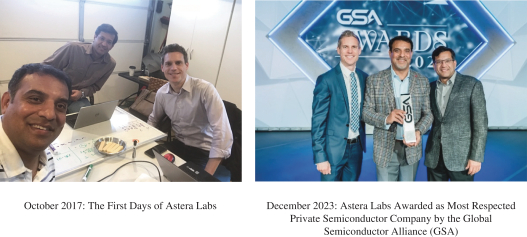
87
Table of Contents
Overview
Our mission is to innovate, design, and deliver semiconductor-based connectivity solutions that are purpose-built to unleash the full potential of cloud and AI infrastructure.
Building on years of experience with a singular focus on addressing connectivity challenges in data-centric systems, we have developed and deployed our leading Intelligent Connectivity Platform built from the ground up for cloud and AI infrastructure. Our Intelligent Connectivity Platform comprises:
i) Semiconductor-based, high-speed, mixed-signal connectivity products that integrate a matrix of microcontrollers and sensors; and
ii) COSMOS, our software suite which is embedded in our connectivity products and integrated into our customers’ systems.
Our Intelligent Connectivity Platform provides our customers with the ability to deploy and operate high performance cloud and AI infrastructure at scale, addressing an increasingly diverse set of requirements. We provide our connectivity products in various form factors including ICs, boards, and modules.
AI touches many aspects of our daily lives today, from vision processing for autonomous vehicles to speech recognition systems for chatbots. The shift towards the cloud from on-premise computing is rapidly accelerating due to increasing demand for compute-intensive AI workloads that are truly optimized when deployed at cloud scale.
To address the performance and scalability requirements of AI and other compute-intensive applications, hyperscalers have adopted heterogeneous, “accelerated computing” system architectures within their data centers, which include GPUs and other AI accelerators, such as TPUs, AI processors, custom ASICs, and FPGAs, to target specific workloads. These new system architectures require a connectivity backbone that is significantly faster with lower latency, is robust, and supports cloud scale deployment.
Our patented software-defined platform approach delivers critical connectivity performance, enables flexibility and customization, and supports observability and predictive analytics. This approach efficiently addresses the data, network, and memory bottlenecks, scalability, and other unique infrastructure requirements of our hyperscaler and system OEM customers.
Based on trusted relationships with the leading hyperscalers and collaboration with data center infrastructure suppliers such as NVIDIA, Advanced Micro Devices, Intel, and many others, our platform is designed to meet our customers’ unique cloud scale requirements. Our COSMOS software suite is foundational to our Intelligent Connectivity Platform and is designed to enable our customers to seamlessly configure, manage, monitor, optimize, troubleshoot, and customize functions in our IC, board, and module products.
We believe that our Intelligent Connectivity Platform addresses a large and growing TAM of $17.2 billion. Specifically, our technology and product portfolios target the global wired connectivity market, including PCIe and Ethernet, and the CXL memory connectivity controller market. We believe that our TAM will grow to $27.4 billion by 2027, and we expect to address an increasing share of this TAM as we expand the breadth and depth of our product portfolio. See the section titled “Business—Our Market Opportunity” for additional information on how we calculate our TAM.
Today, our connectivity solutions are at the heart of major AI platforms deployed worldwide featuring both commercially available GPUs and proprietary AI accelerators. In the last four years, we have successfully introduced three revenue-generating product families across multiple form factors including ICs, boards, and
88
Table of Contents
modules, shipping millions of devices across all of the major hyperscalers. Our products, which include Aries PCIe®/CXL™ Smart DSP Retimers, Taurus Ethernet Smart Cable Modules™, and Leo CXL Memory Connectivity Controllers, leverage our ICs that are built upon industry standard connectivity protocols such as PCIe, Ethernet, and CXL to address the growing demand for purpose-built connectivity solutions that solve critical data, network, and memory bottlenecks inherent in cloud and AI infrastructure.
Since our inception, we have created and commercialized first-to-market PCIe, Ethernet, and CXL products, and, with more than 300 design wins, we have become a trusted partner and a proven supplier to our hyperscaler and system OEM customers. We have experienced strong growth since our founding in October 2017, and particularly since the commercial launch of Aries in 2020. Our revenue grew from $79.9 million in 2022 to $115.8 million in 2023, driven by a significant increase in demand for our products. We have made significant investments in the design and development of new products and platform enhancements, and, as a result, we have not yet achieved profitability on an annual basis. We incurred net losses of $58.3 million in 2022 and $26.3 million in 2023.
Industry Background
The Proliferation of Cloud Computing
Over the past decade, we have witnessed the rapid global adoption of cloud computing. The emergence of mobile internet has resulted in unprecedented data creation from video, social networking, and advanced collaboration applications requiring the scale of cloud infrastructure versus traditional on-premise computing. The widespread digitalization of tasks across industries and associated exponential growth of data has led to a rapid shift from on-premise to cloud computing. Data generated in the cloud is forecasted by IDC to increase materially, from less than 20% of the world’s data generation in 2022 to 32% by 2027. This shift towards the cloud is rapidly accelerating due to increasing demand for compute-intensive AI workloads that are truly optimized only when deployed at cloud scale. According to Dell’Oro, accelerated servers for AI applications represent the fastest growing segment of the server market with shipments forecasted to expand from 1.2 million servers in 2023 to nearly 3.4 million servers in 2027.
The transition to the cloud has been fueled by the unparalleled ease, flexibility, and security of deploying computing resources at scale, with minimal upfront required capital investment by users. Importantly, the cloud provides enterprises with access to the latest technology and superior computing resources to transform their businesses. The result is improved time-to-market for products and services, and a stronger competitive position versus purchasing computing resources such as servers, storage systems, and networking devices from system OEMs and managing those computing resources themselves in on-premise data centers.
Cloud infrastructure requires highly customized integration. Hyperscalers, which include public cloud service providers such as AWS, GCP, and Microsoft Azure, are diverse and complex. Hyperscalers also include large organizations, such as Meta, and their infrastructure is highly optimized for proprietary workloads that run in their private clouds. Other enterprise companies utilize a hybrid approach, using both public and private clouds to balance scale and cost.
89
Table of Contents
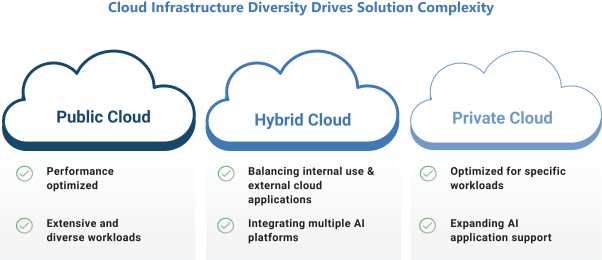
The proliferation of cloud computing has resulted in several important changes in the semiconductor ecosystem as hyperscalers seek to provide differentiated solutions to their users.
Hyperscalers are differentiating with custom hardware and processors. Hyperscalers are increasingly bringing strategic aspects of cloud hardware in-house, which includes custom server designs, CPUs, and AI accelerators such as TPUs. These custom solutions directly impact and add value for their users. Importantly, their suppliers for connectivity and other technologies must keep pace with the hyperscalers’ rapid development of custom hardware, and support each of their unique system requirements.
Hyperscalers are redefining the technology roadmaps and supply chain requirements of their semiconductor suppliers. Hyperscalers require that their suppliers’ products deliver the highest performance across complex and diverse workloads in the cloud. This includes high quality standards such as near-zero defect tolerance and rigorous qualification processes. Furthermore, hyperscalers’ suppliers must ramp up new products at a rapid pace more akin to what is required for consumer electronics such as smartphones. The combination of these quality standards and ramp up requirements has redefined the product roadmaps and supply chain requirements for semiconductor suppliers.
Hyperscalers are laser-focused on server uptime, scaling, and fleet reliability. Hyperscalers deploy their infrastructure as a service, so uptime and utilization are critical for their businesses. If their servers are idle, underutilized, or worse, offline, hyperscalers’ financial results are directly impacted. Hyperscalers’ demand for reliability drives their stringent observability requirements at every level of their operations.
Hyperscalers are committed to green data centers and environmental sustainability. Hyperscalers’ data centers demand for power and their need for more capacity is growing as quickly as the business and services that the hyperscalers’ cloud services support. Hyperscalers demand power efficient and environmentally sustainable infrastructure solutions in order to cost-effectively and responsibly address the demand for cloud and AI workloads.
AI is the Era-Defining Technology Driving the Next Generation of Cloud Infrastructure
AI touches many aspects of our daily lives today, from vision processing for autonomous vehicles to speech recognition systems for chatbots. According to IDC, by 2025, the Global 2000 organizations will allocate over 40% of their core IT spend to AI-related initiatives, leading to a double-digit increase in the rate of product and process innovations. Hyperscalers’ customer demand for AI and other compute-intensive applications such as data analytics, scientific computing, recommendation engines and, most recently, GenAI are rapidly driving an increased need for accelerated computing since conventional computing takes too long and is too expensive. GenAI is a type of AI that can create new content, such as images, videos, audio, text, and 3D models that
90
Table of Contents
requires a massive increase in computing resources. According to Gartner®, by 2025, cloud-native platforms will serve as the foundation for more than 95% of new digital initiatives, up from less than 40% in 2021. This trend is largely driven by a significant increase in AI workloads.
Recent GenAI advances, as demonstrated by the launch of ChatGPT by OpenAI in late 2022, have shown the unprecedented capabilities and immense potential for training LLMs to enhance applications across industries. As with other technologies of the digital era, the speed of these advancements outpaces the rate of commercial and consumer adoption while enterprises determine if and how to leverage AI based solutions to replace existing solutions and consumers determine if and how they will accept AI based solutions. Furthermore, regulators and lawmakers around the world have started to propose and adopt regulations and guidance on the use of AI. Notwithstanding these challenges and uncertainties, according to IDC, GenAI has the potential to drive massive workforce productivity and create up to $10 trillion of value for the global economy by 2033.
According to NVIDIA, the latest GenAI models have up to 1 trillion parameters and are trained upon trillions of training tokens (i.e., data inputs). These GenAI models continue to increase in size and complexity. For example, in October 2021, Microsoft and NVIDIA announced the Megatron-Turing NLG model with 530 billion parameters. Just a few months later, in April 2022, Google published a research paper mentioning a trillion parameters for GenAI models. Doubling in model size typically requires an approximately 10x increase in computing capability. Given their massive need for computing, GenAI is only practical at cloud scale.
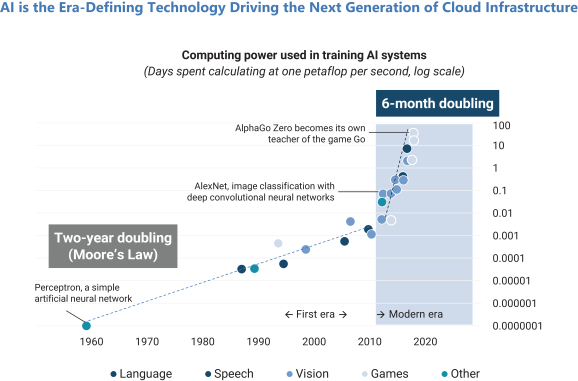
To address the performance and scalability requirements of AI and other compute-intensive applications, hyperscalers have adopted heterogeneous, “accelerated computing” architectures to target specific workloads. AI accelerators such as GPUs, TPUs, and FPGAs, with their massively parallel compute engines and high bandwidth connectivity to memory and data, are foundational to the AI infrastructure. A typical accelerated computing server consists of multiple AI accelerators (for example, eight in NVIDIA’s HGX platform)
91
Table of Contents
connected to a head node which comprises CPUs (two in NVIDIA’s DGX platform), together with multiple NICs (ten in NVIDIA’s DGX). To address increasingly larger and more complex AI workloads, hyperscalers interconnect tens of thousands of GPUs and other AI accelerators that process workloads in parallel across thousands of servers to increase system compute capacity. Put simply, the data center has become the modern computer for AI workloads.
Existing Connectivity Solutions are Inadequate to Deploy AI Infrastructure at Cloud Scale
GPUs and other AI accelerators are often the most expensive and scarce part of data centers. According to SemiAnalysis, AI accelerators constitute more than 70% of the bill-of-materials (“BOM”) for AI servers. AI accelerators are efficient at computing, challenging the rest of the cloud and AI infrastructure to effectively transport data to and from them to maximize their utilization. However, GPUs and other AI accelerators often sit idle waiting for data to become available. Increasing the utilization of AI accelerators presents a large challenge as well as a massive opportunity for connectivity suppliers.
Purpose-built connectivity solutions that connect GPUs and other AI accelerators with each other directly or between servers are required to unleash AI accelerators’ full potential at cloud scale and solve the following critical data, network, and memory bottlenecks:
Data and network bandwidth bottlenecks. The connectivity between GPUs, other AI accelerators, CPUs, storage devices, and networking subsystems in an AI platform must deliver ever-increasing bandwidth. The connectivity topology also changes from a hierarchical network where a server connects to a switch, to a fabric network where AI accelerators connect to each other directly within an AI cluster. This dense fabric connectivity is required since every AI accelerator needs full bandwidth and low latency access to each other. The net result is the number of high-speed links in an AI cluster is growing rapidly. For example, in an NVIDIA GH200 cluster, we estimate that there are 15 high-speed links per AI accelerator.
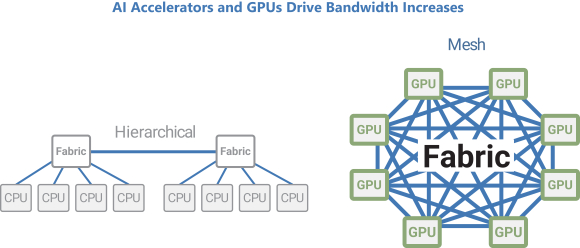
GPUs and other AI accelerators are connected to each other and to system devices over different protocols. There are vendor-specific protocols such as NVLink and InfiniBand that exist alongside other industry standard protocols such as PCIe, Ethernet, and CXL. In response to the insatiable demand for interconnect performance, standards bodies such as The Institute of Electrical and Electronics Engineers (“IEEE”), the PCI-Special Interest Group (PCI-SIG), and the CXL Consortium are fast tracking the release of new generations of specifications with far greater data rates, bandwidth, and capabilities.
92
Table of Contents
PCIe. The PCIe interface is native to GPUs and other AI accelerators, CPUs, solid-state storage devices, and NICs, and is by far the most prevalent protocol for moving data at high-bandwidth and low latency inside a server. The latest PCIe 5.0 deployed solutions support up to 32Gbps/lane, and data rates have doubled since the last version.
Ethernet. Ethernet connects servers to ToR switches, and switches to each other in a hierarchical structure to build large scale networks within data centers. The latest deployed high speed Ethernet ports support up to 100Gbps/lane, and data rates have also been doubling roughly every two years.
CXL. CXL is a cache-coherent protocol which is built on top of PCIe interfaces and operates at the same data rates as PCIe. CXL is defined to optimize low latency connectivity both amongst AI accelerators in a fabric network, and to CPUs.
Exploding signal integrity challenges. Data transfer rates across all protocols have been rapidly growing to support compute-intensive workloads, and the physical size of AI server clusters has grown as well, compounding the signal integrity problem. In AI servers, signals must travel farther distances at faster rates which results in a loss of signal fidelity and reduced link performance.
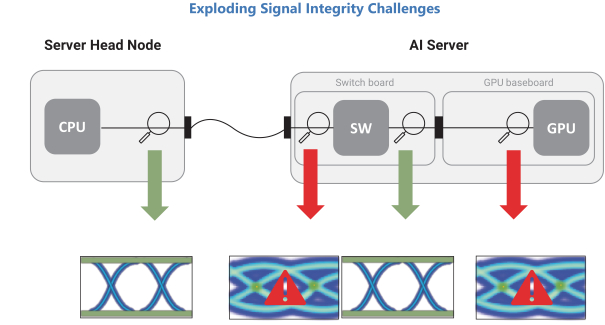
93
Table of Contents
Memory wall. The term “memory wall” was first theorized in the mid-1990s to define what was becoming an obvious problem at the time: CPU performance had outpaced the ability for memory subsystems to provide them with data and memory access, thereby limiting computing performance. Thirty years later, this statement still holds true, especially with respect to memory-intensive applications such as AI where training LLMs on big datasets in a reasonable timeframe requires ultra-fast memory bandwidth and significant memory capacity.
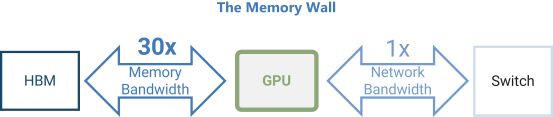
AI models need to be accessed and updated rapidly by all of the GPUs and other AI accelerators in a cluster, requiring model parameters to be stored in quickly accessible HBM. However, large AI models such as LLMs often cannot fit into a single AI accelerator’s memory subsystem. A commonly deployed solution is to divide the AI model into small pieces that can each fit in a single AI accelerator memory subsystem and then interconnect many such AI accelerators to hold the entire AI model in their combined memory. GPUs and other AI accelerators need to be networked together at multi-terabit per second speeds so they can seamlessly access each other’s memory subsystems. Modern connectivity devices allow for the addition of a fast memory tier to each AI accelerator, providing terabytes of capacity at nanosecond level latencies. In addition, CXL is being adopted within the data center to address declining memory bandwidth per core in modern CPUs, and to enable expansion, pooling, and sharing of memory across AI accelerators in a heterogeneous computing system.
Interconnect reliability and observability. Given the massive parallelization of AI workloads across AI accelerators, the progress made by the AI cluster is highly dependent upon each AI accelerator performing flawlessly. When a single server or a single AI accelerator fails, or the network connecting them does not transfer data reliably, the entire AI server cluster will typically stop, re-synchronize, and restart, reducing infrastructure utilization, and increasing the time and cost required to train AI models.
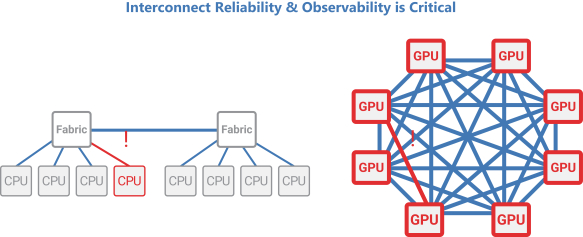
94
Table of Contents
Cloud and AI infrastructure diversity drives connectivity solution complexity. Hyperscalers optimize their cloud infrastructure to meet the unique requirements of their users and internal business models. The system architecture, and therefore the connectivity subsystem needs, tend to be different between cloud infrastructure deployments. This requires customization and flexibility to support a wide range of use cases.
The bottleneck for AI deployments in the cloud has shifted from computing performance to connectivity. We believe a new approach for connectivity is required to address the data, network, and memory bottlenecks in a reliable, scalable, customizable, and interoperable manner for cloud and AI infrastructure.
Our Solution
Building on years of experience with a singular focus on addressing connectivity challenges in data-centric systems, we have developed and deployed our leading Intelligent Connectivity Platform, built from the ground-up to unleash the full potential of cloud and AI infrastructure. Our Intelligent Connectivity Platform comprises:
i) Semiconductor-based, high-speed, mixed-signal connectivity products that include a matrix of microcontrollers and sensors to monitor link performance; and
ii) COSMOS, our software suite, which is embedded in our connectivity products and integrated into our customers’ systems.
Our Intelligent Connectivity Platform provides our customers with the ability to deploy and operate high-performance cloud and AI infrastructure at scale, addressing an increasingly diverse set of requirements. We provide our connectivity products in various form factors including ICs, boards, and modules.
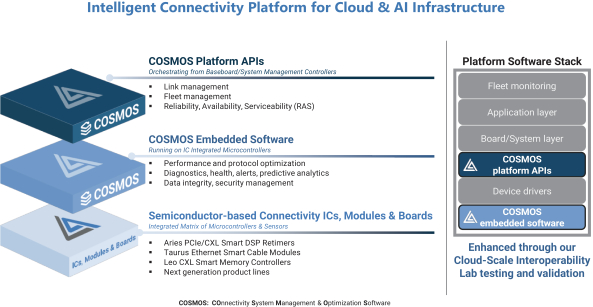
Our patented software-defined platform approach delivers critical connectivity performance, enables flexibility and customization, and supports observability and predictive analytics. We enhance the value of our platform with our Interop Lab, where we validate performance and interoperability between our connectivity products and other data center infrastructure suppliers’ products in real-world scenarios. Our approach is key to efficiently address the data, network, and memory bottlenecks, scalability, customizability and interoperability requirements of hyperscalers.
95
Table of Contents
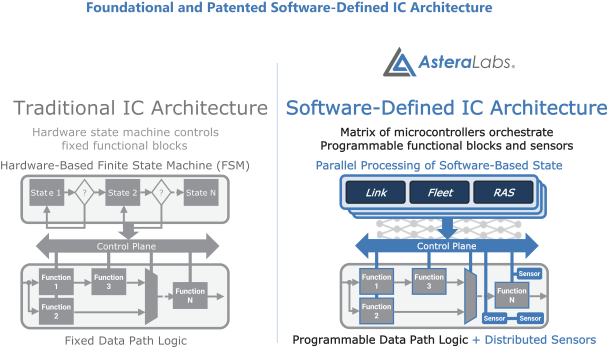
Our Products
In the last four years, we have successfully introduced three revenue-generating product families across multiple form factors including ICs, boards, and modules that are built upon our software-defined IC architecture:
Aries PCIe®/CXL™ Smart DSP Retimers. Our Aries products, which include our COSMOS software suite, are essential to enable higher PCIe/CXL data bandwidth and lower latency interconnectivity between various heterogeneous compute processors, storage, and network controllers. Aries digitally recovers degraded high-speed signals and retransmits a clean copy of the data, thereby extending the reach of existing cost-effective interconnects, while enabling higher data bandwidth.
Taurus Ethernet Smart Cable Modules™. Our Taurus products are hardware modules based on our Taurus ICs that increase network connectivity bandwidth between servers and switches over copper media. Taurus modules incorporate our COSMOS software suite and extend Ethernet signaling reach at higher data rates, providing cost-effective, rack-level network connectivity for cloud and AI infrastructure, removing rack-level Ethernet connectivity bottlenecks.
96
Table of Contents
Leo CXL Memory Connectivity Controllers. Our Leo products allow our customers to overcome processor memory bandwidth bottlenecks and capacity limitations, while leveraging our COSMOS software suite’s built-in memory management and deep diagnostic capabilities. Leo ICs and boards enable expanding, sharing, and pooling of industry standard DRAM memory over high-speed serial links to support memory-intensive workloads running on AI accelerators and CPUs.
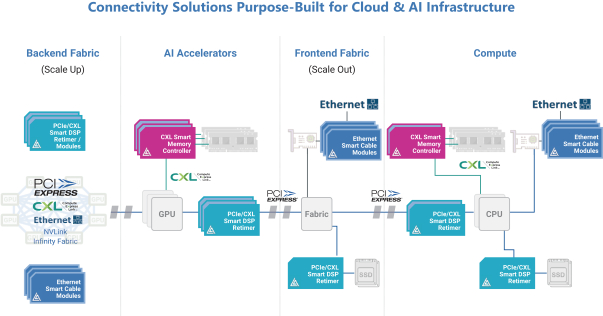
COSMOS Software Suite
Our COnnectivity System Management and Optimization Software, or COSMOS software suite, is foundational to our Intelligent Connectivity Platform. COSMOS is designed to enable our hyperscaler customers to seamlessly configure, manage, monitor, optimize, troubleshoot, and customize functions in our IC, board, and module products. COSMOS has a software component that operates on our customers’ BMC, SMC, BIOS, and/or operating system, and interfaces with other COSMOS software components running on microcontrollers integrated into our ICs, boards, and modules.
Our software suite provides three distinct capabilities to our customers:
Link Management. A critical purpose of COSMOS is to ensure secure and robust data link communication between devices in a computing system. Each data link typically includes a large number of data lanes. Our software autonomously manages data links over wide operating conditions to ensure reliable operation. If a data link does become unstable (e.g., due to overheating or degrading components), our software can retrain the link to restore margins or manage the data rate to ensure robust data communication. This software is used across applications and protocols, ensuring compliance with industry standards (e.g., PCIe, Ethernet, CXL) while providing flexibility for the specific requirements of our customers.
97
Table of Contents
Fleet Management. COSMOS allows real-time monitoring of and predictive maintenance for server fleets. Our hyperscaler customers gather detailed performance data over time from millions of links. Data from device-level software components is communicated to platform-level software to provide fleet-level insights and analytics. This allows for proactive and predictive maintenance of degraded hardware as well as reassignment of customer workloads to healthy hardware.
RAS. COSMOS enables RAS capabilities by detecting, reporting, and testing the data, network, and memory links supported by our product families. On-chip data integrity modules check for a variety of conditions such as media errors and performance anomalies. Software components on our ICs report telemetry data to allow for performance monitoring, error detection, and correction to prevent an application’s performance from being impacted.
COSMOS is an integral part of our Intelligent Connectivity Platform that allows customization to support specific hyperscaler requirements throughout the lifecycle of their infrastructure. COSMOS improves our products over time by giving our customers new features, enhancements, and critical updates.
Industry-Trusted Cloud Scale Interoperability Lab
We have built and deployed our industry-trusted cloud scale Interop Lab and developed comprehensive interoperability test suites. These tests validate performance and interoperability between our connectivity products and other data center infrastructure suppliers’ products in real-world scenarios to minimize interoperation risk, reduce system development costs, lower unplanned downtime, and accelerate time-to-market. Lessons learned from our Interop Lab are continually rolled into our new and existing products, including our COSMOS software suite, making our customers’ platforms work more efficiently over time in a virtuous cycle of improvement.
Together, our software-defined connectivity products and our COSMOS software suite form our Intelligent Connectivity Platform. We enhance the value of our platform with our Interop Lab and by providing early interoperability reports with other data center infrastructure suppliers’ products. Our leading Intelligent Connectivity Platform is performant for the most demanding cloud and AI applications, provides customizable products for different hyperscalers, is reliable at cloud scale, and we believe it increases value to our customers over time.
Key Customer Benefits of Our Intelligent Connectivity Platform
Our Intelligent Connectivity Platform provides our customers with the ability to deploy and operate high-performance cloud and AI infrastructure at scale, addressing an increasingly diverse set of requirements.
Superior connectivity performance critical for the next generation of cloud and AI infrastructure. We developed our purpose-built Intelligent Connectivity Platform to deliver high bandwidth and low latency connectivity at significant scale, enabling the deployment of the next generation of cloud infrastructure critical for data-centric workloads such as AI. This enables our hyperscaler customers to confidently support the latest, largest, and most compute-intensive workloads, enhancing the value of their cloud and AI infrastructure.
Seamless deployment through customizable products, utilizing our customer PSSP model. Our software-defined connectivity platform is highly customizable to address the unique needs of each hyperscaler, which enables our hyperscaler customers to seamlessly provide differentiated solutions to their users without compromising on performance, features, or cost. At the same time, we simplify their connectivity sourcing needs by using the same device across a diverse set of new and existing infrastructure for high-volume requirements. Relative to traditional custom hardware products, our customers benefit from faster time-to-market, reduced risk, and lower cost of ownership due to the economies of scale of our PSSP model. The customizable nature of our products is ideal to address the varying cloud infrastructure requirements:
Public Cloud. Performance is optimized across extensive and diverse workloads;
Hybrid Cloud. Balancing internal use and external cloud applications, typically integrating multiple AI platforms; and
98
Table of Contents
Private Cloud. Optimized for specific workloads, often with expanded AI application support.
Robust reliability, QoS, and software management capabilities facilitate deployment at scale. Our platform provides (i) robust signal integrity to overcome increasing channel insertion loss as connectivity speeds increase, (ii) server-grade RAS support, and (iii) sophisticated link telemetry features that enable signal monitoring for QoS. Our COSMOS software suite provides critical system-level operational insights, allowing our customers to manage, debug, and deploy cloud and AI infrastructure at scale.
Real-time link monitoring for fleet health management and improved user experience. Managing millions of servers with billions of high-speed data links can be an operational nightmare for large cloud operators. Link health monitors embedded in our products and software algorithms implemented in our COSMOS software suite provide rich insights into the health, performance, and utilization of interconnects for predictive maintenance, as well as for the reassignment of user workloads to healthy hardware for improved user experience.
Platform optionality and supply chain flexibility. Today, our connectivity solutions are at the heart of major AI platforms deployed worldwide, featuring both commercially available GPUs and proprietary AI accelerators. Our Intelligent Connectivity Platform supports multiple cloud and AI compute platforms which incorporate a mix of GPUs, other AI accelerators, and CPUs. This enables our customers to seamlessly port their connectivity architectures across multiple system platforms featuring processors from different suppliers, including proprietary in-house processors from hyperscalers.
Multiple form factors expand deployment options and accelerate time-to-market. We provide our connectivity products in various form factors including ICs, boards, and modules. We strive to ensure that our products perform optimally across form factors, which enables our customers to adapt their product sourcing plans with us to support their dynamic system requirements and quickly deploy multiple architectural topologies across their infrastructure. For example, we provide Aries in an IC form factor for board-level applications and have also evolved this offering per our customers’ needs to quickly provide the same solution in a module form factor to extend PCIe over active electrical cables.
Accelerated time-to-market improves ROI for hyperscalers. We believe we enable our hyperscaler customers to offer the latest and largest AI models to their users faster than their peers, which is critical for hyperscalers to retain and grow their user bases. Our products are designed to accelerate time-to-market by solving interoperability issues with data center infrastructure ecosystem suppliers’ products ahead of our customers’ efforts to design and qualify systems for deployment. Our Interop Lab extends the useful life of our customers’ cloud and AI infrastructure, helps them retain and grow their business with their users, and improves the ROI of their infrastructure.
Improved utilization of cloud and AI infrastructure lowers TCO. Our Intelligent Connectivity Platform enables increased utilization of expensive GPUs and other AI accelerators, unlocks scalable memory expansion, and provides greater system uptime to lower the total cost of system ownership for hyperscalers, improving the value proposition that they can provide for their users.
Green data centers and environmental sustainability. Our Intelligent Connectivity Platform increases power efficiency by increasing bandwidth over existing interconnects such as copper cables thereby reducing energy requirements compared to optical cables. We further enable environmental sustainability by extending the useful life of our customers’ existing hardware, which includes copper media.
Our Intelligent Connectivity Platform is purpose-built to unleash the full potential of accelerated computing at cloud scale, making us a critical and trusted partner to our hyperscaler customers and companies in the data center infrastructure ecosystem.
99
Table of Contents
Our Customer Flywheel
Given the use-cases for compute-intensive applications, as led by AI, are diverse and complex, hyperscalers have adopted different accelerated computing architectures that are scale- and cost-optimized depending on the workload. We use our deep technical expertise and ability to innovate and tailor our products to meet each hyperscalers’ exacting needs. As a result, our business sees a powerful flywheel effect, which creates additional demand for existing products and enables us to bring additional new products to market in close relationships with our customers.
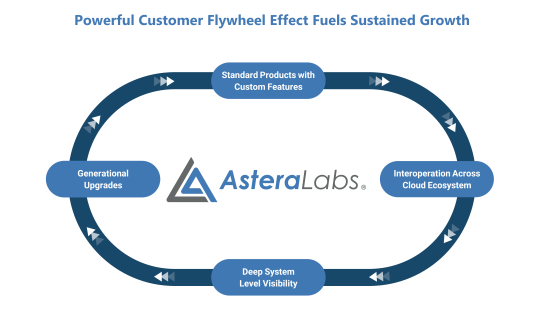
This flywheel effect consists of:
Our customer PSSP business model which enables symbiotic customer relationships. Based on the unique requirements of each customer, our software-defined platform architecture allows us to rapidly develop our standard products and gives us the flexibility to make modifications, customizations, and upgrades, even after deployment. This PSSP approach provides us with operating leverage and leads to increased collaboration with our customers, allowing us better customer access and greater engagement, resulting in greater visibility into new customer platforms and additional content opportunities.
Our cloud scale Interop Lab which provides rigorous testing for interoperability within the data center infrastructure ecosystem. We have invested in ensuring wide interoperability of our products, and this is at the heart of our product development process. Our focus on ensuring interoperability for our products allows our customers to deploy them with confidence and elevates our position as a trusted partner to our customers and across the data center infrastructure ecosystem. We engage with our customers through our Interop Lab, where industry participants work together to establish compatibility and stress test products early in their product development process, and prior to large-scale deployments. When connectivity issues are identified in our labs, we can frequently resolve them through COSMOS software suite enhancements for our products. The ability to identify and resolve them seamlessly, utilizing our COSMOS software suite and our Interop Lab, enhances both our products and our customers’ solutions over time.
Our deep system level visibility into critical components in the data center. Our COSMOS software suite enables deep visibility into the performance and limitations of cloud and AI infrastructure, providing us with a pathway to continuously improve our products and increase the value that they provide to our customers. This visibility, along with the diagnostics and management capabilities of our COSMOS software suite
100
Table of Contents
enables our customers to reduce their total cost of ownership. Once our COSMOS software is integrated into our customers’ systems, we gain visibility into the performance and operation of our customers’ infrastructure, providing us with a pathway to continuously improve our products, expand product offerings, and increase the value that our products add to our customers.
Natural partner for implementing generational upgrades. Our COSMOS software suite allows customizations through link management, fleet management, and RAS to meet unique customer requirements. When coupled with our leading connectivity products, this makes us an ideal partner for hyperscalers when they need to implement generational upgrades. New generations of our products are designed to work seamlessly with COSMOS software, which is already deployed with our customers.
Our customer flywheel creates a virtuous cycle where we gain more insight from existing deployments and translate them into hardware and software feature upgrades for our product families, thereby continuously improving our Intelligent Connectivity Platform.
We sell our products both through distributors and directly to end customers and their manufacturing partners. We are the primary interface with our hyperscaler, system OEM customers and their manufacturing partners whose requirements help drive the design of our solutions. Presently most of our direct revenue comes from distributors who operate as logistics and order fulfillment service providers to our customers.
Our Competitive Strengths
Our market-leading technology, fundamental to our Intelligent Connectivity Platform, has allowed us to win many high-volume designs based on our products for cloud and AI infrastructure. We believe our singular focus on cloud and AI connectivity, our software-defined platform architecture, and our system-level approach fortify our customer relationships, which are reinforced with each generational upgrade and new product family introduction, creating our durable competitive moat. Our competitive strengths include:
Singular focus on cloud and AI connectivity. Our Intelligent Connectivity Platform was purpose-built from the ground up to solve cloud and AI infrastructure challenges. Our comprehensive suite of PCIe, Ethernet, and CXL products addresses the data, network, and memory bottlenecks of accelerated computing at cloud scale. Our singular focus on cloud and AI infrastructure provides us with a deep understanding of our customers’ needs that has enabled us to develop a portfolio of high value-added solutions that meet their exacting, complex, and diverse cloud and AI infrastructure requirements.
Software-defined IC architecture underpins our connectivity products. Unlike legacy approaches that use either a “kitchen sink” super-set product or a highly customized product to address the differentiated infrastructure and workload needs of each hyperscaler, we have partnered with hyperscalers and many of the world’s leading data center infrastructure suppliers, including GPU and other AI accelerator vendors, to create a differentiated platform. Our software-defined architecture optimizes time-to-market and allows us to easily customize our products to match the unique performance and functional requirements of our customers. This approach allows for an accelerated design process, with faster time-to-sample, and greater levels of flexibility and customization compared to traditional hardware-centric approaches. Our approach allows us to upgrade and modify our products in-field, as opposed to requiring hardware replacements which are costly and result in increased downtime. When coupled with our leading connectivity products, this makes us an ideal partner for hyperscalers when they need to implement generational upgrades, fortifying our position and strengthening our competitive moat.
COSMOS software suite provides unmatched flexibility and customizability. COSMOS enables our customers to seamlessly configure, manage, monitor, optimize, troubleshoot, and customize functions within our product families. With link management, fleet management, and RAS capabilities, COSMOS allows for customization to support specific hyperscaler requirements throughout the lifecycle of their infrastructure, offering our customers frequent enhancements and additional capabilities. Adaptability and regular feature refinement establish COSMOS as a differentiated asset of our platform, providing additional value to our customers and solidifying our position within our customers’ cloud and AI infrastructure.
101
Table of Contents
System-level approach to purpose-built product families. We go beyond providing a solution for standard connectivity protocols and take a system-level approach to our products to ensure that we address specific and critical problems for our hyperscaler customers. We provide a complete platform consisting of ICs, boards, and modules coupled with software and interoperability reports that ensure ease of integration and customer adoption. This approach has enabled us to be viewed as a trusted strategic partner by our customers, leading to deeper collaboration and early insight into future product opportunities.
First mover advantage provides early insight into evolving customer needs. We have created and commercialized first-to-market PCIe, Ethernet, and CXL products, and with more than 300 design wins, we have become a trusted partner and a proven supplier to our hyperscaler and system OEM customers. As a result, we gain extensive insight from existing deployments and translate them into new product opportunities.
Cloud-based IC research and development fuels our continued innovation. We were “born in the cloud,” with our research and development located in the public cloud. By harnessing the scale of cloud computing, we believe we improve quality, reduce development costs, and accelerate speed of execution, which allows us to get to market faster than traditional semiconductor companies. Furthermore, the learnings from using the cloud ourselves feeds innovation across all aspects of our Intelligent Connectivity Platform, which is used to improve and scale cloud and AI infrastructure deployments.
Broad and deep relationships across the entire data center infrastructure ecosystem. We have developed deep relationships across the data center infrastructure ecosystem by building our products to be interoperable with products from NVIDIA, Advanced Micro Devices, Intel, proprietary in-house processors from hyperscalers, as well as those from memory and storage vendors. At our Interop Lab, industry participants work together to ensure compatibility and stress test products early in their product development process. Our Interop Lab positions us at the front and center for new product adoptions within the ecosystem, ensuring better interoperability of our products in customers’ infrastructure and providing us with cycles of learning ahead of our competitors.
For instance, we believe being integrated into reference and/or commercial designs provided by industry leaders like NVIDIA, Advanced Micro Devices, and Intel demonstrates their trust in us as a reliable supplier. By aligning our solutions with their established designs, we gain understanding of their product architectures, which not only expedites our product development process, but also ensures better compatibility with a wide array of other hardware elements within the ecosystem. The resulting robustness of our products embeds us deeper with our customers, further strengthening our relationships across the data center infrastructure ecosystem.
Robust supply chain designed to serve hyperscaler customers. We believe we have built a robust and resilient supply chain that will meet the demand profile of hyperscalers, which requires quality assurance and an ability to rapidly scale volume production. We have a strong manufacturing relationship with TSMC, and we qualify multiple suppliers and vendors, enabling us to better weather potential unforeseen supply chain disruptions.
Experienced management team with a proven track record of execution and innovation. We have assembled seasoned leaders in IC, board, module, software, and system engineering to solve the connectivity challenges in cloud and AI infrastructure. Our founding team has spent the last three decades developing and commercializing connectivity products, and has a track record of successfully scaling leading semiconductor businesses and launching category-defining new products. We have further strengthened our senior leadership team by bringing in industry thought leaders with expertise in high-speed connectivity. Under their leadership, we have introduced three product families across multiple form factors including ICs, boards, and modules and feature SKU variants, with our Aries and Taurus product families already shipping second generation products. Over the last four years, we have introduced products at a steady cadence with leading PCIe, Ethernet, and CXL solutions.
102
Table of Contents
Our Market Opportunity
Hyperscalers are in the initial stages of a multi-year investment cycle to build out next-generation cloud and AI infrastructure. According to estimates from Dell’Oro, worldwide data center infrastructure capital expenditures are expected to grow from $264.9 billion in 2023 to $503.4 billion by 2027. Over the same period, Dell’Oro projects that total servers deployed will grow from approximately 14.0 million units in 2023 to over 20.5 million units in 2027. According to Dell’Oro, accelerated servers for AI applications represent the fastest growing segment of the server market with shipments forecasted to expand from 1.2 million units in 2023 to nearly 3.4 million units in 2027. Given our singular focus on cloud and AI connectivity to date, we are strongly positioned to address the large and growing cloud and AI market opportunities for mission critical connectivity solutions.
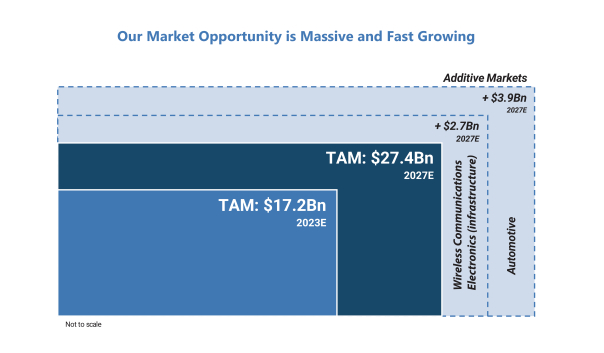
Our technology and product portfolios target the global wired connectivity and CXL memory connectivity controller markets. According to Gartner®, within global wired communication electronics, the wired connectivity market is poised to grow from $16.9 billion in 2023 to over $23.0 billion in 2027. For CXL memory connectivity controller, Yole Intelligence, part of Yole Group, forecasts that nearly 100% of data center server CPUs will be “CXL-capable” by 2027. We estimate this will drive a CXL memory connectivity controller TAM of $4.4 billion in 2027. In aggregate, we estimate that our TAM will grow from approximately $17.2 billion in 2023 to nearly $27.4 billion in 2027.
Within this TAM, we are particularly well positioned to benefit from several of its fastest growing segments, listed below.
PCIe. PCIe connectivity solutions are highly pervasive throughout data center infrastructure with ICs designed into 95% of global servers, according to ABI Research. Also, ABI Research projects PCIe connectivity solutions in the data center will grow from $4.1 billion in 2023 to $6.6 billion in 2027. Importantly, according to ABI Research, AI applications represent one of the fastest growing market opportunities for PCIe in the data center and are expected to expand from $630 million in 2023 to $1.6 billion in 2027, representing a four-year CAGR of 27%. Our Aries product family currently addresses a portion of this market opportunity, and we expect our ability to address more of this market opportunity to increase over time as we introduce new products and add features and capabilities.
103
Table of Contents
Ethernet. Ethernet connectivity solutions in the data center are poised to grow from $4.0 billion in 2023 to $5.8 billion in 2027, according to 650 Group. With Ethernet networking applications transitioning to high-speed 400G/800G data links, 650 Group projects Active Electrical Cables (“AEC”) will represent 63% of cloud NIC-to-ToR interconnects in 2027. We estimate this transition will drive the AEC module TAM from approximately $70 million in 2023 to approximately $1.3 billion in 2027, representing a four-year CAGR of 108%. Our Taurus product family holistically addresses the AEC market opportunity, and we expect our ability to address more of the Ethernet market opportunity to increase over time as we introduce new products and add features and capabilities.
CXL. CXL connectivity solutions are in the early stages of market adoption, with the high-volume deployment of next-generation CXL-capable server CPUs representing the key catalyst for broad-based CXL utilization. Yole Intelligence, part of Yole Group, is projecting that 60% of data center server CPUs will be CXL-capable in 2025, and nearly 100% CXL-capable by 2027. Based on Yole Intelligence, part of Yole Group, trajectory for CXL-capable server CPUs, we estimate the CXL memory controller market opportunity will expand from $265 million in 2023 to $4.4 billion in 2027, representing a four-year CAGR of 102%. Our Leo product family addresses the CXL memory connectivity controller market opportunity, and we expect to accelerate CXL memory connectivity controller adoption over time as we introduce new products and add more features and capabilities.
We expect to introduce new product families that will enable us to service a larger percentage of the broader wired connectivity market opportunity over time. Additionally, we believe our current technology and product portfolios address incremental market opportunities outside of our global wired connectivity and CXL memory connectivity controller TAM. With a focus on solving mission-critical connectivity challenges for compute-intensive applications, wireless communications electronics and automotive markets are examples of additive market opportunities, which are not included in our TAM today and represent $2.7 billion and $3.9 billion market opportunities, respectively, in 2027, according to Gartner®.
Growth Strategies
Today, our connectivity solutions are at the heart of major AI platforms deployed worldwide, featuring both commercially available GPUs and proprietary AI accelerators. We have become a trusted partner and a proven supplier to our hyperscaler and system OEM customers. Building on this foundation, the strategic tenets of our growth strategy include:
Increase sales to our existing customers as cloud and AI workloads continue to grow exponentially. We have established a leading market position with Aries, which is deployed across all of the major hyperscalers’ and system OEMs’ platforms, and we expect to drive future growth as our customers ramp up their platform deployments. Our Taurus and Leo product families are expected to further expand sales to our current customers as they complete technical qualification and are deployed across our customers’ cloud and AI infrastructure.
Increase our revenue-per-server-rack with generational upgrades and new products. We continue to invest in the development of new products and technologies that will address new types of functionalities and span additional form factors across new types of media:
Generational upgrades drive increasing value for our product families – As a leading provider of connectivity products, we believe we are well positioned to address the challenges of accelerated computing, which are exacerbated by the proliferation of GenAI. As the industry deploys next-generation protocols such as PCIe Gen 6.0 and 7.0, 200Gbps per lane Ethernet connections, and CXL 4.0, we expect to provide updates to our product families that support generational upgrades at our hyperscaler customers. We expect each subsequent generational change in technology will drive an increase in our value proposition and enhance our revenue on a like-for-like basis compared to prior product generations.
Increase in attach rates – We anticipate an increase in attach rates for our product families in next- generation system topologies due to higher data rates, larger physical system footprints, and greater memory bandwidth and capacity requirements.
104
Table of Contents
Develop new products to service emerging opportunities – Over time, we also expect to leverage our core semiconductor design, hardware expertise, and custom software assets to develop and introduce new product families and form factors that will enable us to service a larger percentage of the broader wired connectivity market opportunity. As cloud and AI infrastructure requirements scale, we foresee emerging use cases that require new products with added functionalities to solve data, network, and memory bottlenecks across multiple types of interconnects. These new development efforts will span incremental form factors across new types of media as well as address new types of functionalities.
Shape emerging connectivity standards to drive future product adoption. We are committed to participating in the establishment of new and next-generation standard connectivity protocols, providing us with insights to create products to continue to deliver better performance, versatility, and compatibility for cloud and AI infrastructure. As generational advancements in standard connectivity protocols emerge, we believe our proactive involvement with data center infrastructure ecosystem participants will enable us to grow our product offerings, ensuring sustained and robust growth.
Attract and acquire new and emerging customers focused on AI. We believe that we have a substantial opportunity to continue to grow our customer base. In addition to hyperscalers, we foresee emerging demand from companies that provide infrastructure for AI use cases, AI-dedicated data centers, and larger enterprises, as they begin to build proprietary systems with different architectural features to meet their unique requirements. As a leader in intelligent connectivity and as a partner with market leading GPU and CPU suppliers, we expect to be at the forefront of engaging with emerging cloud and AI infrastructure customers.
Leverage our differentiated products and technologies into new data intensive end-markets. We believe that the products and technologies that we have developed to solve connectivity problems for cloud and AI infrastructure can be leveraged for different use cases in adjacent growth markets for data-intensive applications. These markets include those for wireless communications infrastructure and automotive applications, including self-driving vehicles.
Selectively pursue strategic investments or acquisitions to enhance our competitive positioning. Although we expect to focus our growth strategies on organic expansion, we may pursue future investments or acquisitions that complement our Intelligent Connectivity Platform.
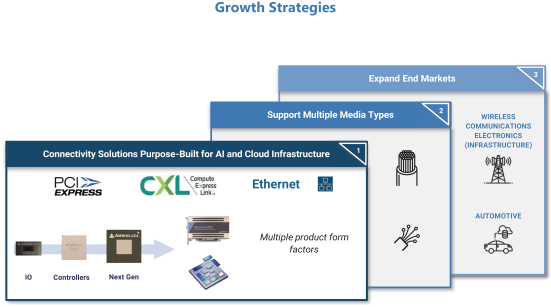
105
Table of Contents
Our Products and Technology
Our differentiated Intelligent Connectivity Platform is comprised of a portfolio of data, network, and memory connectivity products, which are built upon a unifying software-defined architecture. Today, our platform is comprised of three product families: Aries, Taurus, and Leo. Each product family has been purpose-built for cloud and AI infrastructure.
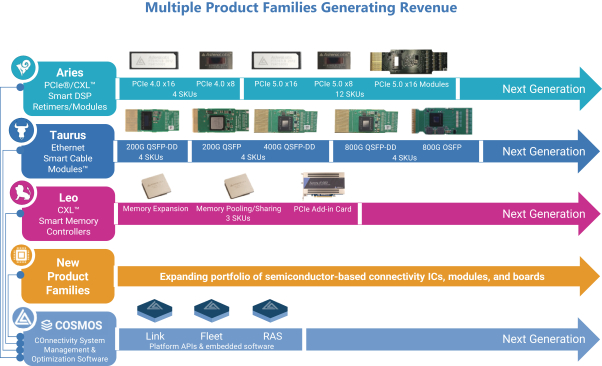
Our products are available in multiple form factors, specifically: ICs, boards, and modules. Our semiconductor-based, high-speed, mixed-signal connectivity products are based on a software-defined architecture incorporating a matrix of microcontrollers and sensors, and COSMOS, our unifying software suite that is embedded in our products and integrated into our customers’ systems.
Aries PCIe®/CXL™ Smart DSP Retimers (Aries). Our Aries products, which include our COSMOS software suite, are essential to enable higher bandwidth and low latency interconnect between various heterogeneous compute processors, storage, and network controllers. Aries ICs are used to digitally recover high-speed signals that have been significantly degraded traveling over printed circuit boards (PCBs) or cables, and then retransmit a clean copy of the signal in compliance with applicable high-speed data transfer standards. Retimer devices can double the physical reach between AI accelerators including GPUs, CPUs, NICs, and other PCIe/CXL devices, enabling system designers to build large, accelerated computing clusters. Our Aries products include our COSMOS software suite and are widely deployed across all of the major hyperscalers as well as private clouds managed by enterprises.
The Aries product family has the following differentiated characteristics:
| • | Purpose-built for cloud and AI infrastructure to double the reach of PCIe between devices (GPU, CPU, NIC, DPU, NVMe SSD, CXL) by compensating for up to 36dB of channel insertion loss at 32Gbps/lane or 1024Gbps per link; |
| • | Ultra-low latency data paths ideal for low-latency CXL memory applications; |
106
Table of Contents
| • | Software-defined architecture which leverages a matrix of microcontrollers and sensors to ensure robust interoperation between links while fully complying with complex PCIe/CXL protocols, and real-time monitoring of link performance; |
| • | Stress tested at our Interop Lab with all major GPUs, other AI accelerators including proprietary in-house processors from hyperscalers, CPUs, switches, and over 30 endpoints; |
| • | COSMOS software suite for advanced link management, deep diagnostics, lane margining, and enhanced telemetry to ensure infrastructure uptime; |
| • | Regular COSMOS software updates, enhancements, and new features roll outs; |
| • | Flexible configuration options to support multiple link widths (x16, x8, x4, x2), which automatically support link width and link speed degradation as well as support lane reversal for ease of PCB layout; and |
| • | Integrated AC-coupling capacitors to reduce overall system BOM cost and improve signal integrity performance. |
Aries is in its second generation, and includes multiple products to support PCIe 4.0, PCIe 5.0, and CXL 1.1, in x16 and x8 package configurations.
Taurus Ethernet Smart Cable Modules™ (Taurus). Our Taurus products are hardware modules based on our Taurus ICs that increase network connectivity bandwidth between servers and switches over copper media. Taurus modules incorporate our COSMOS software suite and extend Ethernet signaling reach at higher data rates to provide cost-effective, rack-level network connectivity for cloud and AI infrastructure and remove rack-level Ethernet connectivity bottlenecks. At the heart of our Taurus products is our COSMOS software suite, which delivers advanced diagnostics and seamless in-field upgrades.
Taurus can remove rack-level Ethernet connectivity bottlenecks by overcoming reach, signal integrity, and bandwidth utilization issues in up to 100Gbps per lane in copper media connectivity applications. By aggregating multiple lanes, Taurus enables 200/400/800Gbps Ethernet Switch-to-Switch and Switch-to-Server connections over thinner, lighter cables, and is optimized for high-density, high-throughput cloud and AI infrastructure rack configurations that demand longer reach, greater airflow, and simple cable management.
Taurus modules are customized to individual hyperscaler requirements and are used by multiple cable manufacturers to assemble full active electrical cables. This business model offers two differentiated advantages to our hyperscaler customers:
i) Taurus provides a consistent electrical interface to the host (server or switch) for managing high speed signal integrity, and a common software interface via our COSMOS software suite for managing diagnostics, telemetry, and in-field updates. This greatly simplifies validation, qualification, and generational upgrades for our customers;
ii) Taurus ensures a diverse cable supply chain for our customers by enabling multiple cable manufacturers to readily meet hyperscalers’ stringent system qualification requirements by integrating Taurus’ proven designs with manufacturing ready hardware and software into their cable assembly processes. Cable manufacturers continue to bring innovation to bulk cable technology and offer multiple cable length configurations to our hyperscaler customers.
Taurus offers the following differentiated characteristics:
| • | Up to three-meter reach over thin copper cables to enable the length and flexibility needed for rack-level data center connectivity that is critical for cloud and AI infrastructure; |
| • | High bandwidth and low latency data paths, which are necessary for accelerated computing applications; |
| • | Lower power consumption, increased reliability, and lower TCO compared to active optical cables; |
107
Table of Contents
| • | Gearbox capability resolves rate mismatch between network interface cards and switches through aggregation and disaggregation of individual lanes, enabling cost-effective and power efficient conversion of data streams at one rate to multiple streams at a lower rate; |
| • | Scalable for 200Gbps/400Gbps/800Gbps per module Ethernet connections; |
| • | COSMOS software suite delivering extensive diagnostics, link management, telemetry, and in-field software updates; and |
| • | Compatible with multiple cable vendors for easy multi-sourcing of active cable assemblies from a diverse supply chain. |
Now in its third generation, Taurus includes multiple module products to support 200GbE, 400GbE, 800GbE in Quad Small Form-Factor Pluggable (“QSFP”), Quad Small Form-Factor Pluggable Double Density (“QSFP-DD”), and Octal Small Form Factor Pluggable (“OSFP”) form factors with a variety of cable configurations.
Leo CXL Memory Connectivity Controller (Leo). Leo products include the Leo IC memory connectivity controller and Aurora add-in-card (“AIC”) boards to overcome processor memory bandwidth bottlenecks and capacity limitations inherent in accelerated computing architectures. Leo includes our COSMOS software suite that supports built-in fleet management with extensive diagnostics, health monitoring, and advanced RAS capabilities. Leo products enable attaching industry standard DDR5 memory to CPUs and AI accelerators over a high-speed serial link.
Leo is a leading CXL memory connectivity controller that addresses the “memory wall” challenges by enabling cost-effective and scalable memory expansion, pooling, and sharing, enabling multiple components in accelerated computing architectures to access the same memory. Working in close collaboration with CPU manufacturers, we believe Leo is the first product with unique hardware features to deliver the benefits of CXL memory expansion without requiring any change to application software. Additionally, Leo also supports memory tiers for CXL-aware applications. In addition to significant memory bandwidth and capacity performance, Leo utilizes COSMOS to customize the solution for specific server grade memory management requirements, deliver unparalleled telemetry, diagnostics, memory stress tests, and in-field software updates.
Since its introduction in 2022, Leo has established a leadership position owing to the following differentiated characteristics:
| • | Purpose-built for cloud, AI, and other memory-intensive workloads; |
| • | Maintains memory coherency between directly attached processor memory and CXL attached memory; |
| • | Supports memory expansion with two channels of DDR5-5600 memory modules with up to 2TB total capacity while fully utilizing the available bandwidth of a x16 CXL 2.0 interface; |
| • | Delivers up to 50% more memory bandwidth and 50% more memory capacity when coupled with leading CXL 1.1+ CPUs; |
| • | COSMOS software fully integrates with cloud operating software to holistically manage DRAM memory attached to a Leo memory connectivity controller; |
| • | Supports memory pooling to reduce memory stranding and memory sharing to improve data transfer efficiency between processors; |
| • | High bandwidth and ultra-low latency data paths to maximize application performance; |
| • | Seamless interoperation with major CXL-enabled processors such as GPU, other AI accelerators, CPUs, and DDR5 memory modules; |
| • | Temperature and health monitoring of Leo memory controllers and attached memory modules; |
| • | Server-grade customizable RAS features to maximize server up-time and reduce operational costs; |
108
Table of Contents
| • | Security features fully aligned with industry specifications to ensure device and firmware integrity for cloud deployment; |
| • | CXL 2.0 integrity and data encryption to provide end-to-end protection of data on the CXL link; and |
| • | Offered as an IC for custom board designs and in a PCIe add-in-card form factor for easy plug-and-play deployment. |
COSMOS Software Suite. Our COnnectivity System Management and Optimization Software, or COSMOS software suite, is foundational to our Intelligent Connectivity Platform. COSMOS is designed to enable our hyperscaler customers to seamlessly configure, manage, monitor, optimize, troubleshoot, and customize functions in our IC, module, and board products. COSMOS has a software component that operates on our customers’ BMC, SMC, BIOS, and/or operating system, and interfaces with other COSMOS software components running on microcontrollers integrated into our IC devices and hardware modules.
Our software suite provides three distinct capabilities to our customers:
Link Management. A critical purpose of our COSMOS software suite is to ensure secure and robust data link communication between devices in a computing system. Software is authenticated using on-chip security modules which ensure only trusted-source microcode is executed and only trusted entities have permission to update the microcode. Each data link typically includes a large number of data lanes. Our software autonomously manages data links over wide operating conditions to ensure reliable operation. Link formation is managed through software-defined protocol engines which conform to industry standards (e.g., PCIe, Ethernet, and CXL) while maintaining the flexibility needed to support specific hyperscaler customer requirements. The link management software is application and system-aware and can optimize signaling (e.g., equalization parameters or signal levels) and protocol parameters (e.g., data path latency or link state timeouts), based on the specific application or system needs. If a data link does become unstable (e.g., due to overheating or degrading components), our software can retrain the link to restore stability or manage the data rate to ensure robust data communication. In some cases of link instability, our software can be empowered, depending on customer preference, to autonomously act to restore link stability and normal operating conditions (e.g., throttling speed to mitigate over-temperature conditions).
Fleet Management. COSMOS allows real-time monitoring of and predictive maintenance for server fleets. Our hyperscaler customers gather detailed performance data over time from millions of links, including link performance. Data from device-level software components is communicated to platform-level software to provide fleet-level insights. This allows for proactive and predictive maintenance of degraded hardware as well as reassignment of customer workloads to healthy hardware. The health analysis encompasses physical layer, protocol layer, and environmental factors. Device/module-level software components maintain time-stamped event logs in light-weight formats which can be aggregated into fleet-level system event logs (SELs) and verbose formats which aid in triaging unexpected link incidents. Insights from low-level parameters (e.g., electrical eye opening, signal to noise ratio, bit error rate) and high-level parameters (e.g., device temperature, voltage supply levels, link stability) are communicated up to platform-level monitoring software for fleet-level trend analytics.
RAS. Our software suite enables RAS capabilities by detecting, reporting, and testing the data and memory links supported by our product families. A system’s ability to operate continuously with a certain level of performance, while minimizing time needed to service that system, is a critical aspect of a fleet’s TCO. COSMOS software, particularly components running inside the device/module, enable RAS capabilities by detecting, reporting, and (in some cases) injecting errors in the links supported by our products. On-chip data integrity modules check for a variety of error conditions (e.g., data errors in attached memory media, errors in PCIe/CXL traffic, errors in on-chip memory), and COSMOS software components running on-chip log/report these errors using standard protocol methods and specialized methods (e.g., out-of-band signaling or customer-specific logging formats). In
109
Table of Contents
many cases, on-chip hardware modules can correct for errors to prevent the application performance from being affected. Still, in other cases, COSMOS software running on a system BMC/SMC can be used to trigger error injection for the purposes of testing system-level error handling and reporting mechanisms or to measure link-level margin.
Specific capabilities enabled by our COSMOS software suite include:
| • | Monitoring of temperature, voltage, current, and overall signal integrity performance; |
| • | Tracking health metrics including signal to noise ratio, eye metrics, and adaptation parameters; |
| • | Threshold checks so the affected system can shut down if the temperature exceeds a set limit; |
| • | Intelligent analytics allowing algorithms to predict failures before they happen; |
| • | Deep diagnostics during the qualification phase to accelerate triage and debug cycles; |
| • | Thorough testing during the manufacturing phase to detect issues earlier and enable the deployment of purpose-built manufacturing test tools that help reduce testing time to increase manufacturing capacity; |
| • | Detailed monitoring and logging during the production phase to monitor the overall health of server fleets, which can be used to detect degrading cables and cables that are not fully connected, thereby increasing uptime for the data center; and |
| • | Security features which can help prevent malicious attacks of unauthorized firmware loading, module diagnostics access, and configurations. |
Ecosystem and Customers
Our customers include major hyperscalers, leading AI accelerator vendors (including GPU vendors), and system OEMs. We collaborate closely with our customers’ manufacturing and design partners, our ecosystem partners, and, importantly, directly with our customers. For instance, we have developed multiple reference and/or commercial designs with different processor vendors.
We engage with our customers and data center infrastructure suppliers through our Interop Lab, where industry participants work together to establish compatibility, and stress-test products early in their product development process and prior to large-scale deployments. These tests validate performance and interoperability between our connectivity products and other data center infrastructure suppliers’ products in real-world scenarios to minimize interoperation risk, reduce system development costs, lower unplanned downtime, and accelerate time-to-market. We enhance the value of our platform with our Interop Lab and by providing early interoperability reports with other data center infrastructure suppliers.
We sell our products directly to our customers and through distributors. Our distributors are primarily focused on fulfillment and logistical purposes, rather than selling, marketing, or providing technical support for our products. Our customers are closely involved in the design and often dictate the sourcing decisions for the systems that incorporate our products. They often engage third party contract manufacturers and design partners to manufacture their systems.
Sales and Marketing
Our sales and marketing strategy is to maintain a deep understanding of our customers’ needs and to design products that are specifically tailored to each customer’s unique requirements. Our deep market knowledge, successful execution track record, and customer trust allow us to identify opportunities for new product design wins as well as for our product roadmap.
We focus our sales and marketing efforts on hyperscalers, leading AI accelerator vendors, and system OEMs. The universe of available end customers in our industry is small and concentrated, and as a result, it is
110
Table of Contents
very important to our success that we maintain strong and collaborative relationships with the end customers in our industry. For example, in 2023, our top three end customers represented an aggregate of approximately % of our revenue. Our arrangements with our customers are typically effected via purchase orders for specific products. These purchase orders dictate the material terms of the arrangement, such as purchase price, purchase quantity, delivery date, and delivery destination.
We primarily sell our products to distributors and our end customers’ manufacturing partners, whom are primarily located in North America and Asia. Once sold, our products are typically incorporated into hyperscaler, leading AI accelerator vendor, and OEM systems. These systems are deployed in data center infrastructure around the world. Because of the global deployment of our products, we maintain a field applications engineering (“FAE”) team, which provides customers with on-site technical resources as required. Our FAE teams are located near customer R&D sites in North America, Asia, and Israel. Our field teams are internally supported by product applications engineers, marketing, and business development teams in North America, Asia, and Israel.
Manufacturing and Suppliers
We use third parties to manufacture our products which include ICs, boards, and modules. The manufacturing process is subject to extensive testing and verification. We use a fabless manufacturing model and partner with TSMC to fabricate all of our ICs. We use Advanced Semiconductor Engineering and Amkor Technologies to assemble, package, and test our ICs. We also rely on a small, limited number of other manufacturing partners for our modules, boards, and IC substrates.
We are committed to supplying the highest quality devices to meet the most stringent demands of the world’s largest hyperscalers. As a result, our supply chain is optimized for quality and for rapid high-volume increases in production.
It is important that our products meet and exceed the Joint Electron Device Engineering Council (“JEDEC”) specifications that define the methodology for reliability testing and qualification of electrical components. Our quality management includes high production test coverage and full product traceability. We have a dedicated quality team which allows us to continuously monitor our customers’ feedback and improve our product quality by incorporating that feedback into our designs. Our partners and suppliers are committed to complying with Registration, Evaluation, Authorization, and Restriction of Chemicals (“REACH”), Restriction of Hazardous Substances Directive (“RoHS”), and industry standards. We are focused on sourcing components and materials that lessen our environmental footprint.
Research and Development
We believe our cloud-based approach to research and development is a valuable competitive strength. We use the cloud to both design new products and improve upon existing products. By harnessing the scale of cloud computing, we accelerate the speed of our research and development efforts, which in turn allows us to get to market faster and more efficiently. We partner with Electronic Design Automation (“EDA”) tool providers to run physical design and development flows in the cloud. With this approach, we can quickly simulate thousands of regressions in parallel with the most up to date and high-performance servers. This enables us to significantly increase our design verification iterations, leading to high quality tapeouts and an overall expedited development schedule.
Our research and development efforts focus on connectivity infrastructure for high-performance data center applications. We have committed, and intend to continue to commit, significant financial and other resources to technology and product innovation and development. We invest heavily in a global team of highly skilled engineers, with dedicated research and development offices in United States, Canada, and Israel.
111
Table of Contents
Intellectual Property
Our commercial success depends in part on our ability to obtain and maintain intellectual property protection for our brand, products and technology, defend and enforce our intellectual property rights, preserve the confidentiality of our trade secrets, operate our business without infringing, misappropriating, or otherwise violating the intellectual property or proprietary rights of third parties and prevent third parties from infringing, misappropriating, or otherwise violating our intellectual property rights. We rely on a combination of intellectual property rights, including patents, copyrights, trademarks, trade secrets, and contractual protections, to protect our core technology.
As of February 1, 2024, we owned eight issued patents and 24 pending patent applications in the United States. Our issued patents and pending patent applications generally relate to interconnect and memory control technology, and printed circuit board and package designs. These issued patents, and any patents granted from our pending patent applications, are expected to expire between 2039 and 2043, without taking potential patent term extensions or adjustments into account. We routinely review our development efforts to assess the existence and patentability of new inventions.
The term of individual patents depends upon the legal term for patents in the countries in which they are granted. In the United States, the patent term is generally 20 years from the earliest claimed filing date of a non-provisional patent application. In the United States, a patent’s term may, in certain cases, be lengthened by patent term adjustment, which compensates a patentee for administrative delays by the United States Patent and Trademark Office in examining and granting a patent. It may also be shortened if a patent is terminally disclaimed over a commonly owned patent or a patent naming a common inventor and having an earlier expiration date. Although we intend to protect our rights vigorously, there can be no assurance that such measures will be successful. See the section titled “Risk Factors—Our failure to protect our intellectual property rights adequately could impair our ability to compete effectively or to defend ourselves from litigation, which could harm our business, financial condition, and results of operations.”
Moreover, we rely, in part, on trade secrets to protect aspects of our business that are not amenable to, or that we do not consider appropriate for, patent protection. However, trade secrets can be difficult to protect. While we take commercially reasonable steps to protect and maintain our trade secrets, including by entering into confidentiality agreements with our employees, consultants, and contractors and by maintaining physical security of our premises and physical and electronic security of our information technology systems, such measures may not prove to be adequate and there may not be any available remedies. In addition, our trade secrets may otherwise become known or be independently discovered by competitors or others.
We also protect our brand through common law trademark protections and trademark registrations. As of November 1, 2023, we owned one trademark registration for the “ASTERA LABS” mark in the United States.
Competition
There are several barriers to entering the cloud and AI infrastructure connectivity market. Meeting the quality standards and production schedules of the world’s leading hyperscalers and data center infrastructure ecosystem technology providers requires a deep understanding of and integration with each of their individual cloud scale architecture requirements and objectives.
We offer a differentiated and holistic Intelligent Connectivity Platform purpose-built for cloud and AI infrastructure workloads. Our Aries product family primarily competes with products offered by Montage Technology and Parade Technologies, Ltd. Our Taurus product family primarily competes with products offered by Broadcom Inc., Credo Technology Group Holding Ltd., and Marvell Technology, Inc. Our Leo product family primarily competes with products offered by Marvell Technology, Inc., Microchip Technology Inc., Montage Technology, and Rambus Inc.
112
Table of Contents
The principal competitive factors in our market include:
| • | Ability to provide a complete platform coupled with software and interoperability reports that ensure ease of integration and customer adoption; |
| • | Product performance in terms of high data throughput, low latency connectivity, robust signal integrity to overcome extended channel insertion loss, and scalable memory expansion; |
| • | Customization to support the specific requirements of each hyperscaler throughout the lifecycle of their infrastructure; |
| • | Interoperability with major host processors and endpoint devices to ensure seamless system operation; |
| • | Near-zero defect tolerance along with stringent qualification processes meeting industry standards and the specific customer requirements; |
| • | Server-grade RAS; |
| • | Sophisticated link telemetry features that enable signal monitoring at scale; |
| • | Ease of making software updates to products to ensure regular software suite enhancements; and |
| • | Ability to deliver products at large volumes in a timely manner to the quality standards required by our customers. |
Human Capital
As of February 1, 2024, we had a total of 267 employees located in five countries, 205 of our employees are located in the United States, 31 are located in Canada, 10 are located in China, seven are located in Israel, and 14 are located in Taiwan. All of our employees are full-time employees. In China, we use a contractor to source our employees, though we consider them to be full-time employees. We also supplement our workforce with additional contractors and consultants.
To our knowledge, none of our employees are represented by a labor union or covered by a collective bargaining agreement. We have not experienced any work stoppages, and we consider our relations with our employees to be good. Our human capital resource objectives include, as applicable, identifying, recruiting, retaining, incentivizing, and integrating our existing and new employees. The principal purposes of our equity incentive plans are to attract, retain, and reward personnel through the granting of stock-based compensation awards in order to increase stockholder value and the success of our company by motivating such individuals to perform to the best of their abilities and achieve our objectives.
Facilities
Our corporate headquarters is located in Santa Clara, California, where we currently lease approximately 51,320 square feet for office space, research and development, and testing, pursuant to a lease agreement that expires in April 2025. We also lease additional facilities in Canada for research and development, in China for local customer support and sales, in Israel for research and development and local customer support and sales, and in Taiwan for customer support and sales.
We believe that our facilities are suitable to meet our current needs. We intend to expand our facilities or add new facilities as we grow, and we believe that suitable additional or alternative space will be available on commercially reasonable terms as needed to accommodate any such growth.
Government Regulation
We are subject to the laws and regulations of various jurisdictions and governmental agencies affecting our operations and the sale of our products in areas including, but not limited to: intellectual property; tax; import
113
Table of Contents
and export requirements; anti-corruption; economic and trade sanctions; national security and foreign investment; foreign exchange controls and cash repatriation restrictions; data privacy and security requirements (such as the CCPA); competition; advertising; employment; product regulations; environment, health and safety requirements; and consumer laws. To date, costs and accruals incurred to comply with these governmental regulations have not been material to our capital expenditures and results of operations. Although there is no assurance that existing or future governmental laws and regulations applicable to our operations and the sale of our products will not have a material adverse effect on our capital expenditures, results of operations, and competitive position, we do not currently anticipate material expenditures for government regulations. Nonetheless, we believe that global trade regulations could potentially have a material impact on our business.
As a global company, the import and export of our products and technology are subject to laws and regulations including international treaties, U.S. export controls and sanctions laws, customs regulations, and local trade rules around the world. The scope, nature, and severity of such controls varies widely across different countries and may change frequently over time. Such laws, rules, and regulations may delay the introduction of some of our products or impact our competitiveness through restricting our ability to do business in certain places or with certain entities and individuals. For example, the U.S. Department of Commerce continues to add Chinese firms to the Entity List. These export restrictions, which would require that we obtain licenses from the U.S. Department of Commerce to allow us to export products to such listed firms, will likely limit or prevent us from doing business with certain potential customers or potential suppliers. These restrictive governmental actions and any similar measures that may be imposed on U.S. companies by other governments, especially in light of ongoing trade tensions with China, could limit our ability to conduct business globally.
See the section titled “Risk Factors” for additional information regarding risks we face related to government regulation.
Legal Proceedings
We are not currently a party to any material pending legal proceedings. From time to time, we may be subject to legal proceedings and claims arising in the ordinary course of business. The results of any current or future litigation cannot be predicted with certainty, and regardless of the outcome, litigation can have an adverse impact on us because of defense and settlement costs, diversion of management resources, and other factors.
114
Table of Contents
Executive Officers and Directors
The following table provides information regarding our executive officers and directors as of the date of this prospectus:
| Name |
Age |
Position | ||||
| Executive Officers: |
||||||
| Jitendra Mohan |
50 | Co-Founder, Chief Executive Officer, and Director | ||||
| Sanjay Gajendra |
49 | Co-Founder, President, Chief Operating Officer, and Director | ||||
| Michael Tate |
57 | Chief Financial Officer | ||||
| Philip Mazzara |
45 | General Counsel and Secretary | ||||
| Non-Employee Directors: |
||||||
| Manuel Alba(1) |
68 | Chair | ||||
| Stefan Dyckerhoff(1)(2)(3) |
51 | Director | ||||
| Michael Hurlston(2) |
57 | Director | ||||
| Jack Lazar(1)(3) |
58 | Director | ||||
| (1) | Member of the audit committee. |
| (2) | Member of the compensation committee. |
| (3) | Member of the nominating and corporate governance committee. |
Each executive officer serves at the discretion of our board of directors and holds office until his successor is duly elected and qualified or until his earlier resignation or removal. There are no family relationships among any of our directors or executive officers.
Executive Officers
Jitendra Mohan is a co-founder of Astera Labs, and has served as our Chief Executive Officer and as a member of our board of directors since November 2017, and served as our President from November 2017 to November 2023. Prior to founding Astera Labs, Mr. Mohan served as Product Line (General) Manager at Texas Instruments Inc. (Nasdaq:TXN), a semiconductor company, from March 2012 to October 2017, and at National Semiconductor Corporation (NYSE:NSM), a semiconductor company, from June 1996 to March 2012 in various technical roles, including most recently as a Design Director. Mr. Mohan holds a Bachelor of Technology degree in Electrical Engineering from Indian Institute of Technology, Bombay, and a Master of Science degree in Electrical Engineering from Stanford University. We believe that Mr. Mohan is qualified to serve as a member of our board of directors because of his knowledge of our company and our business, his experience building and leading our company and his perspective into corporate matters as our Chief Executive Officer.
Sanjay Gajendra is a co-founder of Astera Labs, and has served as our Chief Operating Officer and as a member of our board of directors since November 2017, and as President since November 2023, and served as our Chief Financial Officer and Treasurer from November 2017 to July 2020. Prior to founding Astera Labs, Mr. Gajendra served as Product Line (General) Manager at Texas Instruments Inc. from July 2014 to October 2017 and a Director of Product Management from January 2012 to June 2014, a Product Manager at National Semiconductor Corporation from June 2006 to December 2011, a Principal Software Engineer from May 2000 to June 2006, and a Senior Software Engineer at Wipro Limited (NYSE:WIT), a consulting company, from September 1996 to February 2000. Mr. Gajendra holds a Master of Engineering degree in Engineering Management from University of Colorado Boulder. We believe that Mr. Gajendra is qualified to serve as a member of our board of directors because of his knowledge of our company and our business, his experience building and leading our company and his perspective into corporate matters as our Chief Operating Officer.
115
Table of Contents
Michael Tate has served as our Chief Financial Officer and Treasurer since July 2020. Prior to joining us, Mr. Tate served as an investor and advisor for early stage companies from January 2015 to July 2020. Prior to this time, Mr. Tate served as the Chief Financial Officer at Annapurna Labs, a microelectronics company, from June 2014 to January 2015, and Vice President of Finance and Chief Financial Officer of NetLogic MicroSystems, Inc. (Nasdaq:NETL), a semiconductor company, from July 2007 to February 2012. Additionally, Mr. Tate served in various roles at Marvell Technology Inc. (Nasdaq:MRVL), a semiconductor company, from January 2001 to July 2007, including most recently as Vice President and Interim Chief Financial Officer and in various roles at Galileo Technology, a semiconductor company, from June 1997 to January 2001, including most recently as Chief Financial Officer. Mr. Tate holds a Bachelor of Science degree in Accounting from California Polytechnic State University, San Luis Obispo.
Philip Mazzara has served as our General Counsel and Secretary since September 2022, and previously as our Vice President of Legal from February 2022 to August 2022. Prior to joining Astera Labs, Mr. Mazzara served as Vice President, General Counsel, and Corporate Secretary for Innovium, Inc. from May 2018 to December 2021 and Director of Legal from August 2015 to May 2018. Mr. Mazzara holds a J.D./M.B.A. from Stanford Law School and the Stanford Graduate School of Business.
Non-Employee Directors
Manuel Alba has served as the Chair of the Board of Astera Labs’ since March of 2018. Mr. Alba currently serves as director of Copperleaf Technologies, a publicly traded Canadian company, where he has served since 2010. Additionally, he serves as director of Kardium (Canada) since 2008, Lightbits (Israel) since 2016, Xsight Labs (Israel) since 2017, and as interim Chairman of Lyte.ai (California) since January 2023. Previously, Mr. Alba was a co-founder, director and President of Galileo Technology (Israel, GALTF) from 1994 to 2001, director of Marvell (MRVL) from 2001 to 2004, director of Pixer (Israel) from 2005 to 2008, director of Annapurna Labs (Israel) from 2011 to 2015, director of Habana Labs (Israel) from 2016 to 2020, and director of Banias Labs (Israel) from 2020 to 2022. During his career, Mr. Alba has worked as a design engineer, technical marketing engineer, technology business executive, and active founding investor. Mr. Alba has also served as a board member of various non-profit organizations. Mr. Alba holds a Bachelor of Science degree in Electrical Engineering from the National Polytechnic Institute in Mexico City, Master of Science degrees in Computer Engineering and Engineering Management from the University of Southern California, and a Master of Business Administration from the University of Santa Clara. We believe Mr. Alba is qualified to serve as a member of our board of directors because of his experience as an executive and founder in our industry and his extensive knowledge of our company.
Stefan Dyckerhoff has served as a member of Astera Labs’ board of directors since November 2019. Mr. Dyckerhoff is currently a Managing Director of Sutter Hill Ventures, a venture capital firm, where he has served since October 2012. Prior to joining Sutter Hill Ventures, Mr. Dyckerhoff served in various roles at Juniper Networks (NYSE:JNPR), a software company, from October 2009 to December 2012, including most recently as the as the Executive Vice President and General Manager of the Platform Systems Division from March 2011 to December 2012. Additionally, from May 2004 to September 2009, Mr. Dyckerhoff served in various roles at Cisco Systems (Nasdaq:CSCO), a software company, including most recently as Vice President & General Manager of the Edge Routing Business Unit from February 2007 to October 2009. Mr. Dyckerhoff has served as a member of the board of directors of Lacework, a computer and network security company, since January 2015, SiFive, a semiconductor company, since September 2015, Atmosic Technologies, a semiconductor company, since April 2017, and Enfabrica, a computer networking products company, since May 2020. Mr. Dyckerhoff holds a Bachelor of Science in Electrical Engineering and Computer Science from Duke University and a Master of Science in Electrical Engineering from Stanford University. We believe Mr. Dyckerhoff is qualified to serve as a member of our board of directors because of his experience as an investor and executive in our industry.
116
Table of Contents
Michael Hurlston has served as a member of Astera Labs’ board of directors since November 2022. Mr. Hurlston is currently the President, Chief Executive Officer, and Director of Synaptics, Inc. (Nasdaq:SYNA), a semiconductor company, where he has served since August 2019. Prior to joining Synaptics, Mr. Hurlston served as the Chief Executive Officer and a member of the Board of Directors of Finisar Corporation, a telecommunications company, from January 2018 to August 2019. Before joining Finisar, Mr. Hurlston served in various roles at Broadcom Limited (Nasdaq:AVGO), a semiconductor company, and its predecessor corporation, from November 2001 to October 2017, including Senior Vice President and General Manager of the Mobile Connectivity Products/Wireless Communications and Connectivity Division from February 2016 to October 2017 and from September 2009 to January 2013 and as Executive Vice President of Sales from January 2013 to February 2016. Additionally, Mr. Hurlston previously held senior marketing and engineering positions at Oren Semiconductor, Inc., Avasem, Integrated Circuit Systems, Inc., MicroPower Systems Inc., Exar Corporation, and IC Works Inc. from 1991 to 2001. Mr. Hurlston has served as a member of the board of directors of Flextronics International, Ltd. (Nasdaq:FLEX), a manufacturing company, since September 2020, and currently serves on the Board of Executive Trustees of the UC Davis Foundation and on the Dean’s Executive Committee for the College of Engineering and the Dean’s Advisory Counsel for the Graduate School of Management at the University of California, Davis. Mr. Hurlston holds Bachelor of Science and Master of Science degrees in Electrical Engineering and a Master of Business Administration from the University of California, Davis. We believe Mr. Hurlston is qualified to serve as a member of our board of directors because of his experience in our industry and extensive experience in senior leadership positions at technology companies.
Jack Lazar has served as a member of Astera Labs’ board of directors since December 2022. Since March 2016, Mr. Lazar has served as an independent business consultant. From January 2014 to March 2016, Mr. Lazar served as the Chief Financial Officer of GoPro, Inc. (Nasdaq:GPRO), a provider of wearable and mountable capture devices. From May 2011 to January 2013, Mr. Lazar served as Senior Vice President, Corporate Development at Qualcomm Incorporated (Nasdaq: QCOM) and General Manager of Qualcomm Atheros, Inc., a developer of communications semiconductor solutions. From September 2003 until it was acquired by Qualcomm Incorporated in May 2011, Mr. Lazar served in various positions at Atheros Communications, Inc. (Nasdaq: ATHR), a provider of communications semiconductor solutions, including most recently as Senior Vice President of Corporate Development, Chief Financial Officer, and Secretary. Mr. Lazar has served as a member of the board of directors of ThredUp Inc. (Nasdaq:TDUP), an online marketplace for secondhand clothing, since June 2017, Resideo Technologies, Inc. (NYSE:REZI), a provider of comfort and security solutions, since September 2018, Box, Inc. (NYSE:BOX), an enterprise cloud content and file sharing provider, since March 2020, GlobalFoundries, Inc. (Nasdaq:GFS), a semiconductor manufacturing company, since July 2021. Mr. Lazar has a Bachelor of Science in Commerce with an emphasis in Accounting from Santa Clara University. We believe Mr. Lazar is qualified to serve as a member of our board of directors because of his experience in our industry and his extensive experience as an executive and board member of publicly traded technology companies.
Code of Conduct
Our board of directors have adopted a code of conduct that applies to all of our employees, officers and directors, including our Chief Executive Officer, Chief Financial Officer, and other executive and senior financial officers. The full text of our code of business conduct will be posted on the investor relations page on our website upon the completion of this offering. We intend to disclose any amendments to our code of conduct, or waivers of its requirements, on our website or in filings under the Exchange Act.
Board of Directors
Our business and affairs are managed under the direction of our board of directors. The number of directors will be fixed by our board of directors, subject to the terms of our amended and restated certificate of incorporation and second amended and restated bylaws that will become effective immediately prior to the completion of this offering. Our board of directors consists of six directors, four of whom will qualify as “independent” under Nasdaq listing standards.
117
Table of Contents
In accordance with our amended and restated certificate of incorporation and our second amended and restated bylaws, immediately after the completion of this offering our board of directors will be divided into three classes with staggered three-year terms. Only one class of directors will be elected at each annual meeting of our stockholders, with the other classes continuing for the remainder of their respective three-year terms. Our directors will be divided among the three classes as follows:
| • | the Class I directors will be Jitendra Mohan and Stefan Dyckerhoff, and their terms will expire at the first annual meeting of stockholders after the completion of this offering; |
| • | the Class II directors will be Sanjay Gajendra and Michael Hurlston, and their terms will expire at the second annual meeting of stockholders after the completion of this offering; and |
| • | the Class III directors will be Manuel Alba and Jack Lazar, and their terms will expire at the third annual meeting of stockholders after the completion of this offering. |
Each director’s term will continue until the election and qualification of his or her successor, or his or her earlier death, resignation, or removal. Any increase or decrease in the number of directors will be distributed among the three classes so that, as nearly as possible, each class will consist of one-third of the directors.
This classification of our board of directors may have the effect of delaying or preventing changes in control of our company.
Director Independence
Our board of directors has undertaken a review of the independence of each director. Based on information provided by each director concerning his or her background, employment, and affiliations, our board of directors has determined that each of Manuel Alba, Stefan Dyckerhoff, Michael Hurlston, and Jack Lazar does not have a relationship that would interfere with the exercise of independent judgment in carrying out the responsibilities of a director and that each of these directors is “independent” as that term is defined under the applicable rules and regulations of the SEC and the listing standards of Nasdaq. In making these determinations, our board of directors considered the current and prior relationships that each non-employee director has with our company and all other facts and circumstances our board of directors deemed relevant in determining their independence, including the beneficial ownership of our capital stock by each non-employee director, and the transactions involving them described in the section titled “Certain Relationships and Related Party Transactions.”
Committees of the Board of Directors
Our board of directors has established an audit committee, a compensation committee, and a nominating and corporate governance committee, and may establish other committees from time to time. The composition and responsibilities of each of the committees of our board of directors is described below. Members will serve on these committees until their resignation or until as otherwise determined by our board of directors.
Audit Committee
Our audit committee consists of Jack Lazar, Manuel Alba, and Stefan Dyckerhoff, with Mr. Lazar serving as chair. Subject to certain “phase-in” provisions applicable to newly public companies, Nasdaq and Rule 10A-3 of the Exchange Act require that the audit committee of a listed company be comprised solely of independent directors. Because we intend to list our securities on Nasdaq in connection with this offering, we will have 12 months from the date our securities are first listed on Nasdaq to comply with the audit committee independence requirements. Mr. Dyckerhoff, who is not an independent director for audit committee purposes, will serve on the audit committee until an independent director is appointed. The other members of our audit committee are independent. Each member of our audit committee meets the financial literacy requirements of the Nasdaq listing standards. In addition, our board of directors has determined that Mr. Lazar is an audit committee financial expert within the meaning of Item 407(d) of Regulation S-K under the Securities Act. Our audit committee will, among other things, be responsible for:
| • | selecting a qualified firm to serve as the independent registered public accounting firm to audit our financial statements; |
118
Table of Contents
| • | helping to ensure the independence and performance of the independent registered public accounting firm; |
| • | discussing the scope and results of the audit with the independent registered public accounting firm, and reviewing, with management and the independent registered public accounting firm, our interim and year-end results of operations; |
| • | developing procedures for employees to submit concerns anonymously about questionable accounting or audit matters; |
| • | reviewing and discussing with management our financial statements and our critical accounting policies and practices; |
| • | reviewing our quarterly earnings press releases and reviewing with management financial information and earnings guidance provided to analysis and rating agencies; |
| • | reviewing the adequacy of our internal controls; |
| • | reviewing our policies on risk assessment and risk management; |
| • | reviewing related-party transactions; |
| • | approving or, as required, pre-approving, all audit and all permissible non-audit services to be performed by the independent registered public accounting firm; and |
| • | overseeing the performance and independence of our internal audit function. |
Upon completion of this offering, our audit committee will operate under a written charter, to be effective prior to the completion of this offering, that satisfies the applicable rules of the SEC and the listing standards of Nasdaq.
Compensation Committee
Our compensation committee consists of Michael Hurlston and Stefan Dyckerhoff, with Mr. Hurlston serving as chair. The composition of our compensation committee meets the requirements for independence under Nasdaq listing standards and SEC rules and regulations. Each member of the compensation committee is also a non-employee director, as defined in Rule 16b-3 promulgated under the Exchange Act. The purpose of our compensation committee is to discharge certain of the responsibilities of our board of directors relating to compensation of our executive officers and non-employee directors. Our compensation committee will, among other things, be responsible for:
| • | reviewing and making recommendations to our board of directors regarding, the compensation of our executive officers, including any long-term incentive components of our compensation programs, any employment agreements, severance arrangements, change in control agreements or provisions, and any special or supplemental benefits; |
| • | reviewing and making recommendations to the board of directors regarding the compensation of non-employee directors; |
| • | approving the retention of compensation consultants or other advisers; |
| • | administering our equity-based plans; |
| • | reviewing and approving, or making recommendations to our board of directors regarding, incentive compensation and equity-based plans; and |
| • | overseeing administration of all incentive compensation and equity-based plans for our employees. |
Our compensation committee will operate under a written charter, to be effective prior to the completion of this offering, that satisfies the applicable rules of the SEC and the listing standards of Nasdaq.
119
Table of Contents
Nominating and Corporate Governance Committee
Our nominating and corporate governance committee consists of Stefan Dyckerhoff and Jack Lazar, with Mr. Dyckerhoff serving as chair. The composition of our nominating and corporate governance committee meets the requirements for independence under Nasdaq listing standards and SEC rules and regulations. Our nominating and corporate governance committee will, among other things, be responsible for:
| • | identifying, evaluating, and making recommendations to our board of directors regarding, nominees for election to our board of directors and its committees; |
| • | evaluating the performance of our board of directors, its committees, and management; |
| • | reviewing developments in corporate governance practices; |
| • | reviewing and evaluating the adequacy of our corporate governance practices; and |
| • | developing and making recommendations to our board of directors regarding corporate governance guidelines and matters. |
The nominating and corporate governance committee will operate under a written charter, to be effective prior to the completion of this offering, that satisfies the applicable listing requirements and rules of Nasdaq.
Role of Board of Directors in Risk Oversight Process
Our board of directors has responsibility for the oversight of our risk management processes and, either as a whole or through its committees, regularly discusses with management our major risk exposures, their potential impact on our business, and the steps we take to manage them. The risk oversight process includes receiving regular reports from board committees and members of senior management to enable our board of directors to understand our risk identification, risk management, and risk mitigation strategies with respect to areas of potential material risk, including operations, finance, legal, regulatory, cybersecurity, strategic, and reputational risk.
Compensation Committee Interlocks and Insider Participation
None of the members of our compensation committee is, or has been, an officer or employee of our company. None of our executive officers currently serves, or in the past year has served, as a member of the board of directors or compensation committee of any entity that has one or more executive officers serving on our board of directors or compensation committee.
Non-Employee Director Compensation
2023 Director Compensation
We did not pay any compensation, make any equity awards or non-equity awards to, or pay any other compensation to any of the non-employee members of our board of directors in the year ended December 31, 2023 (“Fiscal Year 2023”). Messrs. Mohan and Gajendra served as members of our board of directors, as well as serving as employees, and were not separately compensated for their services as members of the board of directors. The compensation paid to Mr. Mohan is reported in the “Executive Compensation—2023 Summary Compensation Table” below. However, the compensation paid to Mr. Gajendra is not so reported as Mr. Gajendra is not a named executive officer of the Company.
As of December 31, 2023, Messrs. Alba and Dyckerhoff did not hold any outstanding stock or option awards, Ms. Bjorlin held 20,000 RSUs, Mr. Hurlston held 100,000 RSUs and an option to purchase 40,000 shares of our common stock, and Mr. Lazar held 155,000 RSUs. Ms. Bjorlin resigned from our board of directors effective as of December 3, 2023, and upon such resignation, forfeited all of her RSUs which have not met the applicable time-based vesting condition in her applicable award documents.
In connection with this offering, we intend to adopt the non-employee director compensation policy described below, which is designed to align compensation with our business objectives and the creation of stockholder value, while enabling us to attract, retain, incentivize and reward directors who contribute to our long-term success.
120
Table of Contents
Under the contemplated policy, our non-employee directors will be eligible to receive cash retainers (which will be prorated for partial years of service) and equity awards as set forth below:
| Annual Retainer |
||||
| Board of Directors: |
||||
| Members |
$ | 60,000 | ||
| Additional retainer for non-executive chair |
$ | 70,000 | ||
| Audit Committee: |
||||
| Members (other than chair) |
$ | 12,500 | ||
| Retainer for chair |
$ | 25,000 | ||
| Compensation Committee: |
||||
| Members (other than chair) |
$ | 10,000 | ||
| Retainer for chair |
$ | 20,000 | ||
| Nominating and Corporate Governance Committee: |
||||
| Members (other than chair) |
$ | 5,000 | ||
| Retainer for chair |
$ | 10,000 | ||
In addition, the non-employee director compensation policy will provide that, upon initial election to our board of directors, each non-employee director will be granted a restricted stock unit award with a fair market value of $330,000 (“Initial Grant”). The Initial Grant will vest in equal installments on the first, second, and third anniversaries of the grant date, subject to continued service with the Company through the applicable vesting date. Furthermore, on the date of each annual meeting of stockholders following the completion of this offering, each non-employee director who continues as a non-employee director following such meeting will be granted an annual restricted stock unit award with a fair market value of $200,000 (“Annual Grant”). The Annual Grant will vest in full on the earlier of (i) the first anniversary of the grant date or (ii) our next annual meeting of stockholders, subject to continued service with the Company through the applicable vesting date. Such awards are subject to full accelerated vesting upon a change in control of the Company.
The aggregate amount of compensation, including both equity compensation and cash compensation, paid to any non-employee director in a calendar year period will not exceed $1,000,000 in the first calendar year such individual becomes a non-employee director and $750,000 in any other calendar year.
We will reimburse all reasonable out-of-pocket expenses incurred by directors for their attendance at meetings of the board of directors or any committee thereof.
Employee directors will receive no additional compensation for their service as a director.
Rule 10b5-1 Sales Plans
Our directors and executive officers may adopt written plans, known as Rule 10b5-1 plans, in which they will contract with a broker to buy or sell shares of our common stock on a periodic basis. Under a Rule 10b5-1 plan, a broker executes trades pursuant to parameters established by the director or executive officer when entering into the plan, without further direction from them. The director or executive officer may amend a Rule 10b5-1 plan in some circumstances and may terminate a plan at any time. Our directors and executive officers also may buy or sell additional shares outside of a Rule 10b5-1 plan when they are not in possession of material nonpublic information subject to compliance with the terms of our insider trading policy. Prior to the earlier of (i) the second trading day after the date that we publicly announce earnings for the second quarter following the most recent period for which financial statements are included in this prospectus, and (ii) 180 days after the date of this prospectus, subject to early termination, the sale of any shares under a Rule 10b5-1 plan would be subject to the lock-up agreement that the director or executive officer has entered into with the underwriters.
121
Table of Contents
The following discussion contains forward looking statements that are based on our current plans, considerations, expectations, and determinations regarding future compensation programs. The actual amount and form of compensation and the compensation policies and practices that we adopt in the future may differ materially from currently planned programs as summarized in this discussion.
As an emerging growth company, we have opted to comply with the executive compensation disclosure rules applicable to “smaller reporting companies,” as such term is defined in the rules promulgated under the Securities Act. The compensation provided to our named executive officers for the fiscal year ended December 31, 2023 is detailed in the 2023 Summary Compensation Table and accompanying footnotes and narrative that follow. Our named executive officers are:
| • | Jitendra Mohan, our Co-Founder and Chief Executive Officer; |
| • | Philip Mazzara, our General Counsel and Secretary; and |
| • | Michael Tate, our Chief Financial Officer. |
To date, the compensation of our named executive officers has consisted of a combination of base salary, cash incentive compensation, and long-term incentive compensation, as more fully described below. Our named executive officers, like all full-time employees, are eligible to participate in our health and welfare benefit plans. As we transition from a private company to a publicly traded company, we intend to evaluate our compensation values and philosophy and compensation plans and arrangements as circumstances require.
2023 Summary Compensation Table
The following table presents information regarding the total compensation awarded to, earned by, and paid to our named executive officers for services rendered to us in all capacities in Fiscal Year 2023 and in the year ended December 31, 2022 (“Fiscal Year 2022”), as applicable.
| Name and Principal Position |
Year | Salary ($)(1) |
Bonus ($)(2) |
Stock Awards ($)(3) |
Option Awards ($)(4) |
All Other Compensation ($)(5) |
Total ($) |
|||||||||||||||||||||
| Jitendra Mohan, |
2023 | 309,167 | 170,500 | 12,459 | 492,126 | |||||||||||||||||||||||
| Chief Executive Officer |
2022 | 300,000 | 120,000 | — | — | 12,103 | 432,103 | |||||||||||||||||||||
| Philip Mazzara, |
2023 | 309,167 | 170,500 | 699,834 | — | 11,925 | 1,191,426 | |||||||||||||||||||||
| General Counsel and Secretary(6) |
2022 | 268,182 | 110,250 | 363,612 | 2,301,303 | 10,585 | 3,053,932 | |||||||||||||||||||||
| Michael Tate, Chief Financial Officer |
2023 | 309,167 | 170,500 | 971,991 | — | — | 1,451,658 | |||||||||||||||||||||
| (1) | The amounts reported reflect annual base salaries paid to our named executive officers for Fiscal Years 2023 and 2022. |
| (2) | The amounts reported reflect discretionary annual bonuses paid to our named executive officers based on our board of director’s assessment of overall company performance and individual performance for Fiscal Years 2023 and 2022. |
| (3) | The amounts reported represent the aggregate grant date fair value of the restricted stock units granted to our named executive officer during Fiscal Years 2023 and 2022, calculated in accordance with FASB, ASC Topic 718. Such grant date fair value does not take into account any estimated forfeitures. The assumptions used in calculating the grant date fair value of the restricted stock units reported in this column are set forth in Note 1 and Note 9 of our consolidated financial statements appearing elsewhere in this prospectus. The amount reported in this column reflects the accounting cost for the award and does not correspond to the actual economic value that may be received by our named executive officers upon vesting and settlement of the shares of restricted stock units or any sale of the shares. |
122
Table of Contents
| (4) | The amounts reported represent the aggregate grant date fair value of the options to purchase shares of common stock awarded to our named executive officers during Fiscal Year 2022, calculated in accordance with FASB ASC Topic 718. Such grant date fair value does not take into account any estimated forfeitures. The assumptions used in calculating the grant date fair value of the options reported in this column are set forth in Note 1 and Note 9 of our consolidated financial statements included elsewhere in this prospectus. The amount reported in this column reflects the accounting cost for the option and does not correspond to the actual economic value that may be received by our named executive officers upon the exercise of the options or any sale of the underlying shares. |
| (5) | For Fiscal Years 2023 and 2022, the amount reported represents 401(k) matching contributions in the amounts of $12,459 and $12,103, respectively, made by us to Mr. Mohan and 401(k) matching contributions in the amounts of $11,925 and $10,585, respectively, made by us to Mr. Mazzara. |
| (6) | Mr. Mazzara joined us in February 2022. Mr. Mazzara’s base salary and annual bonus are prorated to reflect his commencement of employment with us in February 2022. |
Narrative Disclosure to the 2023 Summary Compensation Table
Base Salaries
Each of the named executive officers is paid a base salary commensurate with his skill set, experience, performance, role, and responsibilities. As of the beginning of Fiscal Year 2023, the annual base salary for each of Messrs. Mohan, Mazzara, and Tate was $300,000. We increased the annual base salary for each of Messrs. Mohan, Mazzara, and Tate to $310,000, effective February 1, 2023.
Annual Bonus
For Fiscal Year 2023, each of our named executive officers was eligible to earn a discretionary annual bonus based on our board of directors’ assessment of overall company performance and individual performance. The target annual bonus in Fiscal Year 2023 for each of Messrs. Mohan, Mazzara, and Tate was $155,000, and the annual bonus amount actually earned for Fiscal Year 2023 is set forth in the “Bonus” column of the Summary Compensation Table.
Equity Incentive Compensation
Although we do not have a formal policy with respect to the grant of equity awards to our executive officers, we believe that equity awards can provide our executives with a link to our long-term performance, create an ownership culture and help to align the interests of our executives and our stockholders. During Fiscal Year 2023, we granted Messrs. Mazzara and Tate 44,248 and 61,455 restricted stock units, respectively, which generally vest over a period of four years, subject to Messrs. Mazzara’s and Tate’s continued service with us on each applicable vesting date. For additional description of the awards granted to our named executive officers, please see “—Outstanding Equity Awards at 2023 Fiscal Year-End” below.
Additionally, in January and February 2024, we granted awards of RSUs covering shares of our common stock under the 2018 Plan to Messrs. Mohan, Mazzara, and Tate in the amount of 2,704,335, 37,500 and 87,500 RSUs, respectively, which generally vest over a period of four years, or, in the case of a portion of Mr. Tate’s grant, at the end of one year, subject to their respective continued service with us on each applicable vesting date (beginning on February 15, 2025).
Offer Letters and Employment Agreements with Our Named Executive Officers
We have entered into offer letters with Messrs. Mohan and Mazzara and an employment agreement with Mr. Tate the material terms of which are summarized below. All our named executive officers are subject to our standard confidential information and invention assignment agreement. In connection with this offering, we may enter into revised employment agreements with our named executive officers.
123
Table of Contents
Jitendra Mohan
We entered into an offer letter with Mr. Mohan, dated March 13, 2018. Mr. Mohan’s offer letter provides for at-will employment, an initial annual base salary of $160,000, a restricted stock grant for 9,500,000 shares of our common stock, and eligibility to participate in any benefit plans generally made available to employees.
Philip Mazzara
We entered into an offer letter with Mr. Mazzara, dated February 7, 2022, providing for at-will employment. Mr. Mazzara’s offer letter provides him with (i) an annual base salary of $300,000, (ii) eligibility for an annual performance-based target bonus of $150,000, (iii) an option to purchase 250,000 shares of our common stock, subject to a four-year vesting schedule (iv) eligibility to participate in any benefit plans generally made available to employees, and (v) reimbursement of reasonable business expenses.
Michael Tate
We entered into an employment agreement with Mr. Tate, dated July 21, 2020, providing for at-will employment. Mr. Tate’s employment agreement provides him with (i) an annual base salary of $49,920, (ii) an option to purchase 975,000 shares of our common stock, (iii) eligibility to participate in any benefit plans generally made available to employees, and (iv) reimbursement of reasonable business expenses. In addition, Mr. Tate is subject to our standard confidentiality and non-solicitation covenants.
Outstanding Equity Awards at 2023 Fiscal Year-End
The following table sets forth information concerning outstanding equity awards held by each named executive officer as of December 31, 2023.
| Stock Awards | ||||||||||||
| Name |
Grant Date | Number of Shares or Units of Stock That Have Not Vested (#) |
Market Value of Shares or Units of Stock That Have Not Vested ($)(1) |
|||||||||
| Jitendra Mohan |
— | — | — | |||||||||
| Philip Mazzara |
3/11/2022 | (2)(6) | 135,417 | 2,480,839 | ||||||||
| 8/23/2022 | (3)(6) | 30,973 | 567,435 | |||||||||
| 8/9/2023 | (4)(6) | 44,248 | 810,623 | |||||||||
| Mike Tate |
9/10/2020 | (5)(6) | 40,625 | 744,250 | ||||||||
| 8/23/2022 | (3)(6) | 169,125 | 3,098,370 | |||||||||
| 8/9/2023 | (4)(6) | 61,455 | 1,125,865 | |||||||||
| (1) | Amounts reflect the fair value of our common stock of $18.32 per share as of December 31, 2023, as determined by our board of directors, multiplied by the amount shown in the column for the number of shares that have not vested. |
| (2) | This award represents unvested shares acquired upon the exercise of a stock option. Such shares are subject to the following vesting schedule: 25% of the shares vested on February 9, 2023, with the remaining shares vesting in 36 equal monthly installments thereafter, subject to Mr. Mazzara’s continued service with us on each applicable vesting date. |
| (3) | The restricted stock units are subject to both time-and liquidity-based vesting conditions. The time-based condition is satisfied as follows: 25% of the restricted stock units vested on August 15, 2023 and the remaining 75% of the restricted stock units vest in twelve (12) equal quarterly installments thereafter, subject to the named executive officer’s continued service with us on each applicable vesting date. The liquidity-based condition will be satisfied in connection with this offering. |
124
Table of Contents
| (4) | The restricted stock units are subject to both time- and liquidity-based vesting conditions. The time-based condition is satisfied as follows: 25% of the restricted stock units vest on August 15, 2024 and the remaining 75% of the restricted stock units vest in twelve (12) equal quarterly installments thereafter, subject to the name executive officer’s continued service with us on each applicable vesting date. The liquidity-based condition will be satisfied in connection with this offering. |
| (5) | This award represents unvested shares acquired upon the exercise of a stock option. Such shares are subject to the following vesting schedule: 7/48th of the shares vested on September 10, 2020, with the remaining shares vesting in 41 equal monthly installments commencing from one-month anniversary of September 1, 2020, subject to Mr. Tate’s continued service with us on each applicable vesting date. |
| (6) | Upon a Qualifying Termination (as defined below), each of Messrs. Mazzara and Tate are entitled to (A) 50% accelerated vesting of all then unvested equity incentives as of his date of termination, if he has been continuously employed by us for fewer than 24 months on the date of termination, or (B) full accelerated vesting of all unvested equity incentives as of his date of termination, if he has been continuously employed by us for 24 months or greater on the date of termination, subject, in each case, to Messrs. Mazzara’s and Tate’s timely execution of a separation agreement including a release in favor of us. |
Employee Benefit and Equity Compensation Plans
2024 Stock Option and Incentive Plan
Our 2024 Plan was adopted by our board of directors on February 16, 2024, approved by our stockholders on , 2024, and will become effective upon the date immediately preceding the date on which the registration statement of which this prospectus is part is declared effective by the SEC. The 2024 Plan will replace the 2018 Plan as our board of directors has determined not to make additional awards under the 2018 Plan following the closing of this offering. However, the 2018 Plan will continue to govern outstanding equity awards granted thereunder. The 2024 Plan provides flexibility to our compensation committee to use various equity-based incentive awards as compensation tools to motivate our workforce.
We have initially reserved shares of our common stock for the issuance of awards under the 2024 Plan (the “Initial Limit”). The 2024 Plan provides that the number of shares reserved and available for issuance under the 2024 Plan will automatically increase on January 1, 2025 and each January 1 thereafter, by 5% of the outstanding number of shares of our common stock on the immediately preceding December 31, or such lesser number of shares as determined by our compensation committee (the “Annual Increase”). The number of shares reserved under the 2024 Plan is subject to adjustment in the event of a stock split, stock dividend or other change in our capitalization.
The shares we issue under the 2024 Plan will be authorized but unissued shares or shares that we reacquire. The shares of common stock underlying any awards under the 2024 Plan and the 2018 Plan that are forfeited, cancelled, held back upon exercise or settlement of an award to satisfy the exercise price or tax withholding, reacquired by us prior to vesting, satisfied without the issuance of stock or are otherwise terminated (other than by exercise) will be added back to the shares of common stock available for issuance under the 2024 Plan.
The maximum aggregate number of shares that may be issued in the form of incentive stock options shall not exceed the Initial Limit, cumulatively increased on January 1, 2025 and on each January 1 thereafter by the lesser of the Annual Increase for such year or shares of common stock.
The grant date fair value of all awards made under our 2024 Plan and all other cash compensation paid by us to any non-employee director in any calendar year for services as a non-employee director shall not exceed $750,000; provided, however, that such amount shall be $1,000,000 for the calendar year in which the applicable non-employee director is initially elected or appointed to the board of directors.
The 2024 Plan will be administered by our compensation committee. Our compensation committee has the full power to select, from among the individuals eligible for awards, the individuals to whom awards will be
125
Table of Contents
granted and the number of shares subject to such awards, to make any combination of awards to participants, to accelerate at any time the exercisability or vesting of any award, to impose any limitations and/or vesting conditions on each award and to determine the specific terms and conditions of each award, subject to the provisions of the 2024 Plan. Persons eligible to participate in the 2024 Plan will be those full or part-time officers, employees, non-employee directors and consultants as selected from time to time by our compensation committee in its discretion.
The 2024 Plan permits the granting of both options to purchase common stock intended to qualify as incentive stock options under Section 422 of the U.S. Internal Revenue Code of 1986, as amended (the “Code”), and options that do not so qualify. The option exercise price of each option will be determined by our compensation committee but may not be less than 100% of the fair market value of our common stock on the date of grant unless the option is granted (i) pursuant to a transaction described in, and in a manner consistent with, Section 424(a) of the Code or (ii) to individuals who are not subject to U.S. income tax. The term of each option will be fixed by our compensation committee and may not exceed ten years from the date of grant. Our compensation committee will determine at what time or times each option may be exercised.
Our compensation committee may award stock appreciation rights subject to such conditions and restrictions as it may determine. Stock appreciation rights entitle the recipient to shares of common stock, or cash, equal to the value of the appreciation in our stock price over the exercise price. The exercise price of each stock appreciation right may not be less than 100% of the fair market value of our common stock on the date of grant unless the stock appreciation right is granted (i) pursuant to a transaction described in, and in a manner consistent with, Section 424(a) of the Code or (ii) to individuals who are not subject to U.S. income tax. The term of each stock appreciation right will be fixed by our compensation committee and may not exceed ten years from the date of grant. Our compensation committee will determine at what time or times each stock appreciation right may be exercised.
Our compensation committee may award restricted shares of common stock and restricted stock units to participants subject to such conditions and restrictions as it may determine. These conditions and restrictions may include the achievement of certain performance goals and/or continued employment with us through a specified vesting period. Our compensation committee may also grant shares of common stock that are free from any restrictions under the 2024 Plan. Unrestricted stock may be granted to participants in recognition of past services or for other valid consideration and may be issued in lieu of cash compensation due to such participant.
Our compensation committee may grant dividend equivalent rights to participants that entitle the recipient to receive credits for dividends that would be paid if the recipient had held a specified number of shares of our common stock.
Our compensation committee may grant cash bonuses under the 2024 Plan to participants, subject to the achievement of certain performance goals.
The 2024 Plan provides that upon the effectiveness of a “sale event,” as defined in the 2024 Plan, an acquirer or successor entity may assume, continue, or substitute outstanding awards under the 2024 Plan. To the extent that awards granted under the 2024 Plan are not assumed or continued or substituted by the successor entity, upon the effective time of the sale event, such awards shall terminate. In such case, except as may be otherwise provided in the relevant award certificate, all awards with time-based vesting, conditions or restrictions shall become fully vested and exercisable or nonforfeitable as of the effective time of the sale event, and all awards with conditions and restrictions relating to the attainment of performance goals may become vested and exercisable or nonforfeitable in connection with a sale event in the administrator’s discretion or to the extent specified in the relevant award certificate. In the event of such termination, individuals holding options and stock appreciation rights (i) may be permitted to exercise such options and stock appreciation rights (to the extent exercisable) within a specified period of time prior to the sale event, or (ii) we may make or provide for a payment, in cash or in kind, to participants holding vested and exercisable options and stock appreciation rights
126
Table of Contents
equal to the difference between the per share consideration payable to stockholders in the sale event and the exercise price of the options or stock appreciation rights. In addition, we may make or provide for a payment, in cash or in kind, to participants holding other vested awards.
Our board of directors may amend or discontinue the 2024 Plan and our compensation committee may amend or cancel outstanding awards for purposes of satisfying changes in law or any other lawful purpose but no such action may adversely affect rights under an award without the holder’s consent. Certain amendments to the 2024 Plan require the approval of our stockholders. The administrator of the 2024 Plan is specifically authorized to exercise its discretion to reduce the exercise price of outstanding stock options and stock appreciation rights or effect the repricing of such awards through cancellation and re-grants without stockholder consent. No awards may be granted under the 2024 Plan after the date that is ten years from the effective date of the 2024 Plan. No awards under the 2024 Plan have been made prior to the date of this prospectus.
Each award under the 2024 Plan will be subject to reduction, cancellation, forfeiture, or recoupment to the extent necessary to comply with (i) any right we have under any clawback, forfeiture, or recoupment policy or other agreement or arrangement or (ii) applicable law.
2018 Equity Incentive Plan
Our 2018 Plan was originally adopted by our board of directors and stockholders on March 13, 2018, and was most recently amended and approved by our stockholders on , 2024. The 2018 Plan provides flexibility to our compensation committee to use various equity-based incentive awards as compensation tools to motivate our workforce.
As of December 31, 2023, we reserved 37,519,114 shares of our common stock for the issuance of awards under the 2018 Plan. On January 25, 2024, our Board authorized the increase of the number of shares that may be issued under the 2018 Plan to 46,340,261 shares. The maximum aggregate number of shares that may be issued in the form of incentive stock options cannot exceed 10,000,000 shares of common stock. The number of shares reserved under the 2018 Plan is subject to adjustment in the event of a stock split, stock dividend or other change in our capitalization.
The shares we issue under the 2018 Plan are authorized but unissued shares or shares that we reacquire. The shares of common stock underlying any awards under the 2018 Plan that (i) cease to be subject to issuance upon exercise of an option, other than due to the exercise of such option, (ii) are issued upon exercise of an award but are forfeited or repurchased by us, or (iii) in the case of restricted stock units, are forfeited, canceled, reacquired by us prior to vesting, satisfied without the issuance of stock (including awards settled in cash), or withheld upon settlement of an award to cover any tax withholding or otherwise terminated, will be added back to the shares of common stock available for issuance under the 2018 Plan.
The 2018 Plan is administered by our board or a committee designated by our board to administer the plan. The 2018 Plan’s administrator has the full power to select, from among the individuals eligible for awards, the individuals to whom awards will be granted and the number of shares subject to such awards, to make any combination of awards to participants, to accelerate at any time the exercisability or vesting of any award, to impose any limitations and/or vesting conditions on each award and to determine the specific terms and conditions of each award, subject to the provisions of the 2018 Plan. Persons eligible to participate in the 2018 Plan will be those full or part-time officers, employees, non-employee directors and consultants as selected from time to time by the 2018 Plan’s administrator in its discretion.
The 2018 Plan permits the granting of both options to purchase common stock intended to qualify as incentive stock options under Section 422 of the Code and options that do not so qualify. The option exercise price of each option will be determined by the 2018 Plan’s administrator but may not be less than 100% of the fair market value of our common stock on the date of grant unless the option is granted (i) pursuant to a
127
Table of Contents
transaction described in, and in a manner consistent with, Section 424(a) of the Code or (ii) to individuals who are not subject to U.S. income tax. The term of each option will be fixed by the 2018 Plan’s administrator and may not exceed ten years from the date of grant. The 2018 Plan’s administrator determines at what time or times each option may be exercised.
The 2018 Plan’s administrator may award restricted shares of common stock and restricted stock units to participants subject to such conditions and restrictions as it may determine. These conditions and restrictions may include the achievement of certain performance goals and/or continued employment with us through a specified vesting period.
The 2018 Plan provides that in the event of (i) a merger or consolidation in which our company as it currently stands is not the surviving corporation, (ii) a merger in which our company as it currently stands is the surviving corporation but after which our stockholders immediately prior to such merger (other than any stockholder which merges with us in such merger, or which owns or controls another corporation which merges with us in such merger) cease to own their shares or other of our equity interests, or (iii) the sale of all or substantially all of our assets (each, a “Transaction”), an acquirer or successor entity may assume, substitute, convert, or replace outstanding options under the 2018 Plan. To the extent that options granted under the 2018 Plan are not assumed, substituted, converted, or replaced by the acquiring or successor entity, such options will expire, provided that the 2018 Plan’s administrator may elect to accelerate the vesting of any or all such outstanding options. Further, such outstanding options may be treated as provided in the applicable agreement or plan of merger, consolidation, dissolution, liquidation, or sale of assets. In the event of the occurrence of any Transaction described above, any outstanding restricted stock units will be treated as provided in the applicable agreement or plan of merger, consolidation, dissolution, liquidation, or sale of assets. Further, the 2018 Plan’s administrator may cancel restricted stock units without the participant’s consent in exchange for a payment equal to the value of the consideration payable per share pursuant to the Transaction multiplied by the number of shares subject to such restricted stock units held by the applicable participant.
The 2018 Plan’s administrator may amend or discontinue the 2018 Plan, including without limitation amendment of any form of applicable award agreement or instrument to be executed pursuant to the 2018 Plan, but no such action may adversely affect rights under an award without the holder’s consent. Certain amendments to the 2018 Plan require the approval of our stockholders. No awards may be granted under the 2018 Plan after the date that is ten years from the effective date of the 2018 Plan. No awards will be granted under our 2018 Plan following this offering.
2024 Employee Stock Purchase Plan
Our ESPP was adopted by our board of directors on February 16, 2024, and approved by our stockholders on , 2024, and will become effective on the date immediately preceding the date on which the registration statement of which this prospectus is part is declared effective by the SEC. The ESPP is intended to qualify as an “employee stock purchase plan” within the meaning of Section 423 of the Code. The ESPP initially reserves and authorizes the issuance of up to a total of shares of common stock to participating employees. The ESPP provides that the number of shares reserved and available for issuance will automatically increase on January 1, 2025 and each January 1 thereafter through January 1, 2034, by the lesser of (i) shares of common stock, (ii) 1% of the outstanding number of shares of our common stock on the immediately preceding December 31, or (iii) such lesser number of shares of common stock as determined by the administrator of the ESPP. The number of shares reserved under the ESPP will be subject to adjustment in the event of a stock split, stock dividend or other change in our capitalization.
All employees who are customarily employed by us or one of our designated subsidiaries will be eligible to participate in the ESPP. However, any employee who owns 5% or more of the total combined voting power or value of all classes of stock will not be eligible to purchase shares under the ESPP.
128
Table of Contents
We may make one or more offerings each year to our employees to purchase shares under the ESPP. Our initial offerings will begin on the closing of this offering and will end on November 14, 2024. Thereafter, offerings will usually begin on each May 15 and November 15 and will continue for six-month periods, referred to as offering periods. Each eligible employee will be able to elect to participate in any offering by submitting an enrollment form at least 10 calendar days before the relevant offering date.
Each employee who is a participant in the ESPP will be able to purchase shares by authorizing payroll deductions between 1% and 15% of the employee’s eligible compensation during an offering period. Unless the participating employee has previously withdrawn from the offering, his or her accumulated payroll deductions will be used to purchase shares of common stock on the last business day of the purchase period at a price equal to 85% of the fair market value of the shares on the first business day or the last business day of the offering period, whichever is lower, provided that the number of shares of common stock that may be purchased by any one employee during any offering period shall not exceed the lowest of (i) a number of shares of common stock determined by dividing the employee’s accumulated payroll deductions on the last day of the offering period by the lower of (A) 85% of the fair market value of the common stock on the first day of the offering or (B) 85% of the fair market value of the common stock on the last business day of the offering period, (ii) 3,000 shares, or (iii) such other lesser maximum number of shares as may be established by the administrator. Under applicable tax rules, an employee may purchase no more than $25,000 worth of shares of common stock, valued at the start of the purchase period, under the ESPP in any calendar year.
The accumulated payroll deductions of any employee who is not a participant on the last day of an offering period will be refunded. An employee’s rights under the ESPP will terminate upon voluntary withdrawal from the plan or when the employee ceases employment with us for any reason.
The ESPP provides that upon the effectiveness of a “sale event,” as defined in the 2024 Plan, the administrator may take one or more of the following actions to prevent the dilution or enlargement of the intended benefits under the ESPP: (i) terminate outstanding options in exchange for cash compensation, (ii) replace outstanding options in exchange for other options or property, as determined by the administrator, (iii) provide that outstanding options under the ESPP will be assumed or substituted by the successor or survivor corporation, (iv) adjust the number and type of shares of common stock subject to each outstanding option, (v) shorten an offering period by setting a new exercise date on which the current offering period will end (which will occur prior to the sale event), and (vi) terminate outstanding options and refund all accumulated payroll deductions.
The ESPP may be terminated or amended by our board of directors at any time. An amendment that increases the number of shares of common stock authorized under the ESPP and certain other amendments will require the approval of our stockholders.
Change of Control Severance Policy for Principal Executive Officers
In August 2023, our board of directors adopted the Change of Control Severance Policy for Principal Executive Officers (the “Severance Policy”), pursuant to which certain executive officers are eligible for severance upon either a (A) termination by us for any reason other than for “good cause” (as such term is defined in the Severance Policy) or (B) resignation by an eligible executive for “good reason” (as such term is defined in the Severance Policy), in each case, during the period three months prior to or 12 months following a “change of control” (as defined in the Severance Policy) (a “Qualifying Termination”).
Upon a Qualifying Termination, eligible executives are entitled to (i) a lump-sum payment equal to six (6) months of the executive’s base salary in effect on the termination date, (ii) a lump-sum payment equal to 50% of the executive’s annual target bonus, (iii) a lump-sum payment equal to the executive’s target bonus, pro-rated for the number of months employed during the fiscal year prior to the termination date, (iv) up to six (6) months of company-paid COBRA payments equal to the premiums we would have made to provide health insurance to the executive if the executive had remained employed by us, and (v) with respect to equity incentives, (A) 50%
129
Table of Contents
accelerated vesting of all then unvested equity awards as of the executive’s date of termination, if executive has been continuously employed by us for fewer than twenty-four (24) months on the date of termination, or (B) full accelerated vesting of all unvested equity awards as of the executive’s date of termination, if executive has been continuously employed by us for twenty-four (24) months or greater on the date of termination, subject, in each case, to the executive’s timely execution of a separation agreement including a release in favor of us.
Additionally, to the extent the parties to the change of control do not provide for the assumption, continuation or substitution of our equity awards, subject to the executive’s continued employment with us through immediately prior to the effective date of such change of control, all equity awards with time-based vesting conditions that are not vested and/or exercisable immediately prior to the effective time of the change of control shall become fully vested and exercisable as of the effective time of the change of control.
The payments and benefits provided under the Severance Policy in connection with a change in control may not be eligible for a federal income tax deduction by us pursuant to Section 280G of the Code. These payments and benefits may also subject an eligible executive to an excise tax under Section 4999 of the Code. If the payments or benefits payable in connection with a change in control would be subject to the excise tax imposed under Section 4999 of the Code, then those payments or benefits will be reduced if such reduction would result in a higher net after-tax benefit to the eligible executive.
Senior Executive Cash Incentive Bonus Plan
On February 16, 2024, our board of directors adopted the Senior Executive Cash Incentive Bonus Plan (the “Bonus Plan”). The Bonus Plan provides for cash bonus payments based upon company and individual performance targets established by our compensation committee. The payment targets will be related to financial and operational measures or objectives with respect to our company (the “Corporate Performance Goals”), as well as individual performance objectives.
Our compensation committee may select Corporate Performance Goals from among the following: cash flow (including, but not limited to, operating cash flow and free cash flow); revenue; corporate revenue; earnings before interest, taxes, depreciation, and amortization; net income (loss) (either before or after interest, taxes, depreciation and/or amortization); changes in the market price of our common stock; economic value-added; acquisitions or strategic transactions, including licenses, collaborations, joint ventures or promotion arrangements; operating income (loss); return on capital, assets, equity, or investment; stockholder returns; return on sales; gross or net profit levels; productivity; expense efficiency; margins; operating efficiency; customer satisfaction; working capital; earnings (loss) per share of our common stock; bookings, new bookings or renewals; sales or market shares; number of customers, number of new customers or customer references; operating income and/or net annual recurring revenue, or any other performance goal selected by the compensation committee, any of which may be measured in absolute terms, as compared to any incremental increase, in terms of growth, or as compared to results of a peer group, against the market as a whole, compared to applicable market indices and/or measured on a pre-tax or post-tax basis.
Each executive officer who is selected to participate in the Bonus Plan will have a target bonus opportunity set for each performance period. The bonus formulas will be adopted in each performance period by the compensation committee and communicated to each executive. The Corporate Performance Goals will be measured at the end of each performance period after our financial reports have been published or such other appropriate time as the compensation committee determines. If the corporate performance goals and individual performance objectives are met, payments will be made as soon as practicable following the end of each performance period, but not later than 74 days after the end of the fiscal year in which such performance period ends. Subject to the rights contained in any agreement between the executive officer and us, an executive officer shall be required to be employed by us on the bonus payment date to be eligible to receive a bonus payment under the Bonus Plan. The Bonus Plan also permits the compensation committee to approve additional bonuses to executive officers in its sole discretion.
130
Table of Contents
Each award under the Bonus Plan will be subject to reduction, cancellation, forfeiture, or recoupment to the extent necessary to comply with (i) any right we have under any clawback, forfeiture, or recoupment policy or other agreement or arrangement or (ii) applicable law.
401(k) Plan
We participate in a retirement savings plan, or 401(k) plan, that is intended to qualify for favorable tax treatment under Section 401(a) of the Code, and contains a cash or deferred feature that is intended to meet the requirements of Section 401(k) of the Code. U.S. employees who are at least 18 years of age are generally eligible to participate in the 401(k) plan, subject to certain criteria. Participants may make pre-tax and certain after-tax (Roth) salary deferral contributions to the plan from their eligible earnings up to the statutorily prescribed annual limit under the Code. Participants who are 50 years of age or older may contribute additional amounts based on the statutory limits for catch-up contributions. Participant contributions are held in trust as required by law. An employee’s interest in his or her salary deferral contributions is 100% vested when contributed.
131
Table of Contents
CERTAIN RELATIONSHIPS AND RELATED PARTY TRANSACTIONS
In addition to the compensation arrangements, including employment, termination of employment and change in control arrangements, and indemnification arrangements discussed, when required, in the sections titled “Management” and “Executive Compensation” and the registration rights described in the section titled “Description of Capital Stock—Registration Rights,” the following is a description of each transaction since January 1, 2021 and each currently proposed transaction in which:
| • | we have been or are to be a participant; |
| • | the amount involved exceeded or exceeds $120,000; and |
| • | any of our directors, director nominees, executive officers or beneficial owners of more than 5% of any class of our voting securities, or any immediate family member of, or person sharing the household with, any of these individuals, had or will have a direct or indirect material interest. |
Equity Financings
Series C Preferred Stock Financing
From August 2021 through November 2021, we sold an aggregate of 7,809,814 shares of Series C Preferred Stock at a purchase price of $6.7236 per share, for an aggregate purchase price of approximately $52.5 million. The Series C Preferred Stock sold in November 2021 were sold in connection with a secondary sale. See “—2021 Secondary Sales” below. The following table summarizes purchases of our Series C Preferred Stock by our directors and beneficial owners of more than 5% of our capital stock and their affiliated entities. Other than as set forth below, none of our directors or executive officers purchased shares of our Series C Preferred Stock.
| Stockholder |
Shares of Series C Preferred Stock |
Approximate Purchase Price |
||||||
| Entities affiliated with Manuel Alba |
3,718 | $ | 24,998 | |||||
| Entity affiliated with Stefan A. Dyckerhoff |
6,568 | $ | 44,161 | |||||
| Entities affiliated with Sutter Hill Ventures |
651,561 | $ | 4,380,869 | |||||
| Entities affiliated with Fidelity Management and Research |
4,461,895 | $ | 30,000,001 | |||||
Series D Preferred Stock Financing
In May 2022, we sold an aggregate of 8,288,121 shares of Series D Preferred Stock at a purchase price of $20.339 per share, for an aggregate purchase price of approximately $168.6 million. The following table summarizes purchases of our Series D Preferred Stock by our directors and beneficial owners of more than 5% of our capital stock and their affiliated entities. Other than as set forth below, none of our directors or executive officers purchased shares of our Series D Preferred Stock.
| Stockholder |
Shares of Series D Preferred Stock |
Approximate Purchase Price |
||||||
| Entities affiliated with Sutter Hill Ventures |
1,766,833 | $ | 35,935,749 | |||||
| Entities affiliated with Fidelity Management and Research |
5,278,348 | $ | 107,356,401 | |||||
| Entity affiliated with Stefan A. Dyckerhoff |
8,860 | $ | 180,204 | |||||
132
Table of Contents
Secondary Sales
2021 Secondary Sales
On November 23, 2021, certain of our employee-holders, each individually, entered into common stock purchase agreements with certain other holders of our capital stock, including entities affiliated with Sutter Hill Ventures, pursuant to which they sold to entities affiliated with Sutter Hill Ventures 373,332 shares of our common stock to the purchasing stockholders at a purchase price of $6.7236 per share. All shares of our common stock which were sold in such secondary transactions were then exchanged for shares of our Series C Preferred Stock.
2022 Secondary Sales
On May 27, 2022, Mohan & Samant 2022 Living Trust dated 3/29/2022, a trust affiliated with our Co-Founder and Chief Executive Officer, Jitendra Mohan (the “Mohan Trust”), Navad Trust dated November 1, 2012, a trust affiliated with our Co-Founder, President, and Chief Operating Officer, Sanjay Gajendra (the “Gajendra Trust”), the Tate 1997 Living Trust dated 04/24/1997, a trust affiliated with our Chief Financial Officer, Michael Tate (the “Tate Trust”), and other employees, each individually, entered into secondary stock purchase agreements with certain other holders of our capital stock, including entities affiliated with Fidelity Management & Research Company LLC and Sutter Hill Ventures, pursuant to which they sold shares of our common stock to the purchasing stockholders at a purchase price of $20.34 per share. Shares of common stock sold in these secondary sales were exchanged for shares of our Series D Preferred Stock, shares of Series A Preferred Stock sold in these secondary sales were exchanged for shares of our Series A-1 Preferred Stock and shares of Series B Preferred Stock sold in these secondary sales were exchanged for shares of our Series B-1 Preferred Stock, each concurrently with the closing of the applicable secondary sale. In total, the Mohan Trust sold 914,100 shares of Series A Preferred Stock and 149,165 shares of Series B Preferred Stock for an aggregate price of approximately $21.6 million; the Gajendra Trust sold 401,444 shares of common stock, 490,194 shares of Series A Preferred Stock and 89,932 shares of Series B Preferred Stock for an aggregate price of approximately $20 million; and the Tate Trust sold 13,043 shares of Series A Preferred Stock and 165,623 shares of Series B Preferred Stock for an aggregate price of approximately $3.6 million. As part of these sales, the Mohan Trust and the Gajendra Trust sold an aggregate of 2,044,835 shares of our common stock, Series A Preferred Stock, and Series B Preferred Stock to entities affiliated with Fidelity Management & Research Company LLC, and the Tate Trust sold 178,666 shares of our Series A Preferred Stock and Series B Preferred Stock to entities affiliated with Sutter Hill Ventures.
Investors’ Rights Agreement
We are party to an amended and restated investors’ rights agreement, dated as of May 17, 2022 (the “Investors’ Rights Agreement”), that provides, among other things, certain holders of our capital stock, including entities affiliated with Sutter Hill Ventures and Fidelity Management and Research, the Mohan Trust, the Gajendra Trust, the Tate Trust, and Alba 2003 Living Trust, Casa Alameda 2007, LLC, and MAR 2011 Children’s Trust, which are trusts affiliated with our Director, Manuel Alba (collectively, the “Alba Trust”), with registration rights. See the section titled “Description of Capital Stock—Registration Rights” for more information regarding these registration rights. In addition, pursuant to the Investors’ Rights Agreement, certain of our holders of capital stock, including the Tate Trust and the Alba Trust, are also entitled to board observer rights, subject to certain continued ownership thresholds. Such board observer rights will automatically terminate upon the completion of this offering. Pursuant to that certain Amended and Restated Side Letter Agreement dated as of May 17, 2022, certain entities affiliated with Fidelity Management and Research are also entitled to board observer rights. Such board observer rights will automatically terminate upon completion of this offering.
133
Table of Contents
Right of First Refusal
Pursuant to our equity incentive plans, and certain agreements with our stockholders, including the Investors’ Rights Agreement and an amended and restated right of first refusal and co-sale agreement with certain holders of our capital stock, including entities affiliated with Sutter Hill Ventures and Fidelity Management and Research, the Mohan Trust, the Gajendra Trust, the Tate Trust, and the Alba Trust, we or our assignees have a right to purchase shares of our capital stock that certain stockholders propose to sell to other parties. This right will terminate upon completion of this offering. Since January 1, 2020, we have waived, exercised, or assigned our right of first refusal in connection with the sale of certain shares of our capital stock, including with respect to sales by or to certain of our executive officers and directors. See the section titled “Principal and Selling Stockholders” for additional information regarding beneficial ownership of our capital stock.
Voting Agreement
We are party to an amended and restated voting agreement under which certain holders of our capital stock, including entities affiliated with Sutter Hill Ventures and Fidelity Management and Research, the Mohan Trust, the Gajendra Trust, the Tate Trust, and the Alba Trust have agreed as to the manner in which they will vote their shares of our capital stock on certain matters, including with respect to the election of directors. Upon completion of this offering, the voting agreement will terminate and none of our stockholders will have any special rights regarding the election or designation of members of our board of directors.
Option Exercises
On March 14, 2022, Philip Mazzara exercised stock options for 250,000 shares of our common stock that had been previously granted to him at an exercise price of $1.76 per share, for an aggregate exercise price of $440,000.
Other Transactions
We have granted stock options to purchase common stock and RSUs to our executive officers and certain of our directors. See the sections titled “Executive Compensation” and “Management—Non-Employee Director Compensation” for a description of these options and RSUs. In addition, in January and February 2024, we granted 2,704,335, 2,704,335, 87,500, and 37,500 RSUs to our Chief Executive Officer, President, Chief Financial Officer, and General Counsel, respectively, for the purpose of retaining their services in their roles in our Company.
Limitation of Liability and Indemnification of Officers and Directors
We plan to adopt an amended and restated certificate of incorporation in connection with this offering, which will become effective immediately prior to the completion of this offering and which will contain provisions that limit the liability of our directors and officers for monetary damages to the fullest extent permitted by Delaware law. Consequently, our directors and officers will not be personally liable to us or our stockholders for monetary damages for any breach of fiduciary duties as directors and officers, except liability for the following:
| • | any breach of their duty of loyalty to our company or our stockholders; |
| • | any act or omission not in good faith or that involves intentional misconduct or a knowing violation of law; |
| • | for our directors, unlawful payments of dividends or unlawful stock repurchases, or redemptions as provided in Section 174 of the DGCL; |
| • | any transaction from which they derived an improper personal benefit; or |
134
Table of Contents
| • | for our officers, any derivative action by or in the right of the corporation. |
Any amendment to, or repeal of, these provisions will not eliminate or reduce the effect of these provisions in respect of any act, omission or claim that occurred or arose prior to that amendment or repeal. If the DGCL is amended to provide for further limitations on the personal liability of directors and officers of corporations, then the personal liability of our directors and officers will be further limited to the greatest extent permitted by the DGCL.
In addition, we plan to adopt our second amended and restated bylaws in connection with this offering, which will become effective immediately prior to the completion of this offering and which will provide that we will indemnify, to the fullest extent permitted by law, any person who is or was a party or is threatened to be made a party to any action, suit or proceeding by reason of the fact that he or she is or was one of our directors or officers or is or was serving at our request as a director or officer of another corporation, partnership, joint venture, trust, or other enterprise. Our second amended and restated bylaws are expected to provide that we may indemnify to the fullest extent permitted by law any person who is or was a party or is threatened to be made a party to any action, suit, or proceeding by reason of the fact that he or she is or was one of our employees or agents or is or was serving at our request as an employee or agent of another corporation, partnership, joint venture, trust or other enterprise. Our second amended and restated bylaws will also provide that we must advance expenses incurred by or on behalf of a director or officer in advance of the final disposition of any action or proceeding, subject to very limited exceptions.
Further, we have entered into or will enter into, prior to the completion of this offering, indemnification agreements with each of our directors and executive officers that may be broader than the specific indemnification provisions contained in the DGCL. These indemnification agreements will require us, among other things, to indemnify our directors and executive officers against liabilities that may arise by reason of their status or service. These indemnification agreements will also require us to advance all expenses incurred by the directors and executive officers in investigating or defending any such action, suit, or proceeding. We believe that these agreements are necessary to attract and retain qualified individuals to serve as directors and executive officers.
The limitation of liability and indemnification provisions that are included in our amended and restated certificate of incorporation, our second amended and restated bylaws and in indemnification agreements that we enter into with our directors and executive officers may discourage stockholders from bringing a lawsuit against our directors and executive officers for breach of their fiduciary duties. They may also reduce the likelihood of derivative litigation against our directors and executive officers, even though an action, if successful, might benefit us and other stockholders. Further, a stockholder’s investment may be harmed to the extent that we pay the costs of settlement and damage awards against directors and executive officers as required by these indemnification provisions. At present, we are not aware of any pending litigation or proceeding involving any person who is or was one of our directors, officers, employees or other agents or is or was serving at our request as a director, officer, employee or agent of another corporation, partnership, joint venture, trust or other enterprise, for which indemnification is sought, and we are not aware of any threatened litigation that may result in claims for indemnification.
We will obtain insurance policies under which, subject to the limitations of the policies, coverage is provided to our directors and executive officers against loss arising from claims made by reason of breach of fiduciary duty or other wrongful acts as a director or executive officer, including claims relating to public securities matters, and to us with respect to payments that may be made by us to these directors and executive officers pursuant to our indemnification obligations or otherwise as a matter of law.
Certain of our non-employee directors may, through their relationships with their employers, be insured and/or indemnified against certain liabilities incurred in their capacity as members of our board of directors.
135
Table of Contents
The underwriting agreement to be filed as Exhibit 1.1 to this registration statement of which this prospectus forms a part will provide for indemnification by the underwriters of us and our officers, directors, and employees for certain liabilities arising under the Securities Act, or otherwise with respect to information provided by the underwriters specifically for inclusion in the registration statement.
Insofar as indemnification for liabilities arising under the Securities Act may be permitted to directors, officers, or persons controlling our company pursuant to the foregoing provisions, we have been informed that, in the opinion of the SEC, such indemnification is against public policy as expressed in the Securities Act and is therefore unenforceable.
Policies and Procedures for Related Party Transactions
Following the completion of this offering, our audit committee charter will provide that the audit committee has the primary responsibility for reviewing and approving or disapproving “related party transactions,” which are transactions, arrangements or relationships (or any series of similar transactions, arrangements or relationships) between us and related persons in which the aggregate amount involved exceeds or may be expected to exceed $120,000 and in which a related person has or will have a direct or indirect material interest. For purposes of this policy, a related person will be defined as a director, executive officer, nominee for director or greater than 5% beneficial owner of our common stock, in each case since the beginning of the most recently completed year, and their immediate family members. In determining whether to approve or ratify any such transaction, our audit committee will take into account, among other factors it deems appropriate, (i) whether the transaction is on terms no less favorable than terms generally available to unaffiliated third parties under the same or similar circumstances and (ii) the extent of the related party’s interest in the transaction.
All of the transactions described above were entered into prior to the adoption of this policy. Accordingly, each was approved by disinterested members of our board of directors after making a determination that the transaction was executed on terms no less favorable than those that could have been obtained from an unrelated third party.
136
Table of Contents
PRINCIPAL AND SELLING STOCKHOLDERS
The following table sets forth certain information with respect to the beneficial ownership of our common stock as of February 15, 2024 for:
| • | each of our named executive officers; |
| • | each of our directors; |
| • | all of our current executive officers and directors as a group; |
| • | each of the selling stockholders; and |
| • | each person or entity, or group of affiliated persons or entities, known by us to be the beneficial owner of more than five percent of any class of our voting securities. |
We have determined beneficial ownership in accordance with the rules of the SEC, and thus it represents sole or shared voting or investment power with respect to our securities. Unless otherwise indicated below, to our knowledge, the persons and entities named in the table have sole voting and sole investment power with respect to all shares that they beneficially owned, subject to community property laws where applicable. We have deemed shares of our common stock subject to options and warrants that are currently exercisable or exercisable within 60 days of February 15, 2024 and RSUs that would vest based on time-based vesting conditions, assuming any applicable liquidity event condition had been achieved, within 60 days of February 15, 2024 to be beneficially owned by the person holding the option, warrant or RSUs for the purpose of computing the percentage ownership of that person but have not treated them as outstanding for the purpose of computing the percentage ownership of any other person.
We have based percentage ownership of our common stock before this offering on 163,354,409 shares of our common stock outstanding as of February 15, 2024, assuming the conversion of all of our outstanding shares of preferred stock into shares of common stock. Percentage ownership of our common stock after this offering assumes (i) the conversion of all of our outstanding shares of preferred stock into shares of common stock, (ii) our sale of shares of common stock and the sale of shares of common stock by the selling stockholders in this offering, and (iii) no exercise by the underwriters of their option to purchase additional shares of our common stock from us. In addition, the following table does not reflect any shares of common stock that may be purchased in this offering or pursuant to our directed share program described under “Underwriting—Directed Share Program.”
Unless otherwise indicated, the address of each beneficial owner listed in the table below is c/o Astera Labs, Inc., 2901 Tasman Drive, Suite 205, Santa Clara, CA 95054.
| Number of Shares Beneficially Owned |
% of Total Outstanding Before Offering |
% of Total Outstanding After Offering |
||||||||||
| 5% Stockholders: |
||||||||||||
| Entities Affiliated with Sutter Hill Ventures(1) |
22,404,937 | 13.7 | % | |||||||||
| Entities Affiliated with Fidelity Management and Research(2) |
11,383,635 | 7.0 | % | |||||||||
| Named Executive Officers and Directors: |
||||||||||||
| Jitendra Mohan(3) |
10,842,603 | 6.6 | % | |||||||||
| Sanjay Gajendra(4) |
8,855,545 | 5.4 | % | |||||||||
| Michael Tate(5) |
1,924,519 | 1.2 | % | |||||||||
| Philip Mazzara(6) |
261,615 | * | ||||||||||
| Manuel Alba(7) |
5,465,536 | 3.3 | % | |||||||||
| Stefan Dyckerhoff (8) |
22,404,937 | 13.7 | % | |||||||||
| Michael Hurlston(9) |
65,000 | * | ||||||||||
| Jack Lazar(10) |
25,000 | * | ||||||||||
| All directors and executive officers as a group (8 persons)(11) |
48,094,755 | 29.4 | % | |||||||||
| Other Selling Stockholders: |
||||||||||||
137
Table of Contents
| * | Represents less than one percent (1%). |
| ** | Represents a selling stockholder. |
| (1) | Consists of (i) 16,761,590 shares of common stock directly owned of Sutter Hill Ventures, a California Limited Partnership (“SHV”); (ii) 210,013 shares of common stock held by SHM Investments, LLC (“SHM”); and (iii) an aggregate of 5,433,334 shares of common stock of which (a) 2,244,488 shares of common stock are held by entities controlled by members of the management committee (“Management Committee”) of the general partner of SHV, including 229,883 shares of common stock beneficially owned by Stefan A. Dyckerhoff described in Footnote (8), and (b) 3,188,846 shares of common stock held by other individuals and entities affiliated with SHV over which certain individuals associated with SHV have voting or investment power under a power of attorney (“POA”). The POA will no longer confer the right to vote or dispose of the shares following the effectiveness of the registration statement of which this prospectus forms a part. Voting and investment authority over the shares beneficially owned by SHV and SHM are shared by members of the Management Committee, which consists of Mr. Dyckerhoff, Samuel J. Pullara III and Michael L. Speiser. The address for SHV is 755 Page Mill Road, Suite A-200, Palo Alto, California 94304. |
| (2) | Consists of 228,886 shares of common stock held by FIAM Target Date Blue Chip Growth Commingled Pool; 124,184 shares of common stock held by Fidelity Blue Chip Growth Commingled Pool; 8,061 shares of common stock held by Fidelity Blue Chip Growth Institutional Trust; 1,838,591 shares of common stock held by Fidelity Growth Company Commingled Pool; 70,350 shares of common stock held by Fidelity Advisor Series I: Fidelity Advisor Balanced Fund – Information Technology Sub; 89,460 shares of common stock held by Fidelity Advisor Series VII: FA Semiconductors Lead Sub; 447,653 shares of common stock held by Fidelity Advisor Series VII: Fidelity Advisor Technology Fund; 226,980 shares of common stock held by Fidelity Canadian Growth Company Fund; 102,816 shares of common stock held by Fidelity Devonshire Trust: Fidelity Series All-Sector Equity Fund – Information Technology Sub; 406,434 shares of common stock held by Fidelity Global Innovators Investment Trust; 370,145 shares of common stock held by Fidelity Mt. Vernon Street Trust: Fidelity Growth Company K6 Fund; 1,628,064 shares of common stock held by Fidelity Mt. Vernon Street Trust: Fidelity Growth Company Fund; 382,012 shares of common stock held by Fidelity Mt. Vernon Street Trust: Fidelity Series Growth Company Fund; 473,600 shares of common stock held by Fidelity Puritan Trust: Fidelity Balanced Fund – Information Technology Sub; 9,300 shares of common stock held by Fidelity Puritan Trust: Fidelity Balanced K6 Fund – Information Technology Sub-portfolio; 2,491,652 shares of common stock held by Fidelity Securities Fund: Fidelity Blue Chip Growth Fund; 305,326 shares of common stock held by Fidelity Securities Fund: Fidelity Blue Chip Growth K6 Fund; 796,708 shares of common stock held by Fidelity Select Portfolios: Select Semiconductors Lead Sub; 1,099,520 shares of common stock held by Fidelity Select Portfolios: Select Technology Portfolio; 40,200 shares of common stock held by Fidelity Special Situations Fund; 1,850 shares of common stock held by FMR Capital, Inc., Flex Pilot Portfolio; 77,929 shares of common stock held by Variable Insurance Products Fund III: VIP Balanced Portfolio – Information Technology Sub; and 163,914 shares of common stock held by Variable Insurance Products Fund IV: VIP Technology Portfolio. All of the securities listed above are beneficially owned, or may be deemed to be beneficially owned, by FMR LLC, certain of its subsidiaries and affiliates, and other companies. Abigail P. Johnson is a Director, the Chairman and the Chief Executive Officer of FMR LLC. Members of the Johnson family, including Abigail P. Johnson, are the predominant owners, directly or through trusts, of Series B voting common shares of FMR LLC, representing 49% of the voting power of FMR LLC. The Johnson family group and all other Series B shareholders have entered into a shareholders’ voting agreement under which all Series B voting common shares will be voted in accordance with the majority vote of Series B voting common shares. Accordingly, through their ownership of voting common shares and the execution of the shareholders’ voting agreement, members of the Johnson family may be deemed, under the Investment Company Act of 1940, to form a controlling group with respect to FMR LLC. The address of FMR LLC is 245 Summer Street, Boston, MA 02210. |
138
Table of Contents
| (3) | Consists of 8,342,603 shares of common stock held estate planning trusts of which Mr. Mohan is a trustee, 1,750,000 of which are held in estate planning trusts of which our President may also be deemed to have voting and dispositive power, and 2,750,000 shares held in estate planning trusts over Mr. Mohan may be deemed to have voting and dispositive power. |
| (4) | Consists of 7,105,545 shares of common stock held in an estate planning trust of which Mr. Gajendra is a trustee and 1,750,000 shares held in estate planning trusts over Mr. Gajendra may be deemed to have voting and dispositive power, of which our Chief Executive Officer is the trustee. |
| (5) | Consists of (i) 981,989 shares of common stock held by Mr. Tate and 879,108 shares of common stock held by the Tate 1997 Living Trust dated April 24, 1997 and (ii) 63,422 shares of common stock subject to outstanding RSUs that would vest based on time-based vesting conditions, assuming any applicable liquidity event condition had been achieved, within 60 days of February 15, 2024. |
| (6) | Consists of (i) 250,000 shares of common stock and (ii) 11,615 shares of common stock subject to outstanding RSUs that would vest based on time-based vesting conditions, assuming any applicable liquidity event condition had been achieved, within 60 days of February 15, 2024. |
| (7) | Consists of 2,314,498 shares of common stock held by the Alba 2003 Living Trust; 2,632,175 shares of common stock held by the Mar 2011 Children’s Trust; and 518,863 shares of common stock held by Casa Alameda 2007, LLC. |
| (8) | Includes (i) 16,503 shares of common stock held by Bear Creek Trust u/a/d 8/30/2001, of which Mr. Dyckerhoff is a trustee; (ii) 9,936 shares of common stock held by The Flowers, L.P., for which Mr. Dyckerhoff is a trustee of the trust which is the general partner; (iii) 23,827 shares of common stock held by The Dyckerhoff 2020 Irrevocable Trust, of which Mr. Dyckerhoff is a trustee; (iv) 179,617 shares of common stock held by Principal Bank FBO Stefan A. Dyckerhoff Roth IRA, Mr. Dyckerhoff’s Roth IRA account; and (v) the remaining 22,175,054 shares held by the individuals and entities affiliated with SHV as described in footnote (1) above. |
| (9) | Consists of (i) 40,000 shares of common stock subject to outstanding options that are exercisable within 60 days of February 15, 2024 and (ii) 25,000 shares of common stock subject to outstanding RSUs that would vest based on time-based vesting conditions, assuming any applicable liquidity event condition had been achieved, within 60 days of February 15, 2024. |
| (10) | Consists of 25,000 shares of common stock subject to outstanding RSUs that would vest based on time-based vesting conditions, assuming any applicable liquidity event condition had been achieved, within 60 days of February 15, 2024. |
| (11) | Consists of (i) 25,565,111 shares of common stock; (ii) 40,000 shares of common stock subject to outstanding options that are exercisable within 60 days of February 15, 2024; and (iii) 128,475 shares of common stock subject to outstanding RSUs that would vest based on time-based vesting conditions, assuming any applicable liquidity event condition had been achieved, within 60 days of February 15, 2024. |
139
Table of Contents
General
The following description summarizes the most important terms of our capital stock, as they are expected to be in effect upon the completion of this offering. We plan to adopt an amended and restated certificate of incorporation and second amended and restated bylaws in connection with this offering, each of which will become effective immediately prior to the completion of this offering, and this description summarizes the provisions that are included in those documents. Because it is only a summary, it does not contain all the information that may be important to you. For a complete description of the matters that are summarized in this section titled “Description of Capital Stock,” you should refer to our amended and restated certificate of incorporation and second amended and restated bylaws and our Amended and Restated Investors’ Rights Agreement, which are included as exhibits to the registration statement of which this prospectus forms a part, and to the applicable provisions of Delaware law.
Immediately following the completion of this offering, our authorized capital stock will consist of 1,000,000,000 shares of common stock, $0.0001 par value per share, and 100,000,000 shares of undesignated preferred stock, $0.0001 par value per share.
As of December 31, 2023, assuming the conversion of our outstanding shares of convertible preferred stock to occur immediately prior to the completion of this offering, there would have been 132,936,530 outstanding shares of our common stock, held by 132 stockholders of record, and no shares of preferred stock outstanding. Our board of directors is authorized, without stockholder approval except as required by the listing standards of Nasdaq, to issue additional shares of our capital stock.
Common Stock
Dividend Rights
Subject to preferences that may apply to any shares of preferred stock outstanding at the time, the holders of our common stock are entitled to receive dividends out of funds legally available if our board of directors, in its discretion, determines to issue dividends and then only at the times and in the amounts that our board of directors may determine.
Voting Rights
Holders of our common stock are entitled to one vote for each share held on all matters submitted to a vote of stockholders. We will not provide for cumulative voting for the election of directors in our amended and restated certificate of incorporation.
No Preemptive or Similar Rights
Our common stock is not entitled to preemptive rights and is not subject to conversion, redemption, or sinking fund provisions.
Right to Receive Liquidation Distributions
If we become subject to a liquidation, dissolution or winding-up, the assets legally available for distribution to our stockholders would be distributable ratably among the holders of our common stock and any participating preferred stock outstanding at that time, subject to prior satisfaction of all outstanding debt and liabilities and the preferential rights of and the payment of liquidation preferences, if any, on any outstanding shares of preferred stock.
140
Table of Contents
Fully Paid and Non-Assessable
All of the shares of our common stock to be issued pursuant to this offering will be, fully paid and non-assessable.
Preferred Stock
Following this offering, our board of directors will be authorized, subject to limitations prescribed by Delaware law, to issue preferred stock in one or more classes, to establish from time to time the number of shares to be included in each class and to fix the designation, powers, preferences, and rights of the shares of each class and any of its qualifications, limitations, or restrictions, in each case without further vote or action by our stockholders. Our board of directors can also increase or decrease the number of shares of any class of preferred stock, but not below the number of shares of that class then outstanding, without any further vote or action by our stockholders. Our board of directors may authorize the issuance of preferred stock with voting or conversion rights that could adversely affect the voting power or other rights of the holders of our common stock. The issuance of preferred stock, while providing flexibility in connection with possible acquisitions and other corporate purposes, could, among other things, have the effect of delaying, deferring, or preventing a change in control of our company and might adversely affect the market price of our common stock and the voting and other rights of the holders of our common stock. We have no current plan to issue any shares of preferred stock.
Options
As of December 31, 2023, we had outstanding options to purchase an aggregate of 10,058,536 shares of our common stock with a weighted-average exercise price of $0.84 per share pursuant to our 2018 Plan, which was adopted in March 2018 and most recently amended by our board of directors in November 2019.
Restricted Stock Units
As of December 31, 2023, we had 8,582,971 outstanding RSUs representing 8,582,971 shares of our common stock issued pursuant to our 2018 Plan.
Warrants
As of December 31, 2023, there were outstanding warrants to purchase an aggregate of 2,442,360 shares of our common stock with a weighted-average exercise price of $19.30 per share.
Registration Rights
After the completion of this offering, certain holders of our common stock will be entitled to rights with respect to the registration of their shares under the Securities Act. These registration rights are contained in our Investors’ Rights Agreement. We, along with certain holders of our common stock, are parties to the Investors’ Rights Agreement. The registration rights set forth in the Investors’ Rights Agreement will expire upon the earlier of five years following the completion of this offering, or, with respect to any particular stockholder, following the completion of this offering, when such stockholder is able to sell all of its shares pursuant to Rule 144 of the Securities Act without any volume limitations. We will pay the registration expenses (other than underwriting discounts and selling commissions) of the holders of the shares registered pursuant to the registrations described below, including the reasonable fees of one counsel for the selling holders. In an underwritten offering, the underwriters have the right, subject to specified conditions, to limit the number of shares such holders may include. In connection with this offering, each stockholder that has registration rights will agree not to sell or otherwise dispose of any securities without the prior written consent of Morgan Stanley and J.P. Morgan for a period of up to 180 days after the date of this prospectus, subject to certain terms and conditions. See the section titled “Underwriting” for more information regarding such restrictions.
141
Table of Contents
Demand Registration Rights on Form S-1
After the completion of this offering, the holders of up to approximately shares of our common stock will be entitled to certain demand registration rights. At any time beginning 180 days after the completion of this offering, the holders of a majority of these shares then outstanding may request that we register the offer and sale of their shares on a registration statement on Form S-1, so long as the request covers at least 30% of these shares then outstanding, or a lesser percentage if the anticipated aggregate offering price, net of selling expenses, is at least $20.0 million, subject to certain limitations. Following this initial registration, the holders of 30% or more of the shares then outstanding may request that we register at least 20% of these shares then outstanding, or a lesser percentage if the anticipate aggregate offering price, net of underwriting discounts and commissions, is at least $5.0 million. We are obligated to effect only two such registrations in the aggregate. If we determine that it would be seriously detrimental to us and our stockholders to affect such a demand registration, we have the right to defer such registration, not more than once in any 12-month period, for a period of not more than 90 days. Additionally, we will not be required to effect a demand registration on Form S-1 during the period beginning 90 days before our good faith estimate of the filing of, and ending on the date 180 days following the effectiveness of, a registration statement on Form S-1 relating to the public offering of our common stock. Additionally, we will not be required to effect a demand registration on Form S-1 if the requesting stockholders propose to dispose of shares of our common stock that may be immediately registered pursuant to a demand registration on Form S-3 (as described in the subsection titled “—Demand Registration Rights on Form S-3” below).
Piggyback Registration Rights
After the completion of this offering, if we propose to register the offer and sale of our common stock under the Securities Act, in connection with the public offering of such common stock, the holders of up to approximately shares of our common stock will be entitled to certain “piggyback” registration rights allowing such holders to include their shares in such registration, subject to certain marketing and other limitations. As a result, whenever we propose to file a registration statement under the Securities Act, other than with respect to (1) a registration relating to a demand right described above or (2) a registration relating to the sale or grant of securities to our employees pursuant to any stock option, stock purchase, equity incentive or similar plan, the holders of these shares are entitled to notice of the registration and have the right, subject to certain limitations, to include their shares in the registration.
Demand Registration Rights on Form S-3
After the completion of this offering, the holders of up to approximately shares of our common stock will be entitled to certain Form S-3 registration rights. The holders of any of these shares then outstanding may request that we register the offer and sale of their shares on a registration statement on Form S-3 if we are eligible to file a registration statement on Form S-3 so long as the request covers at least that number of shares with an anticipated aggregate offering price, net of selling expenses, of at least $2.0 million, subject to certain limitations. These stockholders may make an unlimited number of requests for registration on Form S-3; however, we will not be required to affect a registration on Form S-3 if we have affected two such registrations in the 12-month period immediately preceding the date of such request. If we determine that it would be seriously detrimental to our stockholders to affect such a registration, we have the right to defer such registration, not more than once in any 12-month period, for a period of not more than 90 days. Additionally, we will not be required to effect a demand registration on Form S-3 during the period beginning 30 days before our good faith estimate of the filing of, and ending on the date 90 days following the effectiveness of, a registration statement on Form S-3 relating to the public offering of our common stock.
Anti-Takeover Provisions
Certain provisions of Delaware law, our amended and restated certificate of incorporation and our second amended and restated bylaws, which are summarized below, may have the effect of delaying, deferring, or discouraging another person from acquiring control of our company. They are also designed, in part, to
142
Table of Contents
encourage persons seeking to acquire control of us to negotiate first with our board of directors. We believe that the benefits of increased protection of our potential ability to negotiate with an unfriendly or unsolicited acquirer outweigh the disadvantages of discouraging a proposal to acquire us because negotiation of these proposals could result in an improvement of their terms.
Delaware Law
We are governed by the provisions of Section 203 of the DGCL. In general, Section 203 prohibits a public Delaware corporation from engaging in a “business combination” with an “interested stockholder” for a period of three years after the date of the transaction in which the person became an interested stockholder, unless the business combination is approved in a prescribed manner. A “business combination” includes mergers, asset sales or other transactions resulting in a financial benefit to the stockholder. An “interested stockholder” is a person who, together with affiliates and associates, owns, or within three years did own, 15% or more of the corporation’s outstanding voting stock. These provisions may have the effect of delaying, deferring, or preventing a change in our control.
Amended and Restated Certificate of Incorporation and Second Amended and Restated Bylaws Provisions
Our amended and restated certificate of incorporation and our second amended and restated bylaws, once effective immediately prior to the completion of this offering, will include a number of provisions that could deter hostile takeovers or delay or prevent changes in control of our board of directors or management team, including the following:
| • | Board of Directors Vacancies. Our amended and restated certificate of incorporation and our second amended and restated bylaws will authorize only our board of directors to fill vacant directorships, including newly created seats. In addition, the number of directors constituting our board of directors will be permitted to be set only by a resolution adopted by a majority vote of our entire board of directors. These provisions would prevent a stockholder from increasing the size of our board of directors and then gaining control of our board of directors by filling the resulting vacancies with its own nominees. These provisions will make it more difficult to change the composition of our board of directors and promote continuity of management. |
| • | Classified Board. Our amended and restated certificate of incorporation and our second amended and restated bylaws will provide that our board of directors is classified into three classes of directors. A third party may be discouraged from making a tender offer or otherwise attempting to obtain control of us as it is more difficult and time consuming for stockholders to replace a majority of the directors on a classified board of directors. See the section titled “Management—Board of Directors.” |
| • | Stockholder Action; Special Meeting of Stockholders. Our amended and restated certificate of incorporation will provide that our stockholders may not take action by written consent but may only take action at annual or special meetings of our stockholders. As a result, a holder controlling a majority of our capital stock would not be able to amend our second amended and restated bylaws or remove directors without holding a meeting of our stockholders called in accordance with our second amended and restated bylaws. Our amended and restated certificate of incorporation will further provide that special meeting of our stockholders may be called only by a majority of our board of directors, thus prohibiting a stockholder from calling a special meeting. These provisions might delay the ability of our stockholders to force consideration of a proposal or for stockholders controlling a majority of our capital stock to take any action, including the removal of directors. |
| • | Advance Notice Requirements for Stockholder Proposals and Director Nominations. Our second amended and restated bylaws will provide advance notice procedures for stockholders seeking to bring business before our annual meeting of stockholders or to nominate candidates for election as directors at our annual meeting of stockholders. Our second amended and restated bylaws will also specify certain requirements regarding the form and content of a stockholder’s notice. These provisions might preclude our stockholders from bringing matters before our annual meeting of stockholders or from |
143
Table of Contents
| making nominations for directors at our annual meeting of stockholders if the proper procedures are not followed. We expect that these provisions may also discourage or deter a potential acquirer from conducting a solicitation of proxies to elect the acquirer’s own slate of directors or otherwise attempting to obtain control of our company. |
| • | No Cumulative Voting. The DGCL provides that stockholders are not entitled to cumulate votes in the election of directors unless a corporation’s certificate of incorporation provides otherwise. Our amended and restated certificate of incorporation will not provide for cumulative voting. |
| • | Directors Removed Only for Cause. Our amended and restated certificate of incorporation will provide that stockholders may remove directors only for cause. |
| • | Amendment of Charter Provisions. Any amendment of the above provisions in our amended and restated certificate of incorporation will require approval by holders of at least a majority of our then outstanding common stock. |
| • | Issuance of Undesignated Preferred Stock. Our board of directors will have the authority, without further action by the stockholders, to issue up to 100,000,000 shares of undesignated preferred stock with rights and preferences, including voting rights, designated from time to time by our board of directors. The existence of authorized but unissued shares of preferred stock would enable our board of directors to render more difficult or to discourage an attempt to obtain control of us by means of a merger, tender offer, proxy contest, or other means. |
| • | Exclusive Forum. Our second amended and restated bylaws will provide that, unless we consent in writing to the selection of an alternative forum, the Court of Chancery of the State of Delaware shall be the sole and exclusive forum for state law claims for (1) any derivative action or proceeding brought on our behalf, (2) any action asserting a claim of, or a claim based on, a breach of a fiduciary duty owed by any of our current or former directors, officers, and employees to us or our stockholders, (3) any action asserting a claim against us, or any current or former director, office or employee of us, arising out of or pursuant to the DGCL, our amended and restated certificate of incorporation or our second amended and restated bylaws or as to which the DGCL confers jurisdiction on the Court of Chancery of the State of Delaware, (4) any action to interpret, apply, enforce, or determine the validity of our amended and restated certificate of incorporation or our second amended and restated bylaws, or (5) any action asserting a claim against us or any current or former director, officer or employee that is governed by the internal affairs doctrine; provided, however, that this provision does not apply to any causes of action arising under the Securities Act or the Exchange Act. In addition, our second amended and restated bylaws will provide that, unless we consent in writing to the selection of an alternative forum, the federal district courts of the United States will be the sole and exclusive forum for resolving any complaint asserting a cause of action arising under the Securities Act, the Exchange Act or the respective rules and regulations promulgated thereunder. To the fullest extent permitted by law, any person or entity purchasing or otherwise acquiring any interest in our securities will be deemed to have notice of and to have consented to these forum provisions. These forum provisions may impose additional litigation costs on stockholders in pursuing any such claims, particularly if the stockholders do not reside in or near the State of Delaware. Additionally, the forum selection clause that will be in our second amended and restated bylaws may limit our stockholders’ ability to bring a claim in a judicial forum they find favorable for disputes with us or our directors, officers or employees, which may discourage such lawsuits against us and our directors, officers, and employees even though an action, if successful, might benefit our stockholders. In addition, while the Delaware Supreme Court and other state courts have upheld the validity of the federal forum selection provisions purporting to require claims under the Securities Act be brought in federal court, there is uncertainty as to whether other courts will enforce our Federal Forum Provision. If the Federal Forum Provision is found to be unenforceable in an action, we may incur additional costs associated with resolving such an action. The Federal Forum Provision may also impose additional litigation costs on stockholders who assert that the provision is not enforceable or invalid. The Court of Chancery of the State of Delaware |
144
Table of Contents
| and the federal district courts of the United States may also reach different judgments or results than would other courts, including courts where a stockholder considering an action may be located or would otherwise choose to bring the action, and such judgments may be more or less favorable to us than our stockholders. |
Transfer Agent and Registrar
Upon the completion of this offering, the transfer agent and registrar for our common stock will be . The transfer agent’s address is .
Listing
We have applied to list our common stock on Nasdaq under the symbol “ .”
145
Table of Contents
SHARES ELIGIBLE FOR FUTURE SALE
Prior to this offering, there has been no public market for our common stock, and we cannot predict the effect, if any, that future sales of shares of our common stock or the availability for future sales of shares of our common stock will have on the market price of our common stock prevailing from time to time. Future sales of our common stock in the public market, or the availability of such shares for sale in the public market, could adversely affect market prices prevailing from time to time. As described below, only a limited number of shares will be available for sale shortly after this offering due to contractual and legal restrictions on resale. Nevertheless, sales of our common stock in the public market after such restrictions lapse, or the perception that those sales may occur, could adversely affect the prevailing market price at such time and our ability to raise equity capital in the future.
Following the completion of this offering, based on the number of shares of our common stock outstanding as of December 31, 2023, we will have a total of shares of our common stock outstanding. Of these outstanding shares, all of the shares of common stock sold in this offering by us and the selling stockholders will be freely tradable, except that any shares purchased in this offering by our affiliates, as that term is defined in Rule 144 under the Securities Act, would only be able to be sold in compliance with the Rule 144 limitations described below.
The remaining outstanding shares of our common stock will be deemed “restricted securities” as defined in Rule 144. Restricted securities may be sold in the public market only if they are registered or if they qualify for an exemption from registration under Rule 144 or Rule 701 under the Securities Act, which are summarized below. In addition, all of our executive officers, directors, and holders of substantially all of our common stock and securities convertible into or exchangeable for our common stock have entered into market standoff agreements with us or lock-up agreements, as described in “—Lock-Up Agreements and Market Standoff Provisions” below. Subject to these lock-up agreements and the provisions of Rule 144 under the Securities Act, as well as our insider trading policy, these restricted securities will be available for sale in the public market after the date of this prospectus.
As a result of these lock-up agreements and subject to the provisions of Rule 144 or 701, these restricted securities will be available for sale in the public market as follows:
| Earliest Date Available for Sale in the Public Market |
Number of Shares of Common Stock | |
| The second trading day immediately following our public release of earnings for the first quarter following the most recent period for which financial statements are included in this prospectus; provided that the closing price of our common stock on Nasdaq is at least 25% greater than the initial public offering price per share set forth on the cover page of this prospectus for the periods described in the section titled “Underwriting.” |
Up to shares. Includes shares held by our current employees (excluding current executive officers and directors, including our founders). Includes all available for sale shares described above. Excludes securities held by “affiliates” for the purposes of Rule 144. | |
| The later of (i) the opening of trading on the second trading day immediately following our public release of earnings for the second quarter following the most recent period for which financial statements are included in this prospectus and (ii) the 180th day after the date of this prospectus (assuming that as of such date we have publicly released our earnings for the second quarter following the most recent period for which financial statements are included in this prospectus). |
All remaining shares held by our stockholders not previously eligible for sale, subject to volume limitations applicable to “affiliates” under Rule 144 as described below. | |
146
Table of Contents
Lock-Up Agreements and Market Standoff Provisions
We, our directors and executive officers, and certain holders of our common stock and securities exercisable for or convertible into our common stock, including the selling stockholders, have or will sign lock-up agreements that, without the prior written consent of Morgan Stanley and J.P. Morgan on behalf of the underwriters, state that we and they will not, in accordance with the terms of such agreements, during the period ending on the earlier of (i) the opening of trading on the second trading day immediately following our public release of earnings for the second quarter following the most recent period for which financial statements are included in this prospectus and (ii) the 180th day after the date of this prospectus (assuming that as of such date we have publicly released our earnings for the second quarter following the most recent period for which financial statements are included in this prospectus) (such period, the “restricted period”):
| (1) | offer, pledge, sell, contract to sell, sell any option or contract to purchase, purchase any option or contract to sell, grant any option, right, or warrant to purchase, lend, or otherwise transfer or dispose of any shares of common stock and securities convertible into or exercisable or exchangeable for our common stock; or |
| (2) | enter into any swap or other arrangement that transfers to another, in whole or in part, any of the economic consequences of ownership of our common stock, whether any such transaction described above is to be settled by delivery of our common stock or such other securities, in cash or otherwise. |
Notwithstanding the foregoing, up to shares of our outstanding common stock and securities directly or indirectly convertible into or exchangeable or exercisable for our common stock held by our current employees and service providers (excluding current executive officers and directors, including our founders) may be sold beginning at the opening of trading on the second trading day immediately following our public release of earnings for the first quarter following the most recent period for which financial statements are included in this prospectus (such release, our “earnings release”); provided, that the last reported closing price of our common stock on Nasdaq is at least 25% greater than the initial public offering price per share set forth on the cover of this prospectus for any five trading days out of the 10 consecutive full trading day period ending on the closing of the first full trading day immediately following our earnings release. The lock-up agreements described above are subject to a number of exceptions, including sales of shares on the open market to cover taxes or estimated taxes due as a result of vesting or settlement of RSUs during the restricted period.
Upon the expiration of the restricted period, substantially all of the securities subject to such transfer restrictions will become eligible for sale, subject to the limitations discussed above.
Rule 144
In general, under Rule 144 as currently in effect, once we have been subject to the public company reporting requirements of Section 13 or Section 15(d) of the Exchange Act for at least 90 days, a person who is not deemed to have been one of our affiliates for purposes of the Securities Act at any time during the 90 days preceding a sale and who has beneficially owned the shares proposed to be sold for at least six months, including the holding period of any prior owner other than our affiliates, is entitled to sell those shares without complying with the manner of sale, volume limitation or notice provisions of Rule 144, subject to compliance with the public information requirements of Rule 144 and subject to the expiration of the lock-up agreements and market standoff agreements described above. If such a person has beneficially owned the shares proposed to be sold for at least one year, including the holding period of any prior owner other than our affiliates, then that person would be entitled to sell those shares without complying with any of the requirements of Rule 144.
147
Table of Contents
In general, under Rule 144, as currently in effect, our affiliates or persons selling shares on behalf of our affiliates are entitled to sell upon expiration of the lock-up agreements and market standoff agreements described above. Beginning 90 days after the date of this prospectus, within any three-month period, such stockholders may sell a number of shares that does not exceed the greater of:
| • | 1% of the number of shares of our common stock then outstanding, which will equal approximately shares immediately after the completion of this offering; or |
| • | the average weekly trading volume of our common stock during the four calendar weeks preceding the filing of a notice on Form 144 with respect to that sale. |
Sales under Rule 144 by our affiliates or persons selling shares on behalf of our affiliates are also subject to certain manner of sale provisions and notice requirements and to the availability of current public information about us.
Rule 701
Rule 701, as currently in effect, generally allows a stockholder who purchased shares of our common stock pursuant to a written compensatory plan or contract and who is not deemed to have been an affiliate of our company during the immediately preceding 90 days to sell these shares in reliance upon Rule 144, but without being required to comply with the public information, holding period, volume limitation or notice provisions of Rule 144. Rule 701 also permits affiliates of our company to sell their Rule 701 shares under Rule 144 without complying with the holding period requirements of Rule 144. All holders of Rule 701 shares, however, are required by that rule to wait until 90 days after the date of this prospectus before selling those shares pursuant to Rule 701, subject to the expiration of the lock-up agreements and market standoff agreements described above.
Registration Rights
Pursuant to the Investors’ Rights Agreement, the holders of up to shares of our common stock and their transferees will be entitled to certain rights with respect to the registration of the offer and sale of those shares under the Securities Act. See the section titled “Description of Capital Stock—Registration Rights” for a description of these registration rights. If the offer and sale of these shares is registered, the shares will be freely tradable without restriction under the Securities Act, and a large number of shares may be sold into the public market.
Registration Statement on Form S-8
We intend to file a registration statement on Form S-8 under the Securities Act to register all of the shares of our common stock issued or reserved for issuance under our 2018 Plan, our 2024 Plan, and our ESPP. We expect to file this registration statement as promptly as possible after the completion of this offering. Shares covered by this registration statement will be eligible for sale in the public market, subject to the Rule 144 limitations applicable to affiliates, vesting restrictions and any applicable lock-up agreements, and market standoff agreements. As of December 31, 2023, RSUs and options to purchase a total of 18,641,507 shares of our common stock pursuant to our 2018 Plan were outstanding and no options or other equity awards were outstanding or exercisable under our 2024 Plan or our ESPP.
148
Table of Contents
MATERIAL U.S. FEDERAL INCOME TAX CONSEQUENCES TO NON-U.S. HOLDERS
OF OUR COMMON STOCK
The following is a general discussion of certain material U.S. federal income tax consequences relating to the ownership and disposition of our common stock by a non-U.S. holder. For purposes of this discussion, the term “non-U.S. holder” means a beneficial owner of our common stock that is not, for U.S. federal income tax purposes:
| • | an individual who is a citizen or resident of the United States; |
| • | a corporation, or other entity treated as a corporation for U.S. federal income tax purposes, created or organized in or under the laws of the United States or of any political subdivision of the United States; |
| • | an estate the income of which is subject to U.S. federal income taxation regardless of its source; or |
| • | a trust, if a U.S. court is able to exercise primary supervision over the administration of the trust and one or more “United States persons” (as defined in the Code) have authority to control all substantial decisions of the trust or if the trust has a valid election in effect to be treated as a United States person under applicable U.S. Treasury Regulations. |
This discussion is based on current provisions of the Code, existing and proposed U.S. Treasury Regulations promulgated thereunder, current administrative rulings, and judicial decisions, all as in effect as of the date of this prospectus and all of which are subject to change or to differing interpretation, possibly with retroactive effect. Any such change or differing interpretation could alter the tax consequences to non-U.S. holders described below. We have not sought and will not seek any rulings from the Internal Revenue Service (the “IRS”) regarding the matters discussed below. There can be no assurance that the IRS will not challenge one or more of the tax consequences described below.
We assume in this discussion that each non-U.S. holder holds shares of our common stock as a capital asset (generally, property held for investment) within the meaning of Section 1221 of the Code. This discussion does not address all aspects of U.S. federal income taxation that may be relevant to a particular non-U.S. holder in light of that non-U.S. holder’s individual circumstances nor does it address any aspects of U.S. state or local or non-U.S. taxes, the alternative minimum tax, the Medicare contribution tax on net investment income, or U.S. federal taxes other than income taxes (e.g., estate or gift taxes). This discussion also does not consider any specific facts or circumstances that may apply to a non-U.S. holder and does not address the special tax rules applicable to particular non-U.S. holders, such as:
| • | banks or other financial institutions; |
| • | insurance companies; |
| • | tax-exempt or governmental organizations; |
| • | regulated investment companies; |
| • | real estate investment trusts; |
| • | brokers or dealers in securities; |
| • | pension plans; |
| • | tax-qualified retirement plans; |
| • | controlled foreign corporations; |
| • | passive foreign investment companies; |
| • | corporations that accumulate earnings to avoid U.S. federal income tax; |
| • | persons that hold our common stock as part of a straddle, hedge, conversion transaction, synthetic security, or other integrated investment; |
149
Table of Contents
| • | persons who own, or are deemed to own, more than five percent of our common stock (except to the extent specifically set forth below); |
| • | certain U.S. expatriates or former citizens or long-term residents of the United States; |
| • | persons who have elected to mark their securities to market; |
| • | persons deemed to sell our common stock under the constructive sale provisions of the Code; |
| • | persons who acquire our common stock pursuant to the exercise of any option or as compensation for services; or |
| • | persons subject to special tax accounting rules as a result of any item of gross income with respect to our common stock being taken into account in an “applicable financial statement” as defined in Section 451(b) of the Code. |
In addition, this discussion does not address the tax treatment of partnerships (including any entity or arrangement treated as a partnership for U.S. federal income tax purposes) or other entities that are transparent for U.S. federal income tax purposes or persons who hold their common stock through partnerships or other entities that are transparent for U.S. federal income tax purposes. In the case of a holder that is classified as a partnership for U.S. federal income tax purposes, the tax treatment of a person treated as a partner in such partnership for U.S. federal income tax purposes generally will depend on the status of the partner, the activities of the partner and the partnership and certain determinations made at the partner level. A person treated as a partner in a partnership that holds our common stock or who holds our common stock through another transparent entity should consult his, her, or its own tax advisor regarding the tax consequences of the ownership and disposition of our common stock through the partnership or other transparent entity, as applicable.
Prospective investors should consult their own tax advisors regarding the U.S. federal, state, or local income tax considerations, and non-U.S. income and other tax considerations, of acquiring, holding, and disposing of our common stock.
Distributions on our common stock
We do not currently expect to pay any dividends. See the section titled “Dividend Policy.” However, in the event that we do pay distributions of cash or property on our common stock, those distributions will constitute dividends for U.S. federal income tax purposes to the extent paid from our current or accumulated earnings and profits, as determined under U.S. federal income tax principles. If a distribution exceeds our current and accumulated earnings and profits, the excess will be treated as a tax-free return of a non-U.S. holder’s investment, up to such holder’s tax basis in our common stock. Any remaining excess will be treated as capital gain, subject to the tax treatment described below under the heading “Gain on Sale, Exchange, or Other Taxable Disposition of Common Stock.”
Subject to the discussion of effectively connected income below and the discussions below under the headings “Information Reporting and Backup Withholding” and “Foreign Account Tax Compliance Act”, dividends paid to a non-U.S. holder generally will be subject to withholding of U.S. federal income tax at a 30% rate or such lower rate as may be specified by an applicable income tax treaty between the United States and such holder’s country of residence. If we or the applicable withholding agent are unable to determine, at a time reasonably close to the date of payment of a distribution on our common stock, what portion, if any, of the distribution will constitute a dividend, then we or the applicable withholding agent may withhold U.S. federal income tax on the basis of assuming that the full amount of the distribution will be a dividend. If we or another withholding agent apply over-withholding on the basis of such an assumption, the non-U.S. holder may be entitled to a refund or credit of any excess tax withheld by timely filing an appropriate claim with the IRS.
A non-U.S. holder who claims the benefit of an applicable income tax treaty between the United States and such holder’s country of residence with respect to U.S. withholding taxes generally will be required to provide a
150
Table of Contents
properly executed IRS Form W-8BEN or W-8BEN-E (or applicable successor form) and satisfy applicable certification and other requirements. A non-U.S. holder that is eligible for a reduced rate of U.S. withholding tax under an income tax treaty but does not timely provide the required documentation may obtain a refund or credit of any excess amounts withheld by timely filing an appropriate claim with the IRS. Non-U.S. holders are urged to consult their own tax advisors regarding their entitlement to benefits under a relevant income tax treaty.
Dividends that are treated as effectively connected with a trade or business conducted by a non-U.S. holder within the United States, and, if an applicable income tax treaty so requires, that are attributable to a permanent establishment or fixed base maintained by the non-U.S. holder within the United States, are generally exempt from the 30% withholding tax if the non-U.S. holder satisfies applicable certification and disclosure requirements. To obtain this exemption, a non-U.S. holder must generally provide us or the applicable withholding agent with a properly executed and unexpired IRS Form W-8ECI properly certifying such exemption. However, such U.S. effectively connected income is generally taxed on a net income basis at the same graduated U.S. federal income tax rates and in the same manner applicable to United States persons (as defined in the Code). Any U.S. effectively connected income received by a non-U.S. holder that is a corporation may also, under certain circumstances, be subject to an additional “branch profits tax” at a 30% rate or such lower rate as may be specified by an applicable income tax treaty between the United States and such holder’s country of residence.
Any documentation provided to an applicable withholding agent may need to be updated in certain circumstances. The certification requirements described above also may require a non-U.S. holder to provide its U.S. taxpayer identification number.
Gain on Sale, Exchange, or Other Taxable Disposition of Common Stock
Subject to the discussions below under the headings “Information Reporting and Backup Withholding” and “Foreign Account Tax Compliance Act,” a non-U.S. holder generally will not be subject to U.S. federal income tax or withholding tax on gain recognized on a sale, exchange, or other taxable disposition of our common stock unless:
| • | the gain is effectively connected with the non-U.S. holder’s conduct of a trade or business within the United States, and, if an applicable income tax treaty so requires, the gain is attributable to a permanent establishment or fixed base maintained by the non-U.S. holder within the United States; in these cases, the non-U.S. holder will generally be taxed on a net income basis at the same graduated U.S. federal income tax rates and in the same manner applicable to United States persons, and, if the non-U.S. holder is a corporation, an additional branch profits tax at a rate of 30%, or a lower rate as may be specified by an applicable income tax treaty, may also apply; |
| • | the non-U.S. holder is a nonresident alien individual who is present in the United States for a period or periods aggregating 183 days or more in the taxable year of the disposition and certain other conditions are met, in which case the non-U.S. holder will be subject to U.S. federal income tax at a rate of 30% (or such lower rate as may be specified by an applicable income tax treaty) on the amount by which the non-U.S. holder’s capital gains allocable to U.S. sources exceed capital losses allocable to U.S. sources during the taxable year of the disposition (without taking into account any capital loss carryovers); or |
| • | we are or were a “United States real property holding corporation” during a certain look-back period; in such case, unless our common stock is regularly traded on an established securities market and the non-U.S. holder held no more than five percent of our outstanding common stock, directly or indirectly, actually, or constructively, during the shorter of the five-year period ending on the date of the disposition or the period that the non-U.S. holder held our common stock, such non-U.S. holder generally will be taxed on its net gain derived from the disposition at the same graduated U.S. federal income tax rates and in the same manner applicable to United States persons (as defined in the Code). Generally, a corporation is a “United States real property holding corporation” if the fair market value |
151
Table of Contents
| of its “United States real property interests,” as defined in the Code and applicable U.S. Treasury Regulations, equals or exceeds 50% of the sum of the fair market value of its worldwide real property interests plus its other assets used or held for use in a trade or business. Although there can be no assurance in this regard, we believe that we have not been and are not currently, and we do not anticipate becoming, a “United States real property holding corporation” for U.S. federal income tax purposes. No assurance can be provided that our common stock will be regularly traded on an established securities market for purposes of the rules described above. |
Non-U.S. holders should consult their tax advisors regarding any applicable tax treaties that may provide for different rules.
Information Reporting and Backup Withholding
We or the applicable withholding agent must report annually to the IRS and to each non-U.S. holder the gross amount of the distributions on our common stock paid to such holder and the tax withheld, if any, with respect to such distributions. Non-U.S. holders may have to comply with specific certification procedures to establish that the holder is not a United States person (as defined in the Code) so as to avoid backup withholding at the applicable rate with respect to distributions on our common stock, unless the holder otherwise establishes an exemption. Generally, a holder will comply with such procedures if it provides a properly executed IRS Form W-8BEN, W-8BEN-E, or W-8ECI or otherwise meets documentary evidence requirements for establishing that it is not a United States person. However, information returns are required to be filed with the IRS in connection with any distributions on our common stock paid to the non-U.S. holder (as described above), even if the holder complies with such procedures so as to avoid backup withholding.
Information reporting and backup withholding generally will apply to the proceeds of a disposition of our common stock by a non-U.S. holder effected by or through the U.S. office of any broker, U.S. or foreign, unless the holder complies with specific certification procedures to establish that it is not a United States person (as described above) and satisfies certain other requirements, or the holder otherwise establishes an exemption. Generally, information reporting and backup withholding will not apply to a payment of disposition proceeds to a non-U.S. holder where the transaction is effected outside the United States through the non-U.S. office of a foreign broker. However, for information reporting purposes, dispositions effected through a non-U.S. office of a broker that is a United States person or has certain substantial U.S. connections relating to its ownership or operations generally will be treated in a manner similar to dispositions effected through a U.S. office of a broker. Non-U.S. holders should consult their own tax advisors regarding the application of the information reporting and backup withholding rules to them.
Copies of information returns may be made available to the tax authorities of the country in which the non-U.S. holder resides or is incorporated under the provisions of a specific treaty or agreement. Any documentation provided to an applicable withholding agent may need to be updated in certain circumstances.
Backup withholding is not an additional tax. Any amounts withheld under the backup withholding rules from a payment to a non-U.S. holder may be refunded or credited against the non-U.S. holder’s U.S. federal income tax liability, if any, provided that an appropriate claim is timely filed with the IRS.
Foreign Account Tax Compliance Act
Provisions of the Code commonly referred to as the Foreign Account Tax Compliance Act and associated guidance (collectively, “FATCA”) generally impose a 30% withholding tax on any “withholdable payment” (as defined below) to a “foreign financial institution” (as defined in the Code) (including, in some cases, when such foreign financial institution is acting as an intermediary), unless such institution enters into an agreement with the U.S. government to collect and provide to the U.S. tax authorities substantial information regarding U.S. account holders of such institution (which would include certain equity and debt holders of such institution, as well as
152
Table of Contents
certain account holders that are foreign entities with substantial U.S. owners) or another applicable exception applies or such institution is compliant with applicable foreign law enacted in connection with an applicable intergovernmental agreement governing FATCA between the United States and a foreign jurisdiction. FATCA will also generally impose a 30% withholding tax on any “withholdable payment” (as defined below) to a foreign entity that is not a financial institution (including, in some cases, when such entity is acting as an intermediary), unless such entity provides the applicable withholding agent with a certification identifying the substantial U.S. owners of the entity (which, subject to certain exceptions, generally includes any United States person who directly or indirectly owns more than 10% of the entity), if any, or another applicable exception applies. Under applicable U.S. Treasury Regulations, “withholdable payments” currently include payments of dividends on our common stock. Currently proposed U.S. Treasury Regulations (the preamble to which specifies that taxpayers are permitted to rely on them pending finalization) provide that FATCA withholding does not apply to gross proceeds from the disposition of property of a type which can produce U.S. source dividends or interest; however, prior versions of the rules would have made such gross proceeds subject to FATCA withholding. Taxpayers (including withholding agents) can currently rely on the proposed U.S. Treasury Regulations that eliminate FATCA withholding on the gross proceeds from a disposition of our common stock. Under certain circumstances, a non-U.S. holder might be eligible for refunds or credits of any taxes withheld pursuant to FATCA.
The preceding discussion of material U.S. federal income tax considerations is for general information only. It is not tax advice. Prospective investors should consult their own tax advisors regarding the particular U.S. federal, state, and local and non-U.S. tax consequences of purchasing, holding, and disposing of our common stock, including the consequences of any proposed changes in applicable laws.
153
Table of Contents
Under the terms and subject to the conditions in an underwriting agreement dated the date of this prospectus, the underwriters named below, for whom Morgan Stanley & Co. LLC and J.P. Morgan Securities LLC are acting as representatives, have severally agreed to purchase, and we and the selling stockholders have agreed to sell to them, severally, the number of shares indicated below:
| Name |
Number of Shares |
|||
| Morgan Stanley & Co. LLC |
||||
| J.P. Morgan Securities LLC |
||||
| Barclays Capital Inc. |
||||
| Deutsche Bank Securities Inc. |
||||
| Evercore Group L.L.C. |
||||
| Jefferies LLC |
||||
| Needham & Company, LLC |
||||
| Stifel, Nicolaus & Company, Incorporated |
||||
| Craig-Hallum Capital Group LLC |
||||
| Roth Capital Partners, LLC |
||||
|
|
|
|||
| Total |
||||
|
|
|
|||
The underwriters and the representatives are collectively referred to as the “underwriters” and the “representatives,” respectively. The underwriters are offering the shares of common stock subject to their acceptance of the shares from us and subject to prior sale. The underwriting agreement provides that the obligations of the several underwriters to pay for and accept delivery of the shares of common stock offered by this prospectus are subject to the approval of certain legal matters by their counsel and to certain other conditions. The underwriters are obligated to take and pay for all of the shares of common stock offered by this prospectus if any such shares are taken. However, the underwriters are not required to take or pay for the shares covered by the underwriters’ over-allotment option described below.
The underwriters initially propose to offer part of the shares of common stock directly to the public at the offering price listed on the cover page of this prospectus and part to certain dealers at a price that represents a concession not in excess of $ per share under the public offering price. After the initial offering of the shares of common stock, the offering price and other selling terms may from time to time be varied by the representatives.
We have granted to the underwriters an option, exercisable for 30 days from the date of this prospectus, to purchase up to additional shares of common stock at the public offering price listed on the cover page of this prospectus, less underwriting discounts and commissions. The underwriters may exercise this option solely for the purpose of covering over-allotments, if any, made in connection with the offering of the shares of common stock offered by this prospectus. To the extent the option is exercised, each underwriter will become obligated, subject to certain conditions, to purchase about the same percentage of the additional shares of common stock as the number listed next to the underwriter’s name in the preceding table bears to the total number of shares of common stock listed next to the names of all underwriters in the preceding table.
The following table shows the per share and total public offering price, underwriting discounts and commissions, and proceeds before expenses to us and the selling stockholders. These amounts are shown assuming both no exercise and full exercise of the underwriters’ option to purchase up to an additional shares of common stock.
| Per Share |
Total | |||||||||||
| No Exercise | Full Exercise |
|||||||||||
| Initial public offering price |
$ | $ | $ | |||||||||
| Underwriting discounts and commissions to be paid by us |
$ | $ | $ | |||||||||
| Proceeds, before expenses, to us |
$ | $ | $ | |||||||||
154
Table of Contents
| Per Share |
Total | |||||||||||
| No Exercise | Full Exercise |
|||||||||||
| Initial public offering price |
$ | $ | $ | |||||||||
| Underwriting discounts and commissions to be paid by the selling stockholders |
$ | $ | $ | |||||||||
| Proceeds, before expenses, to the selling stockholders |
$ | $ | $ | |||||||||
The estimated offering expenses payable by us, exclusive of the underwriting discounts and commissions, are approximately $ . We have agreed to reimburse the underwriters for expenses relating to clearance of this offering with the Financial Industry Regulatory Authority up to $ .
The underwriters have informed us that they do not intend sales to discretionary accounts to exceed 5% of the total number of shares of common stock offered by them.
We have applied to list our common stock on Nasdaq under the trading symbol “ .”
We, our directors and executive officers, and certain holders of our common stock and securities exercisable for or convertible into our common stock, including the selling stockholders, will sign lock-up agreements stating that we and they will not, in accordance with the terms of such agreements, during the period ending on the earlier of (i) the opening of trading on the second trading day immediately following our public release of earnings for the second quarter following the most recent period for which financial statements are included in this prospectus and (ii) the 180th day after the date of this prospectus (assuming that as of such date we have publicly released our earnings for the second quarter following the most recent period for which financial statements are included in this prospectus):
| (1) | offer, pledge, sell, contract to sell, sell any option or contract to purchase, purchase any option or contract to sell, grant any option, right, or warrant to purchase, lend, or otherwise transfer or dispose of any shares of common stock and securities convertible into or exercisable or exchangeable for our common stock; or |
| (2) | enter into any swap or other arrangement that transfers to another, in whole or in part, any of the economic consequences of ownership of our common stock, whether any such transaction described above is to be settled by delivery of our common stock or such other securities, in cash or otherwise. |
Notwithstanding the foregoing, up to shares of our outstanding common stock and securities directly or indirectly convertible into or exchangeable or exercisable for our common stock held by our current employees and service providers (excluding current executive officers and directors, including our founders) may be sold beginning at the opening of trading on the second trading day immediately following our public release of earnings for the first quarter following the most recent period for which financial statements are included in this prospectus; provided, that the last reported closing price of our common stock on Nasdaq is at least 25% greater than the initial public offering price per share set forth on the cover page of this prospectus for any five trading days out of the 10 consecutive full trading day period ending on the closing of the first full trading day immediately following our first post-public offering earnings release.
In order to facilitate the offering of the common stock, the underwriters may engage in transactions that stabilize, maintain, or otherwise affect the price of the common stock. Specifically, the underwriters may sell more shares than they are obligated to purchase under the underwriting agreement, creating a short position. A short sale is covered if the short position is no greater than the number of shares available for purchase by the underwriters under the over-allotment option. The underwriters can close out a covered short sale by exercising the over-allotment option or purchasing shares in the open market. In determining the source of shares to close out a covered short sale, the underwriters will consider, among other things, the open market price of shares compared to the price available under the over-allotment option. The underwriters may also sell shares in excess of the over-allotment
155
Table of Contents
option, creating a naked short position. The underwriters must close out any naked short position by purchasing shares in the open market. A naked short position is more likely to be created if the underwriters are concerned that there may be downward pressure on the price of the common stock in the open market after pricing that could adversely affect investors who purchase in this offering. As an additional means of facilitating this offering, the underwriters may bid for, and purchase, shares of common stock in the open market to stabilize the price of the common stock. These activities may raise or maintain the market price of the common stock above independent market levels or prevent or retard a decline in the market price of the common stock. The underwriters are not required to engage in these activities and may end any of these activities at any time.
We, the selling stockholders, and the underwriters have agreed to indemnify each other against certain liabilities, including liabilities under the Securities Act.
A prospectus in electronic format may be made available on websites maintained by one or more underwriters, or selling group members, if any, participating in this offering. The representatives may agree to allocate a number of shares of common stock to underwriters for sale to their online brokerage account holders. Internet distributions will be allocated by the representatives to underwriters that may make Internet distributions on the same basis as other allocations.
The underwriters and their respective affiliates are full service financial institutions engaged in various activities, which may include securities trading, commercial and investment banking, financial advisory, investment management, investment research, principal investment, hedging, financing, and brokerage activities. Certain of the underwriters and their respective affiliates have, from time to time, performed, and may in the future perform, various financial advisory and investment banking services for us, for which they received or will receive customary fees and expenses.
In addition, in the ordinary course of their various business activities, the underwriters and their respective affiliates may make or hold a broad array of investments and actively trade debt and equity securities (or related derivative securities) and financial instruments (including bank loans) for their own account and for the accounts of their customers and may at any time hold long and short positions in such securities and instruments. Such investment and securities activities may involve our securities and instruments. The underwriters and their respective affiliates may also make investment recommendations or publish or express independent research views in respect of such securities or instruments and may at any time hold, or recommend to clients that they acquire, long or short positions in such securities and instruments.
Pricing of the Offering
Prior to this offering, there has been no public market for our common stock. The initial public offering price will be determined by negotiations between us and the representatives. Among the factors to be considered in determining the initial public offering price will be our future prospects and those of our industry in general, our sales, earnings and certain other financial and operating information in recent periods, and the price-earnings ratios, price-sales ratios, market prices of securities, and certain financial and operating information of companies engaged in activities similar to ours.
Directed Share Program
At our request, the underwriters have reserved up to shares of common stock, or 2% of the shares offered by this prospectus, for sale at the public offering price through a directed share program to certain directors, business partners, and friends and family. If purchased by any of our directors, these shares will be subject to the terms of any lock-up agreements.
The number of shares of common stock available for sale to the general public will be reduced to the extent that such persons purchase such reserved shares. Any reserved shares not so purchased will be offered by the
156
Table of Contents
underwriters to the general public on the same basis as the other shares offered by this prospectus. Other than the underwriting discount described on the front cover of this prospectus, the underwriters will not be entitled to any commission with respect to shares of common stock sold pursuant to the directed share program. We will agree to indemnify the underwriters against certain liabilities and expenses, including liabilities under the Securities Act, in connection with sales of the shares reserved for the directed share program. Morgan Stanley & Co. LLC will administer our directed share program.
Selling Restrictions
Canada
The shares may be sold only to purchasers purchasing, or deemed to be purchasing, as principal that are accredited investors, as defined in National Instrument 45-106 Prospectus Exemptions or subsection 73.3(1) of the Securities Act (Ontario), and are permitted clients, as defined in National Instrument 31-103 Registration Requirements, Exemptions and Ongoing Registrant Obligations. Any resale of the shares must be made in accordance with an exemption from, or in a transaction not subject to, the prospectus requirements of applicable securities laws.
Securities legislation in certain provinces or territories of Canada may provide a purchaser with remedies for rescission or damages if this prospectus (including any amendment thereto) contains a misrepresentation, provided that the remedies for rescission or damages are exercised by the purchaser within the time limit prescribed by the securities legislation of the purchaser’s province or territory. The purchaser should refer to any applicable provisions of the securities legislation of the purchaser’s province or territory for particulars of these rights or consult with a legal advisor.
Pursuant to section 3A.3 of National Instrument 33-105 Underwriting Conflicts (NI 33-105), the underwriters are not required to comply with the disclosure requirements of NI 33-105 regarding underwriter conflicts of interest in connection with this offering.
European Economic Area
In relation to each Member State of the European Economic Area (each, a “Relevant State”), no shares have been offered or will be offered pursuant to the offering to the public in that Relevant State prior to the publication of a prospectus in relation to the shares which has been approved by the competent authority in that Relevant State or, where appropriate, approved in another Relevant State and notified to the competent authority in that Relevant State, all in accordance with the Prospectus Regulation, except that offers of shares may be made to the public in that Relevant State at any time under the following exemptions under the Prospectus Regulation:
| (a) | to any legal entity which is a “qualified investor” as defined under Article 2 of the Prospectus Regulation; |
| (b) | to fewer than 150 natural or legal persons (other than “qualified investors” as defined under Article 2 of the Prospectus Regulation), subject to obtaining the prior consent of the representatives for any such offer; or |
| (c) | in any other circumstances falling within Article 1(4) of the Prospectus Regulation, |
provided that no such offer of the shares shall require us or any underwriter to publish a prospectus pursuant to Article 3 of the Prospectus Regulation or supplement a prospectus pursuant to Article 23 of the Prospectus Regulation and each person who initially acquires any shares or to whom any offer is made will be deemed to have represented, acknowledged and agreed to and with each of the underwriters and us that it is a “qualified investor” within the meaning of Article 2 of the Prospectus Regulation. In the case of any shares being offered to a financial intermediary as that term is used in the Prospectus Regulation, each such financial intermediary will
157
Table of Contents
be deemed to have represented, acknowledged and agreed that the shares acquired by it in the offer have not been acquired on a non-discretionary basis on behalf of, nor have they been acquired with a view to their offer or resale to, persons in circumstances which may give rise to an offer of any shares to the public other than their offer or resale in a Relevant State to qualified investors as so defined or in circumstances in which the prior consent of the underwriters have been obtained to each such proposed offer or resale.
For the purposes of this provision, the expression an “offer to the public” in relation to the shares in any Relevant State means the communication in any form and by any means of sufficient information on the terms of the offer and any shares to be offered so as to enable an investor to decide to purchase or subscribe for any shares, and the expression “Prospectus Regulation” means Regulation (EU) 2017/1129 (as amended).
United Kingdom
No shares have been offered or will be offered pursuant to the offering to the public in the United Kingdom prior to the publication of a prospectus in relation to the shares which has been approved by the Financial Conduct Authority, except that offers of shares may be made to the public in the United Kingdom at any time under the following exemptions under the UK Prospectus Regulation:
| (a) | to any legal entity which is a “qualified investor” as defined under Article 2 of the UK Prospectus Regulation; |
| (b) | to fewer than 150 natural or legal persons (other than “qualified investors” as defined under Article 2 of the UK Prospectus Regulation), subject to obtaining the prior consent of the representatives for any such offer; or |
| (c) | in any other circumstances falling within Section 86 of the Financial Services and Markets Act 2000 (as amended, “FSMA”), |
provided that no such offer of the shares shall require us or any underwriter to publish a prospectus pursuant to Section 85 of the FSMA or supplement a prospectus pursuant to Article 23 of the UK Prospectus Regulation and each person who initially acquires any shares or to whom any offer is made will be deemed to have represented, acknowledged and agreed to and with each of the underwriters and us that it is a “qualified investor” within the meaning of Article 2 of the UK Prospectus Regulation.
We, the underwriters, and their affiliates will rely upon the truth and accuracy of the foregoing representations, warranties, and agreements. Notwithstanding the above, a person who is not a “qualified investor” and who has notified the underwriters of such fact in writing may, with the prior consent of the underwriters, be permitted to acquire shares in the offering.
For the purposes of this provision, the expression an “offer to the public” in relation to the shares in the United Kingdom means the communication in any form and by any means of sufficient information on the terms of the offer and any shares to be offered so as to enable an investor to decide to purchase or subscribe for any shares, and the expression “UK Prospectus Regulation” means Regulation (EU) 2017/1129 as it forms part of domestic law by virtue of the European Union (Withdrawal) Act 2018.
Hong Kong
The shares have not been offered or sold and will not be offered or sold in Hong Kong, by means of any document, other than (a) to “professional investors” as defined in the Securities and Futures Ordinance (Cap. 571 of the Laws of Hong Kong) (the “SFO”) of Hong Kong and any rules made thereunder; or (b) in other circumstances which do not result in the document being a “prospectus” as defined in the Companies (Winding Up and Miscellaneous Provisions) Ordinance (Cap. 32) of Hong Kong (the “CO”) or which do not constitute an offer to the public within the meaning of the CO. No advertisement, invitation, or document relating to the shares
158
Table of Contents
has been or may be issued or has been or may be in the possession of any person for the purposes of issue, whether in Hong Kong or elsewhere, which is directed at, or the contents of which are likely to be accessed or read by, the public of Hong Kong (except if permitted to do so under the securities laws of Hong Kong) other than with respect to shares which are or are intended to be disposed of only to persons outside Hong Kong or only to “professional investors” as defined in the SFO and any rules made thereunder.
Japan
No registration pursuant to Article 4, paragraph 1 of the Financial Instruments and Exchange Law of Japan (Law No. 25 of 1948, as amended) (the “FIEL”) has been made or will be made with respect to the solicitation of the application for the acquisition of the shares of common stock.
Accordingly, the shares of common stock have not been, directly or indirectly, offered or sold and will not be, directly or indirectly, offered or sold in Japan or to, or for the benefit of, any resident of Japan (which term as used herein means any person resident in Japan, including any corporation or other entity organized under the laws of Japan) or to others for re-offering or re-sale, directly or indirectly, in Japan or to, or for the benefit of, any resident of Japan except pursuant to an exemption from the registration requirements, and otherwise in compliance with, the FIEL and the other applicable laws and regulations of Japan.
For Qualified Institutional Investors (“QII”)
Please note that the solicitation for newly-issued or secondary securities (each as described in Paragraph 2, Article 4 of the FIEL) in relation to the shares of common stock constitutes either a “QII only private placement” or a “QII only secondary distribution” (each as described in Paragraph 1, Article 23-13 of the FIEL). Disclosure regarding any such solicitation, as is otherwise prescribed in Paragraph 1, Article 4 of the FIEL, has not been made in relation to the shares of common stock. The shares of common stock may only be transferred to QIIs.
For Non-QII Investors
Please note that the solicitation for newly-issued or secondary securities (each as described in Paragraph 2, Article 4 of the FIEL) in relation to the shares of common stock constitutes either a “small number private placement” or a “small number private secondary distribution” (each as is described in Paragraph 4, Article 23-13 of the FIEL). Disclosure regarding any such solicitation, as is otherwise prescribed in Paragraph 1, Article 4 of the FIEL, has not been made in relation to the shares of common stock. The shares of common stock may only be transferred en bloc without subdivision to a single investor.
Singapore
This prospectus has not been registered as a prospectus with the Monetary Authority of Singapore. Accordingly, this prospectus and any other document or material in connection with the offer or sale, or invitation for subscription or purchase, of shares of our common stock may not be circulated or distributed, nor may the shares of our common stock be offered or sold, or be made the subject of an invitation for subscription or purchase, whether directly or indirectly, to persons in Singapore other than (i) to an institutional investor under Section 274 of the Securities and Futures Act, Chapter 289 of Singapore (the SFA); (ii) to a relevant person, or any person pursuant to Section 275(1A), and in accordance with the conditions, specified in Section 275 of the SFA; or (iii) otherwise pursuant to, and in accordance with the conditions of, any other applicable provision of the SFA.
Where shares of our common stock are subscribed or purchased under Section 275 by a relevant person which is: (i) a corporation (which is not an accredited investor) the sole business of which is to hold investments and the entire share capital of which is owned by one or more individuals, each of whom is an accredited investor; or (ii) a trust (where the trustee is not an accredited investor) whose sole purpose is to hold investments
159
Table of Contents
and each beneficiary is an accredited investor, shares, debentures and units of shares and debentures of that corporation or the beneficiaries’ rights and interest in that trust shall not be transferable for six months after that corporation or that trust has acquired shares of our common stock under Section 275 except: (a) to an institutional investor under Section 274 of the SFA or to a relevant person, or any person pursuant to Section 275(1A), and in accordance with the conditions, specified in Section 275 of the SFA; (b) where no consideration is given for the transfer; or (c) by operation of law.
Solely for the purposes of its obligations pursuant to Sections 309B(1)(a) and 309B(1)(c) of the SFA, we have determined, and hereby notify all relevant persons (as defined in Section 309A of the SFA) that the shares are “prescribed capital markets products” (as defined in the Securities and Futures (Capital Markets Products) Regulations 2018) and Excluded Investment Products (as defined in MAS Notice SFA 04-N12: Notice on the Sale of Investment Products and MAS Notice FAA-N16: Notice on Recommendations on Investment Products).
Switzerland
The shares may not be publicly offered in Switzerland and will not be listed on the SIX Swiss Exchange (“SIX”) or on any other stock exchange or regulated trading facility in Switzerland. This document does not constitute a prospectus within the meaning of, and has been prepared without regard to the disclosure standards for issuance prospectuses under art. 652a or art. 1156 of the Swiss Code of Obligations or the disclosure standards for listing prospectuses under art. 27 ff. of the SIX Listing Rules or the listing rules of any other stock exchange or regulated trading facility in Switzerland. Neither this document nor any other offering or marketing material relating to the shares or the offering may be publicly distributed or otherwise made publicly available in Switzerland.
Neither this document nor any other offering or marketing material relating to the offering, us, or the shares have been or will be filed with or approved by any Swiss regulatory authority. In particular, this document will not be filed with, and the offer of shares will not be supervised by, the Swiss Financial Market Supervisory Authority FINMA (FINMA), and the offer of shares has not been and will not be authorized under the Swiss Federal Act on Collective Investment Schemes (“CISA”). The investor protection afforded to acquirers of interests in collective investment schemes under the CISA does not extend to acquirers of shares.
Dubai International Financial Centre
This prospectus relates to an Exempt Offer in accordance with the Offered Securities Rules of the Dubai Financial Services Authority (“DFSA”). This prospectus is intended for distribution only to persons of a type specified in the Offered Securities Rules of the DFSA. It must not be delivered to, or relied on by, any other person. The DFSA has no responsibility for reviewing or verifying any documents in connection with Exempt Offers. The DFSA has not approved this prospectus nor taken steps to verify the information set forth herein and has no responsibility for the prospectus. The shares to which this prospectus relates may be illiquid and/or subject to restrictions on their resale. Prospective purchasers of the shares offered should conduct their own due diligence on the shares. If you do not understand the contents of this prospectus you should consult an authorized financial advisor.
Australia
No placement document, prospectus, product disclosure statement, or other disclosure document has been lodged with the Australian Securities and Investments Commission in relation to this offering. This prospectus does not constitute a prospectus, product disclosure statement, or other disclosure document under the Corporations Act 2001 (the “Corporations Act”) and does not purport to include the information required for a prospectus, product disclosure statement, or other disclosure document under the Corporations Act.
Any offer in Australia of our common stock may only be made to persons (“Exempt Investors”) who are “sophisticated investors” (within the meaning of section 708(8) of the Corporations Act), “professional
160
Table of Contents
investors” (within the meaning of section 708(11) of the Corporations Act), or otherwise pursuant to one or more exemptions contained in section 708 of the Corporations Act so that it is lawful to offer our common stock without disclosure to investors under Chapter 6D of the Corporations Act.
The common stock applied for by Exempt Investors in Australia must not be offered for sale in Australia in the period of 12 months after the date of allotment under the offering, except in circumstances where disclosure to investors under Chapter 6D of the Corporations Act would not be required pursuant to an exemption under section 708 of the Corporations Act or otherwise or where the offer is pursuant to a disclosure document which complies with Chapter 6D of the Corporations Act. Any person acquiring securities must observe such Australian on-sale restrictions.
This prospectus contains general information only and does not take account of the investment objectives, financial situation, or particular needs of any particular person. It does not contain any securities recommendations or financial product advice. Before making an investment decision, investors need to consider whether the information in this prospectus is appropriate to their needs, objectives and circumstances, and, if necessary, seek expert advice on those matters.
Israel
In the State of Israel this prospectus shall not be regarded as an offer to the public to purchase shares of common stock under the Israeli Securities Law, 5728—1968, which requires a prospectus to be published and authorized by the Israel Securities Authority, if it complies with certain provisions of Section 15 of the Israeli Securities Law, 5728–1968, including, inter alia, if: (i) the offer is made, distributed or directed to not more than 35 investors, subject to certain conditions (the “Addressed Investors”), or (ii) the offer is made, distributed or directed to certain qualified investors defined in the First Addendum of the Israeli Securities Law, 5728—1968, subject to certain conditions (the “Qualified Investors”). The Qualified Investors shall not be taken into account in the count of the Addressed Investors and may be offered to purchase securities in addition to the 35 Addressed Investors. We have not and will not take any action that would require it to publish a prospectus in accordance with and subject to the Israeli Securities Law, 5728—1968. We have not and will not distribute this prospectus or make, distribute or direct an offer to subscribe for our common stock to any person within the State of Israel, other than to Qualified Investors and up to 35 Addressed Investors.
Qualified Investors may have to submit written evidence that they meet the definitions set out in of the First Addendum to the Israeli Securities Law, 5728—1968. In particular, we may request, as a condition to be offered common stock, that Qualified Investors will each represent, warrant, and certify to us and/or to anyone acting on our behalf: (i) that it is an investor falling within one of the categories listed in the First Addendum to the Israeli Securities Law, 5728—1968; (ii) which of the categories listed in the First Addendum to the Israeli Securities Law, 5728—1968 regarding Qualified Investors is applicable to it; (iii) that it will abide by all provisions set forth in the Israeli Securities Law, 5728—1968 and the regulations promulgated thereunder in connection with the offer to be issued common stock; (iv) that the shares of common stock that it will be issued are, subject to exemptions available under the Israeli Securities Law, 5728—1968: (a) for its own account; (b) for investment purposes only; and (c) not issued with a view to resale within the State of Israel, other than in accordance with the provisions of the Israeli Securities Law, 5728—1968; and (v) that it is willing to provide further evidence of its Qualified Investor status. Addressed Investors may have to submit written evidence in respect of their identity and may have to sign and submit a declaration containing, inter alia, the Addressed Investor’s name, address, and passport number or Israeli identification number.
161
Table of Contents
Goodwin Procter LLP, Redwood City, California, which is acting as our counsel in connection with this offering, will pass upon the validity of the shares of our common stock being offered by this prospectus. The underwriters are being represented by Simpson Thacher & Bartlett LLP, Palo Alto, California.
The financial statements as of December 31, 2022 and 2023 and for the years then ended included in this prospectus have been so included in reliance on the report of PricewaterhouseCoopers LLP, an independent registered public accounting firm, given on the authority of said firm as experts in auditing and accounting.
WHERE YOU CAN FIND ADDITIONAL INFORMATION
We have filed with the SEC a registration statement on Form S-1 under the Securities Act with respect to the shares of common stock offered by this prospectus. This prospectus, which constitutes a part of the registration statement, does not contain all of the information set forth in the registration statement, some of which is contained in exhibits to the registration statement as permitted by the rules and regulations of the SEC. For further information with respect to us and our common stock, we refer you to the registration statement, including the exhibits filed as a part of the registration statement. Statements contained in this prospectus concerning the contents of any contract or any other document are not necessarily complete. If a contract or document has been filed as an exhibit to the registration statement, please see the copy of the contract or document that has been filed. Each statement in this prospectus relating to a contract or document filed as an exhibit is qualified in all respects by the filed exhibit. The SEC also maintains an internet website that contains reports, proxy statements, and other information about issuers, like us, that file electronically with the SEC. The address of that website is www.sec.gov.
As a result of this offering, we will become subject to the information and reporting requirements of the Exchange Act and, in accordance with this law, will file periodic reports, proxy statements, and other information with the SEC. These periodic reports, proxy statements, and other information will be available for inspection and copying at the SEC’s public reference facilities and the website of the SEC referred to above. We also maintain a website at www.asteralabs.com. Upon completion of this offering, you may access these materials free of charge as soon as reasonably practicable after they are electronically filed with, or furnished to, the SEC. Information contained on our website is not a part of this prospectus and the inclusion of our website address in this prospectus is intended to be an inactive textual reference only.
162
Table of Contents
INDEX TO CONSOLIDATED FINANCIAL STATEMENTS
| Annual Consolidated Financial Statements |
||||
| F-2 | ||||
| Consolidated Balance Sheets as of December 31, 2022 and 2023 |
F-3 | |||
| F-4 | ||||
| F-5 | ||||
| Consolidated Statements of Cash Flows for the years ended December 31, 2022 and 2023 |
F-6 | |||
| F-7 |
F-1
Table of Contents
Report of Independent Registered Public Accounting Firm
To the Board of Directors and Stockholders of Astera Labs, Inc.
Opinion on the Financial Statements
We have audited the accompanying consolidated balance sheets of Astera Labs, Inc. and its subsidiaries (the “Company”) as of December 31, 2023 and 2022, and the related consolidated statements of operations and comprehensive loss, of changes in redeemable convertible preferred stock and stockholders’ deficit and of cash flows for the years then ended, including the related notes (collectively referred to as the “consolidated financial statements”). In our opinion, the consolidated financial statements present fairly, in all material respects, the financial position of the Company as of December 31, 2023 and 2022, and the results of its operations and its cash flows for the years then ended in conformity with accounting principles generally accepted in the United States of America.
Basis for Opinion
These consolidated financial statements are the responsibility of the Company’s management. Our responsibility is to express an opinion on the Company’s consolidated financial statements based on our audits. We are a public accounting firm registered with the Public Company Accounting Oversight Board (United States) (PCAOB) and are required to be independent with respect to the Company in accordance with the U.S. federal securities laws and the applicable rules and regulations of the Securities and Exchange Commission and the PCAOB.
We conducted our audits of these consolidated financial statements in accordance with the standards of the PCAOB. Those standards require that we plan and perform the audit to obtain reasonable assurance about whether the consolidated financial statements are free of material misstatement, whether due to error or fraud.
Our audits included performing procedures to assess the risks of material misstatement of the consolidated financial statements, whether due to error or fraud, and performing procedures that respond to those risks. Such procedures included examining, on a test basis, evidence regarding the amounts and disclosures in the consolidated financial statements. Our audits also included evaluating the accounting principles used and significant estimates made by management, as well as evaluating the overall presentation of the consolidated financial statements. We believe that our audits provide a reasonable basis for our opinion.
/s/ PricewaterhouseCoopers LLP
Seattle, Washington
February 20, 2024
We have served as the Company’s auditor since 2021.
F-2
Table of Contents
ASTERA LABS, INC.
(In thousands, except par values)
| As of December 31, | ||||||||
| 2022 | 2023 | |||||||
| Assets |
||||||||
| Current assets |
||||||||
| Cash and cash equivalents |
$ | 76,088 | $ | 45,098 | ||||
| Marketable securities |
87,056 | 104,215 | ||||||
| Accounts receivable, net |
10,721 | 8,335 | ||||||
| Inventory |
28,874 | 24,095 | ||||||
| Prepaid expenses and other current assets |
3,266 | 4,064 | ||||||
|
|
|
|
|
|||||
| Total current assets |
206,005 | 185,807 | ||||||
| Property and equipment, net |
3,524 | 4,712 | ||||||
| Other assets |
2,202 | 5,773 | ||||||
|
|
|
|
|
|||||
| Total assets |
$ | 211,731 | $ | 196,292 | ||||
|
|
|
|
|
|||||
| Liabilities, Redeemable Convertible Preferred Stock and Stockholders’ Deficit | ||||||||
| Current liabilities |
||||||||
| Accounts payable |
$ | 10,295 | $ | 6,337 | ||||
| Accrued compensation and benefits |
8,029 | 14,923 | ||||||
| Accrued software license costs |
4,107 | 3,224 | ||||||
| Accrued expenses and other current liabilities |
17,659 | 10,595 | ||||||
|
|
|
|
|
|||||
| Total current liabilities |
40,090 | 35,079 | ||||||
| Other liabilities |
1,806 | 3,787 | ||||||
|
|
|
|
|
|||||
| Total liabilities |
41,896 | 38,866 | ||||||
|
|
|
|
|
|||||
| Commitments and contingencies (Note 6) |
||||||||
| Redeemable convertible preferred stock, $0.0001 par value; 91,131 shares authorized as of December 31, 2022 and 2023; 90,891 shares issued and outstanding as of December 31, 2022 and 2023; liquidation preference of $265,699 as of December 31, 2022 and 2023 |
255,127 | 255,127 | ||||||
| Stockholders’ deficit |
||||||||
| Common stock, $0.0001 par value; 162,641 shares authorized as of December 31, 2022 and 2023; 40,629 and 42,046 shares issued and outstanding as of December 31, 2022 and 2023 |
4 | 4 | ||||||
| Additional paid-in capital |
14,051 | 27,411 | ||||||
| Accumulated other comprehensive (loss) income |
(229 | ) | 259 | |||||
| Accumulated deficit |
(99,118 | ) | (125,375 | ) | ||||
|
|
|
|
|
|||||
| Total stockholders’ deficit |
(85,292 | ) | (97,701 | ) | ||||
|
|
|
|
|
|||||
| Total liabilities, redeemable convertible preferred stock and stockholders’ deficit |
$ | 211,731 | $ | 196,292 | ||||
|
|
|
|
|
|||||
The accompanying notes are an integral part of these consolidated financial statements.
F-3
Table of Contents
ASTERA LABS, INC.
CONSOLIDATED STATEMENTS OF OPERATIONS AND COMPREHENSIVE LOSS
(In thousands, except per share amounts)
| Years Ended December 31, | ||||||||
| 2022 | 2023 | |||||||
| Revenue |
$ | 79,872 | $ | 115,794 | ||||
| Cost of revenue |
21,191 | 35,967 | ||||||
|
|
|
|
|
|||||
| Gross profit |
58,681 | 79,827 | ||||||
|
|
|
|
|
|||||
| Operating expenses |
||||||||
| Research and development |
73,711 | 73,407 | ||||||
| Sales and marketing |
24,407 | 19,992 | ||||||
| General and administrative |
20,757 | 15,925 | ||||||
|
|
|
|
|
|||||
| Total operating expenses |
118,875 | 109,324 | ||||||
|
|
|
|
|
|||||
| Operating loss |
(60,194 | ) | (29,497 | ) | ||||
|
|
|
|
|
|||||
| Interest income |
2,613 | 6,549 | ||||||
|
|
|
|
|
|||||
| Loss before income taxes |
(57,581 | ) | (22,948 | ) | ||||
|
|
|
|
|
|||||
| Income tax provision |
764 | 3,309 | ||||||
|
|
|
|
|
|||||
| Net loss |
(58,345 | ) | (26,257 | ) | ||||
|
|
|
|
|
|||||
| Other comprehensive (loss) income |
||||||||
| Unrealized (losses) gains on marketable securities, net of taxes |
(229 | ) | 488 | |||||
|
|
|
|
|
|||||
| Total other comprehensive (loss) income |
(229 | ) | 488 | |||||
|
|
|
|
|
|||||
| Total comprehensive loss |
$ | (58,574 | ) | $ | (25,769 | ) | ||
|
|
|
|
|
|||||
| Net loss per share attributable to common stockholders: |
||||||||
| Basic and diluted |
$ | (1.71 | ) | $ | (0.71 | ) | ||
|
|
|
|
|
|||||
| Weighted-average shares used in calculating net loss per share attributable to common stockholders: |
||||||||
| Basic and diluted |
34,171 | 37,131 | ||||||
|
|
|
|
|
|||||
The accompanying notes are an integral part of these consolidated financial statements.
F-4
Table of Contents
ASTERA LABS, INC., CONSOLIDATED STATEMENTS OF CHANGES IN REDEEMABLE CONVERTIBLE PREFERRED STOCK AND STOCKHOLDERS’ DEFICIT
(In thousands)
| Redeemable Convertible Preferred Stock |
Common Stock | Additional Paid-in Capital |
Accumulated Other Comprehensive (Loss) Income |
Accumulated Deficit |
Total Stockholders’ Deficit |
|||||||||||||||||||||||||||
| Shares | Amount | Shares | Amount | |||||||||||||||||||||||||||||
| Balances as of December 31, 2021 |
82,603 | $ | 86,689 | 39,572 | $ | 4 | $ | 1,006 | $ | — | $ | (40,773 | ) | $ | (39,763 | ) | ||||||||||||||||
| Issuance of common stock upon exercise of stock options and vesting of early exercised stock options |
— | — | 2,041 | — | 1,341 | — | — | 1,341 | ||||||||||||||||||||||||
| Warrants contra revenue |
— | — | — | — | 344 | — | — | 344 | ||||||||||||||||||||||||
| Repurchase of common stock upon termination |
— | — | (71 | ) | — | (303 | ) | — | — | (303 | ) | |||||||||||||||||||||
| Issuance of Series D preferred stock, net of issuance costs |
7,375 | 149,866 | — | — | — | — | — | — | ||||||||||||||||||||||||
| Exchange of common stock to Series D preferred stock |
913 | 18,572 | (913 | ) | — | (18,572 | ) | — | — | (18,572 | ) | |||||||||||||||||||||
| Stock-based compensation |
— | — | — | — | 30,235 | — | — | 30,235 | ||||||||||||||||||||||||
| Unrealized losses on marketable securities |
— | — | — | — | — | (229 | ) | — | (229 | ) | ||||||||||||||||||||||
| Net loss |
— | — | — | — | — | — | (58,345 | ) | (58,345 | ) | ||||||||||||||||||||||
|
|
|
|
|
|
|
|
|
|
|
|
|
|
|
|
|
|||||||||||||||||
| Balances as of December 31, 2022 |
90,891 | $ | 255,127 | 40,629 | $ | 4 | $ | 14,051 | $ | (229 | ) | $ | (99,118 | ) | $ | (85,292 | ) | |||||||||||||||
|
|
|
|
|
|
|
|
|
|
|
|
|
|
|
|
|
|||||||||||||||||
| Issuance of common stock upon exercise of stock options and vesting of early exercised stock options |
— | — | 1,624 | — | 2,050 | — | — | 2,050 | ||||||||||||||||||||||||
| Warrants contra revenue |
— | — | — | — | 805 | — | — | 805 | ||||||||||||||||||||||||
| Repurchase of common stock upon termination |
— | — | (207 | ) | — | (174 | ) | — | — | (174 | ) | |||||||||||||||||||||
| Stock-based compensation |
— | — | — | — | 10,679 | — | — | 10,679 | ||||||||||||||||||||||||
| Unrealized gains on marketable securities |
— | — | — | — | — | 488 | — | 488 | ||||||||||||||||||||||||
| Net loss |
— | — | — | — | — | — | (26,257 | ) | (26,257 | ) | ||||||||||||||||||||||
|
|
|
|
|
|
|
|
|
|
|
|
|
|
|
|
|
|||||||||||||||||
| Balances as of December 31, 2023 |
90,891 | $ | 255,127 | 42,046 | $ | 4 | $ | 27,411 | $ | 259 | $ | (125,375 | ) | $ | (97,701 | ) | ||||||||||||||||
|
|
|
|
|
|
|
|
|
|
|
|
|
|
|
|
|
|||||||||||||||||
The accompanying notes are an integral part of these consolidated financial statements.
F-5
Table of Contents
ASTERA LABS, INC.,
CONSOLIDATED STATEMENTS OF CASH FLOWS
(In thousands)
| Years Ended December 31, | ||||||||
| 2022 | 2023 | |||||||
| Cash flows from operating activities |
||||||||
| Net loss |
$ | (58,345 | ) | $ | (26,257 | ) | ||
| Adjustments to reconcile net loss to net cash used in operating activities |
||||||||
| Stock-based compensation |
30,235 | 10,679 | ||||||
| Inventory write-down |
110 | 10,343 | ||||||
| Depreciation |
807 | 1,781 | ||||||
| Non-cash operating lease expense |
1,448 | 1,232 | ||||||
| Warrants contra revenue |
343 | 805 | ||||||
| Accretion of discounts on marketable securities |
(525 | ) | (1,624 | ) | ||||
| Changes in operating assets and liabilities |
||||||||
| Accounts receivable, net |
(6,037 | ) | 2,386 | |||||
| Inventory |
(19,358 | ) | (5,564 | ) | ||||
| Prepaid expenses and other assets |
(1,332 | ) | (720 | ) | ||||
| Accounts payable |
2,126 | (4,264 | ) | |||||
| Accrued compensation and benefits |
8,014 | 6,894 | ||||||
| Accrued expenses and other liabilities |
7,936 | (7,061 | ) | |||||
| Operating lease liability |
(1,320 | ) | (1,346 | ) | ||||
|
|
|
|
|
|||||
| Net cash used in operating activities |
(35,898 | ) | (12,716 | ) | ||||
|
|
|
|
|
|||||
| Cash flows from investing activities |
||||||||
| Purchases of property and equipment |
(3,873 | ) | (2,761 | ) | ||||
| Purchases of marketable securities |
(88,713 | ) | (126,225 | ) | ||||
| Maturities of marketable securities |
1,000 | 32,375 | ||||||
| Sales of marketable securities |
996 | 78,839 | ||||||
|
|
|
|
|
|||||
| Net cash used in investing activities |
(90,590 | ) | (17,772 | ) | ||||
|
|
|
|
|
|||||
| Cash flows from financing activities |
||||||||
| Proceeds from issuance of redeemable convertible preferred stock, net of issuance costs |
149,866 | — | ||||||
| Payment of deferred offering costs |
— | (1,407 | ) | |||||
| Proceeds from exercises of stock options |
2,115 | 1,115 | ||||||
| Repurchase of common stock upon termination |
(313 | ) | (210 | ) | ||||
|
|
|
|
|
|||||
| Net cash provided by (used in) financing activities |
151,668 | (502 | ) | |||||
|
|
|
|
|
|||||
| Net increase (decrease) in cash and cash equivalents |
25,180 | (30,990 | ) | |||||
| Cash and cash equivalents |
||||||||
| Beginning of the year |
50,908 | 76,088 | ||||||
|
|
|
|
|
|||||
| End of the year |
$ | 76,088 | $ | 45,098 | ||||
|
|
|
|
|
|||||
| Noncash investing and financing activities |
||||||||
| Exchange of common stock to Series D redeemable convertible preferred stock |
$ | 18,572 | $ | — | ||||
| Vesting of early exercised stock options |
$ | 763 | $ | 1,209 | ||||
| Deferred offering costs accrued but not yet paid |
$ | — | $ | 1,175 | ||||
| Purchase of property and equipment in accounts payable and accrued expenses |
$ | 116 | $ | 325 | ||||
| Supplemental cash flow information: |
||||||||
| Income taxes paid |
$ | — | $ | 2,477 | ||||
The accompanying notes are an integral part of these consolidated financial statements.
F-6
Table of Contents
NOTES TO CONSOLIDATED FINANCIAL STATEMENTS
| 1. | Nature of Business and Summary of Significant Accounting Policies |
Description of Business
Astera Labs, Inc. (the “Company”) offers an Intelligent Connectivity Platform, comprised of:
i) Semiconductor-based, high-speed, mixed-signal connectivity products that integrate a matrix of microcontrollers and sensors; and
ii) COSMOS, our software suite which is embedded in our connectivity products and integrated into our customers’ systems.
The Company delivers critical connectivity performance, enables flexibility and customization, and supports observability and predictive analytics. This approach addresses the data, network, and memory bottlenecks, scalability, and other infrastructure requirements of hyperscalers and system original equipment manufacturers (“OEMs”).
Basis of Presentation
The consolidated financial statements and accompanying notes were prepared in accordance with accounting principles generally accepted in the United States of America (“GAAP”).
Principles of Consolidation
The consolidated financial statements include the accounts of Astera Labs, Inc. and its wholly owned subsidiaries in Taiwan, Canada, and Israel. All intercompany balances and transactions have been eliminated in consolidation.
Reverse Stock Split
On February 12, 2024, a two-for-one reverse stock split of the Company’s redeemable convertible preferred stock, common stock, stock option, stock appreciation rights, restricted stock units, and common stock warrants was effected without any changes to the par value. All information related to the Company’s redeemable convertible preferred stock, common stock, stock option, stock appreciation rights, restricted stock units, and common stock warrants, as well as all per share data included in these financial statements have been retrospectively adjusted to reflect the two-for-one reverse stock split for all periods presented.
Use of Estimates
The preparation of consolidated financial statements in conformity with GAAP requires management to make estimates and assumptions that affect the reported amounts of assets and liabilities and disclosure of contingent assets and liabilities at the date of the financial statements and the reported amounts of revenue and expenses during the reporting period. The Company’s significant estimates include the useful lives and recoverability of long-lived assets, the valuation of deferred tax assets, reserves for uncertain tax positions, the valuation of inventory, warranty reserve, the fair value of marketable securities, the grant date fair value of common stock warrants, the valuation and assumptions underlying stock-based compensation including the per share fair value of the Company’s common stock, and the incremental borrowing rate used in the Company’s operating lease calculations. By their nature, estimates are subject to an inherent degree of uncertainty and actual results could differ from those estimates.
F-7
Table of Contents
The Company assessed certain accounting matters and estimates that generally require consideration of forecasted information using the information reasonably available to the Company. Management is not aware of any specific event or circumstance that would require an update to estimates or judgments or a revision to the carrying value of assets or liabilities. These estimates and judgments may change as new events occur and additional information is obtained, which may result in changes being recognized in the Company’s consolidated financial statements in future periods.
Revenue Recognition
The Company recognizes revenue upon transfer of control of promised goods and services in an amount that reflects the consideration it expects to receive in exchange for those goods and services. Under Accounting Standards Codification (“ASC”) 606, Revenue from Contracts with Customers (“ASC 606”), the Company applies the following five step approach: (1) identify the contract with a customer, (2) identify the performance obligations in the contract, (3) determine the transaction price, (4) allocate the transaction price to the performance obligations in the contract, and (5) recognize revenue when, or as, a performance obligation is satisfied.
The following table presents revenue disaggregated by type (in thousands):
| Years Ended December 31, | ||||||||
| 2022 | 2023 | |||||||
| Product sales |
$ | 78,234 | $ | 111,889 | ||||
| Engineering services |
1,638 | 3,905 | ||||||
|
|
|
|
|
|||||
| Total revenue |
$ | 79,872 | $ | 115,794 | ||||
|
|
|
|
|
|||||
Where an arrangement includes multiple performance obligations, the transaction price is allocated to each performance obligation on a relative standalone selling price (“SSP”) basis. The Company determines the SSP based on an observable standalone selling price when it is available, as well as other factors, including the price charged to customers and the Company’s overall pricing objectives, while maximizing observable inputs.
Accounts receivable are recorded when the customer has been billed or the right to consideration is unconditional. The Company records deferred revenue when it has received consideration, or an amount of consideration is due from the customer, and the Company has a future obligation to transfer products or services. As of December 31, 2022 and 2023, the Company had no deferred revenue. From time to time, the Company has contracts with initial terms that include performance obligations that extend beyond one year. As of December 31, 2022 and 2023, the Company’s future performance obligations beyond one year were not significant.
Product Sales
The Company transacts with customers primarily pursuant to standard purchase orders for delivery of products and does not allow customers to cancel or change purchase orders within limited notice periods. The Company recognizes product sales when control transfers to the customer, generally at the time of product shipment from its facilities or at the time when products are received by customers depending on the shipping terms with the customers, in an amount that reflects the consideration the Company expects to receive in exchange for those goods, net of estimated sales returns, distributor price adjustments (“DPA”), rebates, and other customer incentives.
The Company sells the majority of its products to distributors at a fixed list price. Distributors are authorized to resell its products to their customers at a range of individually negotiated price points based on a variety of factors, including customer, product, quantity, geography, and competitive differentiation. The majority of the distributors’ resales are priced at a discount from list price (the original purchase price). After the resale transaction is completed, the Company issues credit memos to the distributor for the price adjustments.
F-8
Table of Contents
Sales to most distributors are made under programs common in the semiconductor industry whereby distributors receive certain price adjustments, or DPA, to meet individual competitive opportunities. These programs may include credits granted to distributors or price protection credits when the Company’s standard published prices are lowered from the price the distributor paid for product still in its inventory.
In determining the transaction price, DPAs are considered variable consideration that reduce the amount of revenue recognized. The Company’s policy is to estimate such price adjustments based on the Company’s historical prices and contractual terms using the expected value method. To date, actual DPAs have been materially consistent with the provisions the Company has made, based on its historical estimates. However, because of the inherent nature of estimates, there is always a risk that there could be significant differences between actual amounts and the Company’s estimates. The Company also considers the constraint on estimates of variable consideration when estimating the total transaction price.
The Company’s customer programs involve volume-based rebates, which are designed to serve as sales incentives to resellers of the Company’s products in various target markets. The Company accounts for rebates as a reduction to revenue and accrues for potential rebates based on the amount the Company expects to be claimed by customers.
Revenue is recognized net of taxes collected, which are subsequently remitted to governmental authorities. Shipping and handling fees are included in cost of revenue and are recognized as activities to fulfill the promise to transfer the good.
Consideration payable includes cash amounts that the Company pays, or expects to pay, to a customer, and is included in accrued expenses and other current liabilities. Consideration payable also includes credits or other items. The Company accounts for consideration payable as a reduction of the transaction price, and therefore, of revenue, unless the payment to the customer is in exchange for a distinct good or service that the customer transfers to the Company.
During 2022 and 2023, the Company issued to a customer warrants to purchase shares of the Company’s common stock. The Company accounts for the warrants as consideration payable to a customer as the Company did not receive a distinct good or service in exchange for the warrants. The shares underlying the warrants vest upon the achievement of specified tranches of global payments by the customer and its affiliates. As it becomes probable that the performance-based vesting conditions underlying the warrants will be achieved and the related revenue is recognized, the Company recognizes the related grant date fair value of the warrants as a reduction of revenue for each sales transaction in proportion to total expected cumulative sales volume resulting in achievement of the vesting conditions. See Note 8 Common Stock and Common Stock Warrants.
The Company applies the practical expedient to not disclose the value of unsatisfied performance obligations for contracts with an original expected length of one year. The Company applies the practical expedient to expense sales commissions when incurred because the amortization period would have been one year or less.
Product Warranties
The Company’s products are generally subject to a product warranty, which provides for the estimated future costs of replacement upon shipment of the products. The products carry a standard one-year warranty. The warranty accrual is estimated primarily based on historical claims compared to historical revenue and assumes that the Company will have to replace products subject to a claim. Accrued warranty and warranty expenses were not material as of and for the years ended December 31, 2022 and 2023, respectively. The Company does not allow its distributors to return overstocked, obsolete, and discontinued products.
F-9
Table of Contents
Engineering Services
Certain revenue contracts may include performance obligations related to engineering services. The Company recognizes revenue allocated to these performance obligations as certain milestones are completed and upon acceptance by the customer of contract deliverables.
Cost of Revenue
Cost of revenue, including both cost of product sales revenue and cost of engineering services revenue, includes the purchase price of materials, such as wafers processed by third-party foundries, packaging for finished goods, assembly, shipping, amortization of capitalized production masks, logistics and quality assurance, write-downs for excess and obsolete inventory, and personnel costs including salaries, stock-based compensation expense, employee bonus and benefits, and allocation of general corporate expenses including allocated facilities expenses.
Research and Development Expenses
Research and development expenses consist of costs incurred in performing research and development activities and include salaries, stock-based compensation expense, employee bonus and benefits, pre-production engineering mask costs, overhead costs and prototype wafer, packaging and test costs, and allocated facilities expenses. Research and development costs are expensed as incurred.
Sales and Marketing Expenses
Sales and marketing expenses consist of personnel costs including salaries, stock-based compensation expense, employee bonus and benefits, samples to potential customers, travel and entertainment costs, and allocation of general corporate expenses including allocated facilities expenses. Advertising costs are expensed as incurred and were not material for the years ended December 31, 2022 and 2023.
General and Administrative Expenses
General and administrative expenses consist primarily of personnel costs including salaries, stock-based compensation, and employee benefits related to corporate, finance, legal and human resource functions, contractor and professional services fees, audit and compliance expenses, insurance costs, and general corporate expenses including allocated facilities expenses.
Stock-Based Compensation
Stock Options
The Company measures and recognizes stock-based compensation expense for stock options based on the estimated fair value of the award on the date of grant, which is determined using the Black-Scholes-Merton option-pricing model for stock options that vest based on service and performance conditions.
The Black-Scholes-Merton option-pricing model utilizes the following assumptions:
Fair value of common stock: The fair value of the common stock underlying the Company’s stock-based awards is determined by the Company’s board of directors, with input from management and the assistance of a third-party valuation firm. Because there is no public market for the Company’s stock, the independent third-party valuations have generally been performed annually in accordance with the guidance outlined in the AICPA Practice Aid, Valuation of Privately-Held Company Equity Securities Issued as Compensation (AICPA’s Practice Aid). In conducting the valuations, the independent third-party valuation specialist considered all objective and subjective factors that it believed to be relevant for each valuation conducted in
F-10
Table of Contents
accordance with AICPA’s Practice Aid, including the price paid by investors for the Company’s common and preferred stock, actual and forecasted operating and financial performance, market conditions, performance of comparable publicly-traded companies and transactions of comparable companies, developments and milestones within the Company, the rights, preferences, and privileges of the Company’s common and preferred stock, and the likelihood and timing of achieving a liquidity event.
In determining the fair value of the Company’s common stock, the fair value of the Company’s business was determined using various valuation methods, including combinations of the income approach (discounted cash flow method) and the market approach (public company market-multiple method) with input from the Company. The income approach involves applying an appropriate risk-adjusted discount rate to projected cash flows based on forecasted revenue and costs. The market approach estimates value based on a comparison of the Company to comparable public companies in a similar line of business. From the comparable companies, a representative market-value multiple was determined, which was applied to the Company’s operating results to estimate the enterprise value of the Company.
Once the enterprise value was determined under the market approach, the Company derived the equity value of the Company and used the option-pricing model to allocate that value across the various classes of securities to arrive at the fair value of the common stock.
Expected term: The Company calculates the expected term of its stock options based on the simplified method, as the Company does not have sufficient historical information to develop reasonable expectations about future exercise patterns and post-vesting employment termination behavior.
Expected volatility: Expected volatility is a measure of the amount by which the stock price is expected to fluctuate. Since the Company does not have sufficient trading history of its common stock, it estimates the expected volatility by taking the average historical volatility of a group of comparable publicly traded companies over a period equal to the expected term of the awards.
Risk-free interest rate: The risk-free interest rate used is based on the implied yield in effect at the time of grant of U.S. Treasury securities with maturities similar to the expected term of the stock options.
Expected dividend yield: The dividend yield is zero as the Company has not declared or paid any dividends to date and does not currently expect to do so in the future.
For awards with service conditions only, stock-based compensation expense is recognized on a straight-line basis over the requisite service period of the awards, which is generally the vesting period. The Company accounts for forfeitures for awards with service conditions as they occur. For awards with both service and performance conditions, stock-based compensation expense is recognized using the accelerated-attribution method over the estimated vesting period of the awards if and when the Company concludes that it is probable that the performance condition will be achieved. The Company reassesses the probability of vesting at each reporting period for awards with performance conditions and adjusts compensation expense based on its probability assessment.
Restricted Stock Units
The Company measures and recognizes stock-based compensation expense for restricted stock units (“RSUs”) based on the estimated fair value of the underlying common stock on the date of grant. The Company’s RSUs vest upon the satisfaction of both service and performance conditions. The service condition for these awards is generally satisfied over a four-year vesting period. The performance condition is satisfied upon the occurrence of a change in control of the Company or the consummation of an initial public offering of the Company’s equity securities, as defined in such RSU agreements. The Company recognizes compensation expense for awards with both service and performance conditions on a straight-line basis over the requisite service period for each separately vesting portion of the award and, for awards with performance conditions, when it concludes it is probable that the performance condition will be achieved. The Company reassesses the probability of vesting at each balance sheet date and adjusts compensation expense based on the probability
F-11
Table of Contents
assessment. As of December 31, 2022 and 2023, no stock-based compensation expense had been recognized for the RSUs because management determined that it is not probable that the performance condition will be achieved.
Cash and Cash Equivalents
As of December 31, 2022 and 2023, cash and cash equivalents consist of cash held in sweep accounts, checking accounts, restricted cash, money market funds, U.S. treasury and agency securities, and commercial paper. As of December 31, 2022, there was no restricted cash. As of December 31, 2023, the Company’s restricted cash balance was not material and is primarily associated with collateral for the Company’s credit card.
The Company considers all highly liquid instruments purchased with an original maturity of three months or less at the date of purchase, to be cash equivalents. Cash equivalents are recorded at fair value.
Marketable Securities
Marketable securities consist primarily of commercial paper, U.S. treasury and agency securities, corporate debt securities, foreign government bonds, and asset-backed securities. The Company’s investments are all highly liquid and available for use in current operations, including those with maturity dates beyond one year, and therefore the Company classifies these securities within current assets on its consolidated balance sheets. The Company considers its highly liquid investments with original maturities of three months or less at the date of purchase to be cash equivalents. Investments not considered cash equivalents are classified as marketable securities on the Company’s consolidated balance sheets.
The Company classifies and accounts for its marketable securities as available-for-sale, and it carries such securities at fair value with unrealized gains and losses excluded from earnings and reported net of tax as a separate component of stockholders’ deficit in accumulated other comprehensive (loss) income until the security is sold or matures. During the years ended December 31, 2022 and 2023, in connection with its available-for-sale securities, the Company recorded pretax unrealized losses of $0.2 million and unrealized gains of $0.5 million, respectively, in other comprehensive (loss) income with no associated tax benefit.
If an available-for-sale debt security’s fair value declines below its amortized cost basis, the Company evaluates whether it intends to sell the security, or whether it more-likely-than-not will be required to sell the security before the recovery of its amortized cost basis. If either condition is met, the Company records an impairment loss on the security. If neither condition is met, the Company evaluates whether the decline is the result of credit-related factors, in which case the Company records the credit-related portion of the impairment loss. There were no impairment charges for the years ended December 31, 2022 and 2023.
Accounts Receivable, Net
Accounts receivable are recorded at the invoiced amount, net of DPAs, and allowance for credit losses. The Company performs periodic credit evaluations of its customers’ financial condition and does not require collateral from them. Amounts considered uncollectible are charged against the allowance account in the year they are deemed uncollectible. As of December 31, 2022 and 2023 and for the years then ended, the allowance for credit losses and related activity was not material to the consolidated financial statements.
The Company regularly monitors collections and payments from customers and maintains an allowance for credit losses for estimated losses resulting from the inability of customers to make required payments. Management estimates its allowance for credit losses by considering factors including historical credit loss experience and current conditions, such as the length of time accounts receivable are past due, customer payment histories, any specific customer collection issues identified, current market conditions which may affect customer financial condition, and reasonable and supportable forecasts of future credit losses. The Company writes off accounts receivable that have become uncollectible.
F-12
Table of Contents
Inventory
The Company’s inventory, which includes raw materials, work-in-progress, and finished goods, is stated at the lower of cost or net realizable value. Inventory cost, which includes materials purchase cost, inbound freight and capitalized overhead, is computed using standard cost, which approximates actual cost, on a first-in, first-out basis. Net realizable value is the estimated selling price of the Company’s products in the ordinary course of business, less reasonably predictable costs of completion, disposal, and transportation. The carrying value of inventory is reduced for estimated excess and obsolete inventory. Excess and obsolete inventory reductions are determined based on assumptions about product expiration, future demand, and market conditions, and are included in cost of revenue in the consolidated statements of operations and comprehensive loss.
Prepaid Expenses and Other Current Assets
Prepaid expenses and other current assets included prepayments for technology subscription service, cloud computing arrangements, and insurance premiums.
Property and Equipment, Net
Property and equipment is stated at cost, net of accumulated depreciation. Depreciation expense is recorded on a straight-line basis over the estimated useful lives of the assets. The estimated useful lives of the Company’s property and equipment are as follows:
| Asset Category |
Estimated Useful Life | |
| Office furniture | 5 years | |
| Laboratory equipment | 3 years | |
| Servers and workstations | 3 years | |
| Leasehold improvements | Lesser of asset useful life or remaining lease term |
Cloud Computing Arrangements
The Company periodically enters into cloud computing arrangements to access and use third-party software in support of its operations. The Company capitalizes certain implementation costs incurred during the application development statement stage related to hosting arrangements that are accounted for as service contracts. Capitalized costs are included in prepaid expenses and other current assets and other assets on the consolidated balance sheets and are amortized on a straight-line basis over the estimated useful life or the fixed, non-cancellable term of the associated hosting arrangement. There were no capitalized implementation costs and amortization expense for the cloud computing arrangements as of and for the year ended December 31, 2022. As of December 31, 2023, the Company had capitalized implementation costs, net of amortization, of $0.2 million. Amortization expense for the implementation costs was not material for the year ended December 31, 2023.
Impairment of Long-Lived Assets
The Company assesses the impairment of long-lived assets, which consist primarily of property and equipment, whenever events or changes in circumstances indicate that such assets might be impaired and the carrying value may not be recoverable. Events or changes in circumstances that may indicate that an asset is impaired include significant decreases in the market value of an asset, significant underperformance relative to expected historical or projected future results of operations, a change in the extent or manner in which an asset is utilized, significant declines in the estimated fair value of the overall Company for a sustained period, shifts in technology, loss of key management or personnel, changes in the Company’s operating model, or strategy and competitive forces.
If events or changes in circumstances indicate that the carrying amount of an asset may not be recoverable and the expected undiscounted future cash flows attributable to the asset are less than the carrying amount of the
F-13
Table of Contents
asset, an impairment loss equal to the excess of the asset’s carrying value over its fair value is recorded. Fair value is generally determined based on the present value of estimated expected future cash flows using a discount rate commensurate with the risk involved, quoted market prices or appraised values, depending on the nature of the asset. There were no impairments charges of long-lived assets for the years ended December 31, 2022 and 2023.
Leases
The Company determines at contract inception whether an arrangement is a lease based on its ability to control a physically distinct asset and determines the classification of the lease as either operating or finance. For all leases, the Company combines all components of the lease including related non-lease components as a single component. The Company’s operating lease right-of-use (“ROU”) assets represent the Company’s right to use an underlying asset for the lease term and lease liabilities represent the Company’s obligation to make lease payments related to the lease. The Company has also elected to utilize the short-term lease recognition exemption and, for those leases that qualify, the Company has not recognized operating lease ROU assets or operating lease liabilities. The Company does not have any finance leases as of December 31, 2022 and 2023. Operating lease ROU assets and liabilities are recognized at the commencement date based on the present value of lease payments over the lease term. Operating lease ROU assets also include any initial direct costs and prepayments less lease incentives. As the Company’s leases do not provide an implicit rate, the Company uses its collateralized incremental borrowing rate based on the information available at the lease commencement date, including lease term, in determining the present value of lease payments.
Lease terms may include options to extend or terminate the lease when the Company is reasonably certain that it will exercise the option. Lease expense is recognized on a straight-line basis over the lease term in the consolidated statements of operations and comprehensive loss. Certain lease agreements may contain variable costs such as utilities and common area maintenance. Variable lease costs are expensed when the cost is incurred.
Deferred Offering Costs
Deferred offering costs, consisting of legal, accounting, and other fees and costs relating to the Company’s planned initial public offering are capitalized within other assets on the consolidated balance sheets. The deferred offering costs will be offset against the proceeds received by the Company upon the closing of the planned initial public offering. In the event the planned initial public offering is terminated, all of the deferred offering costs will be expensed within operating loss. As of December 31, 2022 and 2023, the deferred offering costs were $0 and $2.6 million, respectively.
Income Taxes
The Company is subject to income taxes in the United States and certain foreign jurisdictions. Significant judgment is required in determining the Company’s provision for income taxes and income tax assets and liabilities, including evaluating uncertainties in the application of accounting principles and complex tax laws.
The Company uses the asset and liability method to account for income taxes. Current income tax expense or benefit represents the amount of income taxes expected to be payable or refundable for the current year. Under this method, deferred income tax assets and liabilities are determined based on differences between the financial statement reporting and tax bases of assets and liabilities and net operating loss and credit carryforwards. Deferred tax assets and liabilities are measured using enacted tax rates applied to taxable income in the years in which those temporary differences are expected to be recovered or settled. A valuation allowance is established when necessary to reduce deferred tax assets to the amount expected to be realized.
The Company accounts for uncertain tax positions in accordance with ASC 740-10, Accounting for Uncertainty in Income Taxes. The Company recognizes the tax effects of an uncertain tax position only if such
F-14
Table of Contents
position is more-likely-than-not to be sustained based solely on its technical merits as of the reporting date and only in an amount more-likely-than-not to be sustained upon review by the tax authorities.
Commitments and Contingencies
Liabilities for loss contingencies arising from claims, assessments, litigation, fines, and penalties and other sources are recorded when it is probable that a liability has been incurred and the amount of loss can be reasonably estimated. The Company does not accrue for contingent losses that, in its judgment, are considered to be reasonably possible. However, if the Company determines that a contingent loss is reasonably possible and the loss or range of loss can be estimated, the Company discloses the possible loss in the consolidated financial statements. Legal costs incurred in connection with loss contingencies are expensed as incurred.
Redeemable Convertible Preferred Stock
The Company records all shares of redeemable convertible preferred shares at their respective fair values less issuance costs on the dates of issuance. The redeemable convertible preferred shares were recorded outside of stockholders’ deficit because, in the event of certain liquidation events, considered not solely within the Company’s control, such as a change in control event and sale of all or substantially all of the Company’s assets, the redeemable convertible preferred shares would become redeemable at the option of the holders.
Foreign Currency Transactions
The functional currency of the Company’s foreign subsidiaries in Taiwan, Canada, and Israel is the U.S. dollar. All foreign currency transactions are initially measured and recorded in U.S. dollars using the exchange rate on the date of the transaction. Foreign currency denominated monetary assets and liabilities are remeasured and recorded at the end of each reporting period using the exchange rate at that date. Foreign exchange gains and losses were not material for the years ended December 31, 2022 and 2023.
Comprehensive Income (Loss)
Certain revenue, expenses, gains, and losses are recognized in comprehensive income (loss) but excluded from net loss. Comprehensive loss includes unrealized gains and losses on the Company’s marketable securities.
Fair Value Measurements
Fair value is defined as the price that would be received to sell an asset or paid to transfer a liability in an orderly transaction between market participants at the measurement date. To increase the comparability of fair value measures, the following hierarchy prioritizes the inputs to valuation methodologies used to measure fair value:
Level 1. Quoted prices for identical assets and liabilities in active markets.
Level 2. Assets and liabilities valued based on observable market data for similar instruments, such as quoted prices for similar assets or liabilities or other inputs that are observable or can be corroborated by observable market data.
Level 3. Unobservable inputs reflecting the Company’s assumptions, consistent with reasonably available assumptions made by other market participants. These valuations require significant judgment.
The fair value hierarchy also requires an entity to maximize the use of observable inputs and minimizes the use of unobservable inputs when measuring fair value.
F-15
Table of Contents
The carrying amount of the Company’s financial instruments, including cash equivalents, accounts receivable, and accounts payable, approximates their respective fair values because of their short maturities.
Concentrations of Credit Risk and Major Customers
For the year ended December 31, 2022, one customer (which is a distributor) accounted for 81.7% and one customer accounted for 14.0% of revenue. For the year ended December 31, 2023, one customer (which is a distributor) accounted for 37.0%, one customer accounted for 24.4%, and one customer accounted for 17.9% of revenue. No other customers accounted for more than 10% of revenue during the years ended December 31, 2022 and 2023.
As of December 31, 2022, one customer (a distributor) accounted for 44.1% and one customer accounted for 43.8% of total accounts receivable, net. As of December 31, 2023, one customer accounted for 39.2% and one customer (a distributor) accounted for 26.8% of total accounts receivable, net. No other customers accounted for more than 10% of accounts receivable, net as of December 31, 2022 and 2023.
Concentration of Supply Risk
The Company relies on a single manufacturing partner for integrated circuits. The Company also relies on a small, limited number of other manufacturing partners for its modules, boards, and integrated circuit substrates. While alternative providers could be identified, the Company is subject to supply and pricing risks.
Recently Issued Accounting Pronouncements Not Yet Adopted
In November 2023, the FASB issued ASU 2023-07, Segment Reporting (Topic 280): Improvements to Reportable Segment Disclosures (“ASU 2023-07”). ASU 2023-07 enhances the disclosures required for operating segments in the Company’s annual and interim consolidated financial statements. The disclosures required under ASU 2023-07 are also required for public entities with a single reportable segment. The ASU is effective for fiscal years beginning after December 15, 2023, and interim periods within fiscal years beginning after December 15, 2024. Early adoption is permitted. The Company is currently evaluating the impact of the adoption of this guidance on its consolidated financial statements and related disclosures.
In December 2023, the FASB issued ASU 2023-09, Income Taxes (Topic 740): Improvements to Income Tax Disclosures (“ASU 2023-09”). ASU 2023-09 requires disaggregated information about a reporting entity’s effective tax rate reconciliation as well as information on income taxes paid. The ASU is effective for public business entities for annual periods beginning after December 15, 2024. For all other entities, the standard is effective for annual periods beginning after December 15, 2025. Early adoption is permitted. The Company is currently evaluating the impact of the adoption of this guidance on its consolidated financial statements and related disclosures.
| 2. | Segment and Geographical Information |
The Company’s chief operating decision maker is its Chief Executive Officer (“CEO”), who reviews financial information presented on a consolidated basis for purposes of making operating decisions, assessing financial performance, and allocating resources. The Company manages its operations and allocates resources as a single operating segment.
F-16
Table of Contents
Revenue by location is determined by the billing address of the customers, who include distributors who purchase the Company’s products and resell them. The following table sets forth revenue by geographic area (in thousands):
| Years Ended December 31, | ||||||||
| 2022 | 2023 | |||||||
| Taiwan |
$ | 61,776 | $ | 72,174 | ||||
| Netherlands |
11,479 | 4,919 | ||||||
| United States |
4,779 | 30,664 | ||||||
| Other |
1,838 | 8,037 | ||||||
|
|
|
|
|
|||||
| Total |
$ | 79,872 | $ | 115,794 | ||||
|
|
|
|
|
|||||
Property and equipment by geographic location is based on the location of the asset. As of December 31, 2022 and 2023, substantially all of the Company’s property and equipment was located in the United States.
| 3. | Consolidated Balance Sheet Components |
Inventory
Inventory consists of the following (in thousands):
| As of December 31, | ||||||||
| 2022 | 2023 | |||||||
|
Work-in-progress |
$ | 18,957 | $ | 11,780 | ||||
| Finished goods |
7,197 | 10,068 | ||||||
| Raw materials |
2,720 | 2,247 | ||||||
|
|
|
|
|
|||||
| Total inventory |
$ | 28,874 | $ | 24,095 | ||||
|
|
|
|
|
|||||
Prepaid Expenses and Other Current Assets
Prepaid expenses and other current assets consists of the following (in thousands):
| As of December 31, | ||||||||
| 2022 | 2023 | |||||||
| Prepaid expenses |
$ | 2,757 | $ | 3,378 | ||||
| Other current assets |
509 | 686 | ||||||
|
|
|
|
|
|||||
| Total prepaid expenses and other current assets |
$ | 3,266 | $ | 4,064 | ||||
|
|
|
|
|
|||||
Property and Equipment, Net
Property and equipment, net consists of the following (in thousands):
| As of December 31, | ||||||||
| 2022 | 2023 | |||||||
| Laboratory equipment |
$ | 3,810 | $ | 6,470 | ||||
| Office furniture |
243 | 242 | ||||||
| Leasehold improvements |
220 | 437 | ||||||
| Servers and workstations |
149 | 242 | ||||||
|
|
|
|
|
|||||
| 4,422 | 7,391 | |||||||
|
|
|
|
|
|||||
| Less: accumulated depreciation |
(898 | ) | (2,679 | ) | ||||
|
|
|
|
|
|||||
| Total property and equipment, net |
$ | 3,524 | $ | 4,712 | ||||
|
|
|
|
|
|||||
F-17
Table of Contents
Depreciation expense of $0.8 million and $1.8 million was recognized during the years ended December 31, 2022 and 2023, respectively.
Accrued Expenses and Other Current Liabilities
Accrued expenses and other current liabilities consists of the following (in thousands):
| As of December 31, | ||||||||
| 2022 | 2023 | |||||||
| Accrued expenses |
$ | 11,863 | $ | 7,358 | ||||
| Accrued rebates |
2,514 | 367 | ||||||
| Early exercise liability |
1,685 | 714 | ||||||
| Operating lease liabilities, current |
1,597 | 2,156 | ||||||
|
|
|
|
|
|||||
| Total accrued expenses and other current liabilities |
$ | 17,659 | $ | 10,595 | ||||
|
|
|
|
|
|||||
| 4. | Marketable Securities |
The amortized cost, gross unrealized gains and losses, and fair value of available-for-sale debt securities by major security type are as follows (in thousands):
| As of December 31, 2022 | ||||||||||||||||
| Amortized Cost |
Gross Unrealized Gains |
Gross Unrealized Losses |
Fair Value |
|||||||||||||
| Cash equivalents |
||||||||||||||||
| Money market funds |
$ | 11,743 | $ | — | $ | — | $ | 11,743 | ||||||||
| Commercial paper |
1,998 | — | — | 1,998 | ||||||||||||
|
|
|
|
|
|
|
|
|
|||||||||
| Total cash equivalents |
$ | 13,741 | $ | — | $ | — | $ | 13,741 | ||||||||
|
|
|
|
|
|
|
|
|
|||||||||
| Marketable securities |
||||||||||||||||
| U.S. treasury and agency securities |
$ | 17,932 | $ | — | $ | (143 | ) | $ | 17,789 | |||||||
| Commercial paper |
28,718 | — | — | 28,718 | ||||||||||||
| Corporate debt securities |
24,502 | 46 | (43 | ) | 24,505 | |||||||||||
| Foreign government bonds |
5,262 | 3 | (31 | ) | 5,234 | |||||||||||
| Asset-backed securities |
10,871 | 3 | (64 | ) | 10,810 | |||||||||||
|
|
|
|
|
|
|
|
|
|||||||||
| Total marketable securities |
$ | 87,285 | $ | 52 | $ | (281 | ) | $ | 87,056 | |||||||
|
|
|
|
|
|
|
|
|
|||||||||
| As of December 31, 2023 | ||||||||||||||||
| Amortized Cost |
Gross Unrealized Gains |
Gross Unrealized Losses |
Fair Value |
|||||||||||||
| Cash equivalents |
||||||||||||||||
| Money market funds |
$ | 757 | $ | — | $ | — | $ | 757 | ||||||||
| U.S. treasury and agency securities |
472 | — | — | 472 | ||||||||||||
| Commercial paper |
250 | — | — | 250 | ||||||||||||
|
|
|
|
|
|
|
|
|
|||||||||
| Total cash equivalents |
$ | 1,479 | $ | — | $ | — | $ | 1,479 | ||||||||
|
|
|
|
|
|
|
|
|
|||||||||
| Marketable securities |
||||||||||||||||
| U.S. treasury and agency securities |
$ | 59,856 | $ | 211 | $ | (64 | ) | $ | 60,003 | |||||||
| Commercial paper |
8,513 | — | (5 | ) | 8,508 | |||||||||||
| Corporate debt securities |
23,552 | 96 | (9 | ) | 23,639 | |||||||||||
| Asset-backed securities |
12,059 | 14 | (8 | ) | 12,065 | |||||||||||
|
|
|
|
|
|
|
|
|
|||||||||
| Total marketable securities |
$ | 103,980 | $ | 321 | $ | (86 | ) | $ | 104,215 | |||||||
|
|
|
|
|
|
|
|
|
|||||||||
F-18
Table of Contents
As of December 31, 2022 and 2023, the Company’s marketable securities that were in a continuous loss position for 12 months or more, as well as the unrealized losses on those marketable securities, were not material.
The contractual maturities of marketable securities classified as available-for-sale, regardless of their classification on the Company’s consolidated balance sheets, are as follows as of December 31, 2022 and 2023 (in thousands):
| As of December 31, 2022 | As of December 31, 2023 | |||||||||||||||
| Amortized Cost | Fair Value | Amortized Cost | Fair Value | |||||||||||||
| Due within one year |
$ | 62,146 | $ | 62,067 | $ | 65,816 | $ | 65,757 | ||||||||
| Due after one year through two years |
38,880 | 38,730 | 39,643 | 39,937 | ||||||||||||
|
|
|
|
|
|
|
|
|
|||||||||
| Total marketable securities |
$ | 101,026 | $ | 100,797 | $ | 105,459 | $ | 105,694 | ||||||||
|
|
|
|
|
|
|
|
|
|||||||||
Actual maturities may differ from contractual maturities because borrowers may have the right to call or prepay obligations with or without call or prepayment penalties.
The Company did not recognize an allowance for credit losses against interest receivable as of December 31, 2022 and 2023 because such potential losses were not material.
There were no material gross unrealized gains or losses from available-for-sale securities and no material realized gains or losses from available-for-sale securities that were reclassified out of accumulated other comprehensive (loss) income for the years ended December 31, 2022 and 2023.
There were no impairments as of December 31, 2022 and 2023.
Fair Value of Assets and Liabilities
The following table presents information about the Company’s financial assets measured at fair value on a recurring basis based on the fair value hierarchy as follows (in thousands):
| As of December 31, 2022 | ||||||||||||||||
| Level 1 | Level 2 | Level 3 | Total Fair Value |
|||||||||||||
| Cash equivalents |
||||||||||||||||
| Money market funds |
$ | 11,743 | $ | — | $ | — | $ | 11,743 | ||||||||
| Commercial paper |
— | 1,998 | — | 1,998 | ||||||||||||
|
|
|
|
|
|
|
|
|
|||||||||
| Total cash equivalents |
$ | 11,743 | $ | 1,998 | $ | — | $ | 13,741 | ||||||||
|
|
|
|
|
|
|
|
|
|||||||||
| Marketable securities |
||||||||||||||||
| U.S. treasury and agency securities |
$ | — | $ | 17,789 | $ | — | $ | 17,789 | ||||||||
| Commercial paper |
— | 28,718 | — | 28,718 | ||||||||||||
| Corporate debt securities |
— | 24,505 | — | 24,505 | ||||||||||||
| Foreign government bonds |
— | 5,234 | — | 5,234 | ||||||||||||
| Asset-backed securities |
— | 10,810 | — | 10,810 | ||||||||||||
|
|
|
|
|
|
|
|
|
|||||||||
| Total marketable securities |
$ | — | $ | 87,056 | $ | — | $ | 87,056 | ||||||||
|
|
|
|
|
|
|
|
|
|||||||||
F-19
Table of Contents
| As of December 31, 2023 | ||||||||||||||||
| Level 1 | Level 2 | Level 3 | Total Fair Value |
|||||||||||||
| Cash equivalents |
||||||||||||||||
| Money market funds |
$ | 757 | $ | — | $ | — | $ | 757 | ||||||||
| U.S. treasury and agency securities |
— | 472 | — | 472 | ||||||||||||
| Commercial paper |
— | 250 | — | 250 | ||||||||||||
|
|
|
|
|
|
|
|
|
|||||||||
| Total cash equivalents |
$ | 757 | $ | 722 | $ | — | $ | 1,479 | ||||||||
|
|
|
|
|
|
|
|
|
|||||||||
| Marketable securities |
||||||||||||||||
| U.S. treasury and agency securities |
$ | — | $ | 60,003 | $ | — | $ | 60,003 | ||||||||
| Commercial paper |
— | 8,508 | — | 8,508 | ||||||||||||
| Corporate debt securities |
— | 23,639 | — | 23,639 | ||||||||||||
| Asset-backed securities |
— | 12,065 | — | 12,065 | ||||||||||||
|
|
|
|
|
|
|
|
|
|||||||||
| Total marketable securities |
$ | — | $ | 104,215 | $ | — | $ | 104,215 | ||||||||
|
|
|
|
|
|
|
|
|
|||||||||
| 5. | Leases |
The Company has operating lease for corporate offices in the U.S., Canada, Israel, and Taiwan. The Company’s lease payments consist primarily of fixed rental payments for the right to use the underlying leased assets over the lease terms for all leases.
Supplemental balance sheet information related to the Company’s operating leases is as follows (in thousands):
| As of December 31, | ||||||||
| 2022 | 2023 | |||||||
| Assets |
||||||||
| Operating lease ROU assets, net |
$ | 1,765 | $ | 2,869 | ||||
|
|
|
|
|
|||||
| Liabilities |
||||||||
| Operating lease liabilities, current |
$ | 1,597 | $ | 2,156 | ||||
| Operating lease liabilities, noncurrent |
361 | 778 | ||||||
|
|
|
|
|
|||||
| Total lease liabilities |
$ | 1,958 | $ | 2,934 | ||||
|
|
|
|
|
|||||
Operating lease ROU assets, net is included in other assets; operating lease liabilities, current is included in accrued expenses and other current liabilities; and operating lease liabilities, non-current is included in other liabilities, on the consolidated balance sheets.
In January 2023, the Company extended the operating lease for its corporate headquarters in Santa Clara, California from the original expiration date in December 2023 to April 2025. In December 2023, the Company entered into new leases for additional spaces for its corporate headquarters with lease commencement date in January 2024 and a lease period expiration date in April 2025.
The components of lease expense, included in operating expenses, were as follows (in thousands):
| Years Ended December 31, | ||||||||
| 2022 | 2023 | |||||||
| Operating lease expense |
$ | 1,448 | $ | 1,640 | ||||
| Short-term lease expense |
602 | 200 | ||||||
| Variable lease expense |
89 | 310 | ||||||
|
|
|
|
|
|||||
| Total lease expense |
$ | 2,139 | $ | 2,150 | ||||
|
|
|
|
|
|||||
F-20
Table of Contents
The weighted-average remaining lease term and discount rates were as follows:
| As of December 31, | ||||||||
| 2022 | 2023 | |||||||
| Weighted average remaining lease term (in years) |
1.4 | 1.4 | ||||||
| Weighted average discount rate |
6.0 | % | 10.8 | % | ||||
Other information related to operating leases were as follows (in thousands):
| Years Ended December 31, | ||||||||
| 2022 | 2023 | |||||||
| Supplemental cash flows information: |
||||||||
| Operating cash flows from operating leases |
$ | 1,320 | $ | 1,346 | ||||
| ROU assets obtained in exchange for lease obligations |
$ | 2,018 | $ | 2,336 | ||||
The future minimum operating lease payments for each of the next five years and thereafter are as follows as of December 31, 2023 (in thousands):
| Years ending December 31 |
Operating Leases | |||
| 2024 |
$ | 2,352 | ||
| 2025 |
885 | |||
|
|
|
|||
| Total future minimum lease payments |
3,237 | |||
|
|
|
|||
| Less: Imputed interest |
(303 | ) | ||
|
|
|
|||
| Total operating lease liabilities |
$ | 2,934 | ||
|
|
|
|||
On February 1, 2024, the Company entered into an agreement to extend the lease for the corporate headquarter from April 2025 to May 2025 for an additional rent payment of $0.2 million, which is excluded from the future minimum operating lease payment table above.
| 6. | Commitments and Contingencies |
Purchase Commitments
The Company utilizes third-party subcontractors to manufacture wafers and other inventory parts. The Company’s subcontractor contractual relationships typically allow for the cancellation of outstanding purchase orders but require payment of all expenses incurred through the date of cancellation. As of December 31, 2022 and 2023, the Company did not have any such material firm purchase commitments.
The Company’s purchase commitments include payments for software licenses when there is a fixed, non-cancellable payment schedule or when minimum payments are due according to a delivery schedule. As of December 31, 2023, the Company is committed to make the following minimum payments under its purchase commitments for software licenses (in thousands):
| Years ending December 31 |
Purchase Commitments |
|||
| 2024 |
$ | 2,119 | ||
| 2025 |
1,587 | |||
|
|
|
|||
| Total purchase commitments |
$ | 3,706 | ||
|
|
|
|||
In December 2022, the Company entered into a cloud service agreement with a vendor for three years. The arrangement provides cloud computing hosting services for the Company’s research and development on designing the Company’s future product offerings. The minimum purchase commitment is $2.0 million annually from 2024 through 2025.
F-21
Table of Contents
Legal Proceedings
From time to time, the Company may become subject to legal proceedings, claims, and litigation arising in the ordinary course of business. The Company is not currently a party to any material legal proceedings or claims, nor is the Company aware of any other pending or threatened legal proceedings or claims that could have a material adverse effect on the Company’s business, operating results, cash flows, or financial condition should such legal proceedings or claims be resolved unfavorably.
Indemnifications
In the ordinary course of business, the Company often includes standard indemnification provisions in its arrangements with its members, partners, suppliers, and vendors. Pursuant to these provisions, the Company may be obligated to indemnify such parties for losses or claims suffered or incurred in connection with its service, breach of representations or covenants, intellectual property infringement or other claims made against such parties. These provisions may limit the time within which an indemnification claim can be made. It is not possible to determine the maximum potential amount under these indemnification obligations due to the limited history of prior indemnification claims and the unique facts and circumstances involved in each particular agreement. The Company has not in the past incurred significant expense defending its licensees against third- party claims, nor has it incurred significant expense under its standard service warranties or arrangements with its members, partners, suppliers, and vendors. Accordingly, the Company had no liabilities recorded for these provisions as of December 31, 2022 and 2023.
| 7. | Redeemable Convertible Preferred Stock |
During the year ended December 31, 2022, the Company raised $149.9 million, net of issuance costs of $0.1 million, through the issuance of 7.4 million shares of Series D redeemable convertible preferred stock priced at $20.34 per share. In connection with this transaction, certain existing employees sold 0.9 million shares of common stock to new and existing investors, which was exchanged for shares of Series D redeemable convertible preferred stock, on a one-to-one basis. All cash received related to the exchange was transferred to all selling shareholders. The Company recorded the exchange of common stock for preferred stock in additional paid-in capital on the consolidated balance sheets.
Redeemable convertible preferred stock has a par value of $0.0001 per share and comprises Series A preferred stock, Series A-1 preferred stock, Series B preferred stock, Series B-1 preferred stock, Series C preferred stock, and Series D preferred stock (collectively, the “Preferred Stock”).
Information relating to the Preferred Stock is as follows (in thousands, except per share amounts):
| As of December 31, 2022 and 2023 | ||||||||||||||||||||
| Issue Title | Original Issue Price per Share |
Shares Authorized |
Shares Issued and Outstanding |
Carrying Amount |
Liquidation Preference |
|||||||||||||||
| Series A |
$ | 0.20 | 41,667 | 41,658 | $ | 8,445 | $ | 16,996 | ||||||||||||
| Series A-1 |
0.20 | 9 | 9 | 0 | 4 | |||||||||||||||
| Series B |
0.78 | 33,126 | 32,975 | 25,861 | 25,879 | |||||||||||||||
| Series B-1 |
0.78 | 151 | 151 | 0 | 118 | |||||||||||||||
| Series C |
6.72 | 7,810 | 7,810 | 52,382 | 52,510 | |||||||||||||||
| Series D |
20.34 | 8,368 | 8,288 | 168,439 | 170,192 | |||||||||||||||
|
|
|
|
|
|
|
|
|
|||||||||||||
| 91,131 | 90,891 | $ | 255,127 | $ | 265,699 | |||||||||||||||
|
|
|
|
|
|
|
|
|
|||||||||||||
F-22
Table of Contents
Dividend Rights
The holders of the outstanding shares of Preferred Stock are entitled to receive, when and if declared by the Company’s board of directors, a noncumulative dividend at an annual rate of 2 times the Series A preferred stock Original Issue Price (“OIP”) and Series A-1 preferred stock OIP, 1 times the Series B preferred stock OIP and Series B-1 preferred stock OIP, and 1 times the Series C preferred stock OIP and Series D preferred stock OIP for each share of such series of Preferred Stock. Such dividends are payable in preference to any dividends for common stock declared by the Company’s board of directors.
Liquidation Rights
In the event of any Liquidation Event, as described below, whether voluntary or involuntary, the holders of Preferred Stock, shall be entitled to receive, on a pari passu basis, prior and in preference to any distribution to holders of common stock, an amount equal to the greater of (i) 2 times the Series A preferred stock OIP, 2 times the Series A-1 preferred stock OIP, 1 times the Series B preferred stock OIP, 1 times the Series B-1 preferred stock OIP, 1 times the Series C preferred stock OIP, and 1 times the Series D preferred stock OIP, respectively, together with any declared but unpaid dividends or (ii) such amount per share as would have been payable had all shares of each respective series of Preferred Stock been converted into common stock immediately prior to such liquidation event (“Liquidation Preference”). If the assets are insufficient to make payment in full to all holders of Preferred Stock, the assets or consideration of the Company legally available for distribution shall be distributed ratably among the holders of the Preferred Stock in proportion to their Liquidation Preference. After the payment of the Liquidation Preference, all remaining assets available for distribution, if any, shall be distributed ratably among the holders of common stock.
Liquidation Event
A liquidation event (“Liquidation Event”) shall mean the following:
Sale, lease or exclusive license or other disposition of all or substantially all of the assets of the Company;
The consummation of a merger or consolidation of the Company with or into another entity (except whereby the holders of more than 50% of the capital stock of the Company continue to own more than 50% of the capital stock);
The transfer of a majority of the Company’s capital stock to a person or group of affiliated persons (other than an underwriter of the Company’s securities); or
Liquidation, dissolution or winding up of the Company, whether voluntary or involuntary, unless to change the state of the Company’s incorporation or to create a holding company that will be majority owned by the same majority holding the Company’s current capital stock.
The occurrence of a Liquidation Event may be waived by consent or vote of the holders of at least 60% of the outstanding shares of Preferred Stock, voting together as a single class on an as-converted basis (the “Preferred Majority”), including a majority of holders of Series C preferred stock and holders of Series D preferred stock (the “Series C and D Majority”).
Redemption
The holders of the redeemable convertible preferred stock have no voluntary rights to redeem shares. The redeemable convertible preferred stock has deemed liquidation provisions which require the shares to be redeemed upon any liquidation, dissolution, or winding up of the Company, whether voluntary or involuntary, or a Liquidation Event. Although the Preferred Stock is not mandatorily or currently redeemable, a deemed Liquidation Event could constitute a redemption event outside the Company’s control. Therefore, all shares of Preferred Stock have been presented outside of permanent equity. The Company recorded all shares of Preferred Stock at their respective issuance price less issuance costs on the dates of issuance. Given the Company’s performance and financial condition, the Company currently does not believe a Liquidation Event is probable. The carrying values of the Company’s Preferred Stock have not been accreted to their redemption values as the
F-23
Table of Contents
Liquidation Event is not considered probable of occurring. Subsequent adjustments of the carrying values to redemption values will be made only if and when it becomes probable the preferred shares will become redeemable.
Voting Rights
The holders of each share of Series A preferred stock, Series A-1 preferred stock, Series B preferred stock, Series B-1 preferred stock, Series C preferred stock, and Series D preferred stock have the right to one vote for each share of common stock into which such Preferred Stock could then be converted. Such holder has voting rights and powers equal to those of the holder of common stock.
As long as at least fifty percent of the shares of Series A preferred stock originally issued remain outstanding, the holders of Series A preferred stock, exclusively and as a separate class, shall be entitled to elect up to 2 directors (the “Series A Directors”). So long as at least 14.7 million shares (adjusted for any stock splits, stock dividends, combinations, subdivisions, recapitalizations or the like) of Series B preferred stock remain outstanding, the holders of the Series B preferred stock, exclusively and as a separate class, shall be entitled to elect 1 director (the “Series B Director”). The holders of record of the shares of common stock, exclusively and as a separate class, shall be entitled to elect 2 directors (the “Common Directors”).
Conversion Rights
Each share of Preferred Stock is convertible, at the option of the holder, at any time, into the number of fully paid and nonassessable shares of common stock determined by dividing the applicable OIP per share by the applicable conversion price per share in effect for the class of Preferred Stock at the time of conversion. The initial conversion price per share of the Preferred Stock is the applicable OIP. The conversion price is subject to adjustment.
Each share of Preferred Stock shall automatically be converted into shares of common stock at the conversion price at the time in effect for such share immediately upon the earlier of (i) the closing of this corporation’s sale of its common stock to the public at a price of at least $10.16 per share in a firm commitment underwritten public offering pursuant to a registration statement under the Securities Act of 1933, provided that the aggregate gross proceeds to this corporation are at least $40.0 million (a “Qualified Public Offering”) or (ii) the date, or the occurrence of an event, specified by vote or written consent or agreement of the holders of the Preferred Majority; provided, however, that the affirmative vote or written consent of the Series C Majority and Series D Majority shall be required to convert the Series C preferred stock and Series D preferred stock in connection with any transaction resulting in the holders of the Series C preferred stock and Series D preferred stock receiving proceeds per share which are less than the Series C OIP and Series D OIP, respectively.
| 8. | Common Stock and Common Stock Warrants |
As of December 31, 2022 and 2023, the Company had authorized 162.6 million shares of common stock with a $0.0001 per share par value. Common stockholders are entitled to one vote for each share held.
As of December 31, 2022 and 2023, the Company had 40.6 million and 42.0 million shares of common stock issued and outstanding, respectively. The total shares of the Company’s common stock reserved for issuance are as follows (in thousands):
| As of December 31, | ||||||||
| 2022 | 2023 | |||||||
| Redeemable convertible preferred stock outstanding |
90,891 | 90,891 | ||||||
| Common stock warrants outstanding |
1,610 | 2,442 | ||||||
| Stock options outstanding under the 2018 Plan |
12,337 | 10,059 | ||||||
| Restricted stock units outstanding |
5,108 | 8,583 | ||||||
| Shares reserved for future issuance under the 2018 Plan (1) |
3,140 | 513 | ||||||
|
|
|
|
|
|||||
| Total shares of common stock reserved for issuance |
113,086 | 112,488 | ||||||
|
|
|
|
|
|||||
F-24
Table of Contents
| (1) | On January 25, 2024, the board of directors authorized to increase the maximum aggregate number of shares that may be issued under the 2018 Plan from 37.5 million to 46.4 million. |
Common Stock Warrants
In April 2021, the Company issued a fully-vested warrant to purchase up to 126,185 shares of the Company’s common stock at an exercise price of $0.30 per share in connection with a legacy loan agreement with Silicon Valley Bank that expired in January 2022. The warrant is exercisable starting on the grant date for a period of 10 years. The grant date fair value of the warrant was not material. The warrant was recorded as a debt issuance cost and was amortized to interest expense from the issuance date to the expiration of the draw period of the Term Loan in January 2022.
In October 2022, the Company issued a warrant to a customer (“Holder”) to purchase an aggregate of up to 1,484,230 shares of common stock at an exercise price of $20.34 per share (the “Customer Warrant”). The exercise period of the Customer Warrant is through the seventh anniversary of the issue date. Upon issuance of the Customer Warrant, 14,844 shares issuable underlying the Customer Warrant were vested. The remainder of the shares underlying the Customer Warrant may vest and become exercisable over the contract term, contingent upon the achievement of performance conditions, comprised of specified tranches of global payments by the Holder and its affiliates to the Company. During the year ended December 31, 2022, an additional 57,033 shares issuable underlying the Customer Warrant vested. During the year ended December 31, 2023, 160,731 shares issuable underlying the Customer Warrant vested. As of December 31, 2022 and 2023, a total of 71,877 and 232,608 shares, respectively, issuable underlying the Customer Warrant were vested.
In October 2023, the Company amended the warrant agreement and issued an additional warrant to purchase an aggregate of up to 831,945 shares of common stock at an exercise price of $20.34 per share (the “2023 Warrant”) with same exercise period as the Customer Warrant originally issued. The 2023 Warrant will vest and become exercisable over the contract term, contingent upon the achievement of performance conditions, comprised of specified tranches of global payments by the Holder and its affiliates to the Company. As of December 31, 2023, no shares were vested underlying the 2023 Warrant.
The grant date fair values of the Customer Warrant and the 2023 Warrant were determined to be $4.78 and $10.04 per share, respectively, using the Black-Scholes-Merton option pricing model, for a maximum total Customer Warrant and 2023 Warrant fair values of $7.1 million and $8.4 million, respectively. The per share grant date fair values of the Customer Warrant and 2023 Warrant were estimated using the following assumptions:
| Customer Warrant |
2023 Warrant | |||||||
| Expected dividend yield |
0.0 | % | 0.0 | % | ||||
| Risk-free interest rate |
4.2 | % | 4.9 | % | ||||
| Expected volatility |
55.0 | % | 60.0 | % | ||||
| Expected term (in years) |
7.0 | 6.0 | ||||||
| Per share fair value of common stock |
$ | 10.64 | $ | 17.62 | ||||
During the years ended December 31, 2022 and 2023, the Company recognized $0.3 million and $0.8 million, respectively, as a reduction of revenue in the consolidated statements of operations and comprehensive loss related to the Customer Warrant. No reduction of revenue was recognized in the consolidated statements of operations and comprehensive loss related to the 2023 Warrant for the year ended December 31, 2023. The remaining grant date fair values of the Customer Warrant and the 2023 Warrant that are probable of vesting will be recognized as a reduction of revenue in proportion to the amount of related product sales, which could be up until October 14, 2029.
F-25
Table of Contents
| 9. | Stock-Based Compensation |
2018 Equity Incentive Plan
The Company primarily grants stock-based compensation awards under its 2018 Equity Incentive Plan (“2018 Plan”). The 2018 Plan provides for the granting of incentive and nonqualified stock options to qualified employees, nonemployee directors, and consultants. Options granted under the 2018 Plan generally expire within 10 years from the date of grant, vest over four years and are exercisable for shares of the Company’s common stock. As of December 31, 2023, the maximum aggregate number of shares that may be issued under the 2018 Plan was 37.5 million, of which 0.5 million shares remained available to be issued under the 2018 Plan.
On January 25, 2024, the board of directors authorized to increase the maximum aggregate number of shares that may be issued under the 2018 Plan from 37.5 million to 46.4 million.
The estimated grant date fair values of the employee stock options granted during the years ended December 31, 2022 and 2023, were calculated using the Black-Scholes-Merton Option-pricing model, based on the following minimum and maximum assumptions:
| Years Ended December 31, | ||||||||
| 2022 | 2023 | |||||||
| Expected dividend yield |
0.0 | % | 0.0 | % | ||||
| Risk-free interest rate |
1.7% - 2.5 | % | 3.9% - 4.7 | % | ||||
| Expected volatility |
47.5% - 47.8 | % | 48.8% - 49.1 | % | ||||
| Expected term (in years) |
6.1 - 6.1 | 6.1 - 6.1 | ||||||
A summary of stock-based compensation expense recognized in the consolidated statements of operations and comprehensive loss is as follows (in thousands):
| Years Ended December 31, | ||||||||
| 2022 | 2023 | |||||||
| Cost of revenue |
$ | 10 | $ | 24 | ||||
| Research and development |
11,223 | 7,360 | ||||||
| Sales and marketing |
10,148 | 2,067 | ||||||
| General and administrative |
8,854 | 1,228 | ||||||
|
|
|
|
|
|||||
| Total stock-based compensation expense |
$ | 30,235 | $ | 10,679 | ||||
|
|
|
|
|
|||||
A summary of stock option activity under the 2018 Plan is as follows (in thousands, except years and per share data):
| Number of Shares |
Weighted-Average Exercise Price |
Weighted-Average Remaining Contractual Term (in years) |
Aggregate Intrinsic Value |
|||||||||||||
| Outstanding at December 31, 2021 |
12,672 | $ | 0.80 | 9.4 | $ | 74,967 | ||||||||||
| Granted |
2,185 | 1.76 | ||||||||||||||
| Exercised |
(2,041 | ) | 1.52 | |||||||||||||
| Cancelled and forfeited |
(479 | ) | 0.58 | |||||||||||||
|
|
|
|
|
|
|
|
|
|||||||||
| Outstanding at December 31, 2022 |
12,337 | $ | 0.86 | 8.5 | $ | 120,610 | ||||||||||
|
|
|
|
|
|
|
|
|
|||||||||
| Granted |
130 | $ | 0.02 | |||||||||||||
| Exercised |
(1,624 | ) | 0.68 | |||||||||||||
| Cancelled and forfeited |
(784 | ) | 1.36 | |||||||||||||
|
|
|
|
|
|
|
|
|
|||||||||
| Outstanding at December 31, 2023 |
10,059 | $ | 0.84 | 7.5 | $ | 175,790 | ||||||||||
|
|
|
|
|
|
|
|
|
|||||||||
| Vested and exercisable at December 31, 2023 |
6,142 | $ | 0.68 | 7.3 | $ | 108,508 | ||||||||||
|
|
|
|
|
|
|
|
|
|||||||||
F-26
Table of Contents
When options are exercised, the Company’s policy is to issue previously unissued shares of common stock. The intrinsic value of a stock option is calculated as the difference between the per share exercise price of the underlying stock option award and the estimated per share fair value of the Company’s common stock at the measurement date. The total intrinsic value of options exercised during the years ended December 31, 2022 and 2023 was $17.6 million and $25.8 million, respectively.
The weighted-average grant date fair value of options granted during the years ended December 31, 2022 and 2023 was $8.82 and $15.48 per share, respectively. The total grant date fair value of options vested during the years ended December 31, 2022 and 2023 was $9.5 million and $13.2 million, respectively.
As of December 31, 2023, there was approximately $19.4 million of total unrecognized compensation cost, related to unvested options, which is expected to be recognized over a weighted-average remaining requisite service period of 2.0 years, using the straight-line method.
Performance Grants
The Company issued performance grants to certain employees for which the number of shares vesting depends on the achievement of certain performance targets for the Company, which the Company determined to be probable at the grant dates. The fair value was derived at the grant date using the Black-Scholes-Merton option-pricing model and stock-based compensation expense is recognized using the accelerated attribution method over the estimated vesting period. The Company recognized $0.2 million stock-based compensation expense related to performance grants during the year ended December 31, 2022. Stock-based compensation expense related to performance grants during the year ended December 31, 2023 was not material. As of December 31, 2023, the performance grants were fully vested. The stock-based compensation expense and options outstanding are included in the stock-based compensation expense and option activity tables above.
Options Subject to Early Exercise
At the discretion of the Company’s board of directors, certain options may be exercisable immediately at the date of grant but are subject to a repurchase right, under which the Company may repurchase any unvested shares at their original exercise price in the event of an employee’s termination prior to full vesting. Common stock purchased pursuant to an early exercise of stock options is not deemed outstanding for accounting purposes until those shares vest. The Company includes unvested shares subject to repurchase in the number of shares outstanding on the consolidated balance sheets and statements of changes in redeemable convertible preferred stock and stockholders’ deficit. The consideration received for an exercise of an unvested option is considered to be a deposit of the exercise price and the related dollar amount is recorded as a liability. The liabilities are reclassified into equity as the awards vest. As of December 31, 2022 and 2023, $1.7 million and $0.7 million, respectively, was included in accrued expenses and other current liabilities on the accompanying consolidated balance sheets related to the early exercise of common stock options that are subject to repurchase.
2019 Stock Appreciation Rights Plan
In 2019, the Company approved the 2019 Stock Appreciation Rights (“SAR”) Plan. The SAR Plan authorizes the granting of SAR units to employees and nonemployees at the discretion of the Company’s board of directors. The SAR unit holders earn value based on the per share value of the common stock multiplied by the number of vested SAR units held by a participant. The SAR units vest upon the occurrence of a triggering event for the Company defined as any of the following events; (i) the closing of the sale or transfer of all or substantially all the Company’s assets (ii) the consummation of the merger or consolidation of the Company with or into another entity; (iii) the closing of the transfer by the Company; (iv) a transfer or a grant of an unlimited exclusive right to all or substantially all of this Company’s intellectual property; or (v) a voluntary or involuntary liquidation, dissolution, or winding up of the Company. Vesting periods are determined by the board of directors and provide for the SAR units to typically vest over a four-year period and generally expire in 10 years.
F-27
Table of Contents
A summary of SAR unit activity is as follows (in thousands, except per share data):
| Number of SAR Units |
Weighted-Average Grant Date Fair Value |
|||||||
| Outstanding at December 31, 2021 |
2,117 | $ | 0.98 | |||||
| Granted |
40 | 10.92 | ||||||
| Cancelled |
(2,157 | ) | 1.16 | |||||
|
|
|
|
|
|||||
| Outstanding at December 31, 2022 |
— | $ | — | |||||
|
|
|
|
|
|||||
The SAR units vest ratably over a four-year period with a 25% cliff vest after the first year and then vest monthly thereafter based on continued service. In addition, the SAR units will only vest and be paid out upon a triggering event, as defined above. No compensation expense will be recognized until the triggering event condition is considered to be probable, at which time the cumulative compensation expense will be recognized and the Company will record a liability for the future cash payment.
During the year ended December 31, 2022, the Company cancelled and replaced the SAR units with RSUs. The Company converted the time-based SAR units into a RSU grant of equivalent value and similar time-based vesting period. No incremental expense was recognized for the exchange of SAR units to RSUs as the fair market value of the SAR units on the modification date equaled the fair market value of the RSUs issued. As of December 31, 2022 and 2023, there were no SAR units outstanding.
Restricted Stock Units
The Company grants RSUs to employees and the RSUs vest upon the satisfaction of both a service condition and a performance condition. The service condition for these awards is generally satisfied over a four-year vesting period. The performance condition is satisfied upon the occurrence of a change in control of the Company or the consummation of an initial public offering of the Company’s equity securities, as defined in such RSU agreements. As of December 31, 2022 and 2023, no stock-based compensation expense had been recognized for the RSUs because management determined that it is not probable that the performance condition will be achieved.
If management had determined the performance condition was probable of achievement as of December 31, 2023, the Company would have recognized $62.3 million of cumulative stock-based compensation expense as of that date and would have $51.2 million of unrecognized compensation cost that represents the RSUs that have not satisfied the service condition for vesting.
A summary of RSU activity is as follows (in thousands, except per share data):
| Number of Restricted Stock Units |
Weighted-Average Grant Date Fair Value |
|||||||
| Outstanding at December 31, 2021 |
— | $ | — | |||||
| Granted |
5,166 | 11.90 | ||||||
| Vested |
— | — | ||||||
| Cancelled and forfeited |
(58 | ) | 11.96 | |||||
|
|
|
|||||||
| Outstanding at December 31, 2022 |
5,108 | $ | 11.90 | |||||
|
|
|
|||||||
| Granted |
3,854 | $ | 15.12 | |||||
| Vested |
— | — | ||||||
| Cancelled and forfeited |
(379 | ) | 12.18 | |||||
|
|
|
|||||||
| Outstanding at December 31, 2023 |
8,583 | $ | 13.34 | |||||
|
|
|
|||||||
F-28
Table of Contents
The aggregate fair value of RSUs granted was $61.4 million and $58.3 million during the years ended December 31, 2022 and 2023, respectively.
Secondary Transactions
During the year ended December 31, 2022, certain existing employees sold 1.4 million shares of Series A redeemable convertible preferred stock, 0.5 million shares of Series B redeemable convertible preferred stock, and 0.9 million shares of common stock to new and existing investors at purchase prices in excess of the estimated fair value of the Series D preferred stock and common stock at the time of the transaction (“2022 secondary transaction”). As a result, the Company recorded a total of $17.7 million in stock-based compensation expense for the excess of the purchase price paid by these investors over the fair value of shares sold. The Company waived its rights of first refusal applicable to such shares. In connection with the secondary sales transaction, 9,721 shares of Series A were exchanged for 9,721 shares of Series A-1 preferred stock and 150,867 shares of Series B were exchanged for 150,867 shares of Series B-1 preferred stock. Upon completion of the Series D preferred stock exchange, the associated shares of common stock were retired.
During the year ended December 31, 2023, certain third-party investors purchased 650,605 shares of common stock from certain employees of the Company, and in certain instances at purchase prices that were above the fair value of the common stock. As a result, the Company recorded $0.6 million stock-based compensation expense for the excess of the purchase price paid over the fair value of the shares on the date of the transaction during the year ended December 31, 2023. In connection with these secondary sales of common stock, the Company waived its right of first refusal applicable to such shares.
| 10. | Net Loss per Share |
The Company follows the two-class method when computing net loss per common share when shares are issued that meet the definition of participating securities. The two-class method determines net income (loss) per share of common stock and participating securities according to dividends declared or accumulated and participation rights in undistributed earnings. The two-class method requires income (loss) available to common stockholders for the period to be allocated between common stock and participating securities based upon their respective rights to receive dividends as if all income (loss) for the period had been distributed. The holders of the Company’s redeemable convertible preferred stock would be entitled to dividends in preference to common stockholders, at specified rates, if declared. Such dividends are not cumulative. Any remaining earnings would be distributed among the holders of redeemable convertible preferred stock and common stock pro rata on an as-converted basis. The holders of the Company’s redeemable convertible preferred stock are not contractually obligated to participate in the Company’s losses.
Basic net loss per share is computed by dividing the net loss attributable to common stockholders by the weighted-average number of shares of common stock outstanding during the period, less shares subject to repurchase. The diluted net loss per share is computed by giving effect to all potentially dilutive securities outstanding for the period using the treasury stock method or the if-converted method. For periods in which the Company reports net losses, diluted net loss per common share is the same as basic net loss per common share, because all potentially dilutive securities are anti-dilutive.
For the calculation of diluted net loss per share, net loss per share attributable to common stockholders for basic net loss per share is adjusted by the effect of dilutive securities, including awards under the Company’s equity compensation plans. Diluted net loss per share attributable to common stockholders is computed by dividing the resulting net loss attributable to common stockholders by the weighted-average number of fully diluted common shares outstanding. For the years ended December 31, 2022 and 2023, the Company’s potentially dilutive shares relating to stock options, redeemable convertible preferred stock, RSUs, and common stock warrants, were not included in the computation of diluted net loss per share as the effect of including these shares in the calculation would have been anti-dilutive.
F-29
Table of Contents
The following table sets forth the computation of basic and diluted net loss per share attributable to the Company’s common stockholders (in thousands, except per share data):
| Years Ended December 31, | ||||||||
| 2022 | 2023 | |||||||
| Numerator: |
||||||||
| Net loss attributable to common stockholders |
$ | (58,345 | ) | $ | (26,257 | ) | ||
|
|
|
|
|
|||||
| Denominator: |
||||||||
| Weighted-average shares used in computing net loss per share attributable to common stockholders, basic and diluted |
34,171 | 37,131 | ||||||
|
|
|
|
|
|||||
| Net loss per share attributable to common stockholders, basic and diluted |
$ | (1.71 | ) | $ | (0.71 | ) | ||
|
|
|
|
|
|||||
As the Company was in a loss position for the years ended December 31, 2022 and 2023, basic net loss per share is the same as diluted net loss per share as the inclusion of all potential common shares outstanding would have been anti-dilutive. Potentially dilutive securities that were not included in the diluted per share calculations because they would have been anti-dilutive were as follows (in thousands):
| Years Ended December 31, | ||||||||
| 2022 | 2023 | |||||||
| Redeemable convertible preferred stock |
90,891 | 90,891 | ||||||
| Options to purchase common stock |
12,337 | 10,050 | ||||||
| Unvested RSUs |
5,108 | 8,583 | ||||||
| Warrants for common stock |
1,610 | 2,442 | ||||||
|
|
|
|
|
|||||
| Total |
109,946 | 111,966 | ||||||
|
|
|
|
|
|||||
| 11. | Income Taxes |
The U.S. and non-U.S. components of loss before income taxes consist of the following (in thousands):
| Years Ended December 31, | ||||||||
| 2022 | 2023 | |||||||
| United States |
$ | (58,059 | ) | $ | (23,655 | ) | ||
| International |
478 | 707 | ||||||
|
|
|
|
|
|||||
| Loss before incomes taxes |
$ | (57,581 | ) | $ | (22,948 | ) | ||
|
|
|
|
|
|||||
The provision for income taxes consists of the following (in thousands):
| Years Ended December 31, | ||||||||
| 2022 | 2023 | |||||||
| Current |
||||||||
| U.S. Federal |
$ | 666 | $ | 3,144 | ||||
| State |
6 | 206 | ||||||
| International |
92 | (41 | ) | |||||
|
|
|
|
|
|||||
| Total current tax expense |
764 | 3,309 | ||||||
|
|
|
|
|
|||||
| Deferred |
||||||||
| U.S. Federal |
— | — | ||||||
| State |
— | — | ||||||
| International |
— | — | ||||||
|
|
|
|
|
|||||
| Total deferred tax expense |
— | — | ||||||
|
|
|
|
|
|||||
| Total income tax expense |
$ | 764 | $ | 3,309 | ||||
|
|
|
|
|
|||||
F-30
Table of Contents
The effective tax rate differs from the U.S. federal statutory rate as follows:
| Years Ended December 31, | ||||||||
| 2022 | 2023 | |||||||
| Federal statutory tax |
21.0 | % | 21.0 | % | ||||
| State taxes |
2.3 | 7.7 | ||||||
| Change in valuation allowance |
(17.2 | ) | (78.9 | ) | ||||
| General business credits |
2.6 | 13.0 | ||||||
| Stock-based compensation* |
(10.0 | ) | 19.3 | |||||
| Other |
— | 3.4 | ||||||
|
|
|
|
|
|||||
| Effective tax rate |
(1.3 | )% | (14.5 | )% | ||||
|
|
|
|
|
|||||
| * | Includes stock-based compensation and stock-based compensation related to secondary transactions, Section 83(b) election, and excess tax benefits. |
Deferred income taxes reflect the net effects of temporary differences between the carrying amounts of assets and liabilities for financial reporting purposes and the amounts used for income tax purposes. The tax effects of the temporary differences and carryforwards that give rise to deferred tax assets and liabilities consist of the following (in thousands):
| As of December 31, | ||||||||
| 2022 | 2023 | |||||||
| Deferred tax assets |
||||||||
| Net operating losses |
$ | 925 | $ | 678 | ||||
| General business credits |
3,155 | 4,291 | ||||||
| Intangibles (**) |
19,353 | 30,806 | ||||||
| Stock-based compensation |
1,586 | 2,727 | ||||||
| Other |
436 | 3,297 | ||||||
|
|
|
|
|
|||||
| Total deferred tax assets before valuation allowance |
25,455 | 41,799 | ||||||
|
|
|
|
|
|||||
| Deferred tax liabilities |
||||||||
| Stock-based compensation – Section 83(b) elections |
(3,230 | ) | (1,145 | ) | ||||
| ROU assets |
(283 | ) | (500 | ) | ||||
| Fixed assets |
(715 | ) | (831 | ) | ||||
|
|
|
|
|
|||||
| Total deferred tax liabilities |
(4,228 | ) | (2,476 | ) | ||||
|
|
|
|
|
|||||
| Less: valuation allowance |
(21,227 | ) | (39,323 | ) | ||||
|
|
|
|
|
|||||
| Net deferred tax assets after valuation allowance |
$ | — | $ | — | ||||
|
|
|
|
|
|||||
| ** | Primarily relates to capitalized R&D. Beginning January 1, 2022, the Tax Cuts and Jobs Act, or the Tax Act, eliminated the option to deduct research and development expenditures in the current year and requires taxpayers to capitalize such expenses pursuant to Internal Revenue Code Section 174. The capitalized expenses are amortized over a 5-year period for domestic expenses and a 15-year period for foreign expenses. |
In determining the need for a valuation allowance, the Company reviewed both positive and negative evidence pursuant to the requirements of ASC 740, Income Taxes, including current and historical results of operations, future income projections, and potential tax planning strategies. A significant piece of objective negative evidence evaluated was the cumulative loss incurred over the four-year period ended December 31, 2023. Such objective evidence limits the ability to consider other subjective evidence such as its projections for future growth. On the basis of this evaluation, as of December 31, 2022, a valuation allowance of $21.2 million
F-31
Table of Contents
has been recorded, which reflects an increase in the valuation allowance of $9.9 million for the year ended December 31, 2022. As of December 31, 2023, a valuation allowance of $39.3 million has been recorded, which reflects an increase in the valuation allowance of $18.1 million for the year ended December 31, 2023.
As of December 31, 2022 and 2023, the Company had gross federal net operating loss carryforwards of approximately $2.1 million and $2.0 million, respectively, which can be carried forward indefinitely, and state net operating loss carryforwards of $6.8 million and $3.7 million, respectively, which begin to expire in 2039. Net operating losses and tax credit carryforwards may become subject to an annual limitation in the event of certain cumulative changes in the ownership interest of significant shareholders over a three-year period in excess of 50%, as defined under Sections 382 and 383 of the Internal Revenue Code, respectively, as well as similar state provisions. This could limit the amount of tax attributes that can be utilized annually to offset future taxable income or tax liabilities. The amount of the annual limitation is determined based on the value of the Company immediately prior to the ownership change. Subsequent ownership changes may further affect the limitation in future years. The Company has performed a preliminary Section 382 analysis through December 31, 2022 and based on this analysis, approximately $0.2 million of its federal R&D credits will expire unutilized and has therefore removed them from the deferred tax asset and related carryforward disclosures as of December 31, 2022. No further Section 382 analysis was performed for 2023 as the Company does not expect any limitation relating to ownership change due to the increased valuation of the Company.
The Company evaluated the provisions of ASC 740 related to the accounting for uncertainty in income taxes recognized in an enterprise’s financial statements. ASC 740 prescribes a comprehensive model for how a company should recognize, present, and disclose uncertain positions that the Company has taken or expects to take in its tax return. For those benefits to be recognized, a tax position must be more-likely-than-not to be sustained upon examination by taxing authorities. Differences between tax positions taken or expected to be taken in a tax return and the net benefit recognized and measured pursuant to the interpretation are referred to as “unrecognized tax benefits.” A liability is recognized (or amount of the tax attribute carry forward reduced) for unrecognized tax benefit because it represents an enterprise’s potential future obligation to the taxing authority for a tax position that was not recognized as a result of applying the provisions of ASC 740.
The Company had approximately $3.2 million and $4.0 million unrecognized tax benefits as of December 31, 2022 and 2023. The unrecognized tax benefits, if recognized, would have an impact of $1.4 million on the Company’s effective tax rate assuming the Company continues to maintain a full valuation allowance position.
A reconciliation of the beginning and ending amount of the Company’s unrecognized tax benefits is as follows (in thousands):
| Years Ended December 31, | ||||||||
| 2022 | 2023 | |||||||
| Balance, beginning of period |
$ | 2,005 | $ | 3,162 | ||||
| Decreases related to prior year tax positions |
(844 | ) | (1,024 | ) | ||||
| Increases related to current year tax positions |
2,001 | 1,855 | ||||||
|
|
|
|
|
|||||
| Balance, end of period |
$ | 3,162 | $ | 3,993 | ||||
|
|
|
|
|
|||||
It is the Company’s policy to include penalties and interest expense related to income taxes as a component of other expense and interest expense, respectively, as necessary. The Company determined that no accrual for interest and penalties related to unrecognized tax benefits was required as of December 31, 2022 and December 31, 2023.
The Company is not currently under examination by the United States Internal Revenue Service or any other state, city, local or foreign jurisdiction. The Company’s tax years from inception are subject to examination by
F-32
Table of Contents
the Internal Revenue Service and state taxing authorities. The Company does not anticipate any significant changes to its unrecognized tax positions within the next twelve months.
Deferred income taxes have not been provided for undistributed earnings of the Company’s consolidated foreign subsidiaries because of the Company’s intent to reinvest such earnings indefinitely in active foreign operations. The Company believes that future domestic cash generation will be sufficient to meet future domestic cash needs. The Company has not recorded a deferred tax liability on the undistributed earnings of non-U.S. subsidiaries. The foreign withholding taxes would not have a material impact on the Company’s financial position and results of operation. As of December 31, 2022 and 2023, the Company had $0.5 million and $1.3 million in unremitted earnings that were permanently reinvested related to its consolidated foreign subsidiaries.
| 12. | Subsequent Events |
The Company has evaluated subsequent events through February 20, 2024, the date these consolidated financial statements were available to be issued, and has determined that the following subsequent events require disclosure in the consolidated financial statements:
The Company filed an Amended and Restated Certificate of Incorporation with the Delaware Secretary of State on January 22, 2024, effective immediately. The Amended and Restated Certificate Incorporation resulted in an increase to the authorized shares of the Company’s common stock from 162,641,331 to 163,375,000 shares.
On January 25, 2024, the board of directors authorized to increase the maximum aggregate number of shares that may be issued under the 2018 Plan from 37.5 million to 46.4 million.
In January and February 2024, the Company’s board of directors approved the grant of 5,533,670 RSUs for its executive officers. The RSUs are subject to a service-based vesting condition, which is satisfied over four years.
On February 12, 2024, a two-for-one reverse stock split of the Company’s redeemable convertible preferred stock, common stock, stock option, stock appreciation rights, restricted stock units, and common stock warrants was effected without any changes to the par value. All information related to the Company’s redeemable convertible preferred stock, common stock, stock option, stock appreciation rights, restricted stock units, and common stock warrants, as well as all per share data included in these financial statements have been retrospectively adjusted to reflect the two-for-one reverse stock split for all periods presented.
F-33
Table of Contents
Shares AsteraLabs. Astera Labs, Inc. Common Stock Preliminary Prospectus MORGAN STANLEY J.P. MORGAN BARCLAYS DEUTSCHE BANK SECURITIES EVERCORE ISI JEFFERIES NEEDHAM & COMPANY STIFEL CRAIG-HALLUM CAPITAL GROUP ROTH CAPITAL PARTNERS ,2024 Through and including , 2024 (the 25th day after the date of this prospectus), all dealers effecting transactions in the sesecurities, whether or not participating in this offering, may be required to deliver a prospectus. This is in addition to the dealers’ obligation to deliver a prospectus when acting as underwriters and with respect to their unsold allotments or subscriptions.
Table of Contents

Our Mission To innovate, design, and deliver semiconductor-based connectivity solutions that are purpose-built to unleash the full potential of cloud and AI infrastructure.
Table of Contents
PART II
INFORMATION NOT REQUIRED IN PROSPECTUS
Item 13. Other Expenses of Issuance and Distribution.
The following table sets forth all expenses to be paid by us, other than underwriting discounts and commissions, in connection with this offering. All amounts shown are estimates except for the SEC registration fee, the FINRA filing fee and the Nasdaq listing fee.
| Amount |
||||
| SEC registration fee |
$ | 14,760 | ||
| FINRA filing fee |
15,500 | |||
| Nasdaq listing fee |
* | |||
| Printing and engraving |
* | |||
| Legal fees and expenses |
* | |||
| Accounting fees and expenses |
* | |||
| Transfer agent and registrar fees |
* | |||
| Miscellaneous |
* | |||
|
|
|
|||
| Total |
$ | * | ||
|
|
|
|||
| * | To be provided by amendment. |
Item 14. Indemnification of Directors and Officers.
Section 145 of the DGCL authorizes a corporation’s board of directors to grant, and authorizes a court to award, indemnity to officers, directors, and other corporate agents.
We plan to adopt an amended and restated certificate of incorporation in connection with this offering, which will become effective immediately prior to the completion of this offering, and which will contain provisions that limit the liability of our directors and officers for monetary damages to the fullest extent permitted by Delaware law. Consequently, our directors and officers will not be personally liable to us or our stockholders for monetary damages for any breach of fiduciary duties as directors and officers, except liability for the following:
| • | any breach of their duty of loyalty to our company or our stockholders; |
| • | any act or omission not in good faith or that involves intentional misconduct or a knowing violation of law; |
| • | for our directors, unlawful payments of dividends or unlawful stock repurchases, or redemptions as provided in Section 174 of the DGCL; |
| • | any transaction from which they derived an improper personal benefit; or |
| • | for our officers, any derivative action by or in the right of the corporation. |
Any amendment to, or repeal of, these provisions will not eliminate or reduce the effect of these provisions in respect of any act, omission or claim that occurred or arose prior to that amendment or repeal. If the DGCL is amended to provide for further limitations on the personal liability of directors and officers of corporations, then the personal liability of our directors and officers will be further limited to the greatest extent permitted by the DGCL.
In addition, we plan to adopt our second amended and restated bylaws in connection with this offering, which will become effective immediately prior to the completion of this offering and which will provide that we will
II-1
Table of Contents
indemnify, to the fullest extent permitted by law, any person who is or was a party or is threatened to be made a party to any action, suit or proceeding by reason of the fact that he or she is or was one of our directors or officers or is or was serving at our request as a director or officer of another corporation, partnership, joint venture, trust or other enterprise. Our second amended and restated bylaws are expected to provide that we may indemnify to the fullest extent permitted by law any person who is or was a party or is threatened to be made a party to any action, suit or proceeding by reason of the fact that he or she is or was one of our employees or agents or is or was serving at our request as an employee or agent of another corporation, partnership, joint venture, trust or other enterprise. Our second amended and restated bylaws will also provide that we must advance expenses incurred by or on behalf of a director or officer in advance of the final disposition of any action or proceeding, subject to very limited exceptions.
Further, prior to the completion of this offering, we expect to enter into indemnification agreements with each of our directors and executive officers that may be broader than the specific indemnification provisions contained in the Delaware General Corporation Law. These indemnification agreements will require us, among other things, to indemnify our directors and executive officers against liabilities that may arise by reason of their status or service. These indemnification agreements will also require us to advance all expenses incurred by the directors and executive officers in investigating or defending any such action, suit, or proceeding. We believe that these agreements are necessary to attract and retain qualified individuals to serve as directors and executive officers.
The limitation of liability and indemnification provisions that are expected to be included in our amended and restated certificate of incorporation, our second amended and restated bylaws and in indemnification agreements that we enter into with our directors and executive officers may discourage stockholders from bringing a lawsuit against our directors and executive officers for breach of their fiduciary duties. They may also reduce the likelihood of derivative litigation against our directors and executive officers, even though an action, if successful, might benefit us and other stockholders. Further, a stockholder’s investment may be harmed to the extent that we pay the costs of settlement and damage awards against directors and executive officers as required by these indemnification provisions. At present, we are not aware of any pending litigation or proceeding involving any person who is or was one of our directors, officers, employees or other agents or is or was serving at our request as a director, officer, employee or agent of another corporation, partnership, joint venture, trust or other enterprise, for which indemnification is sought, and we are not aware of any threatened litigation that may result in claims for indemnification.
We have or will obtain, prior to the completion of this offering, obtained insurance policies under which, subject to the limitations of the policies, coverage is provided to our directors and executive officers against losses arising from claims made by reason of breach of fiduciary duty or other wrongful acts as a director or executive officer, including claims relating to public securities matters, and to us with respect to payments that may be made by us to these directors and executive officers pursuant to our indemnification obligations or otherwise as a matter of law.
The underwriting agreement to be filed as Exhibit 1.1 to this registration statement provides for indemnification by the underwriters of the Registrant and its officers and directors for certain liabilities arising under the Securities Act and otherwise.
Item 15. Recent Sales of Unregistered Securities.
Since January 1, 2021, we made sales of the following unregistered securities:
Preferred Stock Issuances
From August 2021 through September 2021, we sold an aggregate of 7,809,814 shares of Series C Preferred Stock to accredited investors at a purchase price of $6.7236 per share, for an aggregate purchase price of approximately $52.5 million.
II-2
Table of Contents
From May 2022 through September 2022, we sold an aggregate of 8,288,121 shares of Series D Preferred Stock to accredited investors at a purchase price of $20.339 per share, for an aggregate purchase price of approximately $168.6 million.
Option and RSU Issuances
Since January 1, 2021, we granted certain employees, consultants, and directors options to purchase an aggregate of 13,499,407 shares of our common stock under our 2018 Plan, at exercise prices ranging from $0.02 to $1.76 per share.
Since January 1, 2021, we issued an aggregate of 6,726,708 shares of our common stock to certain employees, consultants, and directors upon the exercise of options granted under our 2018 Plan, at exercise prices ranging from $0.22 to $1.76 per share, for an aggregate exercise price of $5.3 million.
Since January 1, 2021, we granted to our employees, consultants, and other service providers restricted stock units representing an aggregate of 16,028,518 shares of common stock under our 2018 Plan.
Warrants
In April 2021, in connection with a legacy loan agreement that expired in January 2022, we issued to Silicon Valley Bank a warrant to purchase up to an aggregate of 126,185 shares of our common stock at an exercise price of $0.30 per share.
In October 2022, we issued to Amazon.com NV Investment Holdings, LLC a warrant to purchase up to an aggregate of 1,484,230 shares of our common stock at an exercise price of $20.34 per share. In October 2023, we amended the Customer Warrant and issued an additional warrant to purchase additional 831,945 shares of common stock at an exercise price of $20.34 per share.
These transactions were deemed exempt from registration under the Securities Act in reliance upon Section 4(a)(2) of the Securities Act, or Regulation D promulgated thereunder, or Rule 701 promulgated under Section 3(b) of the Securities Act as transactions by an issuer not involving any public offering or pursuant to benefit plans and contracts relating to compensation as provided under Rule 701. The recipients of the securities in each of these transactions represented their intentions to acquire the securities for investment only and not with a view to or for sale in connection with any distribution thereof, and appropriate legends were placed upon the stock certificates issued in these transactions. All recipients had adequate access, through their relationships with us, to information about Astera.
II-3
Table of Contents
Item 16. Exhibits and Financial Statement Schedules.
| (a) | Exhibits. |
| Exhibit Number |
Exhibit Title | |
| 1.1* | Form of Underwriting Agreement. | |
| 3.1 | ||
| 3.2 | ||
| 3.3 | Amended and Restated Bylaws of the Registrant, as currently in effect. | |
| 3.4 | ||
| 4.1* | Form of common stock certificate of the Registrant. | |
| 4.2 | ||
| 5.1* | Opinion of Goodwin Procter LLP. | |
| 10.1 | ||
| 10.2#* | Amended and Restated 2018 Equity Incentive Plan, as amended, and forms of award agreements thereunder. | |
| 10.3#* | 2024 Stock Option and Incentive Plan, and forms of award agreements thereunder. | |
| 10.4#* | 2024 Employee Stock Purchase Plan. | |
| 10.5# | ||
| 10.6# | ||
| 10.7# | ||
| 10.8# | Offer Letter by and between the Registrant and Jitendra Mohan, dated March 13, 2018. | |
| 10.9# | Offer Letter by and between the Registrant and Sanjay Gajendra, dated March 13, 2018. | |
| 10.10# | Executive Employment Agreement by and between the Registrant and Michael Tate, dated July 21, 2020. | |
| 10.11# | Offer Letter by and between the Registrant and Philip Mazzara, dated February 7, 2022. | |
| 10.12 | Warrant Agreement with Silicon Valley Bank, dated April 30, 2021. | |
| 10.13† | ||
| 10.14* | Lease Agreement by and between the Registrant and Marriott Plaza Associates LP, dated February 21, 2020, as amended by the First Amendment to Lease Agreement, dated June 15, 2021, as further amended by the Second Amendment to Lease Agreement, dated March 20, 2022, the Third Amendment to Lease Agreement, dated January 30, 2023, the Fourth Amendment to Lease Agreement, dated December 16, 2023, and the Fifth Amendment to Lease Agreement, dated February 1, 2024. | |
| 21.1 | ||
| 23.1 | Consent of PricewaterhouseCoopers LLP, independent registered public accounting firm. | |
| 23.2* | Consent of Goodwin Procter LLP (included in Exhibit 5.1). | |
| 24.1 | Powers of Attorney (included on signature page to this Registration Statement on Form S-1). | |
| 107 | ||
| * | To be filed by amendment. |
| # | Indicates management contract or compensatory plan, contract or agreement. |
| † | Certain confidential information contained in this exhibit has been omitted because it is both (i) not material and (ii) is the type that the Registrant treats as private or confidential. |
II-4
Table of Contents
| (b) | Financial Statement Schedules. |
All schedules are omitted because the required information is either not present, not present in material amounts or is presented within the consolidated financial statements included in the prospectus that is part of this registration statement.
Item 17. Undertakings.
The undersigned Registrant hereby undertakes to provide to the underwriters at the closing specified in the underwriting agreement certificates in such denominations and registered in such names as required by the underwriters to permit prompt delivery to each purchaser.
Insofar as indemnification by the Registrant for liabilities arising under the Securities Act may be permitted to directors, officers, and controlling persons of the Registrant pursuant to the foregoing provisions, or otherwise, the Registrant has been advised that in the opinion of the Securities and Exchange Commission such indemnification is against public policy as expressed in the Securities Act and is, therefore, unenforceable. In the event that a claim for indemnification against such liabilities (other than the payment by the Registrant of expenses incurred or paid by a director, officer or controlling person of the Registrant in the successful defense of any action, suit or proceeding) is asserted by such director, officer or controlling person in connection with the securities being registered, the Registrant will, unless in the opinion of its counsel the matter has been settled by controlling precedent, submit to a court of appropriate jurisdiction the question whether such indemnification by it is against public policy as expressed in the Securities Act and will be governed by the final adjudication of such issue.
The undersigned Registrant hereby undertakes that:
| (1) | For purposes of determining any liability under the Securities Act, the information omitted from the form of prospectus filed as part of this registration statement in reliance upon Rule 430A and contained in a form of prospectus filed by the Registrant pursuant to Rule 424(b)(1) or (4) or 497(h) under the Securities Act shall be deemed to be part of this registration statement as of the time it was declared effective. |
| (2) | For the purpose of determining any liability under the Securities Act, each post-effective amendment that contains a form of prospectus shall be deemed to be a new registration statement relating to the securities offered therein, and the offering of such securities at that time shall be deemed to be the initial bona fide offering thereof. |
II-5
Table of Contents
Pursuant to the requirements of the Securities Act of 1933, as amended, the Registrant has duly caused this Registration Statement to be signed on its behalf by the undersigned, thereunto duly authorized, in Santa Clara, California, on February 20, 2024.
| ASTERA LABS, INC. | ||
| By: |
/s/ Jitendra Mohan | |
| Name: |
Jitendra Mohan | |
| Title: |
Chief Executive Officer | |
POWER OF ATTORNEY
KNOW ALL PERSONS BY THESE PRESENTS, that each person whose signature appears below constitutes and appoints Jitendra Mohan, Michael Tate, and Philip Mazzara, and each of them, as his or her true and lawful attorneys-in-fact and agents, with full power of substitution and resubstitution, for him or her and in his or her name, place and stead, in any and all capacities, to sign the Registration Statement on Form S-1 of Astera Labs, Inc., and any or all amendments (including post-effective amendments) thereto and any new registration statement with respect to the offering contemplated thereby filed pursuant to Rule 462(b) of the Securities Act of 1933, as amended, and to file the same, with all exhibits thereto, and other documents in connection therewith, with the Securities and Exchange Commission, granting unto said attorneys-in-fact and agents full power and authority to do and perform each and every act and thing requisite or necessary to be done in connection therewith and about the premises, as fully to all intents and purposes as he or she might or could do in person, hereby ratifying and confirming all that said attorneys-in-fact and agents, or their, his or her substitute or substitutes, may lawfully do or cause to be done by virtue hereof.
Pursuant to the requirements of the Securities Act of 1933, as amended, this registration statement on Form S-1 has been signed by the following persons in the capacities and on the dates indicated.
| Signature |
Title |
Date | ||
| /s/ Jitendra Mohan |
Co-Founder, Chief Executive Officer, and Director (Principal Executive Officer) |
February 20, 2024 | ||
| Jitendra Mohan | ||||
| /s/ Michael Tate |
Chief Financial Officer (Principal Financial and Accounting Officer) |
February 20, 2024 | ||
| Michael Tate | ||||
| /s/ Manuel Alba |
Chair of the Board | February 20, 2024 | ||
| Manuel Alba | ||||
| /s/ Stefan Dyckerhoff |
Director | February 20, 2024 | ||
| Stefan Dyckerhoff | ||||
| /s/ Sanjay Gajendra |
Co-Founder, President, Chief Operating Officer, and Director | February 20, 2024 | ||
| Sanjay Gajendra | ||||
| /s/ Michael Hurlston |
Director | February 20, 2024 | ||
| Michael Hurlston | ||||
| /s/ Jack Lazar |
Director | February 20, 2024 | ||
| Jack Lazar | ||||
II-6
Exhibit 3.1
AMENDED AND RESTATED CERTIFICATE OF INCORPORATION
OF
ASTERA LABS, INC.
(Pursuant to Sections 242 and 245 of the
General Corporation Law of the State of Delaware)
Astera Labs, Inc., a corporation organized and existing under and by virtue of the provisions of the General Corporation Law of the State of Delaware (the “General Corporation Law”),
DOES HEREBY CERTIFY:
FIRST: That the name of this corporation is Astera Labs, Inc. and that this corporation was originally incorporated pursuant to the General Corporation Law on October 26, 2017 under the name Astera Labs, Inc.
SECOND: That the Board of Directors duly adopted resolutions proposing to amend and restate the Certificate of Incorporation of this corporation, declaring said amendment and restatement to be advisable and in the best interests of this corporation and its stockholders, and authorizing the appropriate officers of this corporation to solicit the consent of the stockholders therefor, which resolution setting forth the proposed amendment and restatement is as follows:
RESOLVED, that the Certificate of Incorporation of this corporation be amended and restated in its entirety as follows:
ARTICLE I
The name of this corporation is Astera Labs, Inc.
ARTICLE II
The address of the registered office of this corporation in the State of Delaware is 1209 Orange Street, in the City of Wilmington, County of Newcastle, State of Delaware, 19801. The name of the corporation’s registered agent at such address is The Corporation Trust Company.
ARTICLE III
The nature of the business or purposes to be conducted or promoted is to engage in any lawful act or activity for which corporations may be organized under the General Corporation Law.
1
ARTICLE IV
A. Authorization of Stock.
This corporation is authorized to issue two classes of stock to be designated, respectively, common stock and preferred stock. The total number of shares that the corporation is authorized to issue is 254,505,932. The total number of shares of common stock authorized to be issued is 163,375,000, par value $0.0001 per share (the “Common Stock”). The total number of shares of preferred stock authorized to be issued is 91,130,932, par value $0.0001 per share (the “Preferred Stock”), 41,666,665 of which shall be designated Series A Preferred Stock (the “Series A Preferred Stock”), 9,722 of which shall be designated as Series A-1 Preferred Stock (the “Series A-1 Preferred Stock”), 33,126,088 of which shall be designated Series B Preferred Stock (the “Series B Preferred Stock”), 150,868 of which shall be designated Series B-1 Preferred Stock (the “Series B-1 Preferred Stock”) 7,809,824 of which shall be designated Series C Preferred Stock (the “Series C Preferred Stock”) and 8,367,765 of which shall be designated Series D Preferred Stock (the “Series D Preferred Stock”).
Effective upon filing this Amended and Restated Certificate of Incorporation (the “Effective Time”) pursuant to Section 242 of the DGCL, each two (2) shares of the Corporation’s Common Stock and each two (2) shares of the Corporation’s Preferred Stock (including without limitation all shares of Series A Preferred Stock, Series A-1 Preferred Stock, Series B Preferred Stock, Series B-1 Preferred Stock, Series C Preferred Stock and Series D Preferred Stock) issued and outstanding immediately prior to the Effective Time shall automatically without further action on the part of the Corporation or any holder of such Common Stock or Preferred Stock, be reclassified, combined, converted and changed into one (1) fully paid and nonassessable share of Common Stock or Preferred Stock, as applicable, subject to the treatment of fractional share interests as described below (the “Reverse Stock Split”). Notwithstanding the immediately preceding sentence, no fractional shares shall be issued in connection with the Reverse Stock Split. Each outstanding stock certificate of the Corporation, which represented one or more shares of Common Stock or Preferred Stock shall immediately after the Reverse Stock Split represent that number of shares of Common Stock or Preferred Stock, respectively, equal to the quotient obtained by dividing (x) the number of shares of stock represented on such certificates by (y) two (2), rounded down to the nearest whole number. The par value of each share of the Company’s capital stock outstanding after giving effect to the Reverse Split shall remain at $0.0001 per share. All share numbers, dollar amounts and other numbers in this Amended and Restated Certificate of Incorporation have been adjusted to reflect the Reverse Stock Split.
B. Rights, Preferences and Restrictions of Preferred Stock. The rights, preferences, privileges and restrictions granted to and imposed on the Preferred Stock are as set forth below in this Article IV(B).
1. Dividend Provisions.
(a) The holders of shares of each series of Preferred Stock shall be entitled to receive dividends, on a pari passu basis among such series of Preferred Stock, out of any assets legally available therefor, prior and in preference to any declaration or payment of any dividend (payable other than in Common Stock or other securities and rights convertible into or
2
entitling the holder thereof to receive, directly or indirectly, additional shares of Common Stock of this corporation) on the Common Stock an amount per share equal to two (2) times the Series A Original Issue Price, two (2) times the Series A-1 Original Issue Price, one (1) times the Series B Original Issue Price, one (1) times the Series B-1 Original Issue Price, one (1) times the Series C Original Issue Price or one (1) times the Series D Original Issue Price, each as defined below and as the case may be (and each in accordance with the class or series of Preferred Stock held by such holder), for each share of such series of Preferred Stock payable when, as, and if declared by the Board of Directors of this corporation (the “Board of Directors”), pro rata according to the amount payable to such holders (provided, however, that this corporation shall not declare or pay any dividends unless unanimously approved by the Board of Directors). Such dividends shall not be cumulative.
(b) If, after dividends specified above in Subsection 1(a) above have been paid, the Board of Directors unanimously declares additional dividends out of funds legally available therefor, then such additional dividends shall be declared among the holders of the then outstanding Common Stock until the holders of the then outstanding Common Stock receive an amount per share equal to the amount per share paid to the holders of shares of Series A Preferred Stock and Series A-1 Preferred Stock under Subsection 1(a) above.
(c) If, after dividends specified in Subsection 1(b) above have been paid, the Board of Directors unanimously declares additional dividends out of funds legally available therefor, then such additional dividends shall be declared among the holders of the then outstanding Common Stock and Preferred Stock pro rata according to the number of shares of Common Stock then held by such holders (where each holder of shares of Preferred Stock is to be treated for this purpose as holding, in lieu of such shares of Preferred Stock, the greatest whole number of shares of Common Stock then issuable upon conversion in full of such shares of Preferred Stock pursuant to Subsection 4(a) below).
2. Liquidation Preference.
(a) In the event of any Liquidation Event, either voluntary or involuntary, the holders of each series of Preferred Stock shall be entitled to receive, on a pari passu basis, prior and in preference to any distribution of the proceeds of such Liquidation Event (the “Proceeds”) to the holders of Common Stock by reason of their ownership thereof, an amount per share equal to, (i) in the case of the Series A Preferred Stock, the greater of (A) two (2) times the Series A Original Issue Price, plus any declared but unpaid dividends (if any) on such share, and (B) such amount per share as would have been payable had all shares of Series A Preferred Stock been converted into Common Stock pursuant to Section 4 immediately prior to such Liquidation Event, (ii) in the case of Series A-1 Preferred Stock, the greater of two (2) times the Series A-1 Original Issue Price, plus any declared but unpaid dividends (if any) on such share, and (B) such amount per share as would have been payable had all shares of Series A-1 Preferred Stock been converted into Common Stock pursuant to Section 4 immediately prior to such Liquidation Event, (iii) in the case of the Series B Preferred Stock, the greater of (A) the Series B Original Issue Price, plus any declared but unpaid dividends (if any) on such share, and (B) such amount per share as would have been payable had all shares of Series B Preferred Stock been converted into Common Stock pursuant to Section 4 immediately prior to such Liquidation Event, (iv) in the case of the Series B-1 Preferred Stock, the greater of (A) the Series B-1 Original Issue Price, plus
3
any declared but unpaid dividends (if any) on such share, and (B) such amount per share as would have been payable had all shares of Series B-1 Preferred Stock been converted into Common Stock pursuant to Section 4 immediately prior to such Liquidation Event, (v) in the case of the Series C Preferred Stock, the greater of (A) the Series C Original Issue Price, plus any declared but unpaid dividends (if any) on such share, and (B) such amount per share as would have been payable had all shares of Series C Preferred Stock been converted into Common Stock pursuant to Section 4 immediately prior to such Liquidation Event, and (vi) in the case of the Series D Preferred Stock, the greater of (A) the Series D Original Issue Price, plus any declared but unpaid dividends (if any) on such share, and (B) such amount per share as would have been payable had all shares of Series D Preferred Stock been converted into Common Stock pursuant to Section 4 immediately prior to such Liquidation Event. If, upon the occurrence of such event, the Proceeds thus distributed among the holders of the Preferred Stock shall be insufficient to permit the payment to such holders of the full aforesaid preferential amounts, then the entire Proceeds legally available for distribution shall be distributed ratably among the holders of the Preferred Stock in proportion to the full preferential amount that each such holder is otherwise entitled to receive under this Subsection 2(a). For purposes of this Amended and Restated Certificate of Incorporation, (u) “Series A Original Issue Price” shall mean $0.051 per share for each share of the Series A Preferred Stock (as adjusted for any stock splits, stock dividends, combinations, subdivisions, recapitalizations or the like after the date of filing of this Amended and Restated Certificate of Incorporation (such date, the “Effective Date”)), (v) “Series A-1 Original Issue Price”) shall mean shall mean $0.051 per share for each share of the Series A-1 Preferred Stock (as adjusted for any stock splits, stock dividends, combinations, subdivisions, recapitalizations or the like after the Effective Date), (w) “Series B Original Issue Price” shall mean $0.1962 per share for each share of the Series B Preferred Stock (as adjusted for any stock splits, stock dividends, combinations, subdivisions, recapitalizations or the like after the Effective Date), (x) “Series B-1 Original Issue Price” shall mean $0.1962 per share for each share of the Series B-1 Preferred Stock (as adjusted for any stock splits, stock dividends, combinations, subdivisions, recapitalizations or the like after the Effective Date), (y) “Series C Original Issue Price” shall mean $1.6809 per share (as adjusted for any stock splits, stock dividends, combinations, subdivisions, recapitalizations or the like after the Effective Date), and (z) “Series D Original Issue Price” shall mean $5.0848 per share (as adjusted for any stock splits, stock dividends, combinations, subdivisions, recapitalizations or the like after the Effective Date). The “applicable Original Issue Price” shall mean the Series A Original Issue Price, Series A-1 Original Issue Price, Series B Original Issue Price, Series B-1 Original Issue Price, Series C Original Issue Price, or Series D Original Issue Price, as applicable.
(b) Upon the completion of the distribution required by Subsection 2(a) above, any remaining Proceeds available for distribution to stockholders, if any, shall be distributed among the holders of Common Stock pro rata based on the number of shares of Common Stock held by each.
(c) For purposes of this Section 2, a “Liquidation Event” shall mean: (A) the closing of the sale, transfer, exclusive license or other disposition of all or substantially all of this corporation’s assets, (B) the consummation of the merger or consolidation of this corporation with or into another entity (except a merger or consolidation in which the holders of capital stock of this corporation immediately prior to such merger or consolidation continue to hold at least 50% of the voting power of the capital stock of this corporation or the surviving or acquiring entity), (C) the closing of the transfer by the corporation (whether by merger,
4
consolidation or otherwise), in one transaction or a series of related transactions, to a person or group of affiliated persons (other than an underwriter of this corporation’s securities), of this corporation’s securities if, after such closing, such person or group of affiliated persons would hold more than 50% of the outstanding voting stock of this corporation, or the surviving or acquiring entity (other than any transaction or series of transactions principally for bona fide equity financing purposes in which cash is received by this corporation or any successor, or indebtedness of this corporation is cancelled or converted or a combination thereof), (D) a transfer or a grant of an unlimited exclusive right to all or substantially all of this corporation’s intellectual property (other than the grant of limited exclusive licenses in the ordinary course of business) or (E) a voluntary or involuntary liquidation, dissolution or winding up of this corporation; provided, however, that a transaction shall not constitute a Liquidation Event if its sole purpose is to change the state of this corporation’s incorporation or to create a holding company that will be owned in substantially the same proportions by the persons who held this corporation’s securities immediately prior to such transaction; provided, further, that a transaction shall not constitute a Liquidation Event if the holders of at least sixty percent (60%) of the then outstanding shares of Preferred Stock (voting together as a single class on an as-converted basis) (the “Preferred Majority”) waive the treatment of such transaction as a Liquidation Event in writing; provided, however that (i) the affirmative vote or written consent of the holders of a majority of the Series C Preferred Stock (the “Series C Majority”) shall also be required to waive the treatment of a particular event as a Liquidation Event with respect to the Series C Preferred Stock and (ii) the affirmative vote or written consent of the holders of a majority of the Series D Preferred Stock (the “Series D Majority”) shall also be required to waive the treatment of a particular event as a Liquidation Event with respect to the Series D Preferred Stock.
(d) In any Liquidation Event, if Proceeds received by this corporation or its stockholders is other than cash, its value will be deemed its fair market value as determined by the Board of Directors in good faith, subject to the provisions of this Subsection 2(d) below. Any securities shall be valued as follows:
(A) Securities not subject to investment letter or other similar restrictions on free marketability covered by (B) below:
(1) If traded on a securities exchange, the value shall be deemed to be the average of the closing prices of the securities on such exchange over the twenty (20) trading-day period ending three (3) trading days prior to the closing of the Liquidation Event;
(2) If actively traded over-the-counter, the value shall be deemed to be the average of the closing bid or sale prices (whichever is applicable) over the twenty (20) trading-day period ending three (3) trading days prior to the closing of the Liquidation Event; and
(3) If there is no active public market, the value shall be the fair market value thereof, as mutually determined by this corporation and the Preferred Majority or external appraiser unanimously elected by the Board of Directors.
5
(B) The method of valuation of securities subject to investment letter or other restrictions on free marketability (other than restrictions arising solely by virtue of a stockholder’s status as an affiliate or former affiliate) shall be to make an appropriate discount from the market value determined as above in (A) (1), (2) or (3) to reflect the approximate fair market value thereof, as determined by the Board of Directors in good faith.
(C) The foregoing methods for valuing non-cash consideration to be distributed in connection with a Liquidation Event shall, with the appropriate approval of the definitive agreements governing such Liquidation Event by the stockholders under the General Corporation Law and Section 6(a) of this Article IV(B), be superseded by the determination of such value set forth in the definitive agreements governing such Liquidation Event.
(e) In the event the requirements of this Section 2 are not complied with, this corporation shall forthwith either:
(A) cause the closing of such Liquidation Event to be postponed until such time as the requirements of this Section 2 have been complied with; or
(B) cancel such transaction, in which event the rights, preferences and privileges of the holders of the Preferred Stock shall revert to and be the same as such rights, preferences and privileges existing immediately prior to the date of the first notice referred to in Subsection 2(f) below.
(f) This corporation shall give each holder of record of Preferred Stock written notice of such impending Liquidation Event not later than twenty (20) days prior to the stockholders’ meeting called to approve such transaction, or twenty (20) days prior to the closing of such transaction, whichever is earlier, and shall also notify such holders in writing of the final approval of such transaction. The first of such notices shall describe the material terms and conditions of the impending transaction and the provisions of this Section 2, and this corporation shall thereafter give such holders prompt notice of any material changes.
3. Redemption. The Preferred Stock is not redeemable at the option of the holder thereof.
4. Conversion. The holders of the Preferred Stock shall have conversion rights as follows (the “Conversion Rights”):
(a) Right to Convert. Subject to Subsection 4(c) below, each share of Preferred Stock shall be convertible, at the option of the holder thereof, at any time after the date of issuance of such share, at the office of this corporation or any transfer agent for such stock, into such number of fully paid and nonassessable shares of Common Stock as is determined by dividing the applicable Original Issue Price for the relevant series of Preferred Stock by the applicable Conversion Price for such series of Preferred Stock determined as hereafter provided, in effect on the date the certificate is provided for conversion. (The number of shares of Common Stock into which each share of Preferred Stock of a series may be converted is hereinafter referred to as the “Conversion Rate” for such series.) The “Conversion Price” for a share of Preferred Stock initially shall be equal to the applicable Original Issue Price for the relevant series of Preferred Stock and thereafter shall be subject to adjustment as set forth in Subsection 4(d) below.
6
(b) Automatic Conversion. Each share of Preferred Stock shall automatically be converted into shares of Common Stock at the Conversion Rate at the time in effect for such series of Preferred Stock immediately upon the earlier of (i) the closing of this corporation’s sale of its Common Stock to the public at a price of at least $2.5424 per share (subject to appropriate adjustment in the event of any stock dividend, stock split, combination or other similar recapitalization with respect to the Common Stock) in a firm commitment underwritten public offering pursuant to a registration statement under the Securities Act of 1933, as amended, provided that the aggregate gross proceeds to this corporation are at least $40,000,000 and, after such offering, shares of the Company’s Common Stock are listed on the Nasdaq or the New York Stock Exchange (a “Qualified Public Offering”) or (ii) the date, or the occurrence of an event, specified by vote or written consent or agreement of the holders of the Preferred Majority; provided, however, that the affirmative vote or written consent of the Series C Majority shall be required to convert the Series C Preferred Stock to Common Stock in connection with any transaction or series of transactions which would result in the holders of the Series C Preferred Stock receiving proceeds per share which are less than the Series C Original Issue Price; and provided, further that the affirmative vote or written consent of the Series D Majority shall be required to convert the Series D Preferred Stock to Common Stock in connection with any transaction or series of transactions which would result in the holders of the Series D Preferred Stock receiving proceeds per share which are less than the Series D Original Issue Price.
(c) Mechanics of Conversion. Before any holder of Preferred Stock shall be entitled to voluntarily convert the same into shares of Common Stock, such holder shall surrender the certificate or certificates therefor, duly endorsed, at the office of this corporation or of any transfer agent for the Preferred Stock, and shall give written notice to this corporation at its principal corporate office, of the election to convert the same and shall state therein the name or names in which the certificate or certificates for shares of Common Stock are to be issued. This corporation shall, as soon as practicable thereafter, (i) issue and deliver at such office to such holder of Preferred Stock, or to the nominee or nominees of such holder, a certificate or certificates for the number of shares of Common Stock to which such holder shall be entitled as set forth above and a certificate for the number (if any) of the shares of Preferred Stock represented by the surrendered certificate that were not converted into Common Stock, (ii) pay in cash such amount as provided in Subsection 4(g) in lieu of any fraction of a share of Common Stock otherwise issuable upon such conversion and (iii) pay all declared but unpaid dividends on the shares of Preferred Stock converted. Such conversion shall be deemed to have been made immediately prior to the close of business on the date of such surrender of the shares of Preferred Stock to be converted (or an affidavit of lost certificate in lieu thereof in a form reasonably acceptable to this corporation), and the person or persons entitled to receive the shares of Common Stock issuable upon such conversion shall be treated for all purposes as the record holder or holders of such shares of Common Stock as of such date. If the conversion is in connection with an underwritten offering of securities registered pursuant to the Securities Act of 1933, as amended, the conversion may, at the option of any holder tendering Preferred Stock for conversion, be conditioned upon the closing with the underwriters of the sale of securities pursuant to such offering, in which event the persons entitled to receive the Common Stock upon conversion of the Preferred Stock shall not be deemed to have converted such Preferred Stock until immediately prior to the closing of such sale of securities. If the conversion is in connection with the automatic conversion provision of Subsection 4(b)(ii) above, such conversion shall be deemed to have been made on the conversion date described in the stockholder consent approving such conversion, and the persons entitled to receive shares of Common Stock issuable upon such conversion shall be treated for all purposes as the record holders of such shares of Common Stock as of such date.
7
(d) Conversion Price Adjustments of Preferred Stock for Certain Dilutive Issuances, Splits and Combinations. The applicable Conversion Price of a series of Preferred Stock shall be subject to adjustment from time to time as follows:
(i) Issuance of Additional Stock below Purchase Price. If this corporation should issue, at any time after the Effective Date any Additional Stock (as defined below) without consideration or for a consideration per share less than the applicable Conversion Price of a series of Preferred Stock in effect immediately prior to the issuance of such Additional Stock, then the applicable Conversion Price of the affected series of Preferred Stock shall automatically be reduced as set forth in this Subsection 4(d)(i), unless otherwise provided in this Subsection 4(d)(i).
(A) Adjustment Formula. Whenever the Conversion Price is adjusted pursuant to this Subsection (4)(d)(i), the new Conversion Price shall be determined (on a broad based weighted average formula) by multiplying the Conversion Price then in effect by a fraction, (x) the numerator of which shall be the number of shares of Common Stock outstanding immediately prior to such issuance (the “Outstanding Common”) plus the number of shares of Common Stock that the aggregate consideration received by this corporation for such issuance would purchase at such Conversion Price; and (y) the denominator of which shall be the number of shares of Outstanding Common plus the number of shares of such Additional Stock so issued. For purposes of the foregoing calculation, the term “Outstanding Common” shall include all outstanding shares of Common Stock and all shares of Common Stock issuable upon conversion and/or exercise of all outstanding Preferred Stock and Common Stock Equivalents.
(B) Definition of “Additional Stock”. For purposes of this Subsection 4(d)(i), “Additional Stock” shall mean any shares of Common Stock issued (or deemed to have been issued pursuant to Subsection 4(d)(i)(D)) by this corporation after the Effective Date other than the following (known collectively, as the “Excluded Securities”):
(1) the issuance of shares of Common Stock to employees, officers, consultants or directors of this corporation or to other persons performing services for this corporation, directly or pursuant to a stock option plan or restricted stock plan or other service provider agreement, in each case approved by the Board of Directors (including the affirmative vote of at least one Series A Director (as such term is defined below) and the Series B Director (as such term is defined below);
(2) the issuance of capital stock of this corporation as a result of stock splits, stock dividends or similar transactions as described in Subsections 4(d)(ii) or 4(f) hereof;
(3) issuances of Common Stock upon the conversion of the Preferred Stock;
8
(4)the issuance of securities of this corporation in connection with a bona fide business acquisition by this corporation, whether by merger, consolidation, sale of assets, sale or exchange of stock or otherwise, that is approved by the Board of Directors (including the affirmative vote of at least one Series A Director and the Series B Director);
(5) issuances of capital stock of this corporation in a Qualified Public Offering approved by the Board of Directors;
(6) the issuance of capital stock of this corporation in connection with joint ventures, development projects, sponsored research, collaboration, technology license, development, OEM, marketing, or other similar agreements or strategic partnerships, each of which is approved by the Board of Directors (including the affirmative vote of at least one Series A Director and the Series B Director);
(7) issuances of capital stock of this corporation pursuant to options, convertible securities, warrants, notes, or other rights to acquire securities of this corporation, in each case, outstanding as of the Effective Date;
(8) the issuance of the securities of this corporation to financial institutions in connection with commercial credit arrangements, equipment financings, commercial property lease transactions or similar transactions, each of which is approved by the Board of Directors (including the affirmative vote of at least one Series A Director and the Series B Director);
(9) any other issuance of capital stock of this corporation approved in writing by either the Board of Directors (including the affirmative vote of at least one Series A Director and the Series B Director) or the vote, written consent, or agreement of the Preferred Majority; provided, however, that (i) such issuance of capital stock of this corporation shall not be deemed Excluded Securities with respect to the Series C Preferred Stock and adjustments to its Conversion Price without the vote, written consent, or agreement of the Series C Majority and (ii) such issuance of capital stock of this corporation shall not be deemed Excluded Securities with respect to the Series D Preferred Stock and adjustments to its Conversion Price without the vote, written consent, or agreement of the Series D Majority; and
(10) issuances of Series A-1 Preferred Stock and/or Series B-1 Preferred Stock pursuant to certain Secondary Stock Purchase Agreements dated on or about the date hereof or pursuant to a certain Series D Preferred Stock Purchase Agreement dated on or about the date hereof.
(C) Determination of Consideration. In the case of the issuance of Common Stock for cash, the consideration shall be deemed to be the amount of cash paid therefor before deducting any reasonable discounts, commissions or other expenses allowed, paid or incurred by this corporation for any underwriting or otherwise in connection with the issuance and sale thereof. In the case of the issuance of the Common Stock for a consideration in whole or in part other than cash, the consideration other than cash shall be deemed to be the fair value thereof as determined by the Board of Directors (including the affirmative vote of at least one Series A Director and the Series B Director) irrespective of any accounting treatment.
9
(D) Deemed Issuances of Common Stock. In the case of the issuance (whether before, on or after the Effective Date) of securities or rights convertible into, or entitling the holder thereof to receive directly or indirectly, additional shares of Common Stock (the “Common Stock Equivalents”), the following provisions shall apply for all purposes of this Subsection 4(d)(i):
(1) The aggregate maximum number of shares of Common Stock deliverable upon conversion, exchange or exercise (assuming the satisfaction of any conditions to convertibility, exchangeability or exercisability, including, without limitation, the passage of time, but without taking into account potential antidilution adjustments) of any Common Stock Equivalents and subsequent conversion, exchange or exercise thereof shall be deemed to have been issued at the time such securities were issued or such Common Stock Equivalents were issued and for a consideration equal to the consideration, if any, received by this corporation for any such securities and related Common Stock Equivalents (excluding any cash received on account of accrued interest or accrued dividends), plus the minimum additional consideration, if any, to be received by this corporation (without taking into account potential antidilution adjustments) upon the conversion, exchange or exercise of any Common Stock Equivalents (the consideration in each case to be determined in the manner provided in Subsection 4(d)(i)(C)).
(2) In the event of any change in the number of shares of Common Stock deliverable or in the consideration payable to this corporation upon conversion, exchange or exercise of any Common Stock Equivalents, other than a change resulting from the antidilution provisions thereof, the Conversion Price of any series of Preferred Stock, to the extent in any way affected by or computed using such Common Stock Equivalents, shall be recomputed to reflect such change, but no further adjustment shall be made for the actual issuance of Common Stock or any payment of such consideration upon the conversion, exchange or exercise of such Common Stock Equivalents.
(3) Upon the termination or expiration of the convertibility, exchangeability or exercisability of any Common Stock Equivalents, the Conversion Price of any series of Preferred Stock, to the extent in any way affected by or computed using such Common Stock Equivalents, shall be recomputed to reflect the issuance of only the number of shares of Common Stock (and Common Stock Equivalents that remain convertible, exchangeable or exercisable) actually issued upon the conversion, exchange or exercise of such Common Stock Equivalents.
(4) The number of shares of Common Stock deemed issued and the consideration deemed paid therefor pursuant to Subsection 4(d)(i)(D)(1) shall be appropriately adjusted to reflect any change, termination or expiration of the type described in either Subsection 4(d)(i)(D)(2) or 4(d)(i)(D)(3).
10
(E) No Increased Conversion Price. Notwithstanding any other provisions of this Subsection (4)(d)(i), except to the limited extent provided for in Subsections 4(d)(i)(D)(2) and 4(d)(i)(D)(3), no adjustment of the Conversion Price pursuant to this Subsection 4(d)(i) shall have the effect of increasing the Conversion Price above the Conversion Price in effect immediately prior to such adjustment.
(F) Multiple Closing Dates. In the event this corporation shall issue on more than one date shares of Additional Stock that are a part of one transaction or a series of related transactions within a ninety (90) day period and that would result in an adjustment to the Conversion Price of any series of Preferred Stock pursuant to the terms of Subsection 4(d)(i), then, upon such final issuance, the applicable Conversion Price of the affected series of Preferred Stock shall be readjusted to give effect to all such issuances within such ninety (90) day period as if they occurred on the date of the first such issuance (and without giving effect to any additional adjustments as a result of any such subsequent issuances within such period).
(ii) Stock Splits and Dividends. In the event this corporation should at any time after the Effective Date fix a record date for the effectuation of a split or subdivision of the outstanding shares of Common Stock or the determination of holders of Common Stock entitled to receive a dividend or other distribution payable in additional shares of Common Stock or Common Stock Equivalents without payment of any consideration by such holder for the additional shares of Common Stock or the Common Stock Equivalents (including the additional shares of Common Stock issuable upon conversion or exercise thereof), then, as of such record date (or the date of such dividend distribution, split or subdivision if no record date is fixed), the Conversion Price for each series of Preferred Stock shall be appropriately decreased so that the number of shares of Common Stock issuable on conversion of each share of such series shall be increased in proportion to such increase of the aggregate of shares of Common Stock outstanding and those issuable with respect to such Common Stock Equivalents with the number of shares issuable with respect to Common Stock Equivalents determined from time to time in the manner provided for deemed issuances in Subsection 4(d)(i)(D).
(iii) Reverse Stock Splits. If the number of shares of Common Stock outstanding at any time after the Effective Date is decreased by a combination of the outstanding shares of Common Stock, then, following the record date of such combination, the Conversion Prices for each series of Preferred Stock that is convertible into Common Stock shall be appropriately increased so that the number of shares of Common Stock issuable on conversion of each share of such series shall be decreased in proportion to such decrease in outstanding shares.
(e) Other Distributions. In the event this corporation shall declare a distribution (other than a subdivision, combination or merger or sale of assets transaction provided for elsewhere in this Section 4 or in Section 2 of this Article IV(B)) payable in securities of other persons, evidences of indebtedness issued by the corporation or other persons, assets (excluding cash dividends) or options or rights not referred to in Subsection 4(d)(i) or 4(d)(ii), then, in each such case for the purpose of this Subsection 4(e), the holders of each series of Preferred Stock that is convertible into Common Stock shall be entitled to a proportionate share of any such distribution as though they were the holders of the number of shares of Common Stock of the corporation into which their shares of Preferred Stock are convertible as of the record date fixed for the determination of the holders of Common Stock of the corporation entitled to receive such distribution.
11
(f) Recapitalizations. If at any time or from time to time there shall be a recapitalization of the Common Stock (other than a subdivision, combination or merger or sale of assets transaction provided for elsewhere in this Section 4 or in Section 2 of this Article IV(B)) provision shall be made so that the holders of each series of Preferred Stock that is convertible into Common Stock shall thereafter be entitled to receive upon conversion of such Preferred Stock the number of shares of stock or other securities or property of this corporation or otherwise, to which a holder of Common Stock deliverable upon conversion would have been entitled on such recapitalization. In any such case, appropriate adjustment shall be made in the application of the provisions of this Section 4 with respect to the rights of the holders of such Preferred Stock after the recapitalization to the end that the provisions of this Section 4 (including adjustment of the Conversion Price then in effect and the number of shares purchasable upon conversion of such Preferred Stock) shall be applicable after that event and be as nearly equivalent as practicable.
(g) No Fractional Shares and Certificate as to Adjustments.
(i) No fractional shares shall be issued upon the conversion of any share or shares of Preferred Stock, and the number of shares of Common Stock to be issued shall be rounded down to the nearest whole share. The number of shares issuable upon such conversion shall be determined on the basis of the total number of shares of Preferred Stock the holder is at the time converting into Common Stock and the number of shares of Common Stock issuable upon such aggregate conversion. If the conversion would result in any fractional share, this corporation shall, in lieu of issuing any such fractional share, pay the holder thereof an amount in cash equal to the fair market value of such fractional share on the date of conversion, as determined in good faith by the Board of Directors.
(ii) Upon the occurrence of each adjustment or readjustment of the Conversion Price of Preferred Stock pursuant to this Section 4, this corporation, at its expense, shall promptly compute such adjustment or readjustment in accordance with the terms hereof and prepare and furnish to each holder of such Preferred Stock a certificate setting forth such adjustment or readjustment and showing in detail the facts upon which such adjustment or readjustment is based. No such certificate need be provided for an aggregate change in the Conversion Price of less than $0.01 per share. This corporation shall, upon the written request at any time of any holder of Preferred Stock, furnish or cause to be furnished to such holder a like certificate setting forth (A) such adjustment and readjustment, (B) the Conversion Price for the applicable series of Preferred Stock at the time in effect, and (C) the number of shares of Common Stock and the amount, if any, of other property which at the time would be received upon the conversion of a share of such series of Preferred Stock.
(h) Notices of Record Date. In the event of any taking by this corporation of a record of the holders of any class of securities for the purpose of determining the holders thereof who are entitled to receive any dividend (other than a cash dividend) or other distribution, any right to subscribe for, purchase or otherwise acquire any shares of stock of any class or any other securities or property, or to receive any other right, this corporation shall mail to each holder of Preferred Stock, at least 10 days prior to the date specified therein, a notice specifying the date on which any such record is to be taken for the purpose of such dividend, distribution or right, and the amount and character of such dividend, distribution or right.
12
(i) Reservation of Stock Issuable Upon Conversion. This corporation shall at all times reserve and keep available out of its authorized but unissued shares of Common Stock, solely for the purpose of effecting the conversion of the shares of each series of Preferred Stock that is convertible into Common Stock, such number of its shares of Common Stock as shall from time to time be sufficient to effect the conversion of all outstanding shares of such series of Preferred Stock; and if at any time the number of authorized but unissued shares of Common Stock shall not be sufficient to effect the conversion of all then outstanding shares of such series of Preferred Stock, in addition to such other remedies as shall be available to the holder of such Preferred Stock, this corporation will take such corporate action as may, in the opinion of its counsel, be necessary to increase its authorized but unissued shares of Common Stock to such number of shares as shall be sufficient for such purposes, including, without limitation, engaging in best efforts to obtain the requisite stockholder approval of any necessary amendment to this Amended and Restated Certificate of Incorporation.
(j) Waiver of Adjustment to Conversion Price. Notwithstanding anything herein to the contrary, any downward adjustment of the Conversion Price of any series of Preferred Stock may be waived, either prospectively or retroactively and either generally or in a particular instance, by the consent or vote of the holders of a majority of such series of Preferred Stock. Any such waiver shall bind all future holders of shares of such series of Preferred Stock.
5. Voting Rights.
(a) General Voting Rights. The holder of each share of Preferred Stock shall have the right to one vote for each share of Common Stock into which such Preferred Stock could then be converted, and with respect to such vote, such holder shall have full voting rights and powers equal to the voting rights and powers of the holders of Common Stock, and shall be entitled, notwithstanding any provision hereof, to notice of any stockholders’ meeting in accordance with the Bylaws of this corporation, and except as provided by law or in Subsection 5(b) below with respect to the election of directors by the separate class vote of the holders of Common Stock, shall be entitled to vote, together with holders of Common Stock, with respect to any question upon which holders of Common Stock have the right to vote. Fractional votes shall not, however, be permitted and any fractional voting rights available on an as-converted basis (after aggregating all shares into which shares of Preferred Stock held by each holder could be converted) shall be rounded to the nearest whole number (with one-half being rounded upward).
(b) Voting for the Election of Directors. So long as at least fifty percent (50%) of the shares of Series A Preferred Stock originally issued remain outstanding (as adjusted for any stock splits, stock dividends, combinations, subdivisions, recapitalizations or the like), the holders of the Series A Preferred Stock, exclusively and as a separate class, shall be entitled to elect up to two (2) directors of the corporation (one director for so long as the group of investors identified as Group A Investors pursuant to that certain Amended and Restated Investors’ Rights Agreement, dated as of May 17, 2022, by and among the Company and the investors party thereto (the “Rights Agreement”), continue to own at least 50% of the shares held by them as of the date hereof (as adjusted for any stock splits, stock dividends, combinations, subdivisions, recapitalizations or the like), and the other director for so long as the group of investors identified as Group B Investors pursuant to the Rights Agreement continue to own at least 50% of the shares held by them as of the date hereof (as adjusted for any stock splits, stock dividends, combinations,
13
subdivisions, recapitalizations or the like)) (the “Series A Directors”). So long as at least 14,651,923 shares of Series B Preferred Stock remain outstanding (as adjusted for any stock splits, stock dividends, combinations, subdivisions, recapitalizations or the like), the holders of the Series B Preferred Stock, exclusively and as a separate class, shall be entitled to elect one (1) director of the corporation (the “Series B Director” and together with the Series A Directors, the “Preferred Directors”). The holders of record of the shares of Common Stock, exclusively and as a separate class, shall be entitled to elect two (2) directors of the corporation (the “Common Directors”). Any additional authorized directors of the corporation shall be elected by the holders of record of the shares of Common Stock, Series A Preferred Stock and Series B Preferred Stock, voting together as a class (each, an “Independent Director” and collectively, the “Independent Directors”). Notwithstanding the provisions of Section 223(a)(1) and 223(a)(2) of the General Corporation Law, any vacancy in the Board of Directors, including vacancies created by removal or resignation of a director, may be filled by a majority of the directors then in office, though less than a quorum, or by a sole remaining director, and the directors so chosen shall hold office until the next annual election and until their successors are duly elected and shall qualify, unless sooner displaced; provided, however, that where such vacancy occurs among the directors elected by the holders of a class or series of stock, the holders of shares of such class or series may override the Board of Directors’ action to fill such vacancy by (i) voting for their own designee to fill such vacancy at a meeting of the corporation’s stockholders or (ii) written consent, if the consenting stockholders hold a sufficient number of shares to elect their designee at a meeting of the stockholders. Any director may be removed during his or her term of office, either with or without cause, by, and only by, the affirmative vote of the holders of the shares of the class or series of stock entitled to elect such director or directors, given either at a special meeting of such stockholders duly called for that purpose or pursuant to a written consent of stockholders, and any vacancy thereby created may be filled by the holders of that class or series of stock represented at the meeting or pursuant to written consent. At any meeting held for the purpose of electing a director, the presence in person or by proxy of the holders of a majority of the outstanding shares of the class or series entitled to elect such director shall constitute a quorum for the purpose of electing such director.
6. Protective Provisions.
(a) Preferred Stock Protective Provisions. So long as a Qualified Public Offering has not occurred and the amount of Preferred Stock issued and outstanding remains in excess of five percent (5%) of the total outstanding share capital of this corporation (as adjusted for any stock splits, stock dividends, combinations, subdivisions, recapitalizations or the like), this corporation shall not (by amendment, merger, consolidation or otherwise) without (in addition to any other vote required by law or this Amended and Restated Certificate of Incorporation) first obtaining the approval (by vote or written consent, as provided by law) of the Preferred Majority:
(i) authorize or issue any equity security (including any other security convertible into or exercisable for any such equity security) having a preference over, or being on a parity with, any series of Preferred Stock, other than the issuance pursuant to the terms of the Series D Preferred Stock Purchase Agreement dated on or about the date hereof among this corporation and the investors listed on Schedule A thereto of any authorized but unissued shares of Series D Preferred Stock designated in this Amended and Restated Certificate of Incorporation;
14
(ii) consummate a Liquidation Event, or effect any other merger, acquisition or consolidation or similar transactions;
(iii) pay or declare any dividend on any shares of capital stock of this corporation;
(iv) redeem, purchase or otherwise acquire (or pay into or set aside for a sinking fund for such purpose) any share or shares of Preferred Stock or Common Stock; provided, however, that this restriction shall not apply to the repurchase of shares of Common Stock at no higher than the original purchase price of such shares from employees, officers, directors, consultants or other persons performing services for this corporation or any subsidiary pursuant to agreements under which this corporation has the option to repurchase such shares upon the occurrence of certain events, such as the termination of employment or service;
(v) (A) reclassify, alter or amend any existing security of this corporation that is pari passu with any series of Preferred Stock with respect to dividends, liquidation or redemption, if such reclassification, alteration or amendment would render such other security senior to such series of Preferred Stock in respect of any such right, preference or privilege or (B) reclassify, alter or amend any existing security of this corporation that is junior to a series of Preferred Stock with respect to dividends, liquidation or redemption, if such reclassification, alteration or amendment would render such other security senior to or pari passu with such series of Preferred Stock in respect of any such right, preference or privilege;
(vi) increase or decrease (other than by redemption or conversion) the total number of authorized shares of Common Stock or Preferred Stock or designated shares of any series of Preferred Stock;
(vii) increase or decrease the authorized number of directors on the Board of Directors;
(viii) alter or change the rights, preferences or privileges of the Preferred Stock in a manner adverse to the Preferred Stock;
(ix) create, or consummate a transaction that results in the corporation holding capital stock in, any subsidiary that is not wholly owned (either directly or through one or more other subsidiaries) by this corporation, or sell, transfer or otherwise dispose of any capital stock of any direct or indirect subsidiary of this corporation, or permit any direct or indirect subsidiary to sell, lease, transfer, exclusively license or otherwise dispose (in a single transaction or series of related transactions) of all or substantially all of the assets of such subsidiary; or
(x) amend this Section 6(a).
(b) Series C Preferred Stock Protective Provisions. So long as a Qualified Public Offering has not occurred and any shares of Series C Preferred Stock remain outstanding, this corporation shall not (by amendment, merger, consolidation or otherwise) without (in addition to any other vote required by law or this Amended and Restated Certificate of Incorporation) first obtaining the approval (by vote or written consent, as provided by law) of the Series C Majority:
15
(i) effect any Liquidation Event where the proceeds payable per share of Series C Preferred Stock at the initial closing of such transaction are less than the Series C Original Issue Price;
(ii) modify, amend or waive the rights, privileges and preferences of the Series C Preferred Stock in a manner adverse to the Series C Preferred Stock;
(iii) pay or declare any dividend on any shares of capital stock of this corporation;
(iv) redeem, purchase or otherwise acquire (or pay into or set aside for a sinking fund for such purpose) any share or shares of Preferred Stock or Common Stock; provided, however, that this restriction shall not apply to the repurchase of shares of Common Stock at no higher than the original purchase price of such shares from employees, officers, directors, consultants or other persons performing services for this corporation or any subsidiary pursuant to agreements under which this corporation has the option to repurchase such shares upon the occurrence of certain events, such as the termination of employment or service;
(v) increase or decrease the number of authorized shares of Series C Preferred Stock; or
(vi) amend this Section 6(b).
(c) Series D Preferred Stock Protective Provisions. So long as a Qualified Public Offering has not occurred and any shares of Series D Preferred Stock remain outstanding, this corporation shall not (by amendment, merger, consolidation or otherwise) without (in addition to any other vote required by law or this Amended and Restated Certificate of Incorporation) first obtaining the approval (by vote or written consent, as provided by law) of the Series D Majority:
(i) effect any Liquidation Event where the proceeds payable per share of Series D Preferred Stock at the initial closing of such transaction are less than the Series D Original Issue Price;
(ii) modify, amend or waive the rights, privileges and preferences of the Series D Preferred Stock in a manner adverse to the Series D Preferred Stock;
(iii) pay or declare any dividend on any shares of capital stock of this corporation;
(iv) redeem, purchase or otherwise acquire (or pay into or set aside for a sinking fund for such purpose) any share or shares of Preferred Stock or Common Stock; provided, however, that this restriction shall not apply to the repurchase of shares of Common Stock at no higher than the original purchase price of such shares from employees, officers, directors, consultants or other persons performing services for this corporation or any subsidiary pursuant to agreements under which this corporation has the option to repurchase such shares upon the occurrence of certain events, such as the termination of employment or service;
16
(v) increase or decrease the number of authorized shares of Series D Preferred Stock; or
(vi) amend this Section 6(c).
7. Status of Converted Stock. In the event any shares of Preferred Stock shall be converted pursuant to Section 4 hereof, the shares so converted shall be cancelled and shall not be issuable by this corporation. This Amended and Restated Certificate of Incorporation of this corporation shall be appropriately amended to effect the corresponding reduction in this corporation’s authorized capital stock.
8. Notices. Any notice required by the provisions of this Article IV(B) to be given to the holders of Preferred Stock shall be deemed given (i) if deposited in the United States mail, postage prepaid (or, in the case of foreign holders, by internationally recognized courier, with written verification of receipt), and addressed to each holder of record at his, her or its address appearing on the books of this corporation, (ii) if such notice is provided by electronic transmission in a manner permitted by Section 232 of the General Corporation Law (including without limitation facsimile transmission when directed to a number at which the stockholder has consented to receive notice and e-mail when directed to the electronic mail address at which the stockholder has consented to receive notice), on the day such electronic transmission is sent, if sent during the normal business hours of the recipient, and if not then on the next business day, or (iii) if such notice is provided in another manner then permitted by the General Corporation Law.
9. Waiver. Except as otherwise set forth herein, (a) any of the rights, powers, preferences and other terms of the Preferred Stock set forth herein may be waived on behalf of all holders of Preferred Stock by the affirmative written consent or vote of the Preferred Majority and (b) at any time more than one (1) series of Preferred Stock is issued and outstanding, any of the rights, powers, preferences and other terms of any series of Preferred Stock set forth herein may be waived on behalf of all holders of such series of Preferred Stock by the affirmative written consent or vote of the holders of a majority the shares of such series of Preferred Stock then outstanding.
C. Common Stock. The rights, preferences, privileges and restrictions granted to and imposed on the Common Stock are as set forth below in this Article IV(C).
1. Dividend Rights. Subject to the prior rights of holders of all classes of stock at the time outstanding having prior rights as to dividends, the holders of the Common Stock shall be entitled to receive, when, as and if declared by the Board of Directors, out of any assets of this corporation legally available therefor, any dividends as may be declared from time to time by the Board of Directors.
2. Liquidation Rights. Upon the liquidation, dissolution or winding up of this corporation, the assets of this corporation shall be distributed as provided in Section 2 of Article IV(B) hereof.
17
3. Redemption. The Common Stock is not redeemable at the option of the holder.
4. Voting Rights. The holder of each share of Common Stock shall have the right to one vote for each such share, and shall be entitled to notice of any stockholders’ meeting in accordance with the Bylaws of this corporation, and shall be entitled to vote upon such matters and in such manner as may be provided by law. Subject to compliance with Article IV(B)(6) hereof, the number of authorized shares of Common Stock may be increased or decreased (but not below the number of shares thereof then outstanding) by the affirmative vote of the holders of a majority of the stock of this corporation entitled to vote, irrespective of the provisions of Section 242(b)(2) of the General Corporation Law.
ARTICLE V
Except as otherwise provided in this Amended and Restated Certificate of Incorporation, in furtherance and not in limitation of the powers conferred by statute, the Board of Directors is expressly authorized to make, repeal, alter, amend and rescind any or all of the Bylaws of this corporation.
ARTICLE VI
The number of directors of this corporation shall be determined in the manner set forth in the Bylaws of this corporation.
Elections of directors need not be by written ballot unless the Bylaws of the corporation so shall so provide.
ARTICLE VII
Meetings of stockholders may be held within or without the State of Delaware, as the Bylaws of this corporation may provide. The books of this corporation may be kept (subject to any provision contained in the statutes) outside the State of Delaware at such place or places as may be designated from time to time by the Board of Directors or in the Bylaws of this corporation.
ARTICLE VIII
To the fullest extent permitted by the General Corporation Law, a director of the corporation shall not be personally liable to the corporation or its stockholders for monetary damages for breach of his or her fiduciary duty as a director, except for liability (i) for any breach of the director’s duty of loyalty to this corporation or its stockholders, (ii) for acts or omissions not in good faith or that involve intentional misconduct or a knowing violation of law, (iii) under Section 174 of the General Corporation Law, or (iv) for any transaction from which the director derived any improper personal benefit. If the General Corporation Law is amended after approval by the stockholders of this Article VIII to authorize corporate action further eliminating or limiting the personal liability of directors, then the liability of a director of this corporation shall be eliminated or limited to the fullest extent permitted by the General Corporation Law as so amended.
18
Any amendment, repeal or modification of the foregoing provisions of this Article VIII by the stockholders of this corporation shall not adversely affect any right or protection of a director of this corporation existing at the time of, or increase the liability of any director of this corporation with respect to any acts or omissions of such director occurring prior to, such amendment, repeal or modification.
ARTICLE IX
This corporation reserves the right to amend, alter, change or repeal any provision contained in this Amended and Restated Certificate of Incorporation, in the manner now or hereafter prescribed by statute, and all rights conferred upon stockholders herein are granted subject to this reservation, subject to the Protective Provisions set forth above.
ARTICLE X
To the fullest extent permitted by applicable law, this corporation is authorized to provide indemnification of (and advancement of expenses to) directors, officers, employees and agents of this corporation (and any other persons to which General Corporation Law permits this corporation to provide indemnification) through Bylaw provisions, agreements with such persons, vote of stockholders or disinterested directors or otherwise, in excess of the indemnification and advancement otherwise permitted by Section 145 of the General Corporation Law, subject only to limits created by applicable General Corporation Law (statutory or non-statutory), with respect to actions for breach of duty to this corporation, its stockholders, and others.
This corporation is authorized to provide indemnification of agents (as defined in Section 317 of the California General Corporation Law (“CGCL”)) for breach of duty to the corporation and its stockholders through bylaw provisions or through agreements with the agents, or through stockholder resolutions, or otherwise, in excess of the indemnification otherwise permitted by Section 317 of the CGCL, subject, at any time or times that the corporation is subject to Section 2115(b) of the CGCL, to the limits on such excess indemnification set forth in Section 204 of the CGCL.
Any amendment, repeal or modification of the foregoing provisions of this Article X shall not adversely affect any right or protection of a director, officer, employee, agent or other person existing at the time of, or increase the liability of any such person with respect to any acts or omissions of such person occurring prior to, such amendment, repeal or modification.
ARTICLE XI
In connection with repurchases by this corporation of its Common Stock from employees, officers, directors, advisors, consultants or other persons performing services for this corporation or any subsidiary pursuant to agreements under which the corporation has the option to repurchase such shares at cost upon the occurrence of certain events, such as the termination of employment, Section 500 of the California Corporations Code shall not apply in all or in part with respect to such repurchases. In the case of any such repurchases, distributions by the corporation may be made without regard to the “preferential dividends arrears amount” or any “preferential rights amount,” as such terms are defined in Section 500(b) of the California Corporations Code.
19
ARTICLE XII
This corporation renounces, to the fullest extent permitted by law, any interest or expectancy of this corporation in, or in being offered an opportunity to participate in, any Excluded Opportunity. An “Excluded Opportunity” is any matter, transaction or interest that is presented to, or acquired, created or developed by, or which otherwise comes into the possession of (i) any director of this corporation who is not an employee of this corporation or any of its subsidiaries, or (ii) any holder of Preferred Stock or any partner, member, director, stockholder, employee, affiliate or agent of any such holder, other than someone who is an employee of this corporation or any of its subsidiaries (collectively, the persons referred to in clauses (i) and (ii) are “Covered Persons”), unless such matter, transaction or interest is presented to, or acquired, created or developed by, or otherwise comes into the possession of, a Covered Person expressly and solely in such Covered Person’s capacity as a director of this corporation while such Covered Person is performing services in such capacity. Any repeal or modification of this Article XII will only be prospective and will not affect the rights under this Article XII in effect at the time of the occurrence of any actions or omissions to act giving rise to liability. Notwithstanding anything to the contrary contained elsewhere in this Amended and Restated Certificate of Incorporation, the affirmative vote of the holders of the Preferred Majority will be required to amend or repeal, or to adopt any provisions inconsistent with this Article XII.
ARTICLE XIII
Unless the corporation consents in writing to the selection of an alternative forum, the Court of Chancery in the State of Delaware shall be the sole and exclusive forum for any stockholder (including a beneficial owner) to bring (i) any derivative action or proceeding brought on behalf of the corporation, (ii) any action asserting a claim of breach of fiduciary duty owed by any director, officer or other employee of the corporation to the corporation or the Corporation’s stockholders, (iii) any action asserting a claim against the Corporation, its directors, officers or employees arising pursuant to any provision of the Delaware General Corporation Law or the corporation’s certificate of incorporation or bylaws or (iv) any action asserting a claim against the Corporation, its directors, officers or employees governed by the internal affairs doctrine, except for, as to each of (i) through (iv) above, any claim as to which the Court of Chancery determines that there is an indispensable party not subject to the jurisdiction of the Court of Chancery (and the indispensable party does not consent to the personal jurisdiction of the Court of Chancery within ten (10) days following such determination), which is vested in the exclusive jurisdiction of a court or forum other than the Court of Chancery, or for which the Court of Chancery does not have subject matter jurisdiction. If any provision or provisions of this Article XIII shall be held to be invalid, illegal or unenforceable as applied to any person or entity or circumstance for any reason whatsoever, then, to the fullest extent permitted by law, the validity, legality and enforceability of such provisions in any other circumstance and of the remaining provisions of this Article XII (including, without limitation, each portion of any sentence of this Article XIII containing any such provision held to be invalid, illegal or unenforceable that is not itself held to be invalid, illegal or unenforceable) and the application of such provision to other persons or entities and circumstances shall not in any way be affected or impaired thereby
* * *
20
THIRD: The foregoing amendment and restatement was approved by the holders of the requisite number of shares of said corporation in accordance with Section 228 of the General Corporation Law.
FOURTH: That this Amended and Restated Certificate of Incorporation, which restates and integrates and further amends the provisions of this corporation’s Amended and Restated Certificate of Incorporation, has been duly adopted in accordance with Sections 242 and 245 of the General Corporation Law.
[Signature page follows.]
21
IN WITNESS WHEREOF, this Amended and Restated Certificate of Incorporation has been executed by a duly authorized officer of this corporation as of February 12, 2024.
| /s/ Jitendra Mohan |
| Jitendra Mohan, Chief Executive Officer |
Exhibit 3.2
AMENDED AND RESTATED
CERTIFICATE OF INCORPORATION
OF
ASTERA LABS, INC.
Astera Labs, Inc., a corporation organized and existing under the laws of the State of Delaware (the “Corporation”), hereby certifies as follows:
1. The name of the Corporation is Astera Labs, Inc. The date of the filing of its original Certificate of Incorporation with the Secretary of State of the State of Delaware was October 26, 2017 (the “Original Certificate”).
2. This Amended and Restated Certificate of Incorporation (the “Certificate”) amends, restates and integrates the provisions of the Amended and Restated Certificate of Incorporation that was filed with the Secretary of State of the State of Delaware on May 16, 2022 (the “Amended and Restated Certificate”), and was duly adopted in accordance with the provisions of Sections 228, 242 and 245 of the General Corporation Law of the State of Delaware (the “DGCL”).
3. The text of the Amended and Restated Certificate is hereby amended and restated in its entirety to provide as herein set forth in full.
ARTICLE I
The name of the Corporation is Astera Labs, Inc.
ARTICLE II
The address of the Corporation’s registered office in the State of Delaware is 1209 Orange Street, in the City of Wilmington, County of Newcastle, State of Delaware, 19801. The name of its registered agent at such address is The Corporation Trust Company.
ARTICLE III
The purpose of the Corporation is to engage in any lawful act or activity for which corporations may be organized under the DGCL.
ARTICLE IV
CAPITAL STOCK
The total number of shares of capital stock which the Corporation shall have authority to issue is one billion one hundred million (1,100,000,000), of which (i) one billion (1,000,000,000) shares shall be a class designated as common stock, par value $0.0001 per share (the “Common Stock”), and (ii) one hundred million (100,000,000) shares shall be a class designated as undesignated preferred stock, par value $0.0001 per share (the “Undesignated Preferred Stock”).
Except as otherwise provided in any certificate of designations of any series of Undesignated Preferred Stock, the number of authorized shares of the class of Common Stock or Undesignated Preferred Stock may be increased or decreased (but not below the number of shares of such class then outstanding) by the affirmative vote of the holders of a majority of the stock of the Corporation entitled to vote thereon irrespective of the provisions of Section 242(b)(2) of the DGCL.
The powers, preferences and rights of, and the qualifications, limitations and restrictions upon, each class or series of stock shall be determined in accordance with, or as set forth below in, this Article IV.
A. COMMON STOCK
Subject to all the rights, powers and preferences of the Undesignated Preferred Stock and except as provided by law or in this Certificate (or in any certificate of designations of any series of Undesignated Preferred Stock):
(a) the holders of the Common Stock shall have the exclusive right to vote for the election of directors of the Corporation (the “Directors”) and on all other matters requiring stockholder action, each outstanding share entitling the holder thereof to one vote on each matter properly submitted to the stockholders of the Corporation for their vote; provided, however, that, except as otherwise required by law, holders of Common Stock, as such, shall not be entitled to vote on any amendment to this Certificate (or on any amendment to a certificate of designations of any series of Undesignated Preferred Stock) that alters or changes the powers, preferences, rights or other terms of one or more outstanding series of Undesignated Preferred Stock if the holders of such affected series of Undesignated Preferred Stock are entitled to vote, either separately or together with the holders of one or more other such series, on such amendment pursuant to this Certificate (or pursuant to a certificate of designations of any series of Undesignated Preferred Stock) or pursuant to the DGCL;
(b) dividends may be declared and paid or set apart for payment upon the Common Stock out of any assets or funds of the Corporation legally available for the payment of dividends, but only when and as declared by the Board of Directors or any authorized committee thereof; and
(c) upon the voluntary or involuntary liquidation, dissolution or winding up of the Corporation, the net assets of the Corporation shall be distributed pro rata to the holders of the Common Stock.
B. UNDESIGNATED PREFERRED STOCK
The Board of Directors or any authorized committee thereof is expressly authorized, to the fullest extent permitted by law, to provide by resolution or resolutions for, out of the unissued shares of Undesignated Preferred Stock, the issuance of the shares of Undesignated Preferred Stock in one or more series of such stock, and by filing a certificate of designations pursuant to applicable law of the State of Delaware, to establish or change from time to time the number of shares of each such series, and to fix the designations, powers, including voting powers, full or limited, or no voting powers, preferences and the relative, participating, optional or other special rights of the shares of each series and any qualifications, limitations and restrictions thereof.
ARTICLE V
STOCKHOLDER ACTION
1. Action without Meeting. Any action required or permitted to be taken by the stockholders of the Corporation at any annual or special meeting of stockholders of the Corporation must be effected at a duly called annual or special meeting of stockholders and may not be taken or effected by a written consent of stockholders in lieu thereof.
2. Special Meetings. Except as otherwise required by statute and subject to the rights, if any, of the holders of any series of Undesignated Preferred Stock, special meetings of the stockholders of the Corporation may be called only by the Board of Directors acting pursuant to a resolution approved by the affirmative vote of a majority of the Directors then in office, and special meetings of stockholders may not be called by any other person or persons. Only those matters set forth in the notice of the special meeting may be considered or acted upon at a special meeting of stockholders of the Corporation.
ARTICLE VI
DIRECTORS
1. General. The business and affairs of the Corporation shall be managed by or under the direction of the Board of Directors except as otherwise provided herein or required by law.
2. Number of Directors; Term of Office. The number of Directors of the Corporation shall be fixed solely and exclusively by resolution duly adopted from time to time by the Board of Directors. The Directors, other than those who may be elected by the holders of any series of Undesignated Preferred Stock, shall be classified, with respect to the term for which they severally hold office, into three classes. The term of office of the initial Class I directors shall expire at the first regularly-scheduled annual meeting of stockholders following the closing of the Corporation’s sale of a class of its capital stock to the public pursuant to a registration statement on Form S-1 under the Securities Act (the “IPO Time”). The term of office of the initial Class II directors shall expire at the second annual meeting of stockholders following the IPO Time. The term of office of the initial Class III directors shall expire at the third annual meeting of stockholders following the IPO Time. The Board of Directors is authorized to assign members of the Board of Directors already in office to such classes at the time the classification becomes effective. At each annual meeting of stockholders, Directors elected to succeed those Directors whose terms expire shall be elected for a term of office to expire at the third succeeding annual meeting of stockholders after their election. Notwithstanding the foregoing, the Directors elected to each class shall hold office until their successors are duly elected and qualified or until their earlier resignation, death or removal.
Notwithstanding the foregoing, whenever, pursuant to the provisions of Article IV of this Certificate, the holders of any one or more series of Undesignated Preferred Stock shall have the right, voting separately as a series or together with holders of other such series, to elect Directors at an annual or special meeting of stockholders, the election, term of office, filling of vacancies and other features of such directorships shall be governed by the terms of this Certificate and any certificate of designations applicable to such series.
3. Vacancies. Subject to the rights, if any, of the holders of any series of Undesignated Preferred Stock to elect Directors and to fill vacancies in the Board of Directors relating thereto, any and all vacancies in the Board of Directors, however occurring, including, without limitation, by reason of an increase in the size of the Board of Directors, or the death, resignation, disqualification or removal of a Director, shall be filled solely and exclusively by the affirmative vote of a majority of the remaining Directors then in office, even if less than a quorum of the Board of Directors, and not by the stockholders. Any Director appointed in accordance with the preceding sentence shall hold office for the remainder of the full term of the class of Directors in which the new directorship was created or the vacancy occurred and until such Director’s successor shall have been duly elected and qualified or until his or her earlier resignation, death or removal. Subject to the rights, if any, of the holders of any series of Undesignated Preferred Stock to elect Directors, when the number of Directors is increased or decreased, the Board of Directors shall, subject to Article VI.3 hereof, determine the class or classes to which the increased or decreased number of Directors shall be apportioned; provided, however, that no decrease in the number of Directors shall shorten the term of any incumbent Director. In the event of a vacancy in the Board of Directors, the remaining Directors, except as otherwise provided by law, shall exercise the powers of the full Board of Directors until the vacancy is filled.
4. Removal. Subject to the rights, if any, of any series of Undesignated Preferred Stock to elect Directors and to remove any Director whom the holders of any such series have the right to elect, any Director (including persons elected by Directors to fill vacancies in the Board of Directors) may be removed from office (i) only for cause and (ii) only by the affirmative vote of the holders not less than two-thirds (2/3) of the outstanding shares of capital stock then entitled to vote at an election of Directors. At least forty-five (45) days prior to any annual or special meeting of stockholders at which it is proposed that any Director be removed from office, written notice of such proposed removal and the alleged grounds thereof shall be sent to the Director whose removal will be considered at the meeting.
ARTICLE VII
LIMITATION OF LIABILITY
1. Directors. To the fullest extent permitted by the DGCL, a Director of the Corporation shall not be personally liable to the Corporation or its stockholders for monetary damages for breach of his or her fiduciary duty as a Director, except for liability (a) for any breach of the Director’s duty of loyalty to the Corporation or its stockholders, (b) for acts or omissions not in good faith or which involve intentional misconduct or a knowing violation of law, (c) under Section 174 of the DGCL or (d) for any transaction from which the Director derived an improper personal benefit. If the DGCL is amended after the effective date of this Certificate to authorize corporate action further eliminating or limiting the personal liability of Directors, then the liability of a Director of the Corporation shall be eliminated or limited to the fullest extent permitted by the DGCL, as so amended.
2. Officers. To the fullest extent permitted by the DGCL, an Officer (as defined below) of the Corporation shall not be personally liable to the Corporation or its stockholders for monetary damages for breach of his or her fiduciary duty as an officer of the Corporation, except for liability (a) for any breach of the Officer’s duty of loyalty to the Corporation or its stockholders, (b) for acts or omissions not in good faith or which involve intentional misconduct or a knowing violation of law, (c) for any transaction from which the Officer derived an improper personal benefit, or (d) arising from any claim brought by or in the right of the Corporation. If the DGCL is amended after the effective date of this Certificate to authorize corporate action further eliminating or limiting the personal liability of Officers, then the liability of an Officer of the Corporation shall be eliminated or limited to the fullest extent permitted by the DGCL, as so amended. For purposes of this Article VII, “Officer” shall mean an individual who has been duly appointed as an officer of the Corporation and who, at the time of an act or omission as to which liability is asserted, is deemed to have consented to service of process to the registered agent of the Corporation as contemplated by 10 Del. C. § 3114(b).
3. Amendment or Modification. Any amendment, repeal or modification of this Article VII by either of (i) the stockholders of the Corporation or (ii) an amendment to the DGCL, shall not adversely affect any right or protection existing at the time of such amendment, repeal or modification with respect to any acts or omissions occurring before such amendment, repeal or modification of a person serving as a Director or Officer, as applicable, at the time of such amendment, repeal or modification.
ARTICLE VIII
AMENDMENT OF BYLAWS
1. Amendment by Directors. Except as otherwise provided by law, the Bylaws of the Corporation may be amended or repealed by the Board of Directors by the affirmative vote of a majority of the Directors then in office.
2. Amendment by Stockholders. Except as otherwise provided therein, the Bylaws of the Corporation may be amended or repealed at any annual meeting of stockholders, or special meeting of stockholders called for such purpose, by the affirmative vote of at least not less than two-thirds (2/3) of the outstanding shares of capital stock entitled to vote on such amendment or repeal, voting together as a single class; provided, however, that if the Board of Directors recommends that stockholders approve such amendment or repeal at such meeting of stockholders, such amendment or repeal shall only require the affirmative vote of the majority of outstanding shares of capital stock entitled to vote on such amendment or repeal, voting together as a single class.
ARTICLE IX
AMENDMENT OF CERTIFICATE OF INCORPORATION
The Corporation reserves the right to amend or repeal this Certificate in the manner now or hereafter prescribed by statute and this Certificate, and all rights conferred upon stockholders herein are granted subject to this reservation. Except as otherwise required by this Certificate or by law, whenever any vote of the holders of capital stock of the Corporation is required to amend or repeal any provision of this Certificate, such amendment or repeal shall require the affirmative vote of the majority of the outstanding shares of capital stock entitled to vote on such amendment or repeal, and the affirmative vote of the majority of the outstanding shares of each class entitled to vote thereon as a class, at a duly constituted meeting of stockholders called expressly for such purpose. For the avoidance of doubt, the provisions of Sections 242(d)(1) and (d)(2) of the DGCL shall apply to the Corporation.
[End of Text]
THIS AMENDED AND RESTATED CERTIFICATE OF INCORPORATION is executed as of this [____] day of [__________], 2024.
| ASTERA LABS, INC. | ||
| By: |
| |
| Name: | Jitendra Mohan | |
| Title: | Chief Executive Officer | |
Exhibit 3.3
ASTERA LABS, INC.
AMENDED AND RESTATED BYLAWS
Adopted April 22, 2022
ARTICLE I
STOCKHOLDERS
Section 1. Annual Meeting.
An annual meeting of the stockholders, for the election of directors to succeed those whose terms expire and for the transaction of such other business as may properly come before the meeting, shall be held at such place, on such date, and at such time as the Board of Directors shall each year fix, which date shall be within 13 months of the last annual meeting of stockholders or, if no such meeting has been held, the date of incorporation.
Section 2. Special Meetings.
Special meetings of the stockholders, for any purpose or purposes prescribed in the notice of the meeting, may be called by the Board of Directors or the Chief Executive Officer, if one is elected, or the President, and shall be held at such place, on such date, and at such time as they or he or she shall fix.
Section 3. Notice of Meetings.
Notice of the place, if any, date, and time of all meetings of the stockholders, the means of remote communications, if any, by which stockholders and proxyholders may be deemed to be present in person and vote at such meeting, and the record date for determining the stockholders entitled to vote at the meeting, if such date is different from the record date for determining stockholders entitled to notice of the meeting, shall be given, not less than 10 nor more than 60 days before the date on which the meeting is to be held, to each stockholder entitled to vote at such meeting as of the record date for determining the stockholders entitled to notice of the meeting, except as otherwise provided herein or required by law (meaning, here and hereinafter, as required from time to time by the Delaware General Corporation Law or the Certificate of Incorporation of the Corporation).
When a meeting is adjourned to another time or place, notice need not be given of the adjourned meeting if the time and place, if any, thereof, and the means of remote communications, if any, by which stockholders and proxyholders may be deemed to be present in person and vote at such adjourned meeting are announced at the meeting at which the adjournment is taken; provided, however, that if the date of any adjourned meeting is more than 30 days after the date for which the meeting was originally noticed, notice of the place, if any, date, and time of the adjourned meeting and the means of remote communications, if any, by which stockholders and proxyholders may be deemed to be present in person and vote at such adjourned meeting, shall be given to each stockholder in conformity herewith. If after the adjournment a new record date for stockholders entitled to vote is fixed for the adjourned meeting, the Board of Directors shall fix a new record date for notice of such adjourned meeting, which record date shall not precede
the date upon which the resolution fixing the record date is adopted by the Board of Directors and, except as otherwise required by law, shall not be more than 60 nor less than 10 days before the date of such adjourned meeting, and shall give notice of the adjourned meeting to each stockholder of record entitled to vote at such adjourned meeting as of the record date fixed for notice of such adjourned meeting. At any adjourned meeting, any business may be transacted which might have been transacted at the original meeting.
Section 4. Quorum.
At any meeting of the stockholders, the holders of a majority of the voting power of all of the shares of stock entitled to vote at the meeting, present in person or by proxy, shall constitute a quorum for all purposes, unless or except to the extent that the presence of a larger number may be required by law. Where a separate vote by a class or classes or series is required, a majority of the voting power of the shares of such class or classes or series present in person or represented by proxy shall constitute a quorum entitled to take action with respect to that vote on that matter. The stockholders present at a duly constituted meeting may continue to transact business until adjournment notwithstanding the withdrawal of enough stockholders to reduce the voting shares below a quorum.
If a quorum shall fail to attend any meeting, the chairman of the meeting or the holders of a majority of the shares of stock entitled to vote who are present, in person or by proxy, may adjourn the meeting to another place, if any, date, or time.
Section 5. Organization.
Such person as the Board of Directors may have designated or, in the absence of such a person, the President of the Corporation or, in his or her absence, such person as may be chosen by the holders of a majority of the voting power of the shares entitled to vote who are present, in person or by proxy, shall call to order any meeting of the stockholders and act as chairman of the meeting. In the absence of the Secretary of the Corporation, the secretary of the meeting shall be such person as the chairman of the meeting appoints.
Section 6. Conduct of Business.
The chairman of any meeting of stockholders shall determine the order of business and the procedure at the meeting, including such regulation of the manner of voting and the conduct of discussion as seem to him or her in order. The date and time of the opening and closing of the polls for each matter upon which the stockholders will vote at the meeting shall be announced at the meeting.
Section 7. Proxies and Voting.
At any meeting of the stockholders, every stockholder entitled to vote may vote in person or by proxy authorized by an instrument in writing or by a transmission permitted by law filed in accordance with the procedure established for the meeting. Any copy, facsimile telecommunication or other reliable reproduction of the writing or transmission created pursuant to this paragraph may be substituted or used in lieu of the original writing or transmission for any and all purposes for which the original writing or transmission could be used, provided that such copy, facsimile telecommunication or other reproduction shall be a complete reproduction of the entire original writing or transmission.
2
The Corporation may, and to the extent required by law, shall, in advance of any meeting of stockholders, appoint one or more inspectors to act at the meeting and make a written report thereof. The Corporation may designate one or more alternate inspectors to replace any inspector who fails to act. If no inspector or alternate is able to act at a meeting of stockholders, the person presiding at the meeting may, and to the extent required by law, shall, appoint one or more inspectors to act at the meeting. Each inspector, before entering upon the discharge of his or her duties, shall take and sign an oath faithfully to execute the duties of inspector with strict impartiality and according to the best of his or her ability. Every vote taken by ballots shall be counted by an inspector or inspectors appointed by the chairman of the meeting.
All elections shall be determined by a plurality of the votes cast, and except as otherwise required by law, all other matters shall be determined by a majority of the votes cast affirmatively or negatively.
Section 8. Stock List.
The officer who has charge of the stock ledger of the Corporation shall, at least 10 days before every meeting of stockholders, prepare and make a complete list of stockholders entitled to vote at any meeting of stockholders, provided, however, if the record date for determining the stockholders entitled to vote is less than 10 days before the meeting date, the list shall reflect the stockholders entitled to vote as of the 10th day before the meeting date, arranged in alphabetical order and showing the address of each such stockholder and the number of shares registered in his or her name. Such list shall be open to the examination of any stockholder for a period of at least 10 days prior to the meeting in the manner provided by law.
A stock list shall also be open to the examination of any stockholder during the whole time of the meeting as provided by law. This list shall presumptively determine (a) the identity of the stockholders entitled to examine such stock list and to vote at the meeting and (b) the number of shares held by each of them.
Section 9. Consent of Stockholders in Lieu of Meeting.
Any action required to be taken at any annual or special meeting of stockholders of the Corporation, or any action which may be taken at any annual or special meeting of the stockholders, may be taken without a meeting, without prior notice and without a vote, if a consent or consents in writing, setting forth the action so taken, shall be signed by the holders of outstanding stock having not less than the minimum number of votes that would be necessary to authorize or take such action at a meeting at which all shares entitled to vote thereon were present and voted and shall be delivered to the Corporation by delivery to its registered office in Delaware, its principal place of business, or an officer or agent of the Corporation having custody of the book in which proceedings of meetings of stockholders are recorded. Delivery made to the Corporation’s registered office shall be made by hand or by certified or registered mail, return receipt requested.
3
Every written consent shall bear the date of signature of each stockholder who signs the consent, and no written consent shall be effective to take the corporate action referred to therein unless, within 60 days of the earliest dated consent delivered to the Corporation, a written consent or consents signed by a sufficient number of holders to take action are delivered to the Corporation in the manner prescribed in the first paragraph of this Section. A telegram, cablegram or other electronic transmission consenting to an action to be taken and transmitted by a stockholder or proxyholder, or by a person or persons authorized to act for a stockholder or proxyholder, shall be deemed to be written, signed and dated for the purposes of this Section to the extent permitted by law. Any such consent shall be delivered in accordance with Section 228(d)(1) of the Delaware General Corporation Law.
Any copy, facsimile or other reliable reproduction of a consent in writing may be substituted or used in lieu of the original writing for any and all purposes for which the original writing could be used, provided that such copy, facsimile or other reproduction shall be a complete reproduction of the entire original writing.
ARTICLE II
BOARD OF DIRECTORS
Section 1. Number and Term of Office.
The number of directors who shall constitute the whole Board of Directors shall be such number as the Board of Directors shall from time to time have designated. Each director shall be elected for a term of one year and until his or her successor is elected and qualified, except as otherwise provided herein or required by law.
Whenever the authorized number of directors is increased between annual meetings of the stockholders, a majority of the directors then in office shall have the power to elect such new directors for the balance of a term and until their successors are elected and qualified. Any decrease in the authorized number of directors shall not become effective until the expiration of the term of the directors then in office unless, at the time of such decrease, there shall be vacancies on the board which are being eliminated by the decrease.
Section 2. Removal of Directors; Resignation Unless otherwise provided by the Certificate of Incorporation or these bylaws, any director or the entire Board of Directors may be removed, with or without cause, by the holders of a majority of shares entitled to vote at an election of directors. Any director may resign at any time upon notice given in writing or by electronic transmission to the Corporation. Such resignation shall be effective upon receipt unless it is specified to be effective at some other time or upon the happening of some other event.
Section 3. Vacancies.
Unless otherwise provided in the Corporation’s Certificate of Incorporation, as it may be amended, if the office of any director becomes vacant by reason of death, resignation, disqualification, removal or other cause, a majority of the directors remaining in office, although less than a quorum, may elect a successor for the unexpired term and until his or her successor is elected and qualified. Unless otherwise provided in the Corporation’s Certificate of Incorporation, as it may be amended, vacancies and newly created directorships resulting from any increase in the authorized number of directors may be filled by a majority of the directors then in office, though less than a quorum, or by a sole remaining director, and the directors so chosen shall hold office until the next annual election and until their successors are duly elected and shall qualify, unless sooner displaced. If there are no directors in office, then an election of directors may be held in the manner provided by statute.
4
Section 4. Regular Meetings.
Regular meetings of the Board of Directors shall be held at such place or places, on such date or dates, and at such time or times as shall have been established by the Board of Directors and publicized among all directors. A notice of each regular meeting shall not be required.
Section 5. Special Meetings.
Special meetings of the Board of Directors may be called by one-third of the directors then in office (rounded up to the nearest whole number) or by the Chief Executive Officer, if one is elected, or, if there is no Chief Executive Officer, the President, and shall be held at such place, on such date, and at such time as they or he or she shall fix. Notice of the place, date, and time of each such special meeting shall be given to each director by whom it is not waived by mailing written notice not less than five days before the meeting or by telegraphing or telexing or by facsimile or electronic transmission of the same not less than 24 hours before the meeting. Unless otherwise indicated in the notice thereof, any and all business may be transacted at a special meeting. A meeting may be held at any time without notice if all the directors are present (except as otherwise provided by law) or if those not present waive notice of the meeting in writing, either before or after such meeting.
Section 6. Quorum.
At any meeting of the Board of Directors, the greater of (a) a majority of the directors then in office at the time quorum is to be determined and (b) one-third of the total number of directors fixed pursuant to Section 1 of Article II of these Bylaws shall constitute a quorum for the transaction of business. Less than a quorum may adjourn any meeting from time to time, and the meeting may be held as adjourned without further notice.
Section 7. Participation in Meetings By Conference Telephone.
Members of the Board of Directors, or of any committee thereof, may participate in a meeting of such Board of Directors or committee by means of conference telephone or other communications equipment by means of which all persons participating in the meeting can hear each other, and such participation shall constitute presence in person at such meeting.
Section 8. Conduct of Business.
At any meeting of the Board of Directors, business shall be transacted in such order and manner as the Board of Directors may from time to time determine, and all matters shall be determined by the vote of a majority of the directors present, except as otherwise provided herein or required by law. Action may be taken by the Board of Directors without a meeting if all members thereof consent thereto in writing or by electronic transmission, and the writing or writings or electronic transmission or transmissions are filed with the minutes of proceedings of the Board of Directors. Such filing shall be in paper form if the minutes are maintained in paper form and shall be in electronic form if the minutes are maintained in electronic form.
5
Section 9. Compensation of Directors.
Directors, as such, may receive, pursuant to resolution of the Board of Directors, fixed fees and other compensation for their services as directors, including, without limitation, their services as members of committees of the Board of Directors.
ARTICLE III
COMMITTEES
Section 1. Committees of the Board of Directors.
The Board of Directors may from time to time designate committees of the Board of Directors, with such lawfully delegable powers and duties as it thereby confers, to serve at the pleasure of the Board of Directors and shall, for those committees and any others provided for herein, elect a director or directors to serve as the member or members, designating, if it desires, other directors as alternate members who may replace any absent or disqualified member at any meeting of the committee. In the absence or disqualification of any member of any committee and any alternate member in his or her place, the member or members of the committee present at the meeting and not disqualified from voting, whether or not he or she or they constitute a quorum, may by unanimous vote appoint another member of the Board of Directors to act at the meeting in the place of the absent or disqualified member.
Section 2. Conduct of Business.
Each committee may determine the procedural rules for meeting and conducting its business and shall act in accordance therewith, except as otherwise provided herein or required by law. Adequate provision shall be made for notice to members of all meetings; one-third of the members shall constitute a quorum unless the committee shall consist of one or two members, in which event one member shall constitute a quorum; and all matters shall be determined by a majority vote of the members present. Action may be taken by any committee without a meeting if all members thereof consent thereto in writing or by electronic transmission, and the writing or writings or electronic transmission or transmissions are filed with the minutes of the proceedings of such committee. Such filing shall be in paper form if the minutes are maintained in paper form and shall be in electronic form if the minutes are maintained in electronic form.
ARTICLE IV
OFFICERS
Section 1. Generally.
The officers of the Corporation will be chosen by the Board of Directors and will consist of a President, a Secretary, a Treasurer and such other officers, including, without limitation, a Chief Executive Officer and one or more Vice Presidents, as may from time to time be appointed by the Board of Directors. Officers shall be elected by the Board of Directors, which shall consider that subject at its first meeting after every annual meeting of stockholders. Each officer shall hold office until his or her successor is elected and qualified or until his or her earlier resignation or removal. Any number of offices may be held by the same person.
6
Subject to any limitations which may be set forth in a resolution of the Board of Directors, all deeds, leases, transfers, contracts, bonds, notes and other obligations to be entered into by the Corporation in the ordinary course of its business without director action may be executed on behalf of the Corporation by a President or by any other officer, employee or agent of the Corporation as the Board of Directors may authorize.
Section 2. Chief Executive Officer.
The Chief Executive Officer, if one is elected, shall have such powers and shall perform such duties as the Board of Directors may from time to time designate.
Section 3. President.
Subject to the provisions of these Bylaws and to the direction of the Board of Directors, the President shall have the responsibility for the general management and control of the business and affairs of the Corporation and shall perform all duties and have all powers which are commonly incident to the office of President or which are delegated to him or her by the Board of Directors. He or she shall have power to sign all stock certificates, contracts and other instruments of the Corporation which are authorized and shall have general supervision and direction of all of the other officers, employees and agents of the Corporation.
Section 4. Vice President.
Each Vice President shall have such powers and duties as may be delegated to him or her by the Board of Directors. One Vice President shall be designated by the Board of Directors to perform the duties and exercise the powers of the President in the event of the President’s absence or disability.
Section 5. Treasurer.
The Treasurer shall have the responsibility for maintaining the financial records of the Corporation. He or she shall make such disbursements of the funds of the Corporation as are authorized and shall render from time to time an account of all such transactions and of the financial condition of the Corporation. The Treasurer shall also perform such other duties as the Board of Directors may from time to time prescribe.
Section 6. Secretary.
The Secretary shall issue all authorized notices for, and shall keep minutes of, all meetings of the stockholders and the Board of Directors. He or she shall have charge of the corporate books and shall perform such other duties as the Board of Directors may from time to time prescribe.
7
Section 7. Chairman of the Board.
Unless otherwise provided by the Board of Directors, the Chairman of the Board of Directors, if one is elected, shall preside, when present, at all meetings of the stockholders and the Board of Directors. The Chairman of the Board shall have such other powers and shall perform such duties as the Board of Directors may from time to time designate.
Section 8. Delegation of Authority.
The Board of Directors may from time to time delegate the powers or duties of any officer to any other officers or agents, notwithstanding any provision hereof.
Section 9. Removal.
Any officer of the Corporation may be removed at any time, with or without cause, by the Board of Directors.
Section 10. Action with Respect to Securities of Other Corporations.
Unless otherwise directed by the Board of Directors, the President or any officer of the Corporation authorized by the President shall have power to vote and otherwise act on behalf of the Corporation, in person or by proxy, at any meeting of stockholders of or with respect to any action of stockholders of any other corporation in which this Corporation may hold securities and otherwise to exercise any and all rights and powers which this Corporation may possess by reason of its ownership of securities in such other corporation.
ARTICLE V
STOCK
Section 1. Certificates of Stock.
The shares of the Corporation shall be represented by certificates, provided that the Board may provide by resolution or resolutions that some or all of any or all classes or series of its stock shall be uncertificated shares. Any such resolution shall not apply to shares represented by a certificate until such certificate is surrendered to the Corporation. Each holder of stock represented by certificates shall be entitled to a certificate signed by, or in the name of the Corporation, by any two of the President, a Vice President, the Secretary, an Assistant Secretary, the Treasurer, an Assistant Treasurer or any other authorized officers of the Corporation, certifying the number of shares owned by him or her. Any or all of the signatures on the certificate may be by facsimile.
Section 2. Transfers of Stock.
Transfers of stock shall be made only upon the transfer books of the Corporation kept at an office of the Corporation or by transfer agents designated to transfer shares of the stock of the Corporation. Except where a certificate is issued in accordance with Section 4 of Article V of these Bylaws, an outstanding certificate, if one has been issued, for the number of shares involved shall be surrendered for cancellation before a new certificate, if any, is issued therefor.
8
Section 3. Record Date.
In order that the Corporation may determine the stockholders entitled to notice of any meeting of stockholders or any adjournment thereof, the Board of Directors may, except as otherwise required by law, fix a record date, which record date shall not precede the date upon which the resolution fixing the record date is adopted by the Board of Directors, and which record date shall not be more than 60 nor less than 10 days before the date of such meeting. If the Board of Directors so fixes a date, such date shall also be the record date for determining the stockholders entitled to vote at such meeting unless the Board of Directors determines, at the time it fixes such record date, that a later date on or before the date of the meeting shall be the date for making such determination. If no record date is fixed by the Board of Directors, the record date for determining stockholders entitled to notice of and to vote at a meeting of stockholders shall be at the close of business on the day next preceding the day on which notice is given or, if notice is waived, at the close of business on the day next preceding the day on which the meeting is held. A determination of stockholders of record entitled to notice of or to vote at a meeting of stockholders shall apply to any adjournment of the meeting; provided, however, that the Board of Directors may fix a new record date for determination of stockholders entitled to vote at the adjourned meeting, and in such case shall also fix as the record date for stockholders entitled to notice of such adjourned meeting the same or an earlier date as that fixed for determination of stockholders entitled to vote in accordance with the foregoing provisions of this Section 3 at the adjourned meeting.
In order that the Corporation may determine the stockholders entitled to receive payment of any dividend or other distribution or allotment of any rights or the stockholders entitled to exercise any rights in respect of any change, conversion or exchange of stock, or for the purpose of any other lawful action, the Board of Directors may fix a record date, which record date shall not precede the date upon which the resolution fixing the record date is adopted, and which record date shall be not more than 60 days prior to such action. If no record date is fixed, the record date for determining stockholders for any such purpose shall be at the close of business on the day on which the Board of Directors adopts the resolution relating thereto.
In order that the Corporation may determine the stockholders entitled to consent to corporate action without a meeting, (including by telegram, cablegram or other electronic transmission as permitted by law), the Board of Directors may fix a record date, which shall not precede the date upon which the resolution fixing the record date is adopted by the Board of Directors, and which record date shall be not more than ten days after the date upon which the resolution fixing the record date is adopted. If no record date has been fixed by the Board of Directors and no prior action by the Board of Directors is required by the Delaware General Corporation Law, the record date shall be the first date on which a consent setting forth the action taken or proposed to be taken is delivered to the Corporation in the manner prescribed by Section 9 of Article I hereof. If no record date has been fixed by the Board of Directors and prior action by the Board of Directors is required by the Delaware General Corporation Law with respect to the proposed action by consent of the stockholders without a meeting, the record date for determining stockholders entitled to consent to corporate action without a meeting shall be at the close of business on the day on which the Board of Directors adopts the resolution taking such prior action.
9
Section 4. Lost, Stolen or Destroyed Certificates.
In the event of the loss, theft or destruction of any certificate of stock, another may be issued in its place pursuant to such regulations as the Board of Directors may establish concerning proof of such loss, theft or destruction and concerning the giving of a satisfactory bond or bonds of indemnity.
Section 5. Regulations.
The issue, transfer, conversion and registration of certificates of stock shall be governed by such other regulations as the Board of Directors may establish.
ARTICLE VI
RESTRICTION ON TRANSFERS
Section 1. Transfer Restrictions.
Before any holder (“Stockholder”) of shares of common stock of the Corporation (“Shares”) may Transfer (as such term is defined below) Shares (or any interest therein) to another prospective holder, such Stockholder must obtain the prior written consent of the Corporation upon resolutions duly approved by the Board of Directors, which consent may be withheld in its sole discretion. “Transfer” shall mean with respect to any security, the direct or indirect assignment, sale, transfer, tender, pledge, hypothecation, or the grant, creation or suffrage of a lien or encumbrance in or upon, or the gift, placement in trust, or the Constructive Sale (as such term is defined below) or other disposition of such security (including transfer by testamentary or intestate succession, merger or otherwise by operation of law) or any right, title or interest therein (including, but not limited to, any right or power to vote to which the holder thereof may be entitled, whether such right or power is granted by proxy or otherwise), or the record or beneficial ownership thereof, the offer to make such a sale, transfer, Constructive Sale or other disposition, and each agreement, arrangement or understanding, whether or not in writing, to effect any of the foregoing. “Constructive Sale” shall mean, with respect to any security, a short sale with respect to such security, entering into or acquiring an offsetting derivative contract with respect to such security, entering into or acquiring a futures or forward contract to deliver such security, or entering into any other hedging or other derivative transaction that has the effect of materially changing the economic benefits and risks of ownership. Any purported Transfer of any Shares of the Corporation’s stock effected in violation of this section shall be null and void and shall have no force or effect and the Corporation shall not register any such purported Transfer
Section 2. Exceptions for Certain Transfers.
Notwithstanding the foregoing, the provisions of Article VI, Section 1 shall not apply to the following transactions:
(a) in the case of a Stockholder who is an individual, the transfer without consideration of any Shares made for bona fide estate planning purposes, either during a Stockholder’s lifetime or on death by will or intestacy to (i) his or her spouse or Spousal Equivalent, child (natural or adopted), sibling, or any other direct lineal antecedent or descendant of such Stockholder (or his or her spouse or Spousal Equivalent) (all of the foregoing collectively referred to as “family members”), or any other relative approved by the Corporation upon resolutions duly approved by the Board of
10
Directors or (ii) any custodian or trustee of any trust, partnership or limited liability company solely for the benefit of, or the ownership interests of which are owned wholly by, such Stockholder or any such family members. “Spousal Equivalent” as used herein shall mean an individual who is registered with any state governmental entity as a domestic partner of the relevant person to whom such individual may be a Spousal Equivalent (a “Registered Domestic Partner”) or who (i) irrespective of whether or not the relevant person to whom such individual may be a Spousal Equivalent and the Spousal Equivalent are the same sex, was the sole spousal equivalent of the other for the last twelve (12) months, (ii) intended to remain so indefinitely, (iii) was not married to anyone else nor a Registered Domestic Partner with anyone else, (iv) was at least 18 years of age and mentally competent to consent to contract, (v) was not related by blood to a degree of closeness that which would prohibit legal marriage in the state in which they legally reside, (vi) was jointly responsible for the other’s common welfare and financial obligations, and (vii) resided with the other in the same residence for the last twelve (12) months and intends to do so indefinitely;
(b) in the case of a Stockholder that is an entity, the transfer without consideration of any Shares by a Stockholder to its stockholders, members, partners, other equity holders, or affiliates; or
(c) any Transfer of Shares issuable or issued upon the conversion of shares of preferred stock of the Corporation.
Section 3. Subsequent Transfers.
In the case of any transfer consented to by the Corporation or described in Section 2 above or otherwise, the transferee, assignee, or other recipient shall receive and hold the Shares subject to the provisions of this Article VI, and there shall be no further transfer of such stock except in accordance with Sections 1, 2, and 3 of this Article VI.
Section 4. Termination of Restriction.
The restrictions in Section 1 of this Article VI shall terminate upon the earlier to occur of (i) the closing of a Sale Event (as defined below); or (ii) the first sale of common stock of the Corporation to the general public pursuant to a registration statement filed with and declared effective by the Securities and Exchange Commission under the Securities Act of 1933, as amended (the “Securities Act”). Upon termination of such restrictions, a new certificate or certificates representing the Shares not repurchased shall be issued, on request, without the legend referred to below and delivered to each Stockholder.
For purposes of these bylaws, “Sale Event” means the consummation of (i) the dissolution or liquidation of the Corporation, (ii) the sale of all or substantially all of the assets of the Corporation on a consolidated basis to an unrelated person or entity, (iii) a merger, reorganization or consolidation pursuant to which the holders of the Corporation’s outstanding voting power immediately prior to such transaction do not own a majority of the outstanding voting power of the surviving or resulting entity (or its ultimate parent, if applicable), (iv) the acquisition of all or a majority of the outstanding voting stock of the Corporation in a single transaction or a series of related transactions by a Person or group of Persons, or (v) any other
11
acquisition of the business of the Corporation, as determined by the Board of Directors; provided, however, that the Corporation’s Initial Public Offering, any subsequent public offering or another capital-raising event, or a merger effected solely to change the Corporation’s domicile shall not constitute a “Sale Event”.
“Person” shall mean any individual, corporation, partnership (limited or general), limited liability company, limited liability partnership, association, trust, joint venture, unincorporated organization or any similar entity.
“Initial Public Offering” means the consummation of the first firm commitment underwritten public offering pursuant to an effective registration statement under the Securities Act covering the offer and sale by the Corporation of its equity securities, as a result of or following which the Shares shall be publicly held.
Section 5. Legend.
The certificate or certificates representing the Shares shall bear the following legend (as well as any legends required by applicable state and federal corporate and securities laws):
THE SHARES REPRESENTED BY THIS CERTIFICATE ARE SUBJECT TO RESTRICTIONS ON TRANSFER CONTAINED IN THE BYLAWS OF THE CORPORATION.
Section 6. Waiver.
The provisions of Section 1 of this Article VI may be waived, with respect to any transaction subject thereto, by the Corporation upon resolutions duly approved by the Board of Directors; provided, however, that such restrictions shall continue to apply to the Shares subsequent to such transaction.
ARTICLE VII
NOTICES
Section 1. Notices.
If mailed, notice to stockholders shall be deemed given when deposited in the mail, postage prepaid, directed to the stockholder at such stockholder’s address as it appears on the records of the Corporation. Without limiting the manner by which notice otherwise may be given effectively to stockholders, any notice to stockholders may be given by electronic transmission in the manner provided in Section 232 of the Delaware General Corporation Law.
Section 2. Waivers.
A written waiver of any notice, signed by a stockholder or director, or waiver by electronic transmission by such person, whether given before or after the time of the event for which notice is to be given, shall be deemed equivalent to the notice required to be given to such person. Neither the business nor the purpose of any meeting need be specified in such a waiver. Attendance of a person at a meeting shall constitute a waiver of notice of such meeting, except when the person attends a meeting for the express purpose of objecting at the beginning of the meeting to the transaction of any business because the meeting is not lawfully called or convened.
12
ARTICLE VIII
MISCELLANEOUS
Section 1. Facsimile Signatures.
In addition to the provisions for use of facsimile signatures elsewhere specifically authorized in these Bylaws, facsimile signatures of any officer or officers of the Corporation may be used whenever and as authorized by the Board of Directors or a committee thereof.
Section 2. Corporate Seal.
The Board of Directors may provide a suitable seal, containing the name of the Corporation, which seal shall be in the charge of the Secretary. If and when so directed by the Board of Directors or a committee thereof, duplicates of the seal may be kept and used by the Treasurer or by an Assistant Secretary or Assistant Treasurer.
Section 3. Reliance upon Books, Reports and Records.
Each director, each member of any committee designated by the Board of Directors, and each officer of the Corporation shall, in the performance of his or her duties, be fully protected in relying in good faith upon the books of account or other records of the Corporation and upon such information, opinions, reports or statements presented to the Corporation by any of its officers or employees, or committees of the Board of Directors so designated, or by any other person as to matters which such director or committee member reasonably believes are within such other person’s professional or expert competence and who has been selected with reasonable care by or on behalf of the Corporation.
Section 4. Fiscal Year.
The fiscal year of the Corporation shall be as fixed by the Board of Directors.
Section 5. Offices.
The Corporation may also have offices at such other places both within and without the State of Delaware as the Board of Directors may from time to time determine or the business of the Corporation may require.
Section 6. Records and Reports.
The application and requirements of Section 1501 of the California General Corporation Law are hereby expressly waived to the fullest extent permitted thereunder.
13
Section 7. Time Periods.
In applying any provision of these Bylaws which requires that an act be done or not be done a specified number of days prior to an event or that an act be done during a period of a specified number of days prior to an event, calendar days shall be used, the day of the doing of the act shall be excluded, and the day of the event shall be included.
ARTICLE IX
INDEMNIFICATION OF DIRECTORS AND OFFICERS
Section 1. Right to Indemnification.
Each person who was or is made a party to or is threatened to be made a party to or is otherwise involved in any action, suit or proceeding, whether civil, criminal, administrative or investigative (hereinafter a “proceeding”), by reason of the fact that he or she is or was a director or an officer of the Corporation or is or was serving at the request of the Corporation as a director, officer, or trustee of another corporation or of a partnership, joint venture, trust or other enterprise, including service with respect to an employee benefit plan (hereinafter an “indemnitee”), whether the basis of such proceeding is alleged action in an official capacity as a director, officer or trustee, or in any other capacity while serving as a director, officer or trustee, shall be indemnified and held harmless by the Corporation to the fullest extent permitted by Delaware law, as the same exists or may hereafter be amended (but, in the case of any such amendment, only to the extent that such amendment permits the Corporation to provide broader indemnification rights than such law permitted the Corporation to provide prior to such amendment) against all expense, liability and loss (including attorneys’ fees, judgments, fines, ERISA excise taxes or penalties and amounts paid in settlement) reasonably incurred or suffered by such indemnitee in connection therewith; provided, however, that, except as provided in Section 3 of this Article IX with respect to proceedings to enforce rights to indemnification, the Corporation shall indemnify any such indemnitee in connection with a proceeding (or part thereof) initiated by such indemnitee only if such proceeding (or part thereof) was authorized by the Board of Directors of the Corporation.
Section 2. Right to Advancement of Expenses.
In addition to the right to indemnification conferred in Section 1 of this Article IX, an indemnitee shall also have the right to be paid by the Corporation the expenses (including attorney’s fees) incurred in defending any such proceeding in advance of its final disposition (hereinafter an “advancement of expenses”); provided, however, that, if the Delaware General Corporation Law requires, an advancement of expenses incurred by an indemnitee in his or her capacity as a director or officer (and not in any other capacity in which service was or is rendered by such indemnitee, including, without limitation, service to an employee benefit plan) shall be made only upon delivery to the Corporation of an undertaking (hereinafter an “undertaking”), by or on behalf of such indemnitee, to repay all amounts so advanced if it shall ultimately be determined by final judicial decision from which there is no further right to appeal (hereinafter a “final adjudication”) that such indemnitee is not entitled to be indemnified for such expenses under this Section 2 or otherwise.
14
Section 3. Right of Indemnitee to Bring Suit.
If a claim under Section 1 or 2 of this Article IX is not paid in full by the Corporation within 60 days after a written claim has been received by the Corporation, except in the case of a claim for an advancement of expenses, in which case the applicable period shall be 20 days, the indemnitee may at any time thereafter bring suit against the Corporation to recover the unpaid amount of the claim. To the fullest extent permitted by law, if successful in whole or in part in any such suit, or in a suit brought by the Corporation to recover an advancement of expenses pursuant to the terms of an undertaking, the indemnitee shall be entitled to be paid also the expense of prosecuting or defending such suit. In (i) any suit brought by the indemnitee to enforce a right to indemnification hereunder (but not in a suit brought by the indemnitee to enforce a right to an advancement of expenses) it shall be a defense that, and (ii) in any suit brought by the Corporation to recover an advancement of expenses pursuant to the terms of an undertaking, the Corporation shall be entitled to recover such expenses upon a final adjudication that, the indemnitee has not met any applicable standard for indemnification set forth in the Delaware General Corporation Law. Neither the failure of the Corporation (including its directors who are not parties to such action, a committee of such directors, independent legal counsel, or its stockholders) to have made a determination prior to the commencement of such suit that indemnification of the indemnitee is proper in the circumstances because the indemnitee has met the applicable standard of conduct set forth in the Delaware General Corporation Law, nor an actual determination by the Corporation (including its directors who are not parties to such action, a committee of such directors, independent legal counsel, or its stockholders) that the indemnitee has not met such applicable standard of conduct, shall create a presumption that the indemnitee has not met the applicable standard of conduct or, in the case of such a suit brought by the indemnitee, be a defense to such suit. In any suit brought by the indemnitee to enforce a right to indemnification or to an advancement of expenses hereunder, or brought by the Corporation to recover an advancement of expenses pursuant to the terms of an undertaking, the burden of proving that the indemnitee is not entitled to be indemnified, or to such advancement of expenses, under this Article IX or otherwise, shall be on the Corporation.
Section 4. Non-Exclusivity of Rights.
The rights to indemnification and to the advancement of expenses conferred in this Article IX shall not be exclusive of any other right which any person may have or hereafter acquire under any statute, the Corporation’s Certificate of Incorporation, Bylaws, agreement, vote of stockholders or disinterested directors or otherwise.
Section 5. Insurance.
The Corporation may maintain insurance, at its expense, to protect itself and any director, officer, employee or agent of the Corporation or another corporation, partnership, joint venture, trust or other enterprise against any expense, liability or loss, whether or not the Corporation would have the power to indemnify such person against such expense, liability or loss under the Delaware General Corporation Law.
15
Section 6. Indemnification of Employees and Agents of the Corporation.
The Corporation may, to the extent authorized from time to time by the Board of Directors, grant rights to indemnification and to the advancement of expenses to any employee or agent of the Corporation to the fullest extent of the provisions of this Article IX with respect to the indemnification and advancement of expenses of directors and officers of the Corporation.
Section 7. Nature of Rights.
The rights conferred upon indemnitees in this Article IX shall be contract rights and such rights shall continue as to an indemnitee who has ceased to be a director, officer or trustee and shall inure to the benefit of the indemnitee’s heirs, executors and administrators. Any amendment, alteration or repeal of this Article IX that adversely affects any right of an indemnitee or its successors shall be prospective only and shall not limit, eliminate, or impair any such right with respect to any proceeding involving any occurrence or alleged occurrence of any action or omission to act that took place prior to such amendment, alteration or repeal.
ARTICLE X
AMENDMENTS
These Bylaws may be amended or repealed by the Board of Directors at any meeting or by the stockholders at any meeting.
16
CERTIFICATE OF SECRETARY OF
ASTERA LABS, INC.
The undersigned, Michael Tate, hereby certifies that he or she is the duly elected and acting Secretary of Astera Labs, Inc., a Delaware corporation (the “Corporation”), and that the Amended and Restated Bylaws attached hereto constitute the Bylaws of said Corporation as duly adopted by the Board of Directors of the Corporation on April 22, 2022.
IN WITNESS WHEREOF, the undersigned has hereunto subscribed his or her name on April 22, 2022.
| /s/ Michael Tate |
| Michael Tate, Secretary |
SIGNATURE PAGE OF ASTERA LABS, INC.
AMENDED AND RESTATED BYLAWS
Exhibit 3.4
SECOND AMENDED AND RESTATED
BYLAWS
OF
ASTERA LABS, INC.
(the “Corporation”)
ARTICLE I
Stockholders
SECTION 1. Annual Meeting. The annual meeting of stockholders (any such meeting being referred to in these Bylaws as an “Annual Meeting”) shall be held at the hour, date and place within or without the United States that is fixed by or in the manner determined by the Board of Directors and stated in the notice of the meeting, which time, date and place may subsequently be changed at any time, before or after the notice for such meeting has been sent to the stockholders, by vote of the Board of Directors. The Board of Directors may, in its sole discretion, determine that a meeting of stockholders shall not be held at any place, but may instead be held solely by means of remote communication as authorized by Section 211(a)(2) of the General Corporation Law of the State of Delaware (the “DGCL”). In the absence of any such designation or determination, stockholders’ meetings shall be held at the Corporation’s principal executive office. If no Annual Meeting has been held for a period of thirteen (13) months after the Corporation’s last Annual Meeting, a special meeting in lieu thereof may be held, and such special meeting shall have, for the purposes of these Bylaws or otherwise, all the force and effect of an Annual Meeting. Any and all references hereafter in these Bylaws to an Annual Meeting or Annual Meetings also shall be deemed to refer to any special meeting(s) in lieu thereof.
SECTION 2. Notice of Stockholder Business and Nominations.
(a) Annual Meetings of Stockholders.
(1) Nominations of persons for election to the Board of Directors of the Corporation (the “Board of Directors”) and the proposal of other business to be considered by the stockholders may be brought before an Annual Meeting (i) by or at the direction of the Board of Directors or (ii) by any stockholder of the Corporation who was a stockholder of record at the time of giving of notice of the Annual Meeting provided for in this Bylaw, who is entitled to vote at the meeting, who is present (in person or by proxy) at the meeting and who complies with the notice procedures set forth in this Bylaw as to such nomination or business. For the avoidance of doubt, the foregoing clause (ii) shall be the exclusive means for a stockholder to bring nominations or business properly before an Annual Meeting (other than matters properly brought under Rule 14a-8 (or any successor rule) under the Securities Exchange Act of 1934, as amended (the “Exchange Act”)), and such stockholder must comply with the notice and other procedures set forth in Article I, Section 2(a)(2), (3) and (4) of this Bylaw to bring such nominations or business properly before an Annual Meeting. In addition to the other requirements set forth in this Bylaw, for any proposal of business to be considered at an Annual Meeting, it must be a proper subject for action by stockholders of the Corporation under Delaware law.
1
(2) For nominations or other business to be properly brought before an Annual Meeting by a stockholder pursuant to clause (ii) of Article I, Section 2(a)(1) of this Bylaw, the stockholder must (i) have given Timely Notice (as defined below) thereof in writing to the Secretary of the Corporation, (ii) have provided any updates or supplements to such notice at the times and in the forms required by this Bylaw and (iii) together with the beneficial owner(s), if any, on whose behalf the nomination or business proposal is made, have acted in accordance with the representations set forth in the Solicitation Statement (as defined below) required by this Bylaw. To be timely, a stockholder’s written notice must be received by the Secretary at the principal executive offices of the Corporation not later than the close of business on the ninetieth (90th) day nor earlier than the close of business on the one hundred twentieth (120th) day prior to the one-year anniversary of the preceding year’s Annual Meeting; provided, however, that in the event the Annual Meeting is first convened more than thirty (30) days before or more than sixty (60) days after such anniversary date, or if no Annual Meeting was held in the preceding year, notice by the stockholder to be timely must be received by the Secretary of the Corporation not later than the close of business on the later of the ninetieth (90th) day prior to the scheduled date of such Annual Meeting or the tenth (10th) day following the day on which public announcement of the date of such meeting is first made (such notice within such time periods shall be referred to as “Timely Notice”). Notwithstanding anything to the contrary provided herein, for the first Annual Meeting following the initial public offering of common stock of the Corporation, a stockholder’s notice shall be timely if received by the Secretary at the principal executive offices of the Corporation not later than the close of business on the later of the ninetieth (90th) day prior to the scheduled date of such Annual Meeting or the tenth (10th) day following the day on which public announcement of the date of such Annual Meeting is first made or sent by the Corporation. Such stockholder’s Timely Notice shall set forth or include:
(A) as to each person whom the stockholder proposes to nominate for election or reelection as a director, (i) the name, age, business address and residence address of the nominee, (ii) the principal occupation or employment of the nominee, (iii) the class and number of shares of capital stock of the Corporation that are held of record or are beneficially owned by the nominee or its Affiliates or Associates (each as defined below) and any Synthetic Equity Interest (as defined below) held or beneficially owned by the nominee or its Affiliates or Associates, (iv) a description of all agreements, arrangements or understandings between or among the stockholder and each nominee and any other person or persons (naming such person or persons) pursuant to which the nominations are to be made by the stockholder or concerning the nominee’s potential service on the Board of Directors, (v) a questionnaire with respect to the background and qualifications of the nominee completed by the nominee in the form provided by the Corporation (which questionnaire shall be provided by the Secretary upon written request of any stockholder of record identified by name within five (5) business days of such written request),
2
(vi) a representation and agreement in the form provided by the Corporation (which form shall be provided by the Secretary upon written request of any stockholder of record identified by name within five (5) business days of such written request) that: (a) such proposed nominee is not and will not become party to any agreement, arrangement or understanding with any person or entity as to how such proposed nominee, if elected as a director of the Corporation, will act or vote on any issue or question (a “Voting Commitment”) that has not been disclosed to the Corporation in the questionnaire described in clause (v) herein; (b) such proposed nominee is not and will not become a party to any agreement, arrangement or understanding with any person or entity other than the Corporation with respect to any direct or indirect compensation, reimbursement or indemnification in connection with service or action as a director that has not been disclosed to the Corporation in the questionnaire described in clause (v) herein; (c) such proposed nominee would, if elected as a director, comply with all applicable rules and regulations of the exchanges upon which shares of the Corporation’s capital stock trade, each of the Corporation’s corporate governance, ethics, conflict of interest, confidentiality, stock ownership and trading policies and guidelines applicable generally to the Corporation’s directors and, if elected as a director of the Corporation, such person currently would be in compliance with any such policies and guidelines that have been publicly disclosed; (d) such proposed nominee intends to serve as a director for the full term for which he or she is to stand for election; and (e) such proposed nominee will promptly provide to the Corporation such other information as it may reasonably request to determine the eligibility of such proposed nominee to serve on any committee or sub-committee of the Board of Directors under any applicable stock exchange listing requirements or appliable law, or that the Board of Directors reasonably determines could be material to a reasonable stockholder’s understanding of the background, qualifications, experiences, independence, or lack thereof, of such proposed nominee; and (vii) any other information relating to such proposed nominee that is required to be disclosed in solicitations of proxies for election of directors in an election contest, or is otherwise required, in each case pursuant to Regulation 14A under the Exchange Act (including, without limitation, such person’s written consent to being named in the proxy statement as a nominee and to serving as a director if elected);
(B) as to any other business that the stockholder proposes to bring before the meeting: a brief description of the business desired to be brought before the meeting, the reasons for conducting such business at the meeting, the text, if any, of any resolutions or Bylaw amendment proposed for adoption, and any material interest in such business of each Proposing Person (as defined below);
3
(C) (i) the name and address of the stockholder giving the notice, as they appear on the Corporation’s books, and the names and addresses of the other Proposing Persons (if any) and (ii) as to each Proposing Person, the following information: (a) the class or series and number of all shares of capital stock of the Corporation that are, directly or indirectly, owned beneficially or of record by such Proposing Person or any of its Affiliates or Associates, including any shares of any class or series of capital stock of the Corporation as to which such Proposing Person or any of its Affiliates or Associates has a right to acquire beneficial ownership at any time in the future (whether or not such right is exercisable immediately or only after the passage of time or upon the satisfaction of any conditions or both) pursuant to any agreement, arrangement or understanding (whether or not in writing), (b) all Synthetic Equity Interests (as defined below) in which such Proposing Person or any of its Affiliates or Associates, directly or indirectly, holds an interest including a description of the material terms of each such Synthetic Equity Interest, including, without limitation, identification of the counterparty to each such Synthetic Equity Interest and disclosure, for each such Synthetic Equity Interest, as to (1) whether or not such Synthetic Equity Interest conveys any voting rights, directly or indirectly, in such shares to such Proposing Person or any of its Affiliates or Associates and (2) whether or not such Synthetic Equity Interest is required to be, or is capable of being, settled through delivery of such shares, (c) any proxy (other than a revocable proxy given in response to a public proxy solicitation made pursuant to, and in accordance with, the Exchange Act), agreement, arrangement, understanding or relationship pursuant to which such Proposing Person or any of its Affiliates or Associates has or shares a right to, directly or indirectly, vote any shares of any class or series of capital stock of the Corporation, (d) any rights to dividends or other distributions on the shares of any class or series of capital stock of the Corporation, directly or indirectly, owned beneficially by such Proposing Person or any of its Affiliates or Associates that are separated or separable from the underlying shares of the Corporation, (e) if such Proposing Person is not a natural person, the identity of the natural person or persons responsible for making voting and investment decisions (including director nominations and any other business that the stockholder proposes to bring before a meeting) on behalf of the Proposing Person (irrespective of whether such person or persons have “beneficial ownership” for purposes of Rule 13d-3 of the Exchange Act of any securities owned of record or beneficially by the Proposing Person) (such person or persons, the “Responsible Person”), (f) any pending or threatened litigation in which such Proposing Person or any of its Affiliates or Associates or any Responsible Person is a party involving the Corporation or any of its officers or directors, or any Affiliate of the Corporation, and (g) any other information relating to such Proposing Person or any of its Affiliates or Associates that would be required to be disclosed in a proxy statement or other filing required to be made in connection with solicitations of proxies or consents by such Proposing Person in support of the business proposed to be brought before the meeting pursuant to Section 14(a) of the Exchange Act (the disclosures to be made pursuant to the foregoing clauses (a) through (g) are referred to, collectively, as “Material Ownership Interests”); provided, however, that the Material Ownership Interests shall not include any such disclosures with respect to the ordinary course business activities of any broker, dealer, commercial bank, trust company or other nominee who is a Proposing Person solely as a result of being the stockholder of record directed to prepare and submit the notice required by these Bylaws on behalf of a beneficial owner;
4
(D) (i) a description of all agreements, arrangements or understandings to which any Proposing Person or any of its Affiliates or Associates is a party (whether the counterparty or counterparties are a Proposing Person or any Affiliate or Associate thereof, on the one hand, or one or more other third parties, on the other hand, (including any proposed nominee(s)) (a) pertaining to the nomination(s) or other business proposed to be brought before the meeting of stockholders or (b) entered into for the purpose of acquiring, holding, disposing or voting of any shares of any class or series of capital stock of the Corporation (which description shall identify the name of each other person who is party to such an agreement, arrangement or understanding) and (ii) identification of the names and addresses of other stockholders (including beneficial owners) known by any of the Proposing Persons to be providing financial support or meaningful assistance in furtherance of the nomination(s) or other business proposed to be brought before the meeting of shareholders and, to the extent known, the class and number of all shares of the Corporation’s capital stock owned beneficially or of record by such other stockholder(s) or other beneficial owner(s); and
(E) a statement (i) that the stockholder is a holder of record of capital stock of the Corporation entitled to vote at such meeting, a representation that such stockholder intends to appear in person or by proxy at the meeting to propose such business or nominees and an acknowledgement that, if such stockholder (or a qualified representative of such stockholder) does not appear to present such business or proposed nominees, as applicable, at such meeting, the Corporation need not present such business or proposed nominees for a vote at such meeting, notwithstanding that proxies in respect of such vote may have been received by the Corporation, (ii) whether or not the stockholder giving the notice and/or the other Proposing Person(s), if any, (a) will deliver a proxy statement and form of proxy to holders of, in the case of a business proposal, at least the percentage of voting power of all of the shares of capital stock of the Corporation required under applicable law to approve the proposal or, in the case of a nomination or nominations, at least 67 percent of the voting power of all of the shares of capital stock of the Corporation entitled to vote on the election of directors or (b) otherwise solicit proxies or votes from stockholders in support of such proposal or nomination, as applicable, (iii) providing a representation as to whether or not such Proposing Person intends to solicit proxies in support of director nominees other than the Corporation’s director nominees in accordance with Rule 14a-19 promulgated under the Exchange Act and (iv) that the stockholder will provide any other information relating to such item of business that would be required to be disclosed in a proxy statement or other filing required to be made in connection with solicitations of proxies in support of the business proposed to be brought before the meeting pursuant to Section 14(a) of the Exchange Act (such statement, the “Solicitation Statement”).
For purposes of this Article I, the term “Proposing Person” shall mean the following persons: (i) the stockholder of record providing the notice of nominations or business proposed to be brought before a stockholders’ meeting and (ii) the beneficial owner(s), if different, on whose behalf the nominations or business proposed to be brought before a stockholders’ meeting is made. For purposes of this Section 2, each of the terms “Affiliates” and “Associates” shall have the meaning attributed to such term in Rule 12b-2 under the Exchange Act. For purposes of this Section 2, the term “Synthetic Equity Interest”
5
shall mean any transaction, agreement or arrangement (or series of transactions, agreements or arrangements), including, without limitation, any derivative, swap, hedge, repurchase or so-called “stock borrowing” or securities lending agreement or arrangement, the purpose or effect of which is to, directly or indirectly: (a) give a person or entity economic benefit and/or risk similar to ownership of shares of any class or series of capital stock of the Corporation, in whole or in part, including due to the fact that such transaction, agreement or arrangement provides, directly or indirectly, the opportunity to profit, or share in any profit, or avoid a loss from any increase or decrease in the value of any shares of any class or series of capital stock of the Corporation, (b) mitigate loss to, reduce the economic risk of, or manage the risk of share price changes for, any person or entity with respect to any shares of any class or series of capital stock of the Corporation, or (c) increase or decrease the voting power of any person or entity with respect to any shares of any class or series of capital stock of the Corporation.
(3) A stockholder providing Timely Notice of nominations or business proposed to be brought before an Annual Meeting shall further update and supplement such notice, if necessary, so that the information (including, without limitation, the Material Ownership Interests information) provided or required to be provided in such notice pursuant to this Bylaw shall be true and correct as of the record date for the meeting and as of the date that is ten (10) business days prior to such Annual Meeting, and such update and supplement shall be received by the Secretary at the principal executive offices of the Corporation not later than the close of business on the fifth (5th) business day after the record date for the Annual Meeting (in the case of the update and supplement required to be made as of the record date), and not later than the close of business on the eighth (8th) business day prior to the date of the Annual Meeting (in the case of the update and supplement required to be made as of ten (10) business days prior to the meeting). For the avoidance of doubt, the obligation to update as set forth in this Section 2(a)(3) shall not limit the Corporation’s rights with respect to any deficiencies in any notice provided by a stockholder, extend any applicable deadlines hereunder, or enable or be deemed to permit a stockholder who has previously submitted notice hereunder to amend or update any proposal or nomination or to submit any new proposal, including by changing or adding nominees, matters, business and/or resolutions proposed to be brought before a meeting of the stockholders. Notwithstanding the foregoing, if a Proposing Person no longer plans to solicit proxies in accordance with its representation pursuant to Article I, Section 2(a)(2)(E), such Proposing Person shall inform the Corporation of this change by delivering a written notice to the Secretary at the principal executive offices of the Corporation no later than two (2) business days after making the determination not to proceed with a solicitation of proxies. A Proposing Person shall also update its notice so that the information required by Article I, Section 2(a)(2)(C) is current through the date of the meeting or any adjournment, postponement or rescheduling thereof, and such update shall be delivered in writing to the secretary at the principal executive offices of the Corporation no later than two (2) business days after the occurrence of any material change to the information previously disclosed pursuant to Article I, Section 2(a)(2)(C).
6
(4) Notwithstanding anything in the second sentence of Article I, Section 2(a)(2) of this Bylaw to the contrary, in the event that the number of directors to be elected to the Board of Directors is increased and there is no public announcement naming all of the nominees for director or specifying the size of the increased Board of Directors made by the Corporation at least ten (10) days before the last day a stockholder may deliver a notice of nomination in accordance with the second sentence of Article I, Section 2(a)(2), a stockholder’s notice required by this Bylaw shall also be considered timely, but only with respect to nominees for any new positions created by such increase, if it shall be received by the Secretary of the Corporation not later than the close of business on the tenth (10th) day following the day on which such public announcement is first made by the Corporation.
(b) General.
(1) Only such persons who are nominated in accordance with the provisions of this Bylaw shall be eligible for election and to serve as directors, and only such business shall be conducted at an Annual Meeting as shall have been brought before the meeting in accordance with the provisions of this Bylaw or in accordance with Rule 14a-8 under the Exchange Act. The Board of Directors or a designated committee thereof shall have the power to determine whether a nomination or any business proposed to be brought before the meeting was made in accordance with the provisions of this Bylaw. If neither the Board of Directors nor such designated committee makes a determination as to whether any stockholder proposal or nomination was made in accordance with the provisions of this Bylaw, the chair of the meeting (as defined in Section 9 of this Article I) shall have the power and duty to determine whether the stockholder proposal or nomination was made in accordance with the provisions of this Bylaw. If the Board of Directors or a designated committee thereof or the chair of the meeting, as applicable, determines that any stockholder proposal or nomination was not made in accordance with the provisions of this Bylaw, such proposal or nomination shall be disregarded and shall not be presented for action at the Annual Meeting.
(2) Except as otherwise required by law, nothing in this Article I, Section 2 shall obligate the Corporation or the Board of Directors to include in any proxy statement or other stockholder communication distributed on behalf of the Corporation or the Board of Directors information with respect to any nominee for director or any other matter of business submitted by a stockholder.
(3) Notwithstanding the foregoing provisions of this Article I, Section 2, if the nominating or proposing stockholder (or a qualified representative of the stockholder) does not appear at the Annual Meeting to present a nomination or any business, such nomination or business shall be disregarded, notwithstanding that proxies in respect of such vote may have been received by the Corporation. For purposes of this Article I, Section 2, to be considered a qualified representative of the proposing stockholder, a person must be authorized by a written instrument executed by such stockholder or an electronic transmission delivered by such stockholder to act for such stockholder as proxy at the meeting of stockholders, and such person must produce such written instrument or electronic transmission, or a reliable reproduction of the written instrument or electronic transmission, to the chair of the meeting at the meeting of stockholders.
7
(4) For purposes of this Bylaw, “public announcement” shall mean disclosure in a press release reported by the Dow Jones News Service, Associated Press or comparable national news service or in a document publicly filed by the Corporation with the Securities and Exchange Commission pursuant to Section 13, 14 or 15(d) of the Exchange Act.
(5) Notwithstanding the foregoing provisions of this Bylaw, a stockholder shall also comply with all applicable requirements of the Exchange Act and the rules and regulations thereunder, including, but not limited to, Rule 14a-19 of the Exchange Act, with respect to the matters set forth in this Bylaw. If a stockholder fails to comply with any applicable requirements of the Exchange Act, including, but not limited to, Rule 14a-19 promulgated thereunder, such stockholder’s proposed nomination or proposed business shall be deemed to have not been made in compliance with this Bylaw and shall be disregarded.
(6) Further notwithstanding the foregoing provisions of this Bylaw, unless otherwise required by law, (i) no Proposing Person shall solicit proxies in support of director nominees other than the Corporation’s nominees unless such Proposing Person has complied with Rule 14a-19 promulgated under the Exchange Act in connection with the solicitation of such proxies, including the provision to the Corporation of notices required thereunder with timely notice and (ii) if any Proposing Person (A) provides notice pursuant to Rule 14a-19(b) promulgated under the Exchange Act, (B) subsequently fails to comply with the requirements of Rule 14a-19(a)(2) or Rule 14a-19(a)(3) promulgated under the Exchange Act, including the provision to the Corporation of notices required thereunder with timely notice and (C) no other Proposing Person has provided notice pursuant to, and in compliance with, Rule 14a-19 under the Exchange Act that it intends to solicit proxies in support of the election of such proposed nominee in accordance with Rule 14a-19(b) under the Exchange Act, then such proposed nominee shall be disqualified from nomination, the Corporation shall disregard the nomination of such proposed nominee and no vote on the election of such proposed nominee shall occur. Upon request by the Corporation, if any Proposing Person provides notice pursuant to Rule 14a-19(b) promulgated under the Exchange Act, such Proposing Person shall deliver to the Corporation, no later than five (5) business days prior to the applicable meeting date, reasonable evidence that it has met the requirements of Rule 14a-19(a)(3) promulgated under the Exchange Act.
(7) The number of nominees a stockholder may nominate for election at the Annual Meeting (or in the case of a stockholder giving the notice on behalf of a beneficial owner, the number of nominees a stockholder may nominate for election at the Annual Meeting on behalf of such beneficial owner) shall not exceed the number of directors to be elected at such Annual Meeting. A stockholder may not designate any substitute nominees unless the stockholder provides timely notice of such substitute nominee(s) in accordance with these Bylaws (and such notice contains all of the information, representations, questionnaires and certifications with respect to such substitute nominee(s) that are required by the Bylaws with respect to nominees for director).
8
SECTION 3. Special Meetings. Except as otherwise required by statute and subject to the rights, if any, of the holders of any series of Undesignated Preferred Stock, special meetings of the stockholders of the Corporation may be called only by or at the direction of the Board of Directors. The Board of Directors may postpone or reschedule any previously scheduled special meeting of stockholders. Only those matters set forth in the notice of the special meeting may be considered or acted upon at a special meeting of stockholders of the Corporation. Nominations of persons for election to the Board of Directors and stockholder proposals of other business shall not be brought before a special meeting of stockholders to be considered by the stockholders unless such special meeting is held in lieu of an annual meeting of stockholders in accordance with Article I, Section 1 of these Bylaws, in which case such special meeting in lieu thereof shall be deemed an Annual Meeting for purposes of these Bylaws and the provisions of Article I, Section 2 of these Bylaws shall govern such special meeting.
SECTION 4. Notice of Meetings; Adjournments.
(a) A notice of each Annual Meeting stating the hour, date and place, if any, of such Annual Meeting, the means of remote communication, if any, by which stockholders and proxyholders may be deemed to be present in person and vote at such meeting, and the record date for determining the stockholders entitled to vote at the meeting, if such date is different from the record date for determining stockholders entitled to notice of the meeting, shall be given not less than ten (10) days nor more than sixty (60) days before the Annual Meeting, to each stockholder entitled to vote thereat by delivering such notice to such stockholder or by mailing it, postage prepaid, addressed to such stockholder at the address of such stockholder as it appears on the Corporation’s stock transfer books. Without limiting the manner by which notice may otherwise be given to stockholders, any notice to stockholders may be given by electronic transmission in the manner provided in Section 232 of the DGCL.
(b) Notice of all special meetings of stockholders shall be given in the same manner as provided for Annual Meetings, except that the notice of all special meetings shall also state the purpose or purposes for which the meeting has been called.
(c) Notice of an Annual Meeting or special meeting of stockholders need not be given to a stockholder if a waiver of notice is executed, or waiver of notice by electronic transmission is provided, before or after such meeting by such stockholder or if such stockholder attends such meeting, unless such attendance is for the express purpose of objecting at the beginning of the meeting to the transaction of any business because the meeting was not lawfully called or convened.
(d) The Board of Directors may postpone and reschedule or cancel any previously scheduled Annual Meeting or special meeting of stockholders and any record date with respect thereto, regardless of whether any notice or public disclosure with respect to any such meeting has been sent or made pursuant to Section 2 of this Article I or otherwise. In no event shall the public announcement of an adjournment, postponement or rescheduling of any previously scheduled meeting of stockholders commence a new time period for the giving of a stockholder’s notice under this Article I.
9
(e) When any meeting is convened, the chair of the meeting or the stockholders present or represented by proxy at such meeting may adjourn the meeting from time to time for any reason, regardless of whether a quorum is present, to reconvene at any other time and at any place at which a meeting of stockholders may be held under these Bylaws. When any Annual Meeting or special meeting of stockholders is adjourned to another hour, date or place (including an adjournment taken to address a technical failure to convene or continue a meeting using remote communication), notice need not be given of the adjourned meeting if the time, place, if any, thereof and the means of remote communications, if any, by which stockholders and proxy holders may be deemed to be present in person and vote at such adjourned meeting are (i) announced at the meeting at which the adjournment is taken, (ii) displayed, during the time scheduled for the meeting, on the same electronic network used to enable stockholders and proxy holders to participate in the meeting by means of remote communication or (iii) set forth in the notice of meeting given in accordance with this Section 4; provided, however, that if the adjournment is for more than thirty (30) days from the meeting date, or if after the adjournment a new record date is fixed for the adjourned meeting, notice of the adjourned meeting and the means of remote communications, if any, by which stockholders and proxyholders may be deemed to be present in person and vote at such adjourned meeting shall be given to each stockholder of record entitled to vote thereat and each stockholder who, by law or under the Certificate of Incorporation of the Corporation (as the same may hereafter be amended and/or restated, the “Certificate”) or these Bylaws, is entitled to such notice.
SECTION 5. Quorum. Except as otherwise provided by law, the certificate of incorporation or these Bylaws, at each meeting of stockholders, the presence in person or by remote communication, if applicable, or represented by proxy, of the holders of a majority in voting power of the outstanding shares of stock entitled to vote at the meeting shall be necessary and sufficient to constitute a quorum. If less than a quorum is present at a meeting, the chair of the meeting or the holders of voting stock, by the affirmative vote of a majority of the voting power present in person or by proxy and entitled to vote thereon, may adjourn the meeting from time to time, and the meeting may be held as adjourned without further notice, except as provided in Section 4 of this Article I. At such adjourned meeting at which a quorum is present, any business may be transacted which might have been transacted at the meeting as originally noticed. The stockholders present at a duly constituted meeting may continue to transact business until adjournment, notwithstanding the withdrawal of enough stockholders to leave less than a quorum.
SECTION 6. Voting and Proxies.
(a) The stockholders entitled to vote at any meeting of stockholders shall be determined in accordance with the provisions of Article IV, Section 4 of these Bylaws, subject to Section 217 (relating to voting rights of fiduciaries, pledgors and joint owners of stock) and Section 218 (relating to voting trusts and other voting agreements) of the DGCL. Stockholders shall have one vote for each share of stock entitled to vote owned by them of record according to the stock ledger of the Corporation as of the record date, unless otherwise provided by law or by the Certificate. Stockholders may vote either (i) in person, (ii) by written proxy or (iii) by a transmission permitted by Section 212(c) of the DGCL. Any copy, facsimile telecommunication or other reliable reproduction of the writing or transmission permitted by Section 212(c) of the DGCL may be substituted for or used in lieu of the original writing or transmission for any and all purposes for which the original writing or transmission could be used, provided that such copy, facsimile telecommunication or other reproduction shall be a complete reproduction of the entire original writing or transmission. Proxies shall be filed in accordance with the procedures established for the meeting of stockholders. A proxy with respect to stock held in the name of two or more persons
10
shall be valid if executed by or on behalf of any one of them unless at or prior to the exercise of the proxy the Corporation receives a specific written notice to the contrary from any one of them. In the event the Corporation receives proxies for disqualified or withdrawn nominees for the Board of Directors, such votes for such disqualified or withdrawn nominees in the proxies will be treated as abstentions.
(b) Any stockholder directly or indirectly soliciting proxies from other stockholders must use a proxy card color other than white, which shall be reserved for the exclusive use by the Board of Directors.
SECTION 7. Action at Meeting. When a quorum is present at any meeting of stockholders, any matter before any such meeting (other than an election of a director or directors) shall be decided by a majority of the votes properly cast for and against such matter, except where a larger vote is required by law, by the Certificate or by these Bylaws. Any election of directors by stockholders shall be determined by a plurality of the votes properly cast on the election of directors.
SECTION 8. Stockholder Lists. The Corporation shall prepare, no later than the tenth (10th) day before each Annual Meeting or special meeting of stockholders, a complete list of the stockholders entitled to vote at the meeting, arranged in alphabetical order, and showing the address of each stockholder and the number of shares registered in the name of each stockholder; provided, however, that if the record date for determining the stockholders entitled to vote is less than ten (10) days before the meeting date, the list shall reflect the stockholders entitled to vote as of the tenth (10th) day before the meeting date. Such list shall be open to the examination of any stockholder for any purpose germane to the meeting for a period of ten (10) days ending on the day before the meeting date in the manner provided by law.
SECTION 9. Conduct of Meeting. The Board of Directors may adopt by resolution such rules, regulations and procedures for the conduct of any meeting of stockholders as it shall deem appropriate. Except to the extent inconsistent with rules, regulations and procedures adopted by the Board of Directors, the chair of the meeting shall have the right to prescribe such rules, regulations and procedures and to do all such acts, as, in the judgment of such chair, are necessary, appropriate or convenient for the proper conduct of the meeting. Such rules, regulations or procedures, whether adopted by the Board of Directors or the chair of the meeting, may include, without limitation, the following: (a) the establishment of an agenda for the meeting; (b) rules and procedures for maintaining order at the meeting and the safety of those present at the meeting; (c) limitations on attendance at or participation in the meeting to stockholders of record of the Corporation, their duly authorized and constituted proxies, or such other persons as the chair of the meeting shall determine; (d) restrictions on entry to the meeting after the time fixed for the commencement thereof; (e) the determination of the circumstances in which any person may make a statement or ask questions and limitations on the time allotted to questions or comments; (f) the determination of when the polls shall open and close for any given matter to be voted on at the meeting; (g) the exclusion or removal of any stockholders or any other individual who refuses to comply with meeting rules, regulations, or procedures; (h) restrictions on the use of audio and video recording devices, cell phones and other electronic devices; (i) rules, regulations and procedures for compliance with any federal, state or local laws or regulations (including those concerning safety, health or security); (j) procedures (if any) requiring attendees to provide the Corporation advance
11
notice of their intent to attend the meeting; and (k) rules, regulations or procedures regarding the participation by means of remote communication of stockholders and proxy holders not physically present at a meeting, whether such meeting is to be held at a designated place or solely by means of remote communication. The chair of the meeting shall be: (i) such person as the Board of Directors shall have designated to preside over all meetings of the stockholders; (ii) if the Board of Directors has not so designated such a chair of the meeting or if the chair of the meeting is unable to so preside or is absent, then the Chairperson of the Board, if one is elected; (iii) if the Board of Directors has not so designated a chair of the meeting and there is no Chairperson of the Board, or if the chair of the meeting or the Chairperson of the Board is unable to so preside or is absent, then the Chief Executive Officer, if one is elected; or (iv) in the absence or inability to serve of any of the aforementioned persons, the President of the Corporation. Unless and to the extent determined by the Board of Directors or the chair of the meeting, the chair of the meeting shall not be obligated to adopt or follow any technical, formal or parliamentary rules or principles of procedure. In the absence of the Secretary of the Corporation, the secretary of the meeting shall be such person as the chair of the meeting appoints.
SECTION 10. Inspectors of Elections. The Corporation shall, in advance of any meeting of stockholders, appoint one or three inspectors to act at the meeting and make a written report thereof. The Corporation may designate one or more persons as alternate inspectors to replace any inspector who fails to act. If no inspector or alternate is able to act at a meeting of stockholders, the chair of the meeting shall appoint one or more inspectors to act at the meeting. Any inspector may, but need not, be an officer, employee or agent of the Corporation. Each inspector, before entering upon the discharge of his or her duties, shall take and sign an oath faithfully to execute the duties of inspector with strict impartiality and according to the best of his or her ability. The inspectors shall perform such duties as are required by the DGCL, including the counting of all votes and ballots. The inspectors may appoint or retain other persons or entities to assist the inspectors in the performance of the duties of the inspectors. The chair of the meeting may review all determinations made by the inspectors, and in so doing the chair of the meeting shall be entitled to exercise his or her sole judgment and discretion and he or she shall not be bound by any determinations made by the inspectors. All determinations by the inspectors and, if applicable, the chair of the meeting, shall be subject to further review by any court of competent jurisdiction.
ARTICLE II
Directors
SECTION 1. Powers. The business and affairs of the Corporation shall be managed by or under the direction of the Board of Directors, except as otherwise provided by the Certificate or required by law.
SECTION 2. Number and Terms. The number of directors of the Corporation shall be fixed solely and exclusively by resolution duly adopted from time to time by the Board of Directors, provided the Board of Directors shall consist of at least one (1) member. The directors shall hold office in the manner provided in the Certificate.
12
SECTION 3. Qualification. No director need be a stockholder of the Corporation.
SECTION 4. Vacancies. Vacancies in the Board of Directors shall be filled in the manner provided in the Certificate.
SECTION 5. Removal. Directors may be removed from office only in the manner provided in the Certificate or by applicable law.
SECTION 6. Resignation. A director may resign at any time by electronic transmission or by giving written notice to the Chairperson of the Board, if one is elected, the Chief Executive Officer, the President or the Secretary. A resignation shall be effective upon receipt, unless the resignation otherwise provides.
SECTION 7. Regular Meetings. Regular meetings of the Board of Directors may be held at such hour, date and place (if any) as the Board of Directors may from time to time determine and publicize by means of reasonable notice given to any director who is not present when such determination is made.
SECTION 8. Special Meetings. Special meetings of the Board of Directors may be called, orally or in writing, by or at the request of a majority of the directors, the Chairperson of the Board, if one is elected, or the Chief Executive Officer or the President. The person calling any such special meeting of the Board of Directors may fix the hour, date and place (if any) thereof. Notice thereof shall be given to each director as provided in Section 9 of this Article II.
SECTION 9. Notice of Meetings. Notice of the hour, date and place (if any) of all special meetings of the Board of Directors shall be given to each director by the Secretary or an Assistant Secretary, or in case of the death, absence, incapacity or refusal of such persons, by the Chairperson of the Board, if one is elected, or the Chief Executive Officer, the President or such other officer designated by the Chairperson of the Board, if one is elected, or any one of the directors calling the meeting. Notice of any special meeting of the Board of Directors shall be given to each director in person, by telephone, or by facsimile, electronic mail or other form of electronic communication, sent to his or her business or home address, at least twenty-four (24) hours in advance of the meeting, or by written notice mailed to his or her business or home address, at least forty-eight (48) hours in advance of the meeting provided, however, that if the person or persons calling the meeting determine that it is otherwise necessary or advisable to hold the meeting sooner, then such person or persons may prescribe a shorter time period for notice to be given personally or by telephone, facsimile, electronic mail or other similar means of communication. Such notice shall be deemed to be delivered when hand-delivered to such address; read to such director by telephone; deposited in the mail so addressed, with postage thereon prepaid, if mailed; or dispatched or transmitted if sent by facsimile transmission or by electronic mail or other form of electronic communication. A written waiver of notice signed or electronically transmitted before or after a meeting by a director and filed with the records of the meeting shall be deemed to be equivalent to notice of the meeting. The attendance of a director at a meeting shall constitute a waiver of notice of such meeting, except where a director attends a meeting for the express purpose of objecting at the beginning of the meeting to the transaction of any business because such meeting is not lawfully called or convened. Except as otherwise required by law, by the Certificate or by these Bylaws, neither the business to be transacted at, nor the purpose of, any meeting of the Board of Directors need be specified in the notice or waiver of notice of such meeting.
13
SECTION 10. Quorum. At any meeting of the Board of Directors, a majority of the total number of directors shall constitute a quorum for the transaction of business, but if less than a quorum is present at a meeting, a majority of the directors present may adjourn the meeting from time to time, and the meeting may be held as adjourned without further notice. Any business that might have been transacted at the meeting as originally noticed may be transacted at such adjourned meeting at which a quorum is present. For purposes of this Article II, the total number of directors includes any unfilled vacancies on the Board of Directors.
SECTION 11. Action at Meeting. At any meeting of the Board of Directors at which a quorum is present, the affirmative vote of a majority of the directors present shall constitute action by the Board of Directors, unless otherwise required by law, by the Certificate or by these Bylaws.
SECTION 12. Action by Consent. Any action required or permitted to be taken at any meeting of the Board of Directors may be taken without a meeting if all members of the Board of Directors consent thereto in writing or by electronic transmission. After such action is taken, the writing or writings or electronic transmission or transmissions shall be filed with the records of the meetings of the Board of Directors. Such filing shall be in paper form if the minutes are maintained in paper form and shall be in electronic form if the minutes are maintained in electronic form. Such consent shall be treated as a resolution of the Board of Directors for all purposes.
SECTION 13. Manner of Participation. Directors may participate in meetings of the Board of Directors by means of video conference, conference telephone or other communications equipment by means of which all directors participating in the meeting can hear each other, and participation in a meeting in accordance herewith shall constitute presence in person at such meeting for purposes of these Bylaws.
SECTION 14. Presiding Director. The Board of Directors shall designate a representative to preside over all meetings of the Board of Directors, provided that if the Board of Directors does not so designate such a presiding director or such designated presiding director is unable to so preside or is absent, then the Chairperson of the Board, if one is elected, shall preside over all meetings of the Board of Directors. If both the designated presiding director, if one is so designated, and the Chairperson of the Board, if one is elected, are unable to preside or are absent, the Board of Directors shall designate an alternate representative to preside over a meeting of the Board of Directors.
SECTION 15. Committees. The Board of Directors may designate one or more committees, including, without limitation, a Compensation Committee, a Nominating & Corporate Governance Committee and an Audit Committee, and may delegate thereto some or all of its powers to such committee(s) except those which by law, by the Certificate or by these Bylaws may not be delegated. Except as the Board of Directors may otherwise determine, any such committee may make rules for the conduct of its business, but unless otherwise provided by the Board of Directors or in such rules, its business shall be conducted so far as possible in the same manner as is provided by these Bylaws for the Board of Directors. All members of such committees shall hold such offices at the pleasure of the Board of Directors. The Board of Directors may abolish any such committee at any time. Any committee to which the Board of Directors delegates any of its powers or duties shall keep records of its meetings. The Corporation elects to be governed by the provisions of Section 141(c)(2) of the DGCL.
14
SECTION 16. Compensation of Directors. Directors shall receive such compensation for their services as shall be determined by the Board of Directors, or a designated committee thereof, provided that directors who are serving the Corporation as employees shall not receive any salary or other compensation for their services as directors of the Corporation.
SECTION 17. Emergency Bylaws. In the event of any emergency, disaster, catastrophe or other similar emergency condition of a type described in Section 110(a) of the DGCL (an “Emergency”), notwithstanding any different or conflicting provisions in the DGCL, the Certificate or these Bylaws, during such Emergency:
(a) A meeting of the Board of Directors or a committee thereof may be called by any director, the Chairperson of the Board, the Chief Executive Officer, the President or the Secretary by such means as, in the judgment of the person calling the meeting, may be feasible at the time, and notice of any such meeting of the Board of Directors or any committee may be given, in the judgment of the person calling the meeting, only to such directors as it may be feasible to reach at the time and by such means as may be feasible at the time. Such notice shall be given at such time in advance of the meeting as, in the judgment of the person calling the meeting, circumstances permit.
(b) The director or directors in attendance at a meeting called in accordance with Section 17(a) of this Article II shall constitute a quorum.
(c) No officer, director or employee acting in accordance with this Section 17 shall be liable except for willful misconduct. No amendment, repeal or change to this Section 17 shall modify the prior sentence with regard to actions taken prior to the time of such amendment, repeal or change.
ARTICLE III
Officers
SECTION 1. Enumeration. The officers of the Corporation shall consist of a Chief Executive Officer, a President, a Treasurer and a Secretary and such other officers, including, without limitation, a Chairperson of the Board and one or more Vice Presidents (including Executive Vice Presidents or Senior Vice Presidents), Assistant Vice Presidents, Assistant Treasurers and Assistant Secretaries, as the Board of Directors may determine. Any number of offices may be held by the same person. The salaries and other compensation of the officers of the Corporation will be fixed by or in the manner designated by the Board of Directors or a committee thereof to which the Board of Directors has delegated such responsibility.
15
SECTION 2. Election. The Board of Directors shall elect the Chief Executive Officer, the President, the Treasurer and the Secretary. Other officers may be elected by the Board of Directors or by such officers delegated such authority by the Board of Directors.
SECTION 3. Qualification. No officer need be a stockholder or a director.
SECTION 4. Tenure. Except as otherwise provided by the Certificate or by these Bylaws, each of the officers of the Corporation shall hold office until his or her successor is elected and qualified or until his or her earlier death, resignation or removal.
SECTION 5. Resignation and Removal. Any officer may resign by delivering his or her written or electronically transmitted resignation to the Corporation addressed to the Chief Executive Officer, the President or the Secretary, and such resignation shall be effective upon receipt, unless the resignation otherwise provides. Any resignation is without prejudice to the rights, if any, of the Corporation under any contract to which the officer is a party. Except as otherwise provided by law or by resolution of the Board of Directors, the Board of Directors may remove any officer. Except as the Board of Directors may otherwise determine, no officer who resigns or is removed shall have any right to any compensation as an officer for any period following his or her resignation or removal, or any right to damages on account of such removal, whether his or her compensation be by the month or by the year or otherwise, unless such compensation is expressly provided in a duly authorized written agreement with the Corporation.
SECTION 6. Absence or Disability. In the event of the absence or disability of any officer, the Board of Directors may designate another officer to act temporarily in place of such absent or disabled officer.
SECTION 7. Vacancies. Any vacancy in any office may be filled for the unexpired portion of the term by the Board of Directors.
SECTION 8. Chief Executive Officer. The Chief Executive Officer, if one is elected, shall have such powers and shall perform such duties as the Board of Directors may from time to time designate. The Chief Executive Officer shall preside as the chair of the meeting at all meetings of the stockholders; provided that if there is no Chief Executive Officer or the Chief Executive Officer is unable to so preside or is absent, then a director or officer chosen by resolution of the Board of Directors shall act as Chairperson at all meetings of stockholders.
16
SECTION 9. President. The President, if one is elected, shall, subject to the direction of the Board of Directors, have such powers and shall perform such duties as the Board of Directors may from time to time designate.
SECTION 10. Chairperson of the Board. The Chairperson of the Board, if one is elected, shall have such powers and shall perform such duties as the Board of Directors may from time to time designate.
SECTION 11. Vice Presidents and Assistant Vice Presidents. Any Vice President (including any Executive Vice President or Senior Vice President) and any Assistant Vice President shall have such powers and shall perform such duties as the Board of Directors or the Chief Executive Officer may from time to time designate.
SECTION 12. Treasurer and Assistant Treasurers. The Treasurer shall, subject to the direction of the Board of Directors and except as the Board of Directors or the Chief Executive Officer may otherwise provide, have general charge of the financial affairs of the Corporation and shall cause to be kept accurate books of account. The Treasurer shall have custody of all funds, securities, and valuable documents of the Corporation. He or she shall have such other duties and powers as may be designated from time to time by the Board of Directors or the Chief Executive Officer. Any Assistant Treasurer shall have such powers and perform such duties as the Board of Directors or the Chief Executive Officer may from time to time designate.
SECTION 13. Secretary and Assistant Secretaries. The Secretary shall record all the proceedings of the meetings of the stockholders and the Board of Directors (including committees of the Board of Directors) in books kept for that purpose. In his or her absence from any such meeting, a temporary secretary chosen at the meeting shall record the proceedings thereof. The Secretary shall have charge of the stock ledger (which may, however, be kept by any transfer or other agent of the Corporation). The Secretary shall have custody of the seal of the Corporation, and the Secretary or an Assistant Secretary shall have authority to affix it to any instrument requiring it, and, when so affixed, the seal may be attested by his or her signature or that of an Assistant Secretary. The Secretary shall have such other duties and powers as may be designated from time to time by the Board of Directors or the Chief Executive Officer. In the absence of the Secretary, any Assistant Secretary may perform his or her duties and responsibilities. Any Assistant Secretary shall have such powers and perform such duties as the Board of Directors or the Chief Executive Officer may from time to time designate.
SECTION 14. Other Powers and Duties. Subject to these Bylaws and to such limitations as the Board of Directors may from time to time prescribe, the officers of the Corporation shall each have such powers and duties as generally pertain to their respective offices, as well as such powers and duties as from time to time may be conferred by the Board of Directors or the Chief Executive Officer.
17
SECTION 15. Representation of Shares of Other Corporations. The Chairperson of the Board, the Chief Executive Officer, the President, any Vice President, the Treasurer, the Secretary or Assistant Secretary of this Corporation, or any other person authorized by the Board of Directors or the Chief Executive Officer or the President or a Vice President, is authorized to vote, represent and exercise on behalf of this Corporation all rights incident to any and all securities of any other entity or entities standing in the name of this Corporation. The authority granted herein may be exercised either by such person directly or by any other person authorized to do so by proxy or power of attorney duly executed by such person having the authority.
SECTION 16. Bonded Officers. The Board of Directors may require any officer to give the Corporation a bond in such sum and with such surety or sureties as shall be satisfactory to the Board of Directors upon such terms and conditions as the Board of Directors may specify, including, without limitation, a bond for the faithful performance of his or her duties and for the restoration to the Corporation of all property in his or her possession or under his or her control belonging to the Corporation.
ARTICLE IV
Capital Stock
SECTION 1. Certificates of Stock. Each stockholder shall be entitled to a certificate of the capital stock of the Corporation in such form as may from time to time be prescribed by the Board of Directors. Such certificate shall be signed by any two authorized officers of the Corporation. The Corporation seal and the signatures by the Corporation’s officers, the transfer agent or the registrar may be facsimiles. In case any officer, transfer agent or registrar who has signed or whose facsimile signature has been placed on such certificate shall have ceased to be such officer, transfer agent or registrar before such certificate is issued, it may be issued by the Corporation with the same effect as if he or she were such officer, transfer agent or registrar at the time of its issue. Every certificate for shares of stock which are subject to any restriction on transfer and every certificate issued when the Corporation is authorized to issue more than one class or series of stock shall contain such legend with respect thereto as is required by law. Notwithstanding anything to the contrary provided in these Bylaws, the Board of Directors may provide by resolution or resolutions that some or all of any or all classes or series of its stock shall be uncertificated shares (except that the foregoing shall not apply to shares represented by a certificate until such certificate is surrendered to the Corporation), and by the approval and adoption of these Bylaws, the Board of Directors has determined that all classes or series of the Corporation’s stock may be uncertificated, whether upon original issuance, re-issuance or subsequent transfer.
SECTION 2. Transfers. Subject to any restrictions on transfer and unless otherwise provided by the Board of Directors, shares of stock that are represented by a certificate may be transferred on the books of the Corporation by the surrender to the Corporation or its transfer agent of the certificate therefor properly endorsed or accompanied by a written assignment or power of attorney properly executed, with transfer stamps (if necessary) affixed, and with such proof of the authenticity of signature as the Corporation or its transfer agent may reasonably require. Shares of stock that are not represented by a certificate may be transferred on the books of the Corporation by submitting to the Corporation or its transfer agent such evidence of transfer and following such other procedures as the Corporation or its transfer agent may require.
18
SECTION 3. Stock Transfer Agreements. The Corporation shall have power to enter into and perform any agreement with any number of stockholders of any one or more classes of stock of the Corporation to restrict the transfer of shares of stock of the Corporation of any one or more classes owned by such stockholders in any manner not prohibited by the DGCL.
SECTION 4. Record Holders. Except as may otherwise be required by law, by the Certificate or by these Bylaws, the Corporation shall be entitled to treat the record holder of stock as shown on its books as the owner of such stock for all purposes, including the payment of dividends and the right to vote with respect thereto, regardless of any transfer, pledge or other disposition of such stock, until the shares have been transferred on the books of the Corporation in accordance with the requirements of these Bylaws.
SECTION 5. Record Date. In order that the Corporation may determine the stockholders entitled to notice of or to vote at any meeting of stockholders or any adjournment thereof or entitled to receive payment of any dividend or other distribution or allotment of any rights, or entitled to exercise any rights in respect of any change, conversion or exchange of stock or for the purpose of any other lawful action, the Board of Directors may fix a record date, which record date shall not precede the date upon which the resolution fixing the record date is adopted by the Board of Directors, and which record date: (a) in the case of determination of stockholders entitled to vote at any meeting of stockholders, shall, unless otherwise required by law, not be more than sixty (60) nor less than ten (10) days before the date of such meeting and (b) in the case of any other action, shall not be more than sixty (60) days prior to such other action. If no record date is fixed: (i) the record date for determining stockholders entitled to notice of or to vote at a meeting of stockholders shall be at the close of business on the day next preceding the day on which notice is given, or, if notice is waived, at the close of business on the day next preceding the day on which the meeting is held; and (ii) the record date for determining stockholders for any other purpose shall be at the close of business on the day on which the Board of Directors adopts the resolution relating thereto.
SECTION 6. Replacement of Certificates. In case of the alleged loss, destruction or mutilation of a certificate of stock of the Corporation, a duplicate certificate may be issued in place thereof, upon such terms as the Board of Directors may prescribe.
ARTICLE V
Indemnification
SECTION 1. Definitions. For purposes of this Article V:
(a) “Corporate Status” describes the status of a person who is serving or has served (i) as a Director of the Corporation, (ii) as an Officer of the Corporation, (iii) as a Non-Officer Employee of the Corporation or (iv) as a director, partner, trustee, officer, employee or agent of any other corporation, partnership, limited liability company, joint venture, trust, employee benefit plan, foundation, association, organization or other legal entity which such person is or was serving at the request of the Corporation. For purposes of this Section 1(a), a Director, Officer or Non- Officer Employee of the Corporation who is serving or has served as a director, partner, trustee, officer, employee or agent of a Subsidiary shall be deemed to be serving at the request of the Corporation. Notwithstanding the foregoing, “Corporate Status” shall not include the status of a person who is serving or has served as a director, officer, employee or agent of a constituent corporation absorbed in a merger or consolidation transaction with the Corporation with respect to such person’s activities prior to said transaction, unless specifically authorized by the Board of Directors or the stockholders of the Corporation;
(b) “Director” means any person who serves or has served the Corporation as a director on the Board of Directors of the Corporation;
19
(c) “Disinterested Director” means, with respect to each Proceeding in respect of which indemnification is sought hereunder, a Director of the Corporation who is not and was not a party to such Proceeding;
(d) “Expenses” means all attorneys’ fees, retainers, court costs, transcript costs, fees of expert witnesses, private investigators and professional advisors (including, without limitation, accountants and investment bankers), travel expenses, duplicating costs, printing and binding costs, costs of preparation of demonstrative evidence and other courtroom presentation aids and devices, costs incurred in connection with document review, organization, imaging and computerization, telephone charges, postage, delivery service fees, and all other disbursements, costs or expenses of the type customarily incurred in connection with prosecuting, defending, preparing to prosecute or defend, investigating, being or preparing to be a witness in, settling or otherwise participating in, a Proceeding;
(e) “Liabilities” means judgments, damages, liabilities, losses, penalties, excise taxes, fines and amounts paid in settlement;
(f) “Non-Officer Employee” means any person who serves or has served as an employee or agent of the Corporation, but who is not or was not a Director or Officer;
(g) “Officer” means any person who serves or has served the Corporation as an officer of the Corporation appointed by the Board of Directors of the Corporation;
(h) “Proceeding” means any threatened, pending or completed action, suit, arbitration, alternate dispute resolution mechanism, inquiry, investigation, administrative hearing or other proceeding, whether civil, criminal, administrative, arbitrative or investigative; and
(i) “Subsidiary” means any corporation, partnership, limited liability company, joint venture, trust or other entity of which the Corporation owns (either directly or through or together with another Subsidiary of the Corporation) either (i) a general partner, managing member or other similar interest or (ii) (A) fifty percent (50%) or more of the voting power of the voting capital equity interests of such corporation, partnership, limited liability company, joint venture or other entity, or (B) fifty percent (50%) or more of the outstanding voting capital stock or other voting equity interests of such corporation, partnership, limited liability company, joint venture or other entity.
20
SECTION 2. Indemnification of Directors and Officers.
(a) Subject to the operation of Section 4 of this Article V, each Director and Officer shall be indemnified and held harmless by the Corporation to the fullest extent authorized by the DGCL, as the same exists or may hereafter be amended (but, in the case of any such amendment, only to the extent that such amendment permits the Corporation to provide broader indemnification rights than such law permitted the Corporation to provide prior to such amendment), and to the extent authorized in this Section 2.
(1) Actions, Suits and Proceedings Other than By or In the Right of the Corporation. Each Director and Officer shall be indemnified and held harmless by the Corporation against any and all Expenses and Liabilities that are incurred or paid by such Director or Officer or on such Director’s or Officer’s behalf in connection with any Proceeding or any claim, issue or matter therein (other than an action by or in the right of the Corporation), which such Director or Officer is, or is threatened to be made, a party to or participant in by reason of such Director’s or Officer’s Corporate Status, if such Director or Officer acted in good faith and in a manner such Director or Officer reasonably believed to be in or not opposed to the best interests of the Corporation and, with respect to any criminal proceeding, had no reasonable cause to believe his or her conduct was unlawful.
(2) Actions, Suits and Proceedings By or In the Right of the Corporation. Each Director and Officer shall be indemnified and held harmless by the Corporation against any and all Expenses that are incurred by such Director or Officer or on such Director’s or Officer’s behalf in connection with any Proceeding or any claim, issue or matter therein by or in the right of the Corporation, which such Director or Officer is, or is threatened to be made, a party to or participant in by reason of such Director’s or Officer’s Corporate Status, if such Director or Officer acted in good faith and in a manner such Director or Officer reasonably believed to be in or not opposed to the best interests of the Corporation; provided, however, that no indemnification shall be made under this Section 2(a)(2) in respect of any claim, issue or matter as to which such Director or Officer shall have been finally adjudged by a court of competent jurisdiction to be liable to the Corporation, unless, and only to the extent that, the Court of Chancery of the State of Delaware or another court in which such Proceeding was brought shall determine upon application that, despite adjudication of liability, but in view of all the circumstances of the case, such Director or Officer is fairly and reasonably entitled to indemnification for such Expenses that such court deems proper.
(3) Survival of Rights. The rights of indemnification provided by this Section 2 shall continue as to a Director or Officer after he or she has ceased to be a Director or Officer and shall inure to the benefit of his or her heirs, executors, administrators and personal representatives.
(4) Actions by Directors or Officers. Notwithstanding the foregoing, the Corporation shall indemnify any Director or Officer seeking indemnification in connection with a Proceeding initiated by such Director or Officer only if such Proceeding (including any parts of such Proceeding not initiated by such Director or Officer) was authorized in advance by the Board of Directors, unless such Proceeding was brought to enforce such Officer’s or Director’s rights to indemnification or, in the case of Directors, advancement of Expenses under these Bylaws in accordance with the provisions set forth herein.
21
SECTION 3. Indemnification of Non-Officer Employees. Subject to the operation of Section 4 of this Article V, each Non-Officer Employee may, in the discretion of the Board of Directors, be indemnified by the Corporation to the fullest extent authorized by the DGCL, as the same exists or may hereafter be amended, against any or all Expenses and Liabilities that are incurred by such Non-Officer Employee or on such Non-Officer Employee’s behalf in connection with any threatened, pending or completed Proceeding, or any claim, issue or matter therein, which such Non-Officer Employee is, or is threatened to be made, a party to or participant in by reason of such Non-Officer Employee’s Corporate Status, if such Non-Officer Employee acted in good faith and in a manner such Non-Officer Employee reasonably believed to be in or not opposed to the best interests of the Corporation and, with respect to any criminal proceeding, had no reasonable cause to believe his or her conduct was unlawful. The rights of indemnification provided by this Section 3 shall exist as to a Non-Officer Employee after he or she has ceased to be a Non-Officer Employee and shall inure to the benefit of his or her heirs, personal representatives, executors and administrators. Notwithstanding the foregoing, the Corporation may indemnify any Non-Officer Employee seeking indemnification in connection with a Proceeding initiated by such Non-Officer Employee only if such Proceeding was authorized in advance by the Board of Directors.
SECTION 4. Determination. Unless ordered by a court, no indemnification shall be provided pursuant to this Article V to a Director, to an Officer or to a Non-Officer Employee unless a determination shall have been made that such person acted in good faith and in a manner such person reasonably believed to be in or not opposed to the best interests of the Corporation and, with respect to any criminal Proceeding, such person had no reasonable cause to believe his or her conduct was unlawful. Such determination shall be made by (a) a majority vote of the Disinterested Directors, even though less than a quorum of the Board of Directors, (b) a committee comprised of Disinterested Directors, such committee having been designated by a majority vote of the Disinterested Directors (even though less than a quorum), (c) if there are no such Disinterested Directors, or if a majority of Disinterested Directors so directs, by independent legal counsel in a written opinion or (d) by the stockholders of the Corporation.
SECTION 5. Advancement of Expenses to Directors Prior to Final Disposition.
(a) The Corporation shall advance all Expenses incurred by or on behalf of any Director in connection with any Proceeding in which such Director is involved by reason of such Director’s Corporate Status within thirty (30) days after the receipt by the Corporation of a written statement from such Director requesting such advance or advances from time to time, whether prior to or after final disposition of such Proceeding. Such statement or statements shall reasonably evidence the Expenses incurred by such Director and shall be preceded or accompanied by an undertaking by or on behalf of such Director to repay any Expenses so advanced if it shall ultimately be determined that such Director is not entitled to be indemnified against such Expenses. Notwithstanding the foregoing, the Corporation shall advance all Expenses incurred by or on behalf of any Director seeking advancement of expenses hereunder in connection with a Proceeding initiated by such Director only if such Proceeding (including any parts of such Proceeding not initiated by such Director) was (i) authorized by the Board of Directors or (ii) brought to enforce such Director’s rights to indemnification or advancement of Expenses under these Bylaws.
22
(b) If a claim for advancement of Expenses hereunder by a Director is not paid in full by the Corporation within thirty (30) days after receipt by the Corporation of documentation of Expenses and the required undertaking, such Director may at any time thereafter bring suit against the Corporation to recover the unpaid amount of the claim and, if successful in whole or in part, such Director shall also be entitled to be paid the expenses of prosecuting such claim. The failure of the Corporation (including its Board of Directors or any committee thereof, independent legal counsel or stockholders) to make a determination concerning the permissibility of such advancement of Expenses under this Article V shall not be a defense to an action brought by a Director for recovery of the unpaid amount of an advancement claim and shall not create a presumption that such advancement is not permissible. The burden of proving that a Director is not entitled to an advancement of expenses shall be on the Corporation.
(c) In any suit brought by the Corporation to recover an advancement of expenses pursuant to the terms of an undertaking, the Corporation shall be entitled to recover such expenses upon a final adjudication that the Director has not met any applicable standard for indemnification set forth in the DGCL.
SECTION 6. Advancement of Expenses to Officers and Non-Officer Employees Prior to Final Disposition.
(a) The Corporation may, at the discretion of the Board of Directors, advance any or all Expenses incurred by or on behalf of any Officer or any Non-Officer Employee in connection with any Proceeding in which such person is involved by reason of his or her Corporate Status as an Officer or Non-Officer Employee upon the receipt by the Corporation of a statement or statements from such Officer or Non-Officer Employee requesting such advance or advances from time to time, whether prior to or after final disposition of such Proceeding. Such statement or statements shall reasonably evidence the Expenses incurred by such Officer or Non-Officer Employee and shall be preceded or accompanied by an undertaking by or on behalf of such person to repay any Expenses so advanced if it shall ultimately be determined that such Officer or Non-Officer Employee is not entitled to be indemnified against such Expenses.
(b) In any suit brought by the Corporation to recover an advancement of expenses pursuant to the terms of an undertaking, the Corporation shall be entitled to recover such expenses upon a final adjudication that the Officer or Non-Officer Employee has not met any applicable standard for indemnification set forth in the DGCL.
SECTION 7. Contractual Nature of Rights.
(a) The provisions of this Article V shall be deemed to be a contract between the Corporation and each Director and Officer entitled to the benefits hereof at any time while this Article V is in effect, in consideration of such person’s past or current and any future performance of services for the Corporation. Neither amendment, repeal or modification of any provision of this Article V nor the adoption of any provision of the Certificate inconsistent with this Article V shall eliminate or reduce any right conferred by this Article V in respect of any act or omission occurring, or any cause of action or claim that accrues or arises or any state of facts existing, at the time of or before such amendment, repeal, modification or adoption of an inconsistent provision (even in the case of a proceeding based on such a state of facts that is commenced after such time), and all rights to indemnification and advancement of Expenses granted herein or arising out of any act or omission shall vest at the time of the act or omission in question, regardless of when or if any proceeding with respect to such act or omission is commenced. The rights to indemnification and to advancement of expenses provided by, or granted pursuant to, this Article V shall continue notwithstanding that the person has ceased to be a director or officer of the Corporation and shall inure to the benefit of the estate, heirs, executors, administrators, legatees and distributees of such person.
23
(b) If a claim for indemnification hereunder by a Director or Officer is not paid in full by the Corporation within sixty (60) days after receipt by the Corporation of a written claim for indemnification, such Director or Officer may at any time thereafter bring suit against the Corporation to recover the unpaid amount of the claim, and if successful in whole or in part, such Director or Officer shall also be entitled to be paid the expenses of prosecuting such claim. The failure of the Corporation (including its Board of Directors or any committee thereof, independent legal counsel or stockholders) to make a determination concerning the permissibility of such indemnification under this Article V shall not be a defense to an action brought by a Director or Officer for recovery of the unpaid amount of an indemnification claim and shall not create a presumption that such indemnification is not permissible. The burden of proving that a Director or Officer is not entitled to indemnification shall be on the Corporation.
(c) In any suit brought by a Director or Officer to enforce a right to indemnification hereunder, it shall be a defense that such Director or Officer has not met any applicable standard for indemnification set forth in the DGCL.
SECTION 8. Non-Exclusivity of Rights. The rights to indemnification and to advancement of Expenses set forth in this Article V shall not be exclusive of any other right that any Director, Officer or Non-Officer Employee may have or hereafter acquire under any statute, provision of the Certificate or these Bylaws, agreement, vote of stockholders or Disinterested Directors or otherwise.
SECTION 9. Insurance. The Corporation may maintain insurance, at its expense, to protect itself and any Director, Officer or Non-Officer Employee against any liability of any character asserted against or incurred by the Corporation or any such Director, Officer or Non-Officer Employee, or arising out of any such person’s Corporate Status, whether or not the Corporation would have the power to indemnify such person against such liability under the DGCL or the provisions of this Article V.
SECTION 10. Other Indemnification. The Corporation’s obligation, if any, to indemnify or provide advancement of Expenses to any person under this Article V as a result of such person serving, at the request of the Corporation, as a director, partner, trustee, officer, employee or agent of another corporation, partnership, joint venture, trust, employee benefit plan or other enterprise shall be reduced by any amount such person may collect as indemnification or advancement of Expenses from such other corporation, partnership, joint venture, trust, employee benefit plan or enterprise (the “Primary Indemnitor”). Any indemnification or advancement of Expenses under this Article V owed by the Corporation as a result of a person serving, at the request of the Corporation, as a director, partner, trustee, officer, employee or agent of another corporation, partnership, joint venture, trust, employee benefit plan or other enterprise shall only be in excess of, and shall be secondary to, the indemnification or advancement of Expenses available from the applicable Primary Indemnitor(s) and any applicable insurance policies.
24
SECTION 11. Savings Clause. If this Article V or any portion hereof shall be invalidated on any ground by any court of competent jurisdiction, then the Corporation shall nevertheless indemnify each indemnitee as to any expenses (including, without limitation, attorneys’ fees), liabilities, losses, judgments, fines (including, without limitation, excise taxes and penalties arising under the Employee Retirement Income Security Act of 1974, as amended) and amounts paid in settlement in connection with any action, suit, proceeding or investigation, whether civil, criminal or administrative, including, without limitation, an action by or in the right of the Corporation, to the fullest extent permitted by any applicable portion of this Article V that shall not have been invalidated and to the fullest extent permitted by applicable law.
ARTICLE VI
Miscellaneous Provisions
SECTION 1. Fiscal Year. The fiscal year of the Corporation shall be determined by the Board of Directors.
SECTION 2. Seal. The Board of Directors shall have power to adopt and alter the seal of the Corporation.
SECTION 3. Execution of Instruments. All deeds, leases, transfers, contracts, bonds, notes and other obligations to be entered into by the Corporation in the ordinary course of its business without director action may be executed on behalf of the Corporation by the Chairperson of the Board, if one is elected, the President or the Treasurer or any other officer, employee or agent of the Corporation as the Board of Directors or an executive committee of the Board of Directors may authorize or determine.
SECTION 4. Voting of Securities. Unless the Board of Directors otherwise provides, the Chairperson of the Board, if one is elected, the President or the Treasurer may waive notice of, and act on behalf of the Corporation, or appoint another person or persons to act as proxy or attorney in fact for the Corporation with or without discretionary power and/or power of substitution, at any meeting of stockholders or stockholders of any other corporation or organization, any of whose securities are held by the Corporation.
SECTION 5. Resident Agent. The Board of Directors may appoint a resident agent upon whom legal process may be served in any action or proceeding against the Corporation.
SECTION 6. Corporate Records. The original or attested copies of the Certificate, Bylaws and records of all meetings of the incorporators, stockholders and the Board of Directors and the stock transfer books, which shall contain the names of all stockholders, their record addresses and the amount of stock held by each, may be kept outside the State of Delaware and shall be kept at the principal office of the Corporation, at an office of its counsel, at an office of its transfer agent or in such manner as may be permitted by law.
25
SECTION 7. Certificate. All references in these Bylaws to the Certificate shall be deemed to refer to the Certificate, as amended and/or restated and in effect from time to time.
SECTION 8. Exclusive Jurisdiction of Delaware Courts or the United States Federal District Courts. Unless the Corporation consents in writing to the selection of an alternative forum, the Court of Chancery of the State of Delaware shall be the sole and exclusive forum for (i) any derivative action or proceeding brought on behalf of the Corporation, (ii) any action asserting a claim of, or a claim based on, a breach of a fiduciary duty owed by any current or former director, officer or other employee or stockholder of the Corporation to the Corporation or the Corporation’s stockholders, (iii) any action asserting a claim arising pursuant to any provision of the DGCL or the Certificate or these Bylaws (including the interpretation, validity or enforceability thereof) or as to which the DGCL confers jurisdiction on the Court of Chancery of the State of Delaware or (iv) any action asserting a claim governed by the internal affairs doctrine; provided, however, that this sentence will not apply to any causes of action arising under the Securities Act of 1933, as amended, or the Exchange Act, or to any claim for which the federal courts have exclusive jurisdiction. Unless the Corporation consents in writing to the selection of an alternative forum, the federal district courts of the United States of America shall be the sole and exclusive forum for resolving any complaint asserting a cause of action arising under the Securities Act of 1933, as amended, the Exchange Act, or the respective rules and regulations promulgated thereunder. To the fullest extent permitted by law, any person or entity purchasing or otherwise acquiring any interest in shares of capital stock of the Corporation shall be deemed to have notice of and consented to the provisions of this Section 8.
SECTION 9. Amendment of Bylaws.
(a) Amendment by Directors. Except as required by law, these Bylaws may be amended or repealed by the Board of Directors.
(b) Amendment by Stockholders. Except as otherwise provided herein, the Bylaws of the Corporation may be amended or repealed at any annual meeting of stockholders, or at any special meeting of stockholders called for such purpose, by the affirmative vote of the holders of not less than two-thirds (2/3) of the voting power of the outstanding shares of capital stock entitled to vote on such amendment or repeal, voting together as a single class; provided, however, that if the Board of Directors recommends that stockholders approve such amendment or repeal at such meeting of stockholders, such amendment or repeal shall only require the affirmative vote of the majority of outstanding shares of capital stock entitled to vote on such amendment or repeal, voting together as a single class.
SECTION 10. Notices. If mailed, notice to stockholders shall be deemed given when deposited in the mail, postage prepaid, directed to the stockholder at such stockholder’s address as it appears on the records of the Corporation. Without limiting the manner by which notice otherwise may be given to stockholders, any notice to stockholders may be given by electronic transmission in the manner provided in Section 232 of the DGCL.
26
SECTION 11. Waivers. A written waiver of any notice, signed by a stockholder or director, or waiver by electronic transmission by such person, whether given before or after the time of the event for which notice is to be given, shall be deemed equivalent to the notice required to be given to such person. Neither the business to be transacted at, nor the purpose of, any meeting need be specified in such a waiver.
Adopted [___________], 2024 and effective as of [___________], 2024.
27
Exhibit 4.2
Execution Version
ASTERA LABS, INC.
AMENDED AND RESTATED INVESTORS’ RIGHTS AGREEMENT
This Amended and Restated Investors’ Rights Agreement (the “Agreement”) is made as of May 17, 2022, by and among Astera Labs, Inc., a Delaware corporation (the “Company”), and the investors listed on Exhibit A hereto, each of which is herein referred to as an “Investor” and collectively as the “Investors”.
R E C I T A L S
A. The Company and certain of the Investors are parties to that certain Series D Preferred Stock Purchase Agreement of even date herewith (the “Purchase Agreement”); and
B. In order to induce certain of the Investors to purchase Series D Preferred Stock, par value $0.0001 per share (the “Series D Preferred Stock”), and invest funds in the Company pursuant to the Purchase Agreement, the Investors and the Company hereby agree that this Agreement shall govern the rights of the Investors to cause the Company to register shares of Common Stock, par value $0.0001 per share (the “Common Stock”), issued or issuable to them and certain other matters as set forth herein.
C. The undersigned Investors, together with the Company, constitute the necessary written consent pursuant to Section 3.6 of that certain Investors’ Rights Agreement dated as of August 24, 2021 (the “Prior Agreement”), to amend and restate in its entirety the Prior Agreement.
NOW, THEREFORE, THE PARTIES HEREBY AGREE AS FOLLOWS:
1. Registration Rights. The Company covenants and agrees as follows:
1.1 Definitions. For purposes of this Agreement:
(a) The term “Act” means the Securities Act of 1933, as amended.
(b) The term “Affiliate” means, with respect to any specified person, any other person who or which, directly or indirectly, controls, is controlled by, or is under common control with such specified person, including, without limitation, any general partner, officer, director or manager of such person and any venture capital fund or other investment fund now or hereafter existing that is controlled by one or more general partners or managing members of, or is under common investment management with, or shares the same investment adviser with, such person.
(c) The term “Form S-3” means such form under the Act as in effect on the date hereof or any registration form under the Act subsequently adopted by the SEC that permits inclusion or incorporation of substantial information by reference to other documents filed by the Company with the SEC.
(d) The term “Free Writing Prospectus” means a free-writing prospectus, as defined in Rule 405.
(e) The term “Holder” means any person owning or having the right to acquire Registrable Securities or any assignee thereof in accordance with Section 1.11 hereof.
(f) The term “Initial Offering” means the Company’s first firm commitment underwritten public offering of its Common Stock under the Act.
(g) The term “1934 Act” means the Securities Exchange Act of 1934, as amended.
(h) The term “Preferred Directors” shall mean any of the Series A Directors or the Series B Director.
(i) The term “Preferred Stock” shall mean, collectively, the Series A Preferred Stock, the Series A-1 Preferred Stock, the Series B Preferred Stock, the Series B-1 Preferred Stock, the Series C Preferred Stock, and the Series D Preferred Stock.
(j) The terms “register,” “registered,” and “registration” refer to a registration effected by preparing and filing a registration statement or similar document in compliance with the Act, and the declaration or ordering of effectiveness of such registration statement or document.
(k) The term “Registrable Securities” means (i) the Common Stock issuable or issued upon conversion of the Preferred Stock; (ii) any Common Stock, or any Common Stock issued or issuable (directly or indirectly) upon conversion and/or exercise of any other securities of the Company, acquired by the Investors on or after the date hereof; and (iii) any Common Stock of the Company issued as (or issuable upon the conversion or exercise of any warrant, right or other security that is issued as) a dividend or other distribution with respect to, or in exchange for, or in replacement of, the shares referenced in clauses (i) and (ii) above, excluding in all cases, however, any Registrable Securities sold by a person in a transaction in which his rights under this Section 1 are not assigned. In addition, the number of shares of Registrable Securities outstanding shall equal the aggregate of the number of shares of Common Stock outstanding that are, and the number of shares of Common Stock issuable pursuant to then exercisable or convertible securities that are, Registrable Securities.
(l) The term “Restated Certificate” shall mean the Company’s Amended and Restated Certificate of Incorporation, as amended and/or restated from time to time.
(m) The term “Rule 144” shall mean Rule 144 under the Act.
(n) The term “Rule 405” shall mean Rule 405 under the Act.
(o) The term “SEC” shall mean the Securities and Exchange Commission.
2
(p) The term “Series A Directors” shall mean any directors of the Company that the holders of record of the Series A Preferred Stock are entitled to elect pursuant to the Company’s Restated Certificate.
(q) The term “Series B Director” shall mean the director of the Company that the holders of record of the Series B Preferred Stock are entitled to elect pursuant to the Company’s Restated Certificate.
(r) The term “Series A Preferred Stock” shall mean shares of the Company’s Series A Preferred Stock, par value $0.0001 per share.
(s) The term “Series A-1 Preferred Stock” shall mean shares of the Company’s Series A-1 Preferred Stock, par value $0.0001 per share.
(t) The term “Series B Preferred Stock” shall mean shares of the Company’s Series B Preferred Stock, par value $0.0001 per share.
(u) The term “Series B-1 Preferred Stock” shall mean shares of the Company’s Series B-1 Preferred Stock, par value $0.0001 per share.
(v) The term “Series C Preferred Stock” shall mean shares of the Company’s Series C Preferred Stock, par value $0.0001 per share.
1.2 Request for Registration.
(a) Subject to the conditions of this Section 1.2, if the Company shall receive at any time after the earlier of (i) five (5) years after the date of this Agreement or (ii) six (6) months after the effective date of the Initial Offering, a written request (the “Request”) from (A) in the case of the first registration to be effected pursuant to this Section 1.2, the Holders of a majority of the Registrable Securities then outstanding (for purposes of this Section 1.2(a)(A), the “Initiating Holders”) that the Company file a registration statement under the Act covering the registration of at least thirty percent (30%) of the Registrable Securities (or any lesser percentage if the anticipated aggregate offering price, net of underwriting discounts and commissions, would exceed $20,000,000), or (B) in the case of any permitted subsequent request following the first registration effected pursuant to this Section 1.2, the Holders of thirty percent (30%) or more of the Registrable Securities then outstanding (for purposes of this Section 1.2(a)(B), the “Initiating Holders”) that the Company file a registration statement under the Act covering the registration of at least twenty percent (20%) of the Registrable Securities (or any lesser percentage if the anticipated aggregate offering price, net of underwriting discounts and commissions, would exceed $5,000,000), then the Company shall, within twenty (20) days of the receipt thereof, give written notice of such request to all Holders, and subject to the limitations of this Section 1.2, use commercially reasonable efforts to effect, as soon as practicable, the registration under the Act of all Registrable Securities that the Holders request to be registered in a written request received by the Company within twenty (20) days of the mailing of the Company’s notice pursuant to the following sentence, subject to the limitations set forth herein. Within ten (10) days of the date the Request is given, the Company shall provide written notice of such Request to all Holders of Registrable Securities.
3
(b) If the Initiating Holders intend to distribute the Registrable Securities covered by their request by means of an underwriting, they shall so advise the Company as a part of their request made pursuant to this Section 1.2, and the Company shall include such information in the written notice referred to in Section 1.2(a). In such event, the right of any Holder to include its Registrable Securities in such registration shall be conditioned upon such Holder’s participation in such underwriting and the inclusion of such Holder’s Registrable Securities in the underwriting (unless otherwise mutually agreed by a majority in interest of the Initiating Holders and such Holder) to the extent provided herein. All Holders proposing to distribute their securities through such underwriting shall enter into an underwriting agreement in customary form with the underwriter or underwriters selected for such underwriting by the Company (which underwriter or underwriters shall be reasonably acceptable to those Initiating Holders holding a majority of the Registrable Securities held by all Initiating Holders). Notwithstanding any other provision of this Section 1.2, if the underwriter advises the Company that marketing factors require a limitation on the number of securities underwritten (including Registrable Securities), then the Company shall so advise all Holders of Registrable Securities that would otherwise be underwritten pursuant hereto, and the number of shares that may be included in the underwriting shall be allocated to the Holders of such Registrable Securities pro rata based on the number of Registrable Securities held by all such Holders (including the Initiating Holders). In no event shall any Registrable Securities be excluded from such underwriting unless all other securities are first excluded. Any Registrable Securities excluded or withdrawn from such underwriting shall be withdrawn from the registration.
(c) Notwithstanding the foregoing, the Company shall not be required to effect a registration pursuant to this Section 1.2:
(i) in any particular jurisdiction in which the Company would be required to execute a general consent to service of process in effecting such registration, unless the Company is already subject to service in such jurisdiction and except as may be required under the Act; or
(ii) after the Company has effected two (2) registrations pursuant to this Section 1.2, and such registrations have been declared or ordered effective; or
(iii) during the period starting with the date ninety (90) days prior to the Company’s good faith estimate of the date of the filing of and ending on a date one hundred eighty (180) days following the effective date of a Company-initiated registration subject to Section 1.3 below, provided that the Company is actively employing commercially reasonable efforts to cause such registration statement to become effective; or
(iv) if the Initiating Holders propose to dispose of Registrable Securities that may be registered on Form S-3 pursuant to Section 1.4 hereof; or
4
(v) if the Company shall furnish to Holders requesting a registration statement pursuant to this Section 1.2 a certificate signed by the Company’s Chief Executive Officer or Chairman of the Board of Directors of the Company (“Board of Directors”) stating that in the good faith judgment of the Board of Directors, it would be materially detrimental to the Company and its stockholders for such registration statement to either become effective or remain effective for as long as such registration statement would be required to remain effective, because such action would (i) materially interfere with a significant acquisition, corporate reorganization, or other similar transaction involving the Company; (ii) require premature disclosure of material information that the Company has a bona fide business purpose for preserving as confidential; or (iii) render the Company unable to comply with requirements under the Act or 1934 Act, then the Company shall have the right to defer such filing for a period of not more than ninety (90) days after receipt of the request of the Initiating Holders, provided that such right shall be exercised by the Company not more than once in any twelve (12) month period, and provided further that the Company shall not register any securities for the account of itself or any other stockholder during such ninety (90) day period (other than a registration relating solely to the sale of securities of participants in a Company stock plan, a registration relating to a corporate reorganization or transaction under Rule 145 of the Act, a registration on any form that does not include substantially the same information as would be required to be included in a registration statement covering the sale of the Registrable Securities, or a registration in which the only Common Stock being registered is Common Stock issuable upon conversion of debt securities that are also being registered).
1.3 Company Registration.
(a) If (but without any obligation to do so) the Company proposes to register (including for this purpose a registration effected by the Company for stockholders other than the Holders) any of its stock or other securities under the Act in connection with the public offering of such securities (other than (i) a registration relating to a demand pursuant to Section 1.2 or (ii) a registration relating solely to the sale of securities of participants in a Company stock plan, a registration relating to a corporate reorganization or transaction under Rule 145 of the Act, a registration on any form that does not include substantially the same information as would be required to be included in a registration statement covering the sale of the Registrable Securities, or a registration in which the only Common Stock being registered is Common Stock issuable upon conversion of debt securities that are also being registered), the Company shall, at such time, promptly give each Holder written notice of such registration. Upon the written request of each Holder given within twenty (20) days after mailing of such notice by the Company in accordance with Section 3.5, the Company shall, subject to the provisions of Section 1.3(c), use commercially reasonable efforts to cause to be registered under the Act all of the Registrable Securities that each such Holder requests to be registered.
(b) Right to Terminate Registration. The Company shall have the right to terminate or withdraw any registration initiated by it under this Section 1.3 prior to the effectiveness of such registration whether or not any Holder has elected to include securities in such registration and shall promptly notify any Holder that has elected to include securities in such registration of such termination or withdrawal. The expenses of such withdrawn registration shall be borne by the Company in accordance with Section 1.7 hereof.
5
(c) Underwriting Requirements. If the registration statement of which the Company gives notice under this Section 1.3 is for an underwritten offering, the Company shall so advise the Holders of Registrable Securities. In connection with any offering involving an underwriting of shares of the Company’s capital stock, the Company shall not be required under this Section 1.3 to include any of the Holders’ securities in such underwriting unless they accept the terms of the underwriting as agreed upon between the Company and the underwriters selected by the Company (or by other persons entitled to select the underwriters) and enter into an underwriting agreement in customary form with such underwriters, and then only in such quantity as the underwriters determine in their sole discretion will not jeopardize the success of the offering by the Company. If the total amount of securities, including Registrable Securities, requested by stockholders to be included in such offering exceeds the amount of securities sold other than by the Company that the underwriters determine in their reasonable discretion is compatible with the success of the offering, then the Company shall be required to include in the offering only that number of such securities, including Registrable Securities, that the underwriters and the Company determine in their sole discretion will not jeopardize the success of the offering. In no event shall any Registrable Securities be excluded from such offering unless all other stockholders’ securities have been first excluded. In the event that the underwriters determine that less than all of the Registrable Securities requested to be registered can be included in such offering, then the Registrable Securities that are included in such offering shall be allocated pro rata among the selling Holders in proportion (as nearly as practicable) to the number of Registrable Securities held by all selling Holders or in such other proportions as shall mutually be agreed to by all such selling Holders. Notwithstanding the foregoing, in no event shall the amount of securities of the selling Holders included in the offering be reduced below twenty-five percent (25%) of the total amount of securities included in such offering, unless such offering is the Initial Offering, in which case the selling Holders may be excluded if the underwriters make the determination described above and no other stockholder’s securities are included in such offering. For purposes of the preceding sentence concerning apportionment, for any selling stockholder that is a Holder of Registrable Securities and that is a venture capital fund, partnership or corporation, the affiliated venture capital funds, partners, members, retired partners and stockholders of such Holder, or the estates and family members of any such partners, members and retired partners and any trusts for the benefit of any of the foregoing persons shall be deemed to be a single “selling Holder,” and any pro rata reduction with respect to such “selling Holder” shall be based upon the aggregate amount of Registrable Securities owned by all such related entities and individuals.
1.4 Form S-3 Registration. In case the Company shall receive from any of the Holders of Registrable Securities (for purposes of this Section 1.4, the “S-3 Initiating Holders”) a written request or requests that the Company effect a registration on Form S-3 and any related qualification or compliance with respect to all or a part of the Registrable Securities owned by such Holder or Holders, the Company shall:
(a) within ten (10) days after such request is given, give written notice of the proposed registration, and any related qualification or compliance, to all other Holders; and
(b) use commercially reasonable efforts to effect, as soon as practicable, such registration and all such qualifications and compliances as may be so requested and as would permit or facilitate the sale and distribution of all or such portion of such Holders’ Registrable Securities as are specified in such request, together with all or such portion of the Registrable Securities of any other Holders joining in such request as are specified in a written request given within fifteen (15) days after receipt of such written notice from the Company, provided, however, that the Company shall not be obligated to effect any such registration, qualification or compliance, pursuant to this Section 1.4:
(i) if Form S-3 is not available for such offering by the Holders;
6
(ii) if the Holders, together with the holders of any other securities of the Company entitled to inclusion in such registration, propose to sell Registrable Securities and such other securities (if any) at an aggregate price to the public (net of any underwriters’ discounts or commissions) of less than $2,000,000;
(iii) if the Company shall furnish to all Holders requesting a registration statement pursuant to this Section 1.4 a certificate signed by the Company’s Chief Executive Officer or Chairman of the Board of Directors stating that in the good faith judgment of the Board of Directors, it would be materially detrimental to the Company and its stockholders for such registration statement to either become effective or remain effective for as long as such registration statement otherwise would be required to remain effective, because such action would (i) materially interfere with a significant acquisition, corporate reorganization, or other similar transaction involving the Company; (ii) require premature disclosure of material information that the Company has a bona fide business purpose for preserving as confidential; or (iii) render the Company unable to comply with requirements under the Act or 1934 Act, then the Company shall have the right to defer such filing for a period of not more than ninety (90) days after receipt of the request of the S-3 Initiating Holders, provided that such right shall be exercised by the Company not more than once in any twelve (12) month period;
(iv) if the Company has, within the twelve (12) month period preceding the date of such request, already effected two (2) registrations on Form S-3 pursuant to this Section 1.4;
(v) in any particular jurisdiction in which the Company would be required to qualify to do business or to execute a general consent to service of process in effecting such registration, qualification or compliance;
(vi) if the Company, within thirty (30) days of receipt of the request of such S-3 Initiating Holders, gives notice of its bona fide intention to effect the filing of a registration statement with the SEC within one hundred twenty (120) days of receipt of such request (other than a registration effected solely to qualify an employee benefit plan or to effect a business combination pursuant to Rule 145), provided that the Company is actively employing in good faith its commercially reasonable efforts to cause such registration statement to become effective; or
(vii) during the period starting with the date thirty (30) days prior to the Company’s good faith estimate of the date of the filing of and ending on a date ninety (90) days following the effective date of a Company-initiated registration subject to Section 1.3 above, provided that the Company is actively employing in good faith commercially reasonable efforts to cause such registration statement to become effective.
(c) If the S-3 Initiating Holders intend to distribute the Registrable Securities covered by their request by means of an underwriting, they shall so advise the Company as a part of their request made pursuant to this Section 1.4 and the Company shall include such information in the written notice referred to in Section 1.4(a). The provisions of Section 1.2(b) shall be applicable to such request (with the substitution of Section 1.4 for references to Section 1.2).
7
(d) Subject to the foregoing, the Company shall file a registration statement covering the Registrable Securities and other securities so requested to be registered as soon as practicable, and in any event within forty-five (45) days after receipt of the request or requests of the S-3 Initiating Holders. Registrations effected pursuant to this Section 1.4 shall not be counted as requests for registration effected pursuant to Section 1.2.
1.5 Obligations of the Company. Whenever required under this Section 1 to effect the registration of any Registrable Securities, the Company shall use commercially reasonable efforts to:
(a) prepare and file with the SEC a registration statement with respect to such Registrable Securities and use all commercially reasonable efforts to cause such registration statement to become effective, and, upon the request of the Holders of a majority of the Registrable Securities registered thereunder, keep such registration statement effective for a period of up to ninety (90) days or, if earlier, until the distribution contemplated in the Registration Statement has been completed; provided, that such ninety (90) day period shall be extended for a period of time equal to the period the Holder refrains, at the request of an underwriter of Common Stock (or other securities) of the Company, from selling any securities included in such registration;
(b) prepare and file with the SEC such amendments and supplements to such registration statement and the prospectus used in connection with such registration statement as may be necessary to comply with the provisions of the Act with respect to the disposition of all securities covered by such registration statement;
(c) furnish to the Holders such number of copies of a prospectus, including a preliminary prospectus and any Free Writing Prospectus, in conformity with the requirements of the Act, and such other documents as they may reasonably request in order to facilitate the disposition of Registrable Securities owned by them;
(d) register and qualify the securities covered by such registration statement under such other securities or Blue Sky laws of such jurisdictions as shall be reasonably requested by the Holders, provided, that the Company shall not be required in connection therewith or as a condition thereto to qualify to do business or to file a general consent to service of process in any such states or jurisdictions;
(e) in the event of any underwritten public offering, enter into and perform its obligations under an underwriting agreement, in usual and customary form, with the managing underwriter of such offering;
8
(f) notify each Holder of Registrable Securities covered by such registration statement at any time when a prospectus or Free Writing Prospectus (to the extent prepared by or on behalf of the Company) relating thereto is required to be delivered under the Act of the happening of any event as a result of which the prospectus included in such registration statement, as then in effect, includes an untrue statement of a material fact or omits to state a material fact required to be stated therein or necessary to make the statements therein not misleading in the light of the circumstances then existing, and, at the request of any such Holder, the Company will, as soon as reasonably practicable, file and furnish to all such Holders a supplement or amendment to such prospectus or Free Writing Prospectus (to the extent prepared by or on behalf of the Company) so that, as thereafter delivered to the purchasers of such Registrable Securities, such prospectus will not contain an untrue statement of a material fact or omit to state any fact necessary to make the statements therein not misleading in light of the circumstances under which they were made;
(g) cause all such Registrable Securities registered pursuant to this Section 1 to be listed on a national exchange or trading system and on each securities exchange and trading system on which similar securities issued by the Company are then listed; and
(h) provide a transfer agent and registrar for all Registrable Securities registered pursuant to this Agreement and a CUSIP number for all such Registrable Securities, in each case not later than the effective date of such registration.
(i) notify each selling Holder, promptly after the Company receives notice thereof, of the time when such registration statement has been declared effective or a supplement to any prospectus forming a part of such registration statement has been filed.
(j) after such registration statement becomes effective, notify each selling Holder of any request by the SEC that the Company amend or supplement such registration statement or prospectus.
Notwithstanding the provisions of this Section 1, the Company shall be entitled to postpone or suspend, for a reasonable period of time, the filing, effectiveness or use of, or trading under, any registration statement if the Company shall determine that any such filing or the sale of any securities pursuant to such registration statement would in the good faith judgment of the Board of Directors:
(i) materially impede, delay or interfere with any material pending or proposed financing, acquisition, corporate reorganization or other similar transaction involving the Company for which the Board of Directors has authorized negotiations;
(ii) materially and adversely impair the consummation of any pending or proposed material offering or sale of any class of securities by the Company; or
(iii) require disclosure of material nonpublic information that, if disclosed at such time, would be materially harmful to the interests of the Company and its stockholders; provided, however, that during any such period all executive officers and directors of the Company are also prohibited from selling securities of the Company (or any security of any of the Company’s subsidiaries or affiliates).
In the event of the suspension of effectiveness of any registration statement pursuant to this Section 1.5, the applicable time period during which such registration statement is to remain effective shall be extended by that number of days equal to the number of days the effectiveness of such registration statement was suspended.
9
1.6 Information from Holder. It shall be a condition precedent to the obligations of the Company to take any action pursuant to this Section 1 with respect to the Registrable Securities of any selling Holder that such Holder shall furnish to the Company such information regarding itself, the Registrable Securities held by it, and the intended method of disposition of such securities as shall be reasonably required to effect the registration of such Holder’s Registrable Securities.
1.7 Expenses of Registration. All expenses other than underwriting discounts and commissions incurred in connection with registrations, filings or qualifications pursuant to Sections 1.2, 1.3 and 1.4, including, without limitation, all registration, filing and qualification fees, printers’ and accounting fees, fees and disbursements of counsel for the Company and the reasonable fees and disbursements of one counsel for the selling Holders (not to exceed $25,000) shall be borne by the Company. Notwithstanding the foregoing, the Company shall not be required to pay for any expenses of any registration proceeding begun pursuant to Section 1.2 or Section 1.4 if the registration request is subsequently withdrawn at the request of the Holders of a majority of the Registrable Securities to be registered (in which case all participating Holders shall bear such expenses pro rata based upon the number of Registrable Securities that were to be included in the withdrawn registration), unless, in the case of a registration requested under Section 1.2, the Holders of a majority of the Registrable Securities agree to forfeit their right to one demand registration pursuant to Section 1.2 and provided, however, that if at the time of such withdrawal, the Holders have learned of a material adverse change in the condition, business or prospects of the Company from that known to the Holders at the time of their request and have withdrawn the request with reasonable promptness following disclosure by the Company of such material adverse change, then the Holders shall not be required to pay any of such expenses and shall retain their rights pursuant to Section 1.2 and 1.4.
1.8 Reserved.
1.9 Indemnification. In the event any Registrable Securities are included in a registration statement under this Section 1:
(a) To the extent permitted by law, the Company will indemnify and hold harmless each Holder, the partners, members, managers, officers, directors and stockholders of each Holder, legal counsel, accountants and investment advisers for each Holder, any underwriter (as defined in the Act) for such Holder and each person, if any, who controls such Holder or underwriter within the meaning of the Act or the 1934 Act, against any losses, claims, damages or liabilities (joint or several), cost and expenses (including any amounts paid in any settlement effected with the Company’s consent) to which they may become subject under the Act, the 1934 Act, any state securities laws or any rule or regulation promulgated under the Act, insofar as such losses, claims, damages, or liabilities (or actions or proceedings, whether commenced or threatened, in respect thereof) arise out of or are based upon any of the following statements, omissions or violations (collectively a “Violation”): (i) any untrue statement or alleged untrue statement of any material fact contained in such registration statement, including any preliminary prospectus, final prospectus, or Free Writing Prospectus contained therein or any amendments or supplements thereto, any issuer information (as defined in Rule 433 of the Act) filed or required to be filed pursuant to Rule 433(d) under the Act or any other document incident to such registration prepared by or on behalf of the Company or used or referred to by
10
the Company, (ii) the omission or alleged omission to state in such registration statement a material fact required to be stated therein, or necessary to make the statements therein not misleading or (iii) any violation or alleged violation by the Company of the Act, the 1934 Act, any state securities laws or any rule or regulation promulgated under the Act, the 1934 Act or any state securities laws, and the Company will reimburse each such Holder, underwriter, controlling person or other aforementioned person promptly upon demand, for any legal or other expenses reasonably incurred by them in connection with investigating, preparing to defend or defending against or appearing as a third-party witness in connection with any such loss, claim, damage, liability, proceeding or action as such expenses are incurred; provided, however, that the indemnity agreement contained in this subsection l.9(a) shall not apply to amounts paid in settlement of any such loss, claim, damage, liability, proceeding or action if such settlement is effected without the consent of the Company (which consent shall not be unreasonably withheld), nor shall the Company be liable in any such case for any such loss, claim, damage, liability or action to the extent that it arises out of or is based upon a Violation that occurs in reliance upon and in conformity with written information furnished expressly for use in connection with such registration by any such Holder, underwriter, controlling person or other aforementioned person.
(b) To the extent permitted by law, each selling Holder, severally and not jointly, will indemnify and hold harmless the Company, each of its directors or officers who has signed the registration statement, each person, if any, who controls the Company within the meaning of the Act, legal counsel and accountants for the Company, any underwriter (as defined in the Act), any other Holder selling securities in such registration statement and any controlling person of any such underwriter or other Holder, against any losses, claims, damages or liabilities (joint or several) to which any of the foregoing persons may become subject, under the Act, the 1934 Act, any state securities laws or any rule or regulation promulgated under the Act, the 1934 Act or any state securities laws, insofar as such losses, claims, damages or liabilities (or actions or proceedings, whether commenced or threatened, in respect thereto) arise out of or are based upon any Violation, in each case to the extent (and only to the extent) that such Violation occurs in reliance upon and in strict conformity with written information furnished by such Holder expressly for use in connection with such registration; and each such Holder will reimburse any person intended to be indemnified pursuant to this subsection l.9(b) for any legal or other expenses reasonably incurred by such person in connection with investigating or defending any such loss, claim, damage, liability, proceeding or action as such expenses are incurred; provided, however, that the foregoing indemnity agreement is subject to the condition that, insofar as it relates to any such untrue statement (or alleged untrue statement) or omission (or alleged omission) made in the preliminary prospectus but eliminated or remedied in the amended prospectus at the time the registration statement becomes effective or in the final prospectus, such indemnity agreement shall not inure to the benefit of (i) the Company and (ii) any underwriter, if a copy of the final prospectus was not furnished to the person or entity asserting the loss, liability, claim or damage at or prior to the time such furnishing is required by the Act; provided, further, that this indemnity shall not be deemed to relieve any underwriter of any of its due diligence obligations; provided, however that the indemnity agreement contained in this subsection l.9(b) shall not apply to amounts paid in settlement of any such loss, claim, damage, liability, proceeding or action if such settlement is effected without the consent of the Holder (which consent shall not be unreasonably withheld), and provided that in no event shall any indemnity or contribution under this subsection l.9(b) exceed the net proceeds from the offering received by such Holder.
11
(c) Promptly after receipt by an indemnified party under this Section 1.9 of notice of the commencement of any action or proceeding (including any governmental action or proceeding) for which a party may be entitled to indemnification, such indemnified party will, if a claim in respect thereof is to be made against any indemnifying party under this Section 1.9, promptly deliver to the indemnifying party a written notice of the commencement thereof and the indemnifying party shall have the right to participate in and, to the extent the indemnifying party so desires, jointly with any other indemnifying party similarly noticed, to assume the defense thereof with counsel mutually satisfactory to the parties; provided, however, that an indemnified party (together with all other indemnified parties that may be represented without conflict by one counsel) shall have the right to retain one (1) separate counsel, with the fees and expenses to be paid by the indemnifying party, if representation of such indemnified party by the counsel retained by the indemnifying party would be inappropriate due to actual or potential differing interests between such indemnified party and any other party represented by such counsel in such proceeding. After notice from the indemnifying party to such indemnified party of its election so to assume the defense thereof, the indemnifying party will not be liable to such indemnified party pursuant to the provisions under this Section 1.9 for any legal or other expense subsequently incurred by such indemnified party in connection with the defense thereof, unless (i) the indemnified party shall have employed counsel in accordance with the provision of the preceding sentence, (ii) the indemnifying party shall not have employed counsel reasonably satisfactory to the indemnified party to represent the indemnified party within a reasonable time after the notice of the commencement of the action and within 15 days after written notice of the indemnified party’s intention to employ separate counsel pursuant to the previous sentence, or (iii) the indemnifying party has authorized the employment of counsel for the indemnified party at the expense of the indemnifying party. No indemnifying party will consent to entry of any judgment or enter into any settlement which does not include as an unconditional term thereof the giving by the claimant or plaintiff to such indemnified party of a release from all liability in respect to such claim or litigation. The failure to deliver written notice to the indemnifying party within a reasonable time of the commencement of any such action, if materially prejudicial to its ability to defend such action, shall relieve such indemnifying party of liability to the indemnified party under this Section 1.9 to the extent of such prejudice, but the omission to so deliver written notice to the indemnifying party will not relieve it of any liability that it may have to any indemnified party otherwise than under this Section 1.9.
(d) If the indemnification provided for in this Section 1.9 is held by a court of competent jurisdiction to be unavailable to an indemnified party with respect to any loss, liability, claim, damage or expense referred to herein, then the indemnifying party, in lieu of indemnifying such indemnified party hereunder, shall contribute to the amount paid or payable by such indemnified party as a result of such loss, liability, claim, damage or expense in such proportion as is appropriate to reflect the relative fault of the indemnifying party on the one hand and the indemnified party on the other hand in connection with the statements or omissions that resulted in such loss, liability, claim, damage or expense, as well as any other relevant equitable considerations; provided, however, that (i) no contribution by any Holder, when combined with any amounts paid by such Holder pursuant to Section 1.9(b), shall exceed the net proceeds from the offering received by such Holder and (ii) no person guilty of fraudulent misrepresentation (within the meaning of Section 11(f) of the Act) will be entitled to contribution from any person who was not guilty of such fraudulent misrepresentation; and provided further that in no event shall a Holder’s liability pursuant to this Section 1.9(d), when combined with the amounts paid or
12
payable by such Holder pursuant to Section 1.9(b), exceed the net proceeds from the offering received by such Holder. The relative fault of the indemnifying party and the indemnified party shall be determined by reference to, among other things, whether the untrue or alleged untrue statement of a material fact or the omission or alleged omission to state a material fact relates to information supplied by the indemnifying party or by the indemnified party and the parties’ relative intent, knowledge, access to information and opportunity to correct or prevent such statement or omission.
(e) Notwithstanding the foregoing, to the extent that the provisions on indemnification and contribution contained in the underwriting agreement entered into in connection with the underwritten public offering are in conflict with the foregoing provisions, the provisions in the underwriting agreement shall control.
(f) Unless otherwise superseded by an underwriting agreement entered into in connection with the underwritten public offering, the obligations of the Company and Holders under this Section 1.9 shall survive the completion of any offering of Registrable Securities in a registration statement under this Section 1 and otherwise.
1.10 Reports Under the 1934 Act. With a view to making available to the Holders the benefits of Rule 144 and any other rule or regulation of the SEC that may at any time permit a Holder to sell securities of the Company to the public without registration or pursuant to a registration on Form S-3, the Company agrees to:
(a) make and keep publicly available to the Holders pursuant to Rule 144, such information as is necessary to enable the Holders to make sales of Registrable Securities pursuant to Rule 144, at all times after the effective date of the Initial Offering;
(b) use commercially reasonable efforts to file with the SEC in a timely manner all reports and other documents required of the Company under the Act and the 1934 Act (at any time after the Company has become subject to such reporting requirements); and
(c) furnish to any Holder, so long as the Holder owns any Registrable Securities, forthwith upon request (i) to the extent accurate, a written statement by the Company that it has complied with the reporting requirements of Rule 144 (at any time after ninety (90) days after the effective date of the first registration statement filed by the Company for its Initial Offering), the Act and the 1934 Act (at any time after it has become subject to such reporting requirements), or that it qualifies as a registrant whose securities may be resold pursuant to Form S-3 (at any time after it so qualifies), (ii) a copy of the most recent annual or quarterly report of the Company and such other reports and documents so filed by the Company and (iii) such other information as may be reasonably requested to avail any Holder of any rule or regulation of the SEC that permits the selling of any such securities without registration (at any time after the Company has become subject to the reporting requirements under the 1934 Act) or pursuant to Form S-3 (at any time after the Company so qualifies to use such form).
13
1.11 Assignment of Registration Rights. The rights to cause the Company to register Registrable Securities pursuant to this Section 1 may be assigned (but only with all related obligations) by a Holder to a transferee or assignee of all or any part of its Registrable Securities, provided: (a) the Company is, within a reasonable time after such transfer, furnished with written notice of the name and address of such transferee or assignee and the securities with respect to which such registration rights are being assigned; (b) such transferee or assignee agrees in writing to be bound by and subject to the terms and conditions of this Agreement, including, without limitation, the provisions of Section 1.13 below; and (c) such assignment shall be effective only if immediately following such transfer the further disposition of such securities by the transferee or assignee is restricted under the Act.
1.12 Limitations on Subsequent Registration Rights. From and after the date of this Agreement, the Company shall not, without the prior written consent of the Investor Consent (as defined below), enter into any agreement with any holder or prospective holder of any securities of the Company that would allow such holder or prospective holder (a) to include any of such securities in any registration filed under Section 1.2, Section 1.3 or Section 1.4 hereof, unless under the terms of such agreement, such holder or prospective holder may include such securities in any such registration only to the extent that the inclusion of such securities will not reduce the amount of the Registrable Securities of the Holders that are included or (b) to demand registration of their securities.
1.13 “Market Stand-Off” Agreement.
(a) Each Holder hereby agrees that it will not, without the prior written consent of the managing underwriter, during the period commencing on the date of the final prospectus relating to the Company’s Initial Offering and ending on the date specified by the Company and the managing underwriter (such period not to exceed one hundred eighty (180) days) (the “Stand-Off Period”) (i) lend, offer, pledge, sell, contract to sell, sell any option or contract to purchase, purchase any option or contract to sell, grant any option, right or warrant to purchase, or otherwise transfer or dispose of, directly or indirectly, any shares of Common Stock or any securities convertible into or exercisable or exchangeable for Common Stock held immediately prior to the effectiveness of the Registration Statement for the Initial Offering, or (ii) enter into any swap or other arrangement that transfers to another, in whole or in part, any of the economic consequences of ownership of the Common Stock, whether any such transaction described in clause (i) or (ii) above is to be settled by delivery of Common Stock or other securities, in cash or otherwise. The foregoing provisions of this Section 1.13 shall apply only to the Company’s Initial Offering, and shall only be applicable to the Holders if all officers, directors and greater than one percent (1%) stockholders of the Company enter into similar agreements. The underwriters in connection with the Company’s Initial Offering are intended third-party beneficiaries of this Section 1.13 and shall have the right, power and authority to enforce the provisions hereof as though they were a party hereto. Each Holder further agrees to execute such agreements as may be reasonably requested by the underwriters in the Company’s Initial Offering that are consistent with this Section 1.13 or that are necessary to give further effect thereto. In the event that the Company or the managing underwriter waives or terminates any of the restrictions contained in this Section 1.13 or in a lock-up agreement with respect to the securities of any Holder, officer, director or greater than one-percent stockholder (in any such case, the “Released Securities”), the restrictions contained in this Section 1.13 and in any lock-up agreements executed by the Holders shall be waived or terminated, as applicable, to the same extent and with respect to the same percentage of securities of each Holder as the percentage of Released Securities represent with respect to the securities held by the applicable Holder, officer, director or greater than one-percent stockholder. The obligations described in this Section 1.13 shall not apply to a registration relating solely to employee benefit plans on Form S-l or Form S-8 or similar forms that may be promulgated in the future, or a registration relating solely to a transaction on Form S-4 or similar forms that may be promulgated in the future. In order to enforce the foregoing covenant, the Company may impose stop-transfer instructions with respect to the Registrable Securities of each Holder (and the shares or securities of every other person subject to the foregoing restriction) until the end of the Stand-Off Period.
14
(b) Each Holder agrees that a legend reading substantially as follows shall be placed on all certificates representing all Registrable Securities of each Holder (and the shares or securities of every other person subject to the restriction contained in this Section 1.13):
THE SECURITIES REPRESENTED HEREBY HAVE BEEN ACQUIRED FOR INVESTMENT AND HAVE NOT BEEN REGISTERED UNDER THE SECURITIES ACT OF 1933. SUCH SHARES MAY NOT BE SOLD, PLEDGED, OR TRANSFERRED IN THE ABSENCE OF SUCH REGISTRATION OR A VALID EXEMPTION FROM THE REGISTRATION AND PROSPECTUS DELIVERY REQUIREMENTS OF SAID ACT.
THE SECURITIES REPRESENTED HEREBY MAY BE TRANSFERRED ONLY IN ACCORDANCE WITH THE TERMS OF AN AGREEMENT BETWEEN THE COMPANY AND THE STOCKHOLDER, A COPY OF WHICH IS ON FILE WITH THE SECRETARY OF THE COMPANY.
(c) The holder of each certificate representing Restricted Securities, by acceptance thereof, agrees to comply in all respects with the provisions of this Section 1. Before any proposed sale, pledge, or transfer of any Restricted Securities, unless there is in effect a registration statement under the Act covering the proposed transaction or, following the Initial Offering, the transfer is made pursuant to Rule 144, the Holder thereof shall give notice to the Company of such Holder’s intention to effect such sale, pledge, or transfer. Each such notice shall describe the manner and circumstances of the proposed sale, pledge, or transfer in sufficient detail and, if reasonably requested by the Company, shall be accompanied at such Holder’s expense by either (i) a written opinion of legal counsel who shall, and whose legal opinion shall, be reasonably satisfactory to the Company, addressed to the Company, to the effect that the proposed transaction may be effected without registration under the Act; (ii) a “no action” letter from the SEC to the effect that the proposed sale, pledge, or transfer of such Restricted Securities without registration will not result in a recommendation by the staff of the SEC that action be taken with respect thereto; or (iii) any other evidence reasonably satisfactory to counsel to the Company to the effect that the proposed sale, pledge, or transfer of the Restricted Securities may be effected without registration under the Act, whereupon the Holder of such Restricted Securities shall be entitled to sell, pledge, or transfer such Restricted Securities in accordance with the terms of the notice given by the Holder to the Company. The Company will not require such a legal opinion or “no action” letter (x) in any transaction in compliance with Rule 144 or (y) in any transaction in which such Holder distributes Restricted Securities to an Affiliate of such Holder for no consideration; provided that, other than in connection with a transaction in compliance with Rule 144 following the Initial Offering, each transferee agrees in writing to be subject to the terms of this 1.13(c). Each certificate or instrument evidencing the Restricted Securities transferred as above provided shall bear, except if such transfer is made pursuant to Rule 144 or pursuant to an effective registration statement, the appropriate restrictive legend set forth in Section 1.13(b), except that such certificate shall not bear such restrictive legend if, in the opinion of counsel for such Holder and the Company, such legend is not required in order to establish compliance with any provisions of the Act.
15
1.14 Termination of Registration Rights. No Holder shall be entitled to exercise any right provided for in this Section 1 after the earlier of (a) five (5) years following the consummation of the Initial Offering or (b) as to any Holder, the date after the Initial Offering on which such Holder can sell all shares held by it under Rule 144 without any limitation on volume of sales.
2. Covenants of the Company.
2.1 Delivery of Financial Statements.
(a) Each Investor shall have the right to receive, upon request:
(i) within 180 days after the end of fiscal year 2021 and within 120 days after the end of each fiscal year of the Company thereafter, an income statement for such fiscal year, a balance sheet of the Company and statement of stockholders’ equity as of the end of such year, and a statement of cash flows for such year, such year-end financial reports to be in reasonable detail, prepared in accordance with generally accepted accounting principles (“GAAP”), and audited and certified by independent public accountants of nationally recognized standing selected by the Board of Directors and accompanied by an opinion of such firm which opinion shall state that such balance sheet and statements of income and cash flow have been prepared in accordance with GAAP applied on a basis consistent with that of the preceding fiscal year, and present fairly and accurately the financial position of the Company as of their date, and that the audit by such accountants in connection with such financial statements has been made in accordance with generally accepted auditing standards;
(ii) for each of the first three (3) fiscal quarters of each fiscal year of the Company, within forty-five (45) days after the end of each such fiscal quarter, an unaudited income statement, statement of cash flows for such fiscal quarter and an unaudited balance sheet as of the end of such fiscal quarter, all prepared in accordance with GAAP (except that such financial statements may (x) be subject to normal year-end audit adjustments and (y) not contain all notes thereto that may be required in accordance with GAAP), as well as a current capitalization table for the Company; and
(iii) at least 30 days prior to the beginning of each fiscal year (or such later date as shall be approved by the Board of Directors including the vote of at least one Series A Director and the Series B Director), a copy of the annual budget for the Company, as established by management in consultation with the Board of Directors (and approved by the affirmative vote of at least one Series A Director and the Series B Director, as set forth in the Restated Certificate).
16
2.2 Inspection. The Company shall permit each Investor holding at least 3,000,000 shares of Preferred Stock (as adjusted for any stock split, stock dividend, combination, or other recapitalization or reclassification effected after the date hereof) (a “Major Investor”), at such Major Investor’s expense, to visit and inspect the Company’s properties, to examine its books of account and records and to discuss the Company’s affairs, finances and accounts with its officers, all at such reasonable times as may be reasonably requested by the Major Investor and convenient to the Company; provided, however, that the Company shall not be obligated pursuant to this Section 2.2 to provide access to any information that (x) it deems in good faith to be a trade secret or similar confidential information (y) the disclosure of which would cause the termination of the attorney-client privilege between the Company and its counsel or (z) to any person determined by the Board of Directors to be a competitor of the Company. For the purposes of determining an Investor’s rights in accordance with this Section 2.2, the Registrable Securities of those Investors identified as Group A Investors on the signature pages hereto shall be aggregated together (the “Group A Investors”), the Registrable Securities of those Investors identified as Group B Investors on the signature pages hereto shall be aggregated together (the “Group B Investors”), and the Registrable Securities of Sutter Hill Ventures, a California Limited Partnership (“SHV”), and its Affiliates shall be aggregated together. For the purposes of exercising their rights as Major Investors, each of the Group A Investors and the Group B Investors shall appoint one (1) representative, who shall have authority to exercise such rights on behalf of each group of Investors. The representative for the Group A Investors shall initially be Manuel Alba. A majority in interest of the Group A Investors and Group B Investors, respectively, may appoint a new representative for such Group upon not less than ten (10) days’ written notice to the Company.
2.3 Confidentiality. Each Investor agrees that such Investor will keep confidential and will not disclose, divulge, or use for any purpose (other than to monitor its investment in the Company) any confidential information obtained from the Company pursuant to the terms of this Agreement (including notice of the Company’s intention to file a registration statement), unless such confidential information (a) is known or becomes known to the public in general (other than as a result of a breach of this Section 2.3 by such Investor), (b) is or has been independently developed or conceived by the Investor without use of the Company’s confidential information, or (c) is or has been made known or disclosed to the Investor by a third party without a breach of any obligation of confidentiality such third party may have to the Company; provided, however, that an Investor may disclose confidential information (i) to its attorneys, accountants, consultants, and other professionals to the extent necessary to obtain their services in connection with monitoring its investment in the Company; (ii) to any prospective purchaser of any Registrable Securities from such Investor, if such prospective purchaser agrees to be bound by the provisions of this Section 2.3; (iii) to any existing or prospective Affiliate, partner, member, stockholder, or wholly owned subsidiary of such Investor in the ordinary course of business, provided that such Investor informs such Person that such information is confidential and directs such Person to maintain the confidentiality of such information; or (iv) as may otherwise be required by law, provided that the Investor promptly notifies the Company of such disclosure and takes reasonable steps to minimize the extent of any such required disclosure.
17
2.4 Right of First Offer. Subject to the terms and conditions specified in this Section 2.4, the Company hereby grants to each Investor a right of first offer with respect to future sales by the Company of its Shares (as hereinafter defined). For the purposes of this Section 2.4, the term “Investor” includes any general partner and Affiliates of an Investor and transferee of an Investor. An Investor shall be entitled to apportion the right of first offer hereby granted it among itself, its partners and its Affiliates in such proportions as it deems appropriate. Each time the Company proposes to offer any shares of its capital stock (including, without limitation, any such shares or securities issued in connection with debt securities), or debt or equity securities convertible into or exchangeable or exercisable for any shares of such capital stock (“Shares”), the Company shall first make an offering of such Shares to each Investor in accordance with the following provisions:
(a) The Company shall deliver a notice in accordance with Section 3.5 (“Notice”) to each Investor stating (i) its bona fide intention to offer such Shares, (ii) the number of such Shares to be offered and (iii) the price and terms upon which it proposes to offer such Shares.
(b) By written notification received by the Company within twenty (20) calendar days after the giving of Notice, each Investor may elect to purchase, at the price and on the terms specified in the Notice, up to that portion of such Shares that equals (i) the number of shares of Common Stock issued and held, or issuable (directly or indirectly) upon conversion or exercise of the equity of the Company then held by such Investor bears to (ii) the total number of issued shares of Common Stock of the Company, on an as converted basis then outstanding (“Pro-Rata Amount”). The Company shall promptly, in writing, inform each Investor that elects to purchase all the Shares available to it (a “Fully-Exercising Investor”) of any other Investor’s failure to do likewise. During the ten (10) day period commencing after such information is given, each Fully-Exercising Investor may, by written notice to the Company elect to purchase up to that portion of the Shares for which Investors were entitled to subscribe, but which were not subscribed for by such Investors, that is equal to the proportion that the number of shares of Common Stock issued and held, or issuable (directly or indirectly) upon conversion or exercise of the equity of the Company then held by such Investor bears to the total number of shares of Common Stock issued and held, or issuable (directly or indirectly) upon conversion or exercise of the equity of the Company then held by all Fully-Exercising Investors who wish to purchase some of the unsubscribed Shares. The closing of any sale pursuant to this subsection 2.4(b) shall occur within the later of ninety (90) days after the date that the Notice is given and the date of initial sale of new Shares pursuant to subsection 2.4(c).
(c) The Company may, during the sixty (60) day period following the expiration of the period provided in subsection 2.4(b) hereof, offer and sell the remaining unsubscribed portion of such Shares to any person or persons at an amount equal to or greater than the price, and upon terms no more favorable to the offeree than those, specified in the Notice. If the Company does not enter into an agreement for the sale of the Shares within such period, or if such agreement is not consummated within twenty (20) days of the execution thereof, the right provided hereunder shall be deemed to be revived and such Shares shall not be offered unless first reoffered to the Investors in accordance herewith.
18
(d) The right of first offer in this Section 2.4 shall not be applicable to (i) Excluded Securities, as defined in the Restated Certificate, set forth in Subsections 4(d)(i)(B)(1)-(8) of Article IV(B) of the Restated Certificate and (ii) the issuance and sale of Series D Preferred Stock pursuant to the Purchase Agreement. In addition to the foregoing, the right of first offer in this Section 2.4 shall not be applicable with respect to any Investor in an offering of Shares if (A) at the time of such offering, the Investor is not an “accredited investor,” as that term is then defined in Rule 501(a) of the Act and (B) such offering of Shares is otherwise being offered only to accredited investors.
(e) The rights provided in this Section 2.4 may be assigned and transferred by any Investor and shall be linked to the Preferred Stock.
(f) The covenants set forth in this Section 2.4 shall terminate and be of no further force or effect upon the consummation of (i) the Initial Offering or (ii) a Liquidation Event, as that term is defined in the Restated Certificate.
2.5 Observer Rights.
(a) As long as the Group A Investors hold fifty percent (50%) of the shares of Series A Preferred Stock originally purchased by them (as adjusted for any stock split, stock dividend, combination, or other recapitalization or reclassification effected after the date hereof), the Company shall invite a representative of Group A Investors (the “Group A Observer”) to attend all regularly scheduled meetings of its Board of Directors in a nonvoting observer capacity and, in this respect, shall give such representative copies of all notices, minutes, consents, and other materials that it provides to its directors; provided, however, that the Group A Observer’s Rights under this Section 2.5(a) shall be subject to the limitations of Section 2.5(d) hereof.
(b) As long as the Group B Investors hold fifty percent (50%) of the shares of Series A Preferred Stock originally purchased by them (as adjusted for any stock split, stock dividend, combination, or other recapitalization or reclassification effected after the date hereof), the Company shall invite a representative of Group B Investors, initially Norman Godinho (the “Group B Observer”), to attend all regularly scheduled meetings of its Board of Directors in a nonvoting observer capacity and, in this respect, shall give such representative copies of all notices, minutes, consents, and other materials that it provides to its directors; provided, however, that the Group B Observer’s Rights under this Section 2.5(b) shall be subject to the limitations of Section 2.5(d) hereof.
(c) In the event that Casey Morrison is not a member of the Company’s Board of Directors, the Company shall invite Casey Morrison (the “Founder Observer”) to attend all regularly scheduled meetings of its Board of Directors in a nonvoting observer capacity for as long as he remains an employee or consultant of the Company and holds at least fifty percent (50%) of the Common Stock held by him as of the date hereof (as adjusted for any stock split, stock dividend, combination, or other recapitalization or reclassification effected after the date hereof). The Company will provide the Founder Observer with copies of all notices, minutes, consents, and other materials that it provides to its directors; provided, however, that the Founder Observer’s rights under this Section 2.5(c) shall be subject to the limitations of Section 2.5(d) hereof.
19
(d) Notwithstanding anything herein to the contrary, the rights of each of the Group A Observer, the Group B Observer, and the Founder Observer shall each be subject to such observer agreeing to holding in confidence and trust all information so provided, except to the extent otherwise required by law and any other regulatory process to which the Group A Investors, the Group B Investors, or the Founder Observer is subject. Notwithstanding anything herein to the contrary, the Company reserves the right to withhold any information and to exclude any observer designated pursuant to this Section 2.5 from any meeting or portion thereof if such observer’s access to such information or attendance at such meeting could adversely affect the attorney-client privilege between the Company and its counsel, result in disclosure of trade secrets or confidential information or result in a conflict of interest.
2.6 Reserved.
2.7 Publicity. The Company shall not use any of the names of the Group A Investors in any manner, context or format (including reference on or links to websites, press releases, etc.), without such party’s prior approval.
2.8 Termination of Covenants. The covenants set forth in this Section 2 (other than those set forth in Sections 2.3, 2.9 and 2.13) shall terminate and be of no further force or effect upon the earlier to occur of (a) the consummation of the Initial Offering, or (b) the consummation of a Liquidation Event, as that term is defined in the Restated Certificate. Notwithstanding the foregoing, the covenants set forth in Section 2.5 hereof may terminate earlier in accordance with its express terms.
2.9 Indemnification. The Company hereby acknowledges that one (1) or more of the directors nominated to serve on the Board of Directors by an Investor that is a venture capital fund (each a “Fund Director”) may have certain rights to indemnification, advancement of expenses and/or insurance provided by such Investor and certain of its affiliates (collectively, the “Fund Indemnitors”). The Company hereby agrees (a) that it is the indemnitor of first resort (i.e., its obligations to any such Fund Director are primary and any obligation of the Fund Indemnitors to advance expenses or to provide indemnification for the same expenses or liabilities incurred by such Fund Director are secondary), (b) that it shall be required to advance the full amount of expenses incurred by such Fund Director and shall be liable for the full amount of all expenses, judgments, penalties, fines and amounts paid in settlement by or on behalf of any such Fund Director to the extent legally permitted and as required by the Restated Certificate or Bylaws of the Company (or any agreement between the Company and such Fund Director), without regard to any rights such Fund Director may have against the Fund Indemnitors, and, (c) that it irrevocably waives, relinquishes and releases the Fund Indemnitors from any and all claims against the Fund Indemnitors for contribution, subrogation or any other recovery of any kind in respect thereof. The Company further agrees that no advancement or payment by the Fund Indemnitors on behalf of any such Fund Director with respect to any claim for which such Fund Director has sought indemnification from the Company shall affect the foregoing and the Fund Indemnitors shall have a right of contribution and/or be subrogated to the extent of such advancement or payment to all of the rights of recovery of such Fund Director against the Company.
20
2.10 Board Committees. Any committee or subcommittee of the Board of Directors shall include each Preferred Director, unless any non-participation by such Preferred Director in respect of such committee or subcommittee is agreed to in advance by such Preferred Director.
2.11 Business Plan. The management of the Company shall establish annually a business plan and budget for the Company (the “Annual Budget”), in consultation with the Board of Directors. The Annual Budget for the following year shall be submitted to the Board of Directors for its approval at least thirty (30) days prior to the first day of the year covered by such Annual Budget (or such later date as shall be unanimously approved by the Board of Directors). The Annual Budget may be modified from time to time with the approval of the Board of Directors.
2.12 Options to Employees. Unless otherwise approved by the Board of Directors, including all of the Preferred Directors, all future employees and consultants of the Company who purchase, receive options to purchase, or receive awards of shares of the Company’s capital stock after the date hereof shall be required to execute restricted stock or option agreements, as applicable, providing for (i) vesting of shares over a minimum period of four (4) years, with the first twenty-five percent (25%) of such shares vesting following twelve (12) months of continued employment or service, and the remaining shares vesting in equal monthly installments over the following thirty-six (36) months, and (ii) a market stand-off provision at least as restrictive as that in Section 1.13. In addition, unless otherwise approved by the Board of Directors, including all of the Preferred Directors, the Company shall retain a “right of first refusal” on employee transfers until the Company’s Initial Offering and shall have the right to repurchase unvested shares at cost upon termination of employment of a holder of restricted stock.
2.13 Successor Indemnification. If the Company or any of its successors or assignees consolidates with or merges into any other person or otherwise consummates a Liquidation Event (as such term is defined in the Restated Certificate) and is not the continuing or surviving corporation or entity of such consolidation or merger or Liquidation Event, then to the extent necessary, proper provision shall be made so that the successors and assignees of the Company assume the obligations of the Company with respect to indemnification of members of the Board of Directors as in effect immediately before such transaction, whether such obligations are contained in the Company’s Bylaws, its Restated Certificate, or elsewhere, as the case may be.
3. Miscellaneous.
3.1 Governing Law; Jurisdiction. This Agreement and any controversy arising out of or relating to this Agreement shall be governed by and construed in accordance with the internal laws of the State of Delaware, regardless of the laws that might otherwise govern under applicable principles of conflicts of law. The parties hereby irrevocably and unconditionally submit to the jurisdiction of the federal and state courts located within the geographic boundaries of the United States District Court for the Northern District of California and agree not to commence any suit, action or other proceeding arising out of or based upon this Agreement except in the federal and state courts located within the geographic boundaries of the United States District Court for the Northern District of California.
21
3.2 Successors and Assigns. The terms and conditions of this Agreement shall inure to the benefit of and be binding upon the respective successors and assigns of the parties (including transferees of any Registrable Securities). Nothing in this Agreement, express or implied, is intended to confer upon any party other than the parties hereto or their respective successors and assigns any rights, remedies, obligations, or liabilities under or by reason of this Agreement, except as expressly provided in this Agreement.
3.3 Counterparts; Facsimile. This Agreement may be executed and delivered by facsimile or other electronic signature and in two or more counterparts, each of which shall be deemed an original, but all of which together shall constitute one and the same instrument. Counterparts may be delivered by facsimile, electronic mail (including pdf) or other transmission method and any counterpart so delivered shall be deemed to have been duly and validly delivered and be valid and effective for all purposes.
3.4 Titles and Subtitles. The titles and subtitles used in this Agreement are used for convenience only and are not to be considered in construing or interpreting this Agreement.
3.5 Notices.
(a) General. All notices and other communications given or made pursuant hereto shall be in writing and shall be deemed effectively given: (i) upon personal delivery to the party to be notified, (ii) when sent by confirmed electronic mail or facsimile if sent during normal business hours of the recipient; if not, then on the next business day, (iii) with respect to U.S. persons, five (5) days after having been sent by registered or certified mail, return receipt requested, postage prepaid or (iv) upon receipt if sending through a recognized courier with written verification of receipt. All communications shall be sent to the respective parties at the addresses set forth on Exhibit A or the signature pages attached hereto (or at such other addresses as shall be specified by notice given in accordance with this Section 3.5). If notice is given to the Company, a copy (not constituting notice) shall also be sent to Goodwin Procter LLP, 601 Marshall Street, Redwood City, CA 94063, Attention: Heidi Mayon; if notice is given to an Investor holding shares of Series A Preferred Stock, a copy (not constituting notice) shall also be sent to Yigal Arnon & Co., 1 Azrieli Center, 46th Floor, Tel Aviv, Israel, 6702101, attn. Orly Tsioni .
(b) Consent to Electronic Notice. Each Investor consents to the delivery of any stockholder notice pursuant to the Delaware General Corporation Law (the “DGCL”), as amended or superseded from time to time, by electronic transmission pursuant to Section 232 of the DGCL (or any successor thereto) at the electronic mail address set forth below such Investor’s name on Schedule A hereto, as updated from time to time by notice to the Company, or as on the books of the Company. Each Investor agrees to promptly notify the Company of any change in its electronic mail address, and that failure to do so shall not affect the foregoing.
22
3.6 Amendments and Waivers. Any term of this Agreement may be amended and the observance of any term of this Agreement may be waived (either generally or in a particular instance and either retroactively or prospectively), only with the written consent of the Company and the Investor Consent. Any amendment or waiver effected in accordance with this section shall be binding upon each holder of any Registrable Securities, each future holder of all such securities, and the Company. Notwithstanding the foregoing, no consent shall be necessary to add additional persons that purchase Series D Preferred Stock of the Company as Investors under the Purchase Agreement. The “Investor Consent” means the affirmative vote or written consent of Investors holding at least 60% of the shares of Common Stock issuable or issued upon conversion of shares of Preferred Stock. Notwithstanding the foregoing, this Agreement may not be amended, modified or terminated and the observance of any term hereof may not be waived with respect to any Fidelity Investor (as defined below) without the written consent of the Fidelity Investors holding a majority of the Registrable Securities held by the Fidelity Investors, unless such amendment, modification, termination, or waiver applies to all Investors in the same fashion.
3.7 Severability. If one or more provisions of this Agreement are held to be unenforceable under applicable law, such provision shall be excluded from this Agreement and the balance of the Agreement shall be interpreted as if such provision were so excluded and shall be enforceable in accordance with its terms.
3.8 Aggregation of Stock. All Registrable Securities held or acquired by Affiliates shall be aggregated together for the purpose of determining the availability of any rights under this Agreement.
3.9 Delays or Omissions. No delay or omission to exercise any right, power or remedy accruing to any party under this Agreement, upon any breach or default of any other party under this Agreement, shall impair any such right, power or remedy of such non-breaching or non-defaulting party nor shall it be construed to be a waiver of any such breach or default, or an acquiescence therein, or of or in any similar breach or default thereafter occurring; nor shall any waiver of any single breach or default be deemed a waiver of any other breach or default previously or thereafter occurring. Any waiver, permit, consent or approval of any kind or character on the part of any party of any breach or default under this Agreement, or any waiver on the part of any party of any provisions or conditions of this Agreement, must be in writing and shall be effective only to the extent specifically set forth in such writing. All remedies, either under this Agreement or by law or otherwise afforded to any party, shall be cumulative and not alternative.
3.10 Entire Agreement. This Agreement (including the Exhibits hereto), the Purchase Agreement, the Restated Certificate and the other Ancillary Agreements, as defined in the Purchase Agreement, constitute the full and entire understanding and agreement between the parties with respect to the subject matter hereof, and any other written or oral agreement relating to the subject matter hereof existing between the parties are expressly canceled. Upon the effectiveness of this Agreement, the Prior Agreement shall be deemed amended and restated to read in its entirety as set forth in this Agreement.
23
3.11 Massachusetts Business Trust. A copy of the Agreement and Declaration of Trust of each Fidelity Investor or any Affiliate thereof is on file with the Secretary of State of the Commonwealth of Massachusetts and notice is hereby given that this Agreement has been executed on behalf of the trustees of such Fidelity Investor or any Affiliate thereof as trustees and not individually and that the obligations of this Agreement are not binding on any of the trustees, officers or stockholders of such Fidelity Investor or any Affiliate thereof individually but are binding only upon such Fidelity Investor or any Affiliate thereof and its assets and property. “Fidelity Investors” means the Investors that are advisory or sub-advisory clients of Fidelity Management & Research Company LLC and any successor or affiliated registered investment adviser.
24
IN WITNESS WHEREOF, the parties have executed this Amended and Restated Investors’ Rights Agreement as of the date first above written.
| ASTERA LABS, INC. | ||
| By: | /s/ Jitendra Mohan | |
| Jitendra Mohan, | ||
| Chief Executive Officer | ||
| Address: |
2901 Tasman Drive, Suite 204 | |
| Santa Clara, CA 95054 |
SIGNATURE PAGE TO ASTERA LABS, INC.
AMENDED AND RESTATED INVESTORS’ RIGHTS AGREEMENT
IN WITNESS WHEREOF, the parties have executed this Amended and Restated Investors’ Rights Agreement as of the date first above written.
| GROUP A INVESTORS: | ||
| SZILAGYI FAMILY TRUST | ||
| By: | /s/ Gary Szilagyi | |
| Name: |
Gary Szilagyi | |
| Title: |
Trustee | |
SIGNATURE PAGE TO ASTERA LABS, INC.
AMENDED AND RESTATED INVESTORS’ RIGHTS AGREEMENT
IN WITNESS WHEREOF, the parties have executed this Amended and Restated Investors’ Rights Agreement as of the date first above written.
| GROUP A INVESTORS: |
| /s/ Adv. Orly Tsioni |
| ADV. ORLY TSIONI |
| /s/ Adv. Orly Tsioni |
| ADV. ORLY TSIONI |
SIGNATURE PAGE TO ASTERA LABS, INC.
AMENDED AND RESTATED INVESTORS’ RIGHTS AGREEMENT
IN WITNESS WHEREOF, the parties have executed this Amended and Restated Investors’ Rights Agreement as of the date first above written.
| GROUP A INVESTORS:
ALBA 2003 LIVING TRUST | ||
| By: | /s/ Manuel Alba | |
| Name: | Manuel Alba | |
| Title: | Trustee | |
SIGNATURE PAGE TO ASTERA LABS, INC.
AMENDED AND RESTATED INVESTORS’ RIGHTS AGREEMENT
IN WITNESS WHEREOF, the parties have executed this Amended and Restated Investors’ Rights Agreement as of the date first above written.
| GROUP A INVESTORS: | ||
| MAR 2011 CHILDREN’S TRUST | ||
| By: | /s/ Manuel Alba | |
| Name: | Manuel Alba | |
| Title: | Trustee | |
SIGNATURE PAGE TO ASTERA LABS, INC.
AMENDED AND RESTATED INVESTORS’ RIGHTS AGREEMENT
IN WITNESS WHEREOF, the parties have executed this Amended and Restated Investors’ Rights Agreement as of the date first above written.
| GROUP A INVESTORS: | ||
| CASA ALAMEDA 2007, LLC | ||
| By: | /s/ Manuel Alba | |
| Name: | Manuel Alba | |
| Title: | Manager | |
SIGNATURE PAGE TO ASTERA LABS, INC.
AMENDED AND RESTATED INVESTORS’ RIGHTS AGREEMENT
IN WITNESS WHEREOF, the parties have executed this Amended and Restated Investors’ Rights Agreement as of the date first above written.
| GROUP A INVESTORS: |
| /s/ Avigdor Willenz |
| AVIGDOR WILLENZ |
SIGNATURE PAGE TO ASTERA LABS, INC.
AMENDED AND RESTATED INVESTORS’ RIGHTS AGREEMENT
IN WITNESS WHEREOF, the parties have executed this Amended and Restated Investors’ Rights Agreement as of the date first above written.
| GROUP A INVESTORS: | ||
| THE EDWARD AND LOURDES RODRIGUEZ 1999 TRUST | ||
| By: | /s/ Edward Rodriguez | |
| Name: |
Edward Rodriguez | |
| Title: |
Trustee | |
SIGNATURE PAGE TO ASTERA LABS, INC.
AMENDED AND RESTATED INVESTORS’ RIGHTS AGREEMENT
IN WITNESS WHEREOF, the parties have executed this Amended and Restated Investors’ Rights Agreement as of the date first above written.
| GROUP B INVESTORS: | ||
| Michael T Tate and Jeanne Larue Tate as Trustees of the Tate 1997 Living Trust Dated April 24, 1997 | ||
| By: | /s/ Michael T Tate | |
| Name: |
Michael T Tate | |
| Title: |
Trustee | |
SIGNATURE PAGE TO ASTERA LABS, INC.
AMENDED AND RESTATED INVESTORS’ RIGHTS AGREEMENT
IN WITNESS WHEREOF, the parties have executed this Amended and Restated Investors’ Rights Agreement as of the date first above written.
| GROUP B INVESTORS: | ||
| Zoom Ventures LLC | ||
| By: | /s/ Roland Cortes | |
| Name: |
Alyona Federova | |
| Title: Managing Member, InvestRight, LLC (Managing Member of Zoom Ventures LLC) | ||
SIGNATURE PAGE TO ASTERA LABS, INC.
AMENDED AND RESTATED INVESTORS’ RIGHTS AGREEMENT
IN WITNESS WHEREOF, the parties have executed this Amended and Restated Investors’ Rights Agreement as of the date first above written.
| GROUP B INVESTORS: | ||
| Christopher J. O’Reilly Revocable Trust | ||
| By: | /s/ Roland Cortes | |
| Name: |
Christopher J. O’Reilly | |
| Title: |
Trustee | |
SIGNATURE PAGE TO ASTERA LABS, INC.
AMENDED AND RESTATED INVESTORS’ RIGHTS AGREEMENT
IN WITNESS WHEREOF, the parties have executed this Amended and Restated Investors’ Rights Agreement as of the date first above written.
| GROUP B INVESTORS: | ||
| Korgav Family Trust UAD 10/2/1989, Ibrahim and Sandra L. Korgav, Trustees | ||
| By: | /s/ Roland Cortes | |
| Name: |
Ibrahim Korgav | |
| Title: |
Trustee | |
SIGNATURE PAGE TO ASTERA LABS, INC.
AMENDED AND RESTATED INVESTORS’ RIGHTS AGREEMENT
IN WITNESS WHEREOF, the parties have executed this Amended and Restated Investors’ Rights Agreement as of the date first above written.
| GROUP B INVESTORS: | ||
| Mozafar Maghsoudnia and Nikoo Iravani, Trustees of the Maghsoudnia Family 2015 Trust | ||
| By: | /s/ Roland Cortes | |
| Name: |
Mozafar Maghsoudnia | |
| Title: |
Trustee | |
SIGNATURE PAGE TO ASTERA LABS, INC.
AMENDED AND RESTATED INVESTORS’ RIGHTS AGREEMENT
IN WITNESS WHEREOF, the parties have executed this Amended and Restated Investors’ Rights Agreement as of the date first above written.
| GROUP B INVESTORS: | ||
| Stefanos Sidiropoulos and Eleni Tsakmaki, JTWROS | ||
| By: | /s/ Roland Cortes | |
| Name: |
Stefanos Sidiropoulos | |
| By: | /s/ Roland Cortes | |
| Name: |
Eleni Tsakmaki | |
SIGNATURE PAGE TO ASTERA LABS, INC.
AMENDED AND RESTATED INVESTORS’ RIGHTS AGREEMENT
IN WITNESS WHEREOF, the parties have executed this Amended and Restated Investors’ Rights Agreement as of the date first above written.
| GROUP B INVESTORS: | ||
| Michael E. and Yuki M.F. Ichiriu Family Trust, Michael E. Ichiriu, Trustee | ||
| By: | /s/ Roland Cortes | |
| Name: |
Michael E. Ichiriu | |
| Title: |
Trustee | |
SIGNATURE PAGE TO ASTERA LABS, INC.
AMENDED AND RESTATED INVESTORS’ RIGHTS AGREEMENT
IN WITNESS WHEREOF, the parties have executed this Amended and Restated Investors’ Rights Agreement as of the date first above written.
| GROUP B INVESTORS: | ||
| Cortes Family Revocable Trust DTD April 25, 2012, Roland and Kimberly Cortes, Trustees | ||
| By: | /s/ Roland Cortes | |
| Name: |
Roland Cortes | |
| Title: |
Trustee | |
SIGNATURE PAGE TO ASTERA LABS, INC.
AMENDED AND RESTATED INVESTORS’ RIGHTS AGREEMENT
IN WITNESS WHEREOF, the parties have executed this Amended and Restated Investors’ Rights Agreement as of the date first above written.
| GROUP B INVESTORS: | ||
| Kelvin Khoo and Susanne Wong, Trustees of the Khoo Family Living Trust Dated April 8, 2014 | ||
| By: | /s/ Roland Cortes | |
| Name: |
Kelvin Khoo | |
| Title: |
Trustee | |
SIGNATURE PAGE TO ASTERA LABS, INC.
AMENDED AND RESTATED INVESTORS’ RIGHTS AGREEMENT
IN WITNESS WHEREOF, the parties have executed this Amended and Restated Investors’ Rights Agreement as of the date first above written.
| GROUP B INVESTORS: | ||
| Michael Lambert Trust U/T/D 3/1/93 | ||
| By: | /s/ Roland Cortes | |
| Name: |
Michael Lambert | |
| Title: |
Trustee | |
SIGNATURE PAGE TO ASTERA LABS, INC.
AMENDED AND RESTATED INVESTORS’ RIGHTS AGREEMENT
IN WITNESS WHEREOF, the parties have executed this Amended and Restated Investors’ Rights Agreement as of the date first above written.
| GROUP B INVESTORS: |
| Hiroyuki Wada |
| /s/ Roland Cortes |
SIGNATURE PAGE TO ASTERA LABS, INC.
AMENDED AND RESTATED INVESTORS’ RIGHTS AGREEMENT
IN WITNESS WHEREOF, the parties have executed this Amended and Restated Investors’ Rights Agreement as of the date first above written.
| GROUP B INVESTORS: |
| Ryusuke Rick Murayama |
| /s/ Roland Cortes |
SIGNATURE PAGE TO ASTERA LABS, INC.
AMENDED AND RESTATED INVESTORS’ RIGHTS AGREEMENT
IN WITNESS WHEREOF, the parties have executed this Amended and Restated Investors’ Rights Agreement as of the date first above written.
| GROUP B INVESTORS: |
| Sujan Patel |
| /s/ Roland Cortes |
SIGNATURE PAGE TO ASTERA LABS, INC.
AMENDED AND RESTATED INVESTORS’ RIGHTS AGREEMENT
IN WITNESS WHEREOF, the parties have executed this Amended and Restated Investors’ Rights Agreement as of the date first above written.
| GROUP B INVESTORS: | ||
| Grace Czimarik 1998 Charitable Remainder Unitrust, established August 19, 1998, doing business as GLOBALLINK 1 CAPITAL LLC, Richard A. Jankov successor sole trustee | ||
| By: | /s/ Roland Cortes | |
| Name: |
Richard A. Jankov | |
| Title: | Successor Sole Trustee | |
SIGNATURE PAGE TO ASTERA LABS, INC.
AMENDED AND RESTATED INVESTORS’ RIGHTS AGREEMENT
IN WITNESS WHEREOF, the parties have executed this Amended and Restated Investors’ Rights Agreement as of the date first above written.
| GROUP B INVESTORS: | ||
| THE GODINHO FAMILY REVOCABLE LIVING TRUST | ||
| By: | /s/ Norman Godinho | |
| Name: |
Norman Godinho | |
| Title: | Trustee | |
SIGNATURE PAGE TO ASTERA LABS, INC.
AMENDED AND RESTATED INVESTORS’ RIGHTS AGREEMENT
IN WITNESS WHEREOF, the parties have executed this Amended and Restated Investors’ Rights Agreement as of the date first above written.
| OTHER INVESTORS: | ||
| MOHAN & SAMANT LIVING TRUST DATED 3/29/2022 | ||
| By: | /s/ Jitendra Mohan | |
| Name: |
Jitendra Mohan | |
| Title: | Co-Trustee | |
SIGNATURE PAGE TO ASTERA LABS, INC.
AMENDED AND RESTATED INVESTORS’ RIGHTS AGREEMENT
IN WITNESS WHEREOF, the parties have executed this Amended and Restated Investors’ Rights Agreement as of the date first above written.
| OTHER INVESTORS: | ||
| NAVAD TRUST DATED NOVEMBER 1, 2012 | ||
| By: | /s/ Gajendra Sanjay Akkasalamakki | |
| Name: |
Gajendra Sanjay Akkasalamakki | |
| Title: | Trustee | |
| By: | /s/ Roopa Nayak | |
| Name: |
Roopa Nayak | |
| Title: | Trustee | |
SIGNATURE PAGE TO ASTERA LABS, INC.
AMENDED AND RESTATED INVESTORS’ RIGHTS AGREEMENT
IN WITNESS WHEREOF, the parties have executed this Amended and Restated Investors’ Rights Agreement as of the date first above written.
| OTHER INVESTORS: |
| /s/ Casey Morrison |
| CASEY MORRISON |
SIGNATURE PAGE TO ASTERA LABS, INC.
AMENDED AND RESTATED INVESTORS’ RIGHTS AGREEMENT
IN WITNESS WHEREOF, the parties have executed this Amended and Restated Investors’ Rights Agreement as of the date first above written.
| ATREIDES FOUNDATION MASTER FUND LP | ||
| By: Atreides Foundation Fund GP, LLC, its General Partner | ||
| By: | /s/ David Finn | |
| Name: | David Finn | |
| Title: | Chief Financial Officer | |
SIGNATURE PAGE TO ASTERA LABS, INC.
AMENDED AND RESTATED INVESTORS’ RIGHTS AGREEMENT
IN WITNESS WHEREOF, the parties have executed this Amended and Restated Investors’ Rights Agreement as of the date first above written.
| OTHER INVESTORS: | ||
| INTEL CAPITAL CORPORATION | ||
| By: | /s/ Abhay Gadkari | |
| Name: | Abhay Gadkari | |
| Title: | Authorized Signatory | |
| Legal OK | ||
| /s/ Edward Vermeer | ||
| Edward Vermeer | ||
| Assoc General Counsel | ||
| 5.16.22 | ||
SIGNATURE PAGE TO ASTERA LABS, INC.
AMENDED AND RESTATED INVESTORS’ RIGHTS AGREEMENT
IN WITNESS WHEREOF, the parties have executed this Amended and Restated Investors’ Rights Agreement as of the date first above written.
| OTHER INVESTORS: | ||
| Fidelity Select Portfolios: Select Semiconductors Lead Sub | ||
| By: | /s/ Colm Hogan | |
| Name: | Colm Hogan | |
| Title: | Authorized Signatory | |
SIGNATURE PAGE TO ASTERA LABS, INC.
AMENDED AND RESTATED INVESTORS’ RIGHTS AGREEMENT
IN WITNESS WHEREOF, the parties have executed this Amended and Restated Investors’ Rights Agreement as of the date first above written.
| OTHER INVESTORS: | ||
| Fidelity Advisor Series VII: FA Semiconductors Lead Sub | ||
| By: | /s/ Colm Hogan | |
| Name: | Colm Hogan | |
| Title: | Authorized Signatory | |
SIGNATURE PAGE TO ASTERA LABS, INC.
AMENDED AND RESTATED INVESTORS’ RIGHTS AGREEMENT
IN WITNESS WHEREOF, the parties have executed this Amended and Restated Investors’ Rights Agreement as of the date first above written.
| OTHER INVESTORS: | ||
| Fidelity Advisor Series VII: Fidelity Advisor Technology Fund | ||
| By: | /s/ Colm Hogan | |
| Name: | Colm Hogan | |
| Title: | Authorized Signatory | |
SIGNATURE PAGE TO ASTERA LABS, INC.
AMENDED AND RESTATED INVESTORS’ RIGHTS AGREEMENT
IN WITNESS WHEREOF, the parties have executed this Amended and Restated Investors’ Rights Agreement as of the date first above written.
| OTHER INVESTORS: | ||
| Variable Insurance Products Fund IV: VIP Technology Portfolio | ||
| By: | /s/ Colm Hogan | |
| Name: | Colm Hogan | |
| Title: | Authorized Signatory | |
SIGNATURE PAGE TO ASTERA LABS, INC.
AMENDED AND RESTATED INVESTORS’ RIGHTS AGREEMENT
IN WITNESS WHEREOF, the parties have executed this Amended and Restated Investors’ Rights Agreement as of the date first above written.
| OTHER INVESTORS: | ||
| Fidelity Mt. Vernon Street Trust: Fidelity Series Growth Company Fund | ||
| By: | /s/ Colm Hogan | |
| Name: | Colm Hogan | |
| Title: | Authorized Signatory | |
SIGNATURE PAGE TO ASTERA LABS, INC.
AMENDED AND RESTATED INVESTORS’ RIGHTS AGREEMENT
IN WITNESS WHEREOF, the parties have executed this Amended and Restated Investors’ Rights Agreement as of the date first above written.
| OTHER INVESTORS: | ||
| Fidelity Mt. Vernon Street Trust: Fidelity Growth Company Fund | ||
| By: | /s/ Colm Hogan | |
| Name: | Colm Hogan | |
| Title: | Authorized Signatory | |
SIGNATURE PAGE TO ASTERA LABS, INC.
AMENDED AND RESTATED INVESTORS’ RIGHTS AGREEMENT
IN WITNESS WHEREOF, the parties have executed this Amended and Restated Investors’ Rights Agreement as of the date first above written.
| OTHER INVESTORS: | ||
| Fidelity Growth Company Commingled Pool | ||
| By: Fidelity Management Trust Company, as Trustee | ||
| By: | /s/ Colm Hogan | |
| Name: | Colm Hogan | |
| Title: | Authorized Signatory | |
SIGNATURE PAGE TO ASTERA LABS, INC.
AMENDED AND RESTATED INVESTORS’ RIGHTS AGREEMENT
IN WITNESS WHEREOF, the parties have executed this Amended and Restated Investors’ Rights Agreement as of the date first above written.
| OTHER INVESTORS: | ||
| Fidelity Mt. Vernon Street Trust : Fidelity Growth Company K6 Fund | ||
| By: | /s/ Colm Hogan | |
| Name: | Colm Hogan | |
| Title: | Authorized Signatory | |
SIGNATURE PAGE TO ASTERA LABS, INC.
AMENDED AND RESTATED INVESTORS’ RIGHTS AGREEMENT
IN WITNESS WHEREOF, the parties have executed this Amended and Restated Investors’ Rights Agreement as of the date first above written.
| OTHER INVESTORS: | ||
| Variable Insurance Products Fund III: VIP Balanced Portfolio - Information Technology Sub | ||
| By: | /s/ Colm Hogan | |
| Name: | Colm Hogan | |
| Title: | Authorized Signatory | |
SIGNATURE PAGE TO ASTERA LABS, INC.
AMENDED AND RESTATED INVESTORS’ RIGHTS AGREEMENT
IN WITNESS WHEREOF, the parties have executed this Amended and Restated Investors’ Rights Agreement as of the date first above written.
| OTHER INVESTORS: | ||
| Fidelity Advisor Series I: Fidelity Advisor Balanced Fund - Information Technology Sub | ||
| By: | /s/ Colm Hogan | |
| Name: | Colm Hogan | |
| Title: | Authorized Signatory | |
SIGNATURE PAGE TO ASTERA LABS, INC.
AMENDED AND RESTATED INVESTORS’ RIGHTS AGREEMENT
IN WITNESS WHEREOF, the parties have executed this Amended and Restated Investors’ Rights Agreement as of the date first above written.
| OTHER INVESTORS: | ||
| Fidelity Puritan Trust: Fidelity Balanced K6 Fund - Information Technology Sub-portfolio | ||
| By: | /s/ Colm Hogan | |
| Name: | Colm Hogan | |
| Title: | Authorized Signatory | |
SIGNATURE PAGE TO ASTERA LABS, INC.
AMENDED AND RESTATED INVESTORS’ RIGHTS AGREEMENT
IN WITNESS WHEREOF, the parties have executed this Amended and Restated Investors’ Rights Agreement as of the date first above written.
| OTHER INVESTORS: | ||
| Fidelity Puritan Trust: Fidelity Balanced Fund - Information Technology Sub | ||
| By: | /s/ Colm Hogan | |
| Name: | Colm Hogan | |
| Title: | Authorized Signatory | |
SIGNATURE PAGE TO ASTERA LABS, INC.
AMENDED AND RESTATED INVESTORS’ RIGHTS AGREEMENT
IN WITNESS WHEREOF, the parties have executed this Amended and Restated Investors’ Rights Agreement as of the date first above written.
| OTHER INVESTORS: | ||
| Fidelity Devonshire Trust: Fidelity Series All- Sector Equity Fund - Information Technology Sub | ||
| By: | /s/ Colm Hogan | |
| Name: | Colm Hogan | |
| Title: | Authorized Signatory | |
SIGNATURE PAGE TO ASTERA LABS, INC.
AMENDED AND RESTATED INVESTORS’ RIGHTS AGREEMENT
IN WITNESS WHEREOF, the parties have executed this Amended and Restated Investors’ Rights Agreement as of the date first above written.
| OTHER INVESTORS: | ||
| Fidelity Select Portfolios: Select Technology Portfolio | ||
| By: | /s/ Colm Hogan | |
| Name: | Colm Hogan | |
| Title: | Authorized Signatory | |
SIGNATURE PAGE TO ASTERA LABS, INC.
AMENDED AND RESTATED INVESTORS’ RIGHTS AGREEMENT
IN WITNESS WHEREOF, the parties have executed this Amended and Restated Investors’ Rights Agreement as of the date first above written.
| OTHER INVESTORS: | ||
| FIDELITY SPECIAL SITUATIONS FUND | ||
| By: its manager Fidelity Investments Canada ULC | ||
| By: | /s/ Colm Hogan | |
| Name: | Colm Hogan | |
| Title: | Authorized Signatory | |
SIGNATURE PAGE TO ASTERA LABS, INC.
AMENDED AND RESTATED INVESTORS’ RIGHTS AGREEMENT
IN WITNESS WHEREOF, the parties have executed this Amended and Restated Investors’ Rights Agreement as of the date first above written.
| OTHER INVESTORS: | ||
| Fidelity Global Innovators Investment Trust | ||
| By: its manager Fidelity Investments Canada ULC | ||
| By: | /s/ Colm Hogan | |
| Name: | Colm Hogan | |
| Title: | Authorized Signatory | |
SIGNATURE PAGE TO ASTERA LABS, INC.
AMENDED AND RESTATED INVESTORS’ RIGHTS AGREEMENT
IN WITNESS WHEREOF, the parties have executed this Amended and Restated Investors’ Rights Agreement as of the date first above written.
| OTHER INVESTORS: | ||
| Fidelity Securities Fund: Fidelity Blue Chip Growth Fund | ||
| By: | /s/ Colm Hogan | |
| Name: | Colm Hogan | |
| Title: | Authorized Signatory | |
SIGNATURE PAGE TO ASTERA LABS, INC.
AMENDED AND RESTATED INVESTORS’ RIGHTS AGREEMENT
IN WITNESS WHEREOF, the parties have executed this Amended and Restated Investors’ Rights Agreement as of the date first above written.
| OTHER INVESTORS: | ||
| Fidelity Blue Chip Growth Commingled Pool | ||
| By: Fidelity Management Trust Company, as Trustee | ||
| By: | /s/ Colm Hogan | |
| Name: | Colm Hogan | |
| Title: | Authorized Signatory | |
SIGNATURE PAGE TO ASTERA LABS, INC.
AMENDED AND RESTATED INVESTORS’ RIGHTS AGREEMENT
IN WITNESS WHEREOF, the parties have executed this Amended and Restated Investors’ Rights Agreement as of the date first above written.
| OTHER INVESTORS: | ||
| Fidelity Securities Fund: Fidelity Flex Large | ||
| Cap Growth Fund | ||
| By: | /s/ Colm Hogan | |
| Name: |
Colm Hogan | |
| Title: |
Authorized Signatory | |
SIGNATURE PAGE TO ASTERA LABS, INC.
AMENDED AND RESTATED INVESTORS’ RIGHTS AGREEMENT
IN WITNESS WHEREOF, the parties have executed this Amended and Restated Investors’ Rights Agreement as of the date first above written.
| OTHER INVESTORS: | ||
| Fidelity Securities Fund: Fidelity Blue Chip Growth K6 Fund | ||
| By: | /s/ Colm Hogan | |
| Name: | Colm Hogan | |
| Title: | Authorized Signatory | |
SIGNATURE PAGE TO ASTERA LABS, INC.
AMENDED AND RESTATED INVESTORS’ RIGHTS AGREEMENT
IN WITNESS WHEREOF, the parties have executed this Amended and Restated Investors’ Rights Agreement as of the date first above written.
| OTHER INVESTORS: | ||
| Fidelity Blue Chip Growth Institutional Trust By its manager Fidelity Investments Canada ULC | ||
| By: | /s/ Colm Hogan | |
| Name: | Colm Hogan | |
| Title: | Authorized Signatory | |
SIGNATURE PAGE TO ASTERA LABS, INC.
AMENDED AND RESTATED INVESTORS’ RIGHTS AGREEMENT
IN WITNESS WHEREOF, the parties have executed this Amended and Restated Investors’ Rights Agreement as of the date first above written.
| OTHER INVESTORS: | ||
| FIAM Target Date Blue Chip Growth Commingled Pool | ||
| By: Fidelity Institutional Asset Management Trust Company as Trustee | ||
| By: | /s/ Colm Hogan | |
| Name: | Colm Hogan | |
| Title: | Authorized Signatory | |
SIGNATURE PAGE TO ASTERA LABS, INC.
AMENDED AND RESTATED INVESTORS’ RIGHTS AGREEMENT
IN WITNESS WHEREOF, the parties have executed this Amended and Restated Investors’ Rights Agreement as of the date first above written.
| OTHER INVESTORS: | ||
| Fidelity Canadian Growth Company Fund by its manager Fidelity Investments Canada ULC | ||
| By: | /s/ Colm Hogan | |
| Name: | Colm Hogan | |
| Title: | Authorized Signatory | |
SIGNATURE PAGE TO ASTERA LABS, INC.
AMENDED AND RESTATED INVESTORS’ RIGHTS AGREEMENT
IN WITNESS WHEREOF, the parties have executed this Amended and Restated Investors’ Rights Agreement as of the date first above written.
| OTHER INVESTORS: | ||
| SUTTER HILL VENTURES, A CALIFORNIA LIMITED PARTNERSHIP | ||
| By: | Sutter Hill Ventures, L.L.C. | |
| Its: | General Partner | |
| By: | /s/ Stefan Dyckerhoff | |
| Name: | Stefan Dyckerhoff | |
| Title: | Managing Director | |
SIGNATURE PAGE TO ASTERA LABS, INC.
AMENDED AND RESTATED INVESTORS’ RIGHTS AGREEMENT
IN WITNESS WHEREOF, the parties have executed this Amended and Restated Investors’ Rights Agreement as of the date first above written.
| OTHER INVESTORS: | ||
| SHM INVESTMENTS, LLC | ||
| By: | Sutter Hill Management Company, L.L.C. | |
| Its: | Manager | |
| By: | /s/ Kanwalpreet S. Kalra | |
| Name: | Kanwalpreet S. Kalra | |
| Title: | Director of Finance | |
SIGNATURE PAGE TO ASTERA LABS, INC.
AMENDED AND RESTATED INVESTORS’ RIGHTS AGREEMENT
IN WITNESS WHEREOF, the parties have executed this Amended and Restated Investors’ Rights Agreement as of the date first above written.
| OTHER INVESTORS: | ||
| ROOSTER PARTNERS, L.P. | ||
| By: | /s/ Kanwalpreet Kalra | |
| Tench Coxe, Trustee of The Coxe Revocable Trust U/A/D 4/23/98, | ||
| General Partner | ||
| By Kanwalpreet Kalra | ||
| Under Power of Attorney | ||
SIGNATURE PAGE TO ASTERA LABS, INC.
AMENDED AND RESTATED INVESTORS’ RIGHTS AGREEMENT
IN WITNESS WHEREOF, the parties have executed this Amended and Restated Investors’ Rights Agreement as of the date first above written.
| OTHER INVESTORS: | ||
| JAMES N. WHITE AND PATRICIA A. O’BRIEN, CO-TRUSTEES OF THE WHITE REVOCABLE TRUST U/A/D 4/3/97 | ||
| By: | /s/ Kanwalpreet Kalra | |
| James N. White, Trustee | ||
| By Kanwalpreet Kalra | ||
| Under Power of Attorney | ||
SIGNATURE PAGE TO ASTERA LABS, INC.
AMENDED AND RESTATED INVESTORS’ RIGHTS AGREEMENT
IN WITNESS WHEREOF, the parties have executed this Amended and Restated Investors’ Rights Agreement as of the date first above written.
| OTHER INVESTORS: | ||
| ANDREW T. SHEEHAN AND NICOLE J. SHEEHAN AS TRUSTEES OF SHEEHAN 2003 TRUST | ||
| By: | /s/ Kanwalpreet Kalra | |
| Andrew T. Sheehan, Trustee | ||
| By Kanwalpreet Kalra | ||
| Under Power of Attorney | ||
SIGNATURE PAGE TO ASTERA LABS, INC.
AMENDED AND RESTATED INVESTORS’ RIGHTS AGREEMENT
IN WITNESS WHEREOF, the parties have executed this Amended and Restated Investors’ Rights Agreement as of the date first above written.
| OTHER INVESTORS: | ||
| MICHAEL L. SPEISER, TRUSTEE OF THE MICHAEL L. SPEISER REVOCABLE TRUST U/A/D 2/18/2020 | ||
| By: | /s/ Kanwalpreet Kalra | |
| Michael L. Speiser, Trustee | ||
| By Kanwalpreet Kalra | ||
| Under Power of Attorney | ||
SIGNATURE PAGE TO ASTERA LABS, INC.
AMENDED AND RESTATED INVESTORS’ RIGHTS AGREEMENT
IN WITNESS WHEREOF, the parties have executed this Amended and Restated Investors’ Rights Agreement as of the date first above written.
| OTHER INVESTORS: | ||
| MARY ELIZABETH SPEISER, TRUSTEE OF THE MARY ELIZABETH SPEISER REVOCABLE TRUST U/A/D 3/22/2017 | ||
| By: | /s/ Kanwalpreet Kalra | |
| Mary E. Speiser, Trustee | ||
| By Kanwalpreet Kalra | ||
| Under Power of Attorney | ||
SIGNATURE PAGE TO ASTERA LABS, INC.
AMENDED AND RESTATED INVESTORS’ RIGHTS AGREEMENT
IN WITNESS WHEREOF, the parties have executed this Amended and Restated Investors’ Rights Agreement as of the date first above written.
| OTHER INVESTORS: | ||
| STEFAN A. DYCKERHOFF AND WENDY G. DYCKERHOFF-JANSSEN, CO-TRUSTEES OF | ||
| BEAR CREEK TRUST U/A/D 8/30/2001 | ||
| By: | /s/ Kanwalpreet Kalra | |
| Stefan A. Dyckerhoff, Trustee | ||
| By Kanwalpreet Kalra | ||
| Under Power of Attorney | ||
SIGNATURE PAGE TO ASTERA LABS, INC.
AMENDED AND RESTATED INVESTORS’ RIGHTS AGREEMENT
IN WITNESS WHEREOF, the parties have executed this Amended and Restated Investors’ Rights Agreement as of the date first above written.
| OTHER INVESTORS: | ||
| SAMUEL J. PULLARA III AND LUCIA CHOI PULLARA, CO-TRUSTEES OF THE PULLARA REVOCABLE TRUST U/A/D 8/21/13 | ||
| By: | /s/ Kanwalpreet Kalra | |
| Samuel J. Pullara III, Trustee | ||
| By Kanwalpreet Kalra | ||
| Under Power of Attorney | ||
SIGNATURE PAGE TO ASTERA LABS, INC.
AMENDED AND RESTATED INVESTORS’ RIGHTS AGREEMENT
IN WITNESS WHEREOF, the parties have executed this Amended and Restated Investors’ Rights Agreement as of the date first above written.
| OTHER INVESTORS: | ||
| CHRISTOPHER J. BASSO AND JULIE BASSO, TRUSTEES OF CHRISTOPHER AND JULIE BASSO REVOCABLE LIVING TRUST U/A/D JANUARY 9, 2015 | ||
| By: | /s/ Kanwalpreet Kalra | |
| Christopher J. Basso, Trustee | ||
| By Kanwalpreet Kalra | ||
| Under Power of Attorney | ||
SIGNATURE PAGE TO ASTERA LABS, INC.
AMENDED AND RESTATED INVESTORS’ RIGHTS AGREEMENT
IN WITNESS WHEREOF, the parties have executed this Amended and Restated Investors’ Rights Agreement as of the date first above written.
| OTHER INVESTORS: | ||
| BRIAN J. BLOND AND JUDY BLOND, TRUSTEES OF THE BLOND 2007 REVOCABLE TRUST DATED JULY 10, 2007 | ||
| By: | /s/ Kanwalpreet Kalra | |
| Brian J. Blond, Co-Trustee | ||
| By Kanwalpreet Kalra | ||
| Under Power of Attorney | ||
SIGNATURE PAGE TO ASTERA LABS, INC.
AMENDED AND RESTATED INVESTORS’ RIGHTS AGREEMENT
IN WITNESS WHEREOF, the parties have executed this Amended and Restated Investors’ Rights Agreement as of the date first above written.
| OTHER INVESTORS: | ||
| WILLIAM E. BULL AND KIMBERLY D. BULL, CO-TRUSTEES OF THE BULL REVOCABLE TRUST U/A/D MARCH 31, 2021 | ||
| By: | /s/ Kanwalpreet Kalra | |
| William E. Bull, Trustee | ||
| By Kanwalpreet Kalra | ||
| Under Power of Attorney | ||
SIGNATURE PAGE TO ASTERA LABS, INC.
AMENDED AND RESTATED INVESTORS’ RIGHTS AGREEMENT
IN WITNESS WHEREOF, the parties have executed this Amended and Restated Investors’ Rights Agreement as of the date first above written.
| OTHER INVESTORS: | ||
| DAVID A. WEIPER, TRUSTEE OF DAVID A. WEIPER TRUST | ||
| By: | /s/ Kanwalpreet Kalra | |
| David A. Weiper, Trustee | ||
| By Kanwalpreet Kalra | ||
| Under Power of Attorney | ||
SIGNATURE PAGE TO ASTERA LABS, INC.
AMENDED AND RESTATED INVESTORS’ RIGHTS AGREEMENT
IN WITNESS WHEREOF, the parties have executed this Amended and Restated Investors’ Rights Agreement as of the date first above written.
| OTHER INVESTORS: | ||
| CHAD PEETS AND CARI JEAN PEETS, TRUSTEES OF THE 2005 PEETS FAMILY TRUST DATED: NOVEMBER 15, 2005 | ||
| By: | /s/ Kanwalpreet Kalra | |
| Chad Peets, Trustee | ||
| By Kanwalpreet Kalra | ||
| Under Power of Attorney | ||
SIGNATURE PAGE TO ASTERA LABS, INC.
AMENDED AND RESTATED INVESTORS’ RIGHTS AGREEMENT
IN WITNESS WHEREOF, the parties have executed this Amended and Restated Investors’ Rights Agreement as of the date first above written.
| OTHER INVESTORS: | ||
| TENCH COXE AND SIMONE OTUS COXE, CO-TRUSTEES OF THE COXE REVOCABLE TRUST U/A/D 4/23/98 | ||
| By: | /s/ Kanwalpreet Kalra | |
| Tench Coxe, Trustee | ||
| By Kanwalpreet Kalra | ||
| Under Power of Attorney | ||
SIGNATURE PAGE TO ASTERA LABS, INC.
AMENDED AND RESTATED INVESTORS’ RIGHTS AGREEMENT
IN WITNESS WHEREOF, the parties have executed this Amended and Restated Investors’ Rights Agreement as of the date first above written.
| OTHER INVESTORS: | ||
| ROSETIME PARTNERS L.P. | ||
| By: | /s/ Kanwalpreet Kalra | |
| James N. White, Trustee of The White Revocable Trust U/A/D 4/3/97, | ||
| General Partner | ||
| By Kanwalpreet Kalra | ||
| Under Power of Attorney | ||
SIGNATURE PAGE TO ASTERA LABS, INC.
AMENDED AND RESTATED INVESTORS’ RIGHTS AGREEMENT
IN WITNESS WHEREOF, the parties have executed this Amended and Restated Investors’ Rights Agreement as of the date first above written.
| OTHER INVESTORS: | ||
| CHATTER PEAK PARTNERS, L.P. | ||
| By: | /s/ Kanwalpreet Kalra | |
| Michael L. Speiser, Trustee of Speiser Trust U/A/D 7/19/06, | ||
| General Partner | ||
| By Kanwalpreet Kalra | ||
| Under Power of Attorney | ||
SIGNATURE PAGE TO ASTERA LABS, INC.
AMENDED AND RESTATED INVESTORS’ RIGHTS AGREEMENT
IN WITNESS WHEREOF, the parties have executed this Amended and Restated Investors’ Rights Agreement as of the date first above written.
| OTHER INVESTORS: | ||
| By: | /s/ Kanwalpreet Kalra | |
| BRIAN J. BLOND | ||
| By Kanwalpreet Kalra | ||
| Under Power of Attorney | ||
SIGNATURE PAGE TO ASTERA LABS, INC.
AMENDED AND RESTATED INVESTORS’ RIGHTS AGREEMENT
IN WITNESS WHEREOF, the parties have executed this Amended and Restated Investors’ Rights Agreement as of the date first above written.
| OTHER INVESTORS: | ||
| PATRICK ANDREW CHEN AND YU-YING CHIU CHEN AS TRUSTEES OF PATRICK AND YING CHEN 2001 LIVING TRUST DATED 3/17/01 | ||
| By: | /s/ Kanwalpreet Kalra | |
| Yu-Ying Chiu Chen, Trustee | ||
| By Kanwalpreet Kalra | ||
| Under Power of Attorney | ||
SIGNATURE PAGE TO ASTERA LABS, INC.
AMENDED AND RESTATED INVESTORS’ RIGHTS AGREEMENT
IN WITNESS WHEREOF, the parties have executed this Amended and Restated Investors’ Rights Agreement as of the date first above written.
| OTHER INVESTORS: | ||
| BARBARA NISS, TRUSTEE OF BARBARA NISS 2013 REVOCABLE TRUST DATED DECEMBER 18, 2013 | ||
| By: | /s/ Kanwalpreet Kalra | |
| Barbara Niss, Trustee | ||
| By Kanwalpreet Kalra | ||
| Under Power of Attorney | ||
SIGNATURE PAGE TO ASTERA LABS, INC.
AMENDED AND RESTATED INVESTORS’ RIGHTS AGREEMENT
IN WITNESS WHEREOF, the parties have executed this Amended and Restated Investors’ Rights Agreement as of the date first above written.
| OTHER INVESTORS: | ||
| PATRICIA TOM, TRUSTEE OF PATRICIA TOM LIVING TRUST DATED APRIL 15, 2019 | ||
| By: | /s/ Kanwalpreet Kalra | |
| Patricia Tom, Trustee | ||
| By Kanwalpreet Kalra | ||
| Under Power of Attorney | ||
SIGNATURE PAGE TO ASTERA LABS, INC.
AMENDED AND RESTATED INVESTORS’ RIGHTS AGREEMENT
IN WITNESS WHEREOF, the parties have executed this Amended and Restated Investors’ Rights Agreement as of the date first above written.
| OTHER INVESTORS: | ||
| MICHAEL L. SPEISER AND MARY ELIZABETH SPEISER, CO-TRUSTEES OF SPEISER TRUST U/A/D 7/19/06 | ||
| By: | /s/ Kanwalpreet Kalra | |
| Michael L. Speiser, Trustee | ||
| By Kanwalpreet Kalra | ||
| Under Power of Attorney | ||
SIGNATURE PAGE TO ASTERA LABS, INC.
AMENDED AND RESTATED INVESTORS’ RIGHTS AGREEMENT
IN WITNESS WHEREOF, the parties have executed this Amended and Restated Investors’ Rights Agreement as of the date first above written.
| OTHER INVESTORS: | ||
| THE FLOWERS, L.P | ||
| By: | /s/ Kanwalpreet Kalra | |
| Stefan A. Dyckerhoff, Trustee of Bear Creek Trust U/A/D 8/30/2001, | ||
| General Partner | ||
| By Kanwalpreet Kalra | ||
| Under Power of Attorney | ||
SIGNATURE PAGE TO ASTERA LABS, INC.
AMENDED AND RESTATED INVESTORS’ RIGHTS AGREEMENT
IN WITNESS WHEREOF, the parties have executed this Amended and Restated Investors’ Rights Agreement as of the date first above written.
| OTHER INVESTORS: |
| Principal Trust Company FBO SHV PROFIT SHARING PLAN FBO DIVANNY I. LAMAS |
| /s/ Todd Noetzelmann |
SIGNATURE PAGE TO ASTERA LABS, INC.
AMENDED AND RESTATED INVESTORS’ RIGHTS AGREEMENT
IN WITNESS WHEREOF, the parties have executed this Amended and Restated Investors’ Rights Agreement as of the date first above written.
| OTHER INVESTORS: |
| Principal Bank, FBO DIANE J. NAAR ROTH IRA |
| /s/ Todd Noetzelmann |
SIGNATURE PAGE TO ASTERA LABS, INC.
AMENDED AND RESTATED INVESTORS’ RIGHTS AGREEMENT
IN WITNESS WHEREOF, the parties have executed this Amended and Restated Investors’ Rights Agreement as of the date first above written.
| OTHER INVESTORS: |
| PRINCIPAL BANK, FBO YU-YING CHEN ROTH IRA |
| /s/ Todd Noetzelmann |
SIGNATURE PAGE TO ASTERA LABS, INC.
AMENDED AND RESTATED INVESTORS’ RIGHTS AGREEMENT
IN WITNESS WHEREOF, the parties have executed this Amended and Restated Investors’ Rights Agreement as of the date first above written.
| OTHER INVESTORS: |
| PRINCIPAL BANK, FBO BARBARA NISS ROTH IRA |
| /s/ Todd Noetzelmann |
SIGNATURE PAGE TO ASTERA LABS, INC.
AMENDED AND RESTATED INVESTORS’ RIGHTS AGREEMENT
IN WITNESS WHEREOF, the parties have executed this Amended and Restated Investors’ Rights Agreement as of the date first above written.
| OTHER INVESTORS: |
| Principal Bank, FBO Tench Coxe Roth IRA |
| /s/ Todd Noetzelmann |
SIGNATURE PAGE TO ASTERA LABS, INC.
AMENDED AND RESTATED INVESTORS’ RIGHTS AGREEMENT
IN WITNESS WHEREOF, the parties have executed this Amended and Restated Investors’ Rights Agreement as of the date first above written.
| OTHER INVESTORS: |
| Principal Bank, FBO Andrew T. Sheehan Roth IRA |
| /s/ Todd Noetzelmann |
SIGNATURE PAGE TO ASTERA LABS, INC.
AMENDED AND RESTATED INVESTORS’ RIGHTS AGREEMENT
IN WITNESS WHEREOF, the parties have executed this Amended and Restated Investors’ Rights Agreement as of the date first above written.
| OTHER INVESTORS: |
| Principal Trust Company, FBO SHV Profit Sharing Plan FBO Stefan A. Dyckerhoff |
| /s/ Todd Noetzelmann |
SIGNATURE PAGE TO ASTERA LABS, INC.
AMENDED AND RESTATED INVESTORS’ RIGHTS AGREEMENT
IN WITNESS WHEREOF, the parties have executed this Amended and Restated Investors’ Rights Agreement as of the date first above written.
| OTHER INVESTORS: |
| Principal Bank, FBO Stefan A. Dyckerhoff Roth IRA |
| /s/ Todd Noetzelmann |
SIGNATURE PAGE TO ASTERA LABS, INC.
AMENDED AND RESTATED INVESTORS’ RIGHTS AGREEMENT
IN WITNESS WHEREOF, the parties have executed this Amended and Restated Investors’ Rights Agreement as of the date first above written.
| OTHER INVESTORS: |
| Principal Trust, Company, FBO SHV Profit Sharing Plan FBO Samuel J. Pullara III |
| /s/ Todd Noetzelmann |
SIGNATURE PAGE TO ASTERA LABS, INC.
AMENDED AND RESTATED INVESTORS’ RIGHTS AGREEMENT
IN WITNESS WHEREOF, the parties have executed this Amended and Restated Investors’ Rights Agreement as of the date first above written.
| OTHER INVESTORS: |
| Principal Bank, FBO Samuel J. Pullara III Roth IRA |
| /s/ Todd Noetzelmann |
SIGNATURE PAGE TO ASTERA LABS, INC.
AMENDED AND RESTATED INVESTORS’ RIGHTS AGREEMENT
IN WITNESS WHEREOF, the parties have executed this Amended and Restated Investors’ Rights Agreement as of the date first above written.
| OTHER INVESTORS: |
| Principal Trust Company, FBO SHV Profit Sharing Plan FBO Christopher J. Basso (Rollover) |
| /s/ Todd Noetzelmann |
SIGNATURE PAGE TO ASTERA LABS, INC.
AMENDED AND RESTATED INVESTORS’ RIGHTS AGREEMENT
IN WITNESS WHEREOF, the parties have executed this Amended and Restated Investors’ Rights Agreement as of the date first above written.
| OTHER INVESTORS: |
| Principal Trust Company, FBO SHV Profit Sharing Plan FBO Diane J. Naar |
| /s/ Todd Noetzelmann |
SIGNATURE PAGE TO ASTERA LABS, INC.
AMENDED AND RESTATED INVESTORS’ RIGHTS AGREEMENT
IN WITNESS WHEREOF, the parties have executed this Amended and Restated Investors’ Rights Agreement as of the date first above written.
| OTHER INVESTORS: |
| Principal Trust Company, FBO SHV Profit Sharing Plan FBO Barbara Niss |
| /s/ Todd Noetzelmann |
SIGNATURE PAGE TO ASTERA LABS, INC.
AMENDED AND RESTATED INVESTORS’ RIGHTS AGREEMENT
IN WITNESS WHEREOF, the parties have executed this Amended and Restated Investors’ Rights Agreement as of the date first above written.
| OTHER INVESTORS: |
| Principal Trust Company, FBO SHV Profit Sharing Plan FBO Andrew T. Sheehan |
| /s/ Todd Noetzelmann |
SIGNATURE PAGE TO ASTERA LABS, INC.
AMENDED AND RESTATED INVESTORS’ RIGHTS AGREEMENT
Schedule A
Schedule of Investors
A-2
Exhibit 10.1
ASTERA LABS, INC.
INDEMNIFICATION AGREEMENT
This Indemnification Agreement (“Agreement”) is made as of ________________ by and between Astera Labs, Inc., a Delaware corporation (the “Company”), and ____________ (“Indemnitee”).
RECITALS
WHEREAS, the Company desires to attract and retain the services of highly qualified individuals, such as Indemnitee, to serve the Company;
WHEREAS, in order to induce Indemnitee to [provide or continue to provide] services to the Company, the Company wishes to provide for the indemnification of, and advancement of expenses to, Indemnitee to the maximum extent permitted by law;
WHEREAS, the Certificate of Incorporation (the “Charter”) and the Bylaws (the “Bylaws”) of the Company require indemnification of the officers and directors of the Company, and Indemnitee may also be entitled to indemnification pursuant to the General Corporation Law of the State of Delaware (the “DGCL”);
WHEREAS, the Charter, the Bylaws and the DGCL expressly provide that the indemnification provisions set forth therein are not exclusive, and thereby contemplate that contracts may be entered into between the Company and members of the Board of Directors of the Company (the “Board”), officers and other persons with respect to indemnification;
WHEREAS, the Board has determined that the increased difficulty in attracting and retaining highly qualified persons such as Indemnitee is detrimental to the best interests of the Company’s stockholders;
WHEREAS, it is reasonable and prudent for the Company contractually to obligate itself to indemnify, and to advance expenses on behalf of, such persons to the fullest extent permitted by applicable law, regardless of any amendment or revocation of the Charter or the Bylaws, so that they will [serve or continue to serve] the Company free from undue concern that they will not be so indemnified[; and][.]
WHEREAS, this Agreement is a supplement to and in furtherance of the indemnification provided in the Charter or the Bylaws and any resolutions adopted pursuant thereto, and shall not be deemed a substitute therefor, nor to diminish or abrogate any rights of Indemnitee thereunder; [and]
[WHEREAS, Indemnitee has certain rights to indemnification and/or insurance provided by [Name of Fund/Sponsor] which Indemnitee and [Name of Fund/Sponsor] intend to be secondary to the primary obligation of the Company to indemnify Indemnitee as provided in this Agreement, with the Company’s acknowledgment and agreement to the foregoing being a material condition to Indemnitee’s willingness to [serve or continue to serve] on the Board.]1
| 1 | This recital should be included if the director is affiliated with a fund or other entity that provides indemnification to the director that is intended to backstop the indemnification provided by the Company. |
1
NOW, THEREFORE, in consideration of the premises and the covenants contained herein, the Company and Indemnitee do hereby covenant and agree as follows:
Section 1. Services to the Company. Indemnitee agrees to serve as a director of the Company. Indemnitee may at any time and for any reason resign from such position (subject to any other contractual obligation or any obligation imposed by law), in which event the Company shall have no obligation under this Agreement to continue Indemnitee in such position. This Agreement shall not be deemed an employment contract between the Company (or any of its subsidiaries or any Enterprise) and Indemnitee.
Section 2. Definitions.
As used in this Agreement:
(a) “Affiliate” and “Associate” shall have the respective meanings ascribed to such terms in Rule 12b-2 of the General Rules and Regulations under the Securities Exchange Act of 1934, as amended (the “Exchange Act”), as in effect on the date of this Agreement; provided, however, that no Person who is a director or officer of the Company shall be deemed an Affiliate or an Associate of any other director or officer of the Company solely as a result of his or her position as director or officer of the Company.
(b) A Person shall be deemed the “Beneficial Owner” of, and shall be deemed to “Beneficially Own” and have “Beneficial Ownership” of, any securities:
(i) which such Person or any of such Person’s Affiliates or Associates, directly or indirectly, Beneficially Owns (as determined pursuant to Rule 13d-3 of the Rules under the Exchange Act, as in effect on the date of this Agreement);
(ii) which such Person or any of such Person’s Affiliates or Associates, directly or indirectly, has: (A) the legal, equitable or contractual right or obligation to acquire (whether directly or indirectly and whether exercisable immediately or only after the passage of time, compliance with regulatory requirements, satisfaction of one or more conditions (whether or not within the control of such Person) or otherwise) upon the exercise of any conversion rights, exchange rights, rights, warrants or options, or otherwise; (B) the right to vote pursuant to any agreement, arrangement or understanding (whether or not in writing); or (C) the right to dispose of pursuant to any agreement, arrangement or understanding (whether or not in writing) (other than customary arrangements with and between underwriters and selling group members with respect to a bona fide public offering of securities);
2
(iii) which are Beneficially Owned, directly or indirectly, by any other Person (or any Affiliate or Associate thereof) with which such Person or any of such Person’s Affiliates or Associates has any agreement, arrangement or understanding (whether or not in writing) (other than customary agreements with and between underwriters and selling group members with respect to a bona fide public offering of securities) for the purpose of acquiring, holding, voting or disposing of any securities of the Company; or
(iv) that are the subject of a derivative transaction entered into by such Person or any of such Person’s Affiliates or Associates, including, for these purposes, any derivative security acquired by such Person or any of such Person’s Affiliates or Associates that gives such Person or any of such Person’s Affiliates or Associates the economic equivalent of ownership of an amount of securities due to the fact that the value of the derivative security is explicitly determined by reference to the price or value of such securities, or that provides such Person or any of such Person’s Affiliates or Associates an opportunity, directly or indirectly, to profit or to share in any profit derived from any change in the value of such securities, in any case without regard to whether (A) such derivative security conveys any voting rights in such securities to such Person or any of such Person’s Affiliates or Associates; (B) the derivative security is required to be, or capable of being, settled through delivery of such securities; or (C) such Person or any of such Person’s Affiliates or Associates may have entered into other transactions that hedge the economic effect of such derivative security.
Notwithstanding the foregoing, no Person engaged in business as an underwriter of securities shall be deemed the Beneficial Owner of any securities acquired through such Person’s participation as an underwriter in good faith in a firm commitment underwriting.
(c) A “Change in Control” shall be deemed to occur upon the earliest to occur after the date of this Agreement of any of the following events:
(i) Acquisition of Stock by Third Party. Any Person is or becomes the Beneficial Owner (as defined above), directly or indirectly, of securities of the Company representing fifty percent (50%) or more of the combined voting power of the Company’s then outstanding securities unless the change in relative Beneficial Ownership of the Company’s securities by any Person results solely from a reduction in the aggregate number of outstanding shares of securities entitled to vote generally in the election of directors, provided that a Change of Control shall be deemed to have occurred if subsequent to such reduction such Person becomes the Beneficial Owner, directly or indirectly, of any additional securities of the Company conferring upon such Person any additional voting power;
(ii) Change in Board of Directors. During any period of two (2) consecutive years (not including any period prior to the execution of this Agreement), individuals who at the beginning of such period constitute the Board, and any new director (other than a director designated by a person who has entered into an agreement with the Company to effect a transaction described in Sections 2(c)(i), 2(c)(iii) or 2(c)(iv)) whose election by the Board or nomination for election by the Company’s stockholders was approved by a vote of at least two-thirds of the directors then still in office who either were directors at the beginning of the period or whose election or nomination for election was previously so approved, cease for any reason to constitute at least a majority of the members of the Board;
3
(iii) Corporate Transactions. The effective date of a merger or consolidation of the Company with any other entity, other than a merger or consolidation which would result in the voting securities of the Company outstanding immediately prior to such merger or consolidation continuing to represent (either by remaining outstanding or by being converted into voting securities of the surviving or successor entity) more than 50% of the combined voting power of the voting securities of the surviving or successor entity outstanding immediately after such merger or consolidation and with the power to elect at least a majority of the board of directors or other governing body of such surviving or successor entity;
(iv) Liquidation. The approval by the stockholders of the Company of a complete liquidation of the Company or an agreement for the sale, lease, exchange or other transfer by the Company, in one or a series of related transactions, of all or substantially all of the Company’s assets; and
(v) Other Events. There occurs any other event of a nature that would be required to be reported in response to Item 6(e) of Schedule 14A of Regulation 14A (or a response to any similar item on any similar schedule or form) promulgated under the Exchange Act, whether or not the Company is then subject to such reporting requirement.
(d) “Corporate Status” describes the status of a person as a current or former director of the Company or current or former director, manager, partner, officer, employee, agent or trustee of any other Enterprise which such person is or was serving at the request of the Company.
(e) “Enforcement Expenses” shall include all reasonable attorneys’ fees, court costs, transcript costs, fees of experts, travel expenses, duplicating costs, printing and binding costs, telephone charges, postage, delivery service fees, and all other out-of-pocket disbursements or expenses of the types customarily incurred in connection with an action to enforce indemnification or advancement rights, or an appeal from such action. Expenses, however, shall not include fees, salaries, wages or benefits owed to Indemnitee.
(f) “Enterprise” shall mean any corporation (other than the Company), partnership, joint venture, trust, employee benefit plan, limited liability company, or other legal entity of which Indemnitee is or was serving at the request of the Company as a director, manager, partner, officer, employee, agent or trustee.
(g) “Expenses” shall include all reasonable attorneys’ fees, court costs, transcript costs, fees of experts, travel expenses, duplicating costs, printing and binding costs, telephone charges, postage, delivery service fees, and all other out-of-pocket disbursements or expenses of the types customarily incurred in connection with prosecuting, defending, preparing to prosecute or defend, investigating, being or preparing to be a witness in, or otherwise participating in, a Proceeding or an appeal resulting from a Proceeding. Expenses, however, shall not include amounts paid in settlement by Indemnitee, the amount of judgments or fines against Indemnitee or fees, salaries, wages or benefits owed to Indemnitee.
4
(h) “Independent Counsel” means a law firm, or a partner (or, if applicable, member or shareholder) of such a law firm, that is experienced in matters of Delaware corporation law and neither presently is, nor in the past five (5) years has been, retained to represent: (i) the Company, any subsidiary of the Company, any Enterprise or Indemnitee in any matter material to any such party; or (ii) any other party to the Proceeding giving rise to a claim for indemnification hereunder. Notwithstanding the foregoing, the term “Independent Counsel” shall not include any person who, under the applicable standards of professional conduct then prevailing, would have a conflict of interest in representing either the Company or Indemnitee in an action to determine Indemnitee’s rights under this Agreement. The Company agrees to pay the reasonable fees and expenses of the Independent Counsel referred to above and to fully indemnify such counsel against any and all expenses, claims, liabilities and damages arising out of or relating to this Agreement or its engagement pursuant hereto.
(i) “Person” shall mean (i) an individual, a corporation, a partnership, a limited liability company, an association, a joint stock company, a trust, a business trust, a government or political subdivision, any unincorporated organization, or any other association or entity including any successor (by merger or otherwise) thereof or thereto, and (ii) a “group” as that term is used for purposes of Section 13(d)(3) of the Exchange Act.
(j) The term “Proceeding” shall include any threatened, pending or completed action, suit, arbitration, alternate dispute resolution mechanism, investigation, inquiry, administrative hearing or any other actual, threatened or completed proceeding, whether brought in the right of the Company or otherwise and whether of a civil, criminal, administrative, regulatory or investigative nature, and whether formal or informal, in which Indemnitee was, is or will be involved as a party or otherwise by reason of the fact that Indemnitee is or was a director of the Company or is or was serving at the request of the Company as a director, manager, partner, officer, employee, agent or trustee of any Enterprise or by reason of any action taken by Indemnitee or of any action taken on his or her part while acting as a director of the Company or while serving at the request of the Company as a director, manager, partner, officer, employee, agent or trustee of any Enterprise, in each case whether or not serving in such capacity at the time any liability or expense is incurred for which indemnification, reimbursement or advancement of expenses can be provided under this Agreement; provided, however, that the term “Proceeding” shall not include any action, suit or arbitration, or part thereof, initiated by Indemnitee to enforce Indemnitee’s rights under this Agreement as provided for in Section 12(a) of this Agreement.
Section 3. Indemnity in Third-Party Proceedings. The Company shall indemnify Indemnitee to the extent set forth in this Section 3 if Indemnitee is, or is threatened to be made, a party to or a participant in any Proceeding, other than a Proceeding by or in the right of the Company to procure a judgment in its favor. Pursuant to this Section 3, Indemnitee shall be indemnified against all Expenses, judgments, fines, penalties, excise taxes, and amounts paid in settlement actually and reasonably incurred by Indemnitee or on his or her behalf in connection with such Proceeding or any claim, issue or matter therein, if Indemnitee acted in good faith and in a manner he or she reasonably believed to be in or not opposed to the best interests of the Company and, in the case of a criminal proceeding, had no reasonable cause to believe that his or her conduct was unlawful.
5
Section 4. Indemnity in Proceedings by or in the Right of the Company. The Company shall indemnify Indemnitee to the extent set forth in this Section 4 if Indemnitee is, or is threatened to be made, a party to or a participant in any Proceeding by or in the right of the Company to procure a judgment in its favor. Pursuant to this Section 4, Indemnitee shall be indemnified against all Expenses actually and reasonably incurred by Indemnitee or on his or her behalf in connection with such Proceeding or any claim, issue or matter therein, if Indemnitee acted in good faith and in a manner he or she reasonably believed to be in or not opposed to the best interests of the Company. No indemnification for Expenses shall be made under this Section 4 in respect of any claim, issue or matter as to which Indemnitee shall have been finally adjudged by a court to be liable to the Company, unless and only to the extent that the Delaware Court of Chancery (the “Delaware Court”) shall determine upon application that, despite the adjudication of liability but in view of all the circumstances of the case, Indemnitee is fairly and reasonably entitled to indemnification for such expenses as the Delaware Court shall deem proper.
Section 5. Indemnification for Expenses of a Party Who is Wholly or Partly Successful. Notwithstanding any other provisions of this Agreement and except as provided in Section 7, to the extent that Indemnitee is a party to or a participant in any Proceeding and is successful in such Proceeding or in defense of any claim, issue or matter therein, the Company shall indemnify Indemnitee against all Expenses actually and reasonably incurred by him or her in connection therewith. If Indemnitee is not wholly successful in such Proceeding but is successful as to one or more but less than all claims, issues or matters in such Proceeding, the Company shall indemnify Indemnitee against all Expenses actually and reasonably incurred by Indemnitee or on his or her behalf in connection with each successfully resolved claim, issue or matter. For purposes of this Section and without limitation, the termination of any claim, issue or matter in such a Proceeding by dismissal, with or without prejudice, shall be deemed to be a successful result as to such claim, issue or matter.
Section 6. Reimbursement for Expenses of a Witness or in Response to a Subpoena. Notwithstanding any other provision of this Agreement, to the extent that Indemnitee, by reason of his or her Corporate Status, (i) is a witness in any Proceeding to which Indemnitee is not a party and is not threatened to be made a party or (ii) receives a subpoena with respect to any Proceeding to which Indemnitee is not a party and is not threatened to be made a party, the Company shall reimburse Indemnitee for all Expenses actually and reasonably incurred by him or her or on his or her behalf in connection therewith.
Section 7. Exclusions. Notwithstanding any provision in this Agreement to the contrary, the Company shall not be obligated under this Agreement:
(a) to indemnify for amounts otherwise indemnifiable hereunder (or for which advancement is provided hereunder) if and to the extent that Indemnitee has otherwise actually received such amounts under any insurance policy, contract, agreement or otherwise[; provided that the foregoing shall not affect the rights of Indemnitee or the Fund Indemnitors as set forth in Section 13(c)];
(b) to indemnify for an accounting of profits made from the purchase and sale (or sale and purchase) by Indemnitee of securities of the Company within the meaning of Section 16(b) of the Exchange Act, or similar provisions of state statutory law or common law[, or from the purchase or sale by Indemnitee of such securities in violation of Section 306 of the Sarbanes-Oxley Act of 2002 (“SOX”)];
6
(c) to indemnify with respect to any Proceeding, or part thereof, brought by Indemnitee against the Company, any legal entity which it controls, any director or officer thereof or any third party, unless (i) the Board has consented to the initiation of such Proceeding or part thereof and (ii) the Company provides the indemnification, in its sole discretion, pursuant to the powers vested in the Company under applicable law; provided, however, that this Section 7(c) shall not apply to (A) counterclaims or affirmative defenses asserted by Indemnitee in an action brought against Indemnitee or (B) any action brought by Indemnitee for indemnification or advancement from the Company under this Agreement or under any directors’ and officers’ liability insurance policies maintained by the Company in the suit for which indemnification or advancement is being sought as described in Section 12; or
(d) to provide any indemnification or advancement of expenses that is prohibited by applicable law (as such law exists at the time payment would otherwise be required pursuant to this Agreement).
Section 8. Advancement of Expenses. Subject to Section 9(b), the Company shall advance, the Expenses incurred by Indemnitee in connection with any Proceeding, and such advancement shall be made within thirty (30) days after the receipt by the Company of a statement or statements requesting such advances (including any invoices received by Indemnitee, which such invoices may be redacted as necessary to avoid the waiver of any privilege accorded by applicable law) from time to time, whether prior to or after final disposition of any Proceeding. Advances shall be unsecured and interest free. Advances shall be made without regard to Indemnitee’s (i) ability to repay the expenses, (ii) ultimate entitlement to indemnification under the other provisions of this Agreement, and (iii) entitlement to and availability of insurance coverage, including advancement, payment or reimbursement of defense costs, expenses or covered loss under the provisions of any applicable insurance policy (including, without limitation, whether such advancement, payment or reimbursement is withheld, conditioned or delayed by the insurer(s)). Indemnitee shall qualify for advances upon the execution and delivery to the Company of this Agreement which shall constitute an undertaking providing that Indemnitee undertakes to the fullest extent required by law to repay the advance if and to the extent that it is ultimately determined by a court of competent jurisdiction in a final judgment, not subject to appeal, that Indemnitee is not entitled to be indemnified by the Company. No other form of undertaking shall be required. The right to advances under this paragraph shall in all events continue until final disposition of any Proceeding, including any appeal therein. Nothing in this Section 8 shall limit Indemnitee’s right to advancement pursuant to Section 12(e) of this Agreement.
Section 9. Procedure for Notification and Defense of Claim.
(a) To obtain indemnification under this Agreement, Indemnitee shall submit to the Company a written request therefor specifying the basis for the claim, the amounts for which Indemnitee is seeking payment under this Agreement, and all documentation related thereto as reasonably requested by the Company.
7
(b) In the event that the Company shall be obligated hereunder to provide indemnification for or make any advancement of Expenses with respect to any Proceeding, the Company shall be entitled to assume the defense of such Proceeding, or any claim, issue or matter therein, with counsel approved by Indemnitee (which approval shall not be unreasonably withheld or delayed) upon the delivery to Indemnitee of written notice of the Company’s election to do so. After delivery of such notice, approval of such counsel by Indemnitee and the retention of such counsel by the Company, the Company will not be liable to Indemnitee under this Agreement for any fees or expenses of separate counsel subsequently employed by or on behalf of Indemnitee with respect to the same Proceeding; provided that (i) Indemnitee shall have the right to employ separate counsel in any such Proceeding at Indemnitee’s expense and (ii) if (A) the employment of separate counsel by Indemnitee has been previously authorized by the Company, (B) Indemnitee shall have reasonably concluded that there may be a conflict of interest between the Company and Indemnitee in the conduct of such defense, (C) the Company shall not continue to retain such counsel to defend such Proceeding, or (D) a Change in Control shall have occurred, then the fees and expenses actually and reasonably incurred by Indemnitee with respect to his or her separate counsel shall be Expenses hereunder.
(c) In the event that the Company does not assume the defense in a Proceeding pursuant to paragraph (b) above, then the Company will be entitled to participate in the Proceeding at its own expense.
(d) The Company shall not be liable to indemnify Indemnitee under this Agreement for any amounts paid in settlement of any Proceeding effected without its prior written consent (which consent shall not be unreasonably withheld or delayed). Without limiting the generality of the foregoing, the fact that an insurer under an applicable insurance policy delays or is unwilling to consent to such settlement or is or may be in breach of its obligations under such policy, or the fact that directors’ and officers’ liability insurance is otherwise unavailable or not maintained by the Company, may not be taken into account by the Company in determining whether to provide its consent. The Company shall not, without the prior written consent of Indemnitee (which consent shall not be unreasonably withheld or delayed), enter into any settlement which (i) includes an admission of fault of Indemnitee, any non-monetary remedy imposed on Indemnitee or any monetary damages for which Indemnitee is not wholly and actually indemnified hereunder or (ii) with respect to any Proceeding with respect to which Indemnitee may be or is made a party or may be otherwise entitled to seek indemnification hereunder, does not include the full release of Indemnitee from all liability in respect of such Proceeding.
Section 10. Procedure Upon Application for Indemnification.
(a) Upon written request by Indemnitee for indemnification pursuant to Section 9(a), a determination, if such determination is required by applicable law, with respect to Indemnitee’s entitlement to indemnification hereunder shall be made in the specific case by one of the following methods: (x) if a Change in Control shall have occurred, by Independent Counsel in a written opinion to the Board; or (y) if a Change in Control shall not have occurred: (i) by a majority vote of the disinterested directors, even though less than a quorum; (ii) by a committee of disinterested directors designated by a majority vote of the disinterested directors, even though less than a quorum; or (iii) if there are no disinterested directors or if the
8
disinterested directors so direct, by Independent Counsel in a written opinion to the Board. For purposes hereof, disinterested directors are those members of the Board who are not parties to the action, suit or proceeding in respect of which indemnification is sought. In the case that such determination is made by Independent Counsel, a copy of Independent Counsel’s written opinion shall be delivered to Indemnitee and, if it is so determined that Indemnitee is entitled to indemnification, payment to Indemnitee shall be made within thirty (30) days after such determination. Indemnitee shall cooperate with the Independent Counsel or the Company, as applicable, in making such determination with respect to Indemnitee’s entitlement to indemnification, including providing to such counsel or the Company, upon reasonable advance request, any documentation or information which is not privileged or otherwise protected from disclosure and which is reasonably available to Indemnitee and reasonably necessary to such determination. The Company shall likewise cooperate with Indemnitee and Independent Counsel, if applicable, in making such determination with respect to Indemnitee’s entitlement to indemnification, including providing to such counsel and Indemnitee, upon reasonable advance request, any documentation or information which is not privileged or otherwise protected from disclosure and which is reasonably available to the Company and reasonably necessary to such determination. Any out-of-pocket costs or expenses (including reasonable attorneys’ fees and disbursements) actually and reasonably incurred by Indemnitee in so cooperating with the Independent Counsel or the Company shall be borne by the Company (irrespective of the determination as to Indemnitee’s entitlement to indemnification) and the Company hereby indemnifies and agrees to hold Indemnitee harmless therefrom.
(b) If the determination of entitlement to indemnification is to be made by Independent Counsel pursuant to Section 10(a), the Independent Counsel shall be selected by the Board if a Change in Control shall not have occurred or, if a Change in Control shall have occurred, by Indemnitee. Indemnitee or the Company, as the case may be, may, within ten (10) days after written notice of such selection, deliver to the Company or Indemnitee, as the case may be, a written objection to such selection; provided, however, that such objection may be asserted only on the ground that the Independent Counsel so selected does not meet the requirements of “Independent Counsel” as defined in Section 2 of this Agreement, and the objection shall set forth with particularity the factual basis of such assertion. Absent a proper and timely objection, the person so selected shall act as Independent Counsel. If such written objection is so made and substantiated, the Independent Counsel so selected may not serve as Independent Counsel unless and until such objection is withdrawn or the Delaware Court has determined that such objection is without merit. If, within twenty (20) days after the later of (i) submission by Indemnitee of a written request for indemnification pursuant to Section 9(a), and (ii) the final disposition of the Proceeding, including any appeal therein, no Independent Counsel shall have been selected without objection, either Indemnitee or the Company may petition the Delaware Court for resolution of any objection which shall have been made by Indemnitee or the Company to the selection of Independent Counsel and/or for the appointment as Independent Counsel of a person selected by the court or by such other person as the court shall designate. The person with respect to whom all objections are so resolved or the person so appointed shall act as Independent Counsel under Section 10(a) hereof. Upon the due commencement of any judicial proceeding or arbitration pursuant to Section 12(a) of this Agreement, Independent Counsel shall be discharged and relieved of any further responsibility in such capacity (subject to the applicable standards of professional conduct then prevailing).
9
(c) Notwithstanding anything to the contrary contained in this Agreement, the determination of entitlement to indemnification under this Agreement shall be made without regard to the Indemnitee’s entitlement to and availability of insurance coverage, including advancement, payment or reimbursement of defense costs, expenses or covered loss under the provisions of any applicable insurance policy (including, without limitation, whether such advancement, payment or reimbursement is withheld, conditioned or delayed by the insurer(s)).
Section 11. Presumptions and Effect of Certain Proceedings.
(a) To the extent permitted by applicable law, in making a determination with respect to entitlement to indemnification hereunder, it shall be presumed that Indemnitee is entitled to indemnification under this Agreement if Indemnitee has submitted a request for indemnification in accordance with Section 9(a) of this Agreement, and the Company shall have the burden of proof and the burden of persuasion by clear and convincing evidence to overcome that presumption in connection with the making of any determination contrary to that presumption.
(b) The termination of any Proceeding or of any claim, issue or matter therein, by judgment, order, settlement or conviction, or upon a plea of guilty, nolo contendere or its equivalent, shall not (except as otherwise expressly provided in this Agreement) of itself adversely affect the right of Indemnitee to indemnification or create a presumption that Indemnitee did not act in good faith and in a manner which he or she reasonably believed to be in or not opposed to the best interests of the Company or, with respect to any criminal Proceeding, that Indemnitee had reasonable cause to believe that his or her conduct was unlawful.
(c) Indemnitee shall be deemed to have acted in good faith if Indemnitee’s actions based on the records or books of account of the Company or any other Enterprise, including financial statements, or on information supplied to Indemnitee by the directors, officers, agents or employees of the Company or any other Enterprise in the course of their duties, or on the advice of legal counsel for the Company or any other Enterprise or on information or records given or reports made to the Company or any other Enterprise by an independent certified public accountant or by an appraiser or other expert selected with reasonable care by the Company or any other Enterprise. The provisions of this Section 11(c) shall not be deemed to be exclusive or to limit in any way the other circumstances in which Indemnitee may be deemed to have met the applicable standard of conduct set forth in this Agreement. In addition, the knowledge and/or actions, or failure to act, of any director, manager, partner, officer, employee, agent or trustee of the Company, any subsidiary of the Company, or any Enterprise shall not be imputed to Indemnitee for purposes of determining the right to indemnification under this Agreement. Whether or not the foregoing provisions of this Section 11(c) are satisfied, it shall in any event be presumed that Indemnitee has at all times acted in good faith and in a manner Indemnitee reasonably believed to be in or not opposed to the best interests of the Company. Anyone seeking to overcome this presumption shall have the burden of proof and the burden of persuasion by clear and convincing evidence.
10
Section 12. Remedies of Indemnitee.
(a) Subject to Section 12(f), in the event that (i) a determination is made pursuant to Section 10 of this Agreement that Indemnitee is not entitled to indemnification under this Agreement, (ii) advancement of Expenses is not timely made pursuant to Section 8 of this Agreement, (iii) no determination of entitlement to indemnification shall have been made pursuant to Section 10(a) of this Agreement within sixty (60) days after receipt by the Company of the request for indemnification for which a determination is to be made other than by Independent Counsel, (iv) payment of indemnification or reimbursement of expenses is not made pursuant to Section 5 or 6 or the last sentence of Section 10(a) of this Agreement within thirty (30) days after receipt by the Company of a written request therefor (including any invoices received by Indemnitee, which such invoices may be redacted as necessary to avoid the waiver of any privilege accorded by applicable law) or (v) payment of indemnification pursuant to Section 3 or 4 of this Agreement is not made within thirty (30) days after a determination has been made that Indemnitee is entitled to indemnification, Indemnitee shall be entitled to an adjudication by the Delaware Court of his or her entitlement to such indemnification or advancement. Alternatively, Indemnitee, at his or her option, may seek an award in arbitration to be conducted by a single arbitrator pursuant to the Commercial Arbitration Rules of the American Arbitration Association. Indemnitee shall commence such proceeding seeking an adjudication or an award in arbitration within 180 days following the date on which Indemnitee first has the right to commence such proceeding pursuant to this Section 12(a); provided, however, that the foregoing time limitation shall not apply in respect of a proceeding brought by Indemnitee to enforce his or her rights under Section 5 of this Agreement. The Company shall not oppose Indemnitee’s right to seek any such adjudication or award in arbitration.
(b) In the event that a determination shall have been made pursuant to Section 10(a) of this Agreement that Indemnitee is not entitled to indemnification, any judicial proceeding or arbitration commenced pursuant to this Section 12 shall be conducted in all respects as a de novo trial, or arbitration, on the merits and Indemnitee shall not be prejudiced by reason of that adverse determination. In any judicial proceeding or arbitration commenced pursuant to this Section 12, the Company shall have the burden of proving Indemnitee is not entitled to indemnification or advancement, as the case may be.
(c) If a determination shall have been made pursuant to Section 10(a) of this Agreement that Indemnitee is entitled to indemnification, the Company shall be bound by such determination in any judicial proceeding or arbitration commenced pursuant to this Section 12, absent (i) a misstatement by Indemnitee of a material fact, or an omission of a material fact necessary to make Indemnitee’s statement not materially misleading, in connection with the request for indemnification, or (ii) a prohibition of such indemnification under applicable law.
(d) The Company shall be precluded from asserting in any judicial proceeding or arbitration commenced pursuant to this Section 12 that the procedures and presumptions of this Agreement are not valid, binding and enforceable and shall stipulate in any such court or before any such arbitrator that the Company is bound by all the provisions of this Agreement.
11
(e) The Company shall indemnify Indemnitee to the fullest extent permitted by law against any and all Enforcement Expenses and, if requested by Indemnitee, shall (within thirty (30) days after receipt by the Company of a written request therefor) advance, to the extent not prohibited by law, such Enforcement Expenses to Indemnitee, which are incurred by Indemnitee in connection with any action brought by Indemnitee for indemnification or advancement from the Company under this Agreement or under any directors’ and officers’ liability insurance policies maintained by the Company in the suit for which indemnification or advancement is being sought. Such written request for advancement shall include invoices received by Indemnitee in connection with such Enforcement Expenses but, in the case of invoices in connection with legal services, any references to legal work performed or to expenditures made that would cause Indemnitee to waive any privilege accorded by applicable law need not be included with the invoice.
(f) Notwithstanding anything in this Agreement to the contrary, no determination as to entitlement to indemnification under this Agreement shall be required to be made prior to the final disposition of the Proceeding, including any appeal therein.
Section 13. Non-exclusivity; Survival of Rights; Insurance; [Primacy of Indemnification;] Subrogation.
(a) The rights of indemnification and to receive advancement as provided by this Agreement shall not be deemed exclusive of any other rights to which Indemnitee may at any time be entitled under applicable law, the Charter, the Bylaws, any agreement, a vote of stockholders or a resolution of directors, or otherwise. No amendment, alteration or repeal of this Agreement or of any provision hereof shall limit or restrict any right of Indemnitee under this Agreement in respect of any action taken or omitted by such Indemnitee in his or her Corporate Status prior to such amendment, alteration or repeal. To the extent that a change in Delaware law, whether by statute or judicial decision, permits greater indemnification or advancement than would be afforded currently under the Charter, Bylaws and this Agreement, it is the intent of the parties hereto that Indemnitee shall enjoy by this Agreement the greater benefits so afforded by such change. No right or remedy herein conferred is intended to be exclusive of any other right or remedy, and every other right and remedy shall be cumulative and in addition to every other right and remedy given hereunder or now or hereafter existing at law or in equity or otherwise. The assertion or employment of any right or remedy hereunder, or otherwise, shall not prevent the concurrent assertion or employment of any other right or remedy.
(b) To the extent that the Company maintains an insurance policy or policies providing liability insurance for directors, managers, partners, officers, employees, agents or trustees of the Company or of any other Enterprise, Indemnitee shall be covered by such policy or policies in accordance with its or their terms to the maximum extent of the coverage available for any such director, manager, partner, officer, employee, agent or trustee under such policy or policies. If, at the time of the receipt of a notice of a claim pursuant to the terms hereof, the Company has director and officer liability insurance in effect, the Company shall give prompt notice of such claim to the insurers in accordance with the procedures set forth in the respective policies. The Company shall thereafter take all necessary or desirable action to cause such insurers to pay, on behalf of the Indemnitee, all amounts payable as a result of such Proceeding in accordance with the terms of such policies. Upon request of Indemnitee, the Company shall also promptly provide to Indemnitee: (i) copies of all of the Company’s potentially applicable directors’ and officers’ liability insurance policies, (ii) copies of such notices delivered to the applicable insurers, and (iii) copies of all subsequent communications and correspondence between the Company and such insurers regarding the Proceeding, in each case substantially concurrently with the delivery or receipt thereof by the Company.
12
(c) [The Company hereby acknowledges that Indemnitee has certain rights to indemnification, advancement of expenses and/or insurance provided by [Name of Fund/Sponsor] and certain of [its][their] affiliates (collectively, the “Fund Indemnitors”). The Company hereby agrees (i) that it is the indemnitor of first resort (i.e., its obligations to Indemnitee are primary and any obligation of the Fund Indemnitors to advance expenses or to provide indemnification for the same expenses or liabilities incurred by Indemnitee are secondary), (ii) that it shall be required to advance the full amount of expenses incurred by Indemnitee and shall be liable for the full amount of all Expenses, judgments, penalties, fines and amounts paid in settlement to the extent legally permitted and as required by the terms of this Agreement and the Charter and/or the Bylaws (or any other agreement between the Company and Indemnitee), without regard to any rights Indemnitee may have against the Fund Indemnitors, and (iii) that it irrevocably waives, relinquishes and releases the Fund Indemnitors from any and all claims against the Fund Indemnitors for contribution, subrogation or any other recovery of any kind in respect thereof. The Company further agrees that no advancement or payment by the Fund Indemnitors on behalf of Indemnitee with respect to any claim for which Indemnitee has sought indemnification from the Company shall affect the foregoing and the Fund Indemnitors shall have a right of contribution and/or be subrogated to the extent of such advancement or payment to all of the rights of recovery of Indemnitee against the Company. The Company and Indemnitee agree that the Fund Indemnitors are express third party beneficiaries of the terms of this Section 13(c).]
(d) [Except as provided in paragraph (c) above,] [I/i]n the event of any payment under this Agreement, the Company shall be subrogated to the extent of such payment to all of the rights of recovery of Indemnitee [(other than against the Fund Indemnitors)], who shall execute all papers required and take all action necessary to secure such rights, including execution of such documents as are necessary to enable the Company to bring suit to enforce such rights.
(e) [Except as provided in paragraph (c) above,] [T/t]he Company’s obligation to provide indemnification or advancement hereunder to Indemnitee who is or was serving at the request of the Company as a director, manager, partner, officer, employee, agent or trustee of any other Enterprise shall be reduced by any amount Indemnitee has actually received as indemnification or advancement from such other Enterprise.
Section 14. Duration of Agreement. This Agreement shall continue until and terminate upon the later of: (a) ten (10) years after the date that Indemnitee shall have ceased to serve as a director of the Company or (b) one (1) year after the final termination of any Proceeding, including any appeal, then pending in respect of which Indemnitee is granted rights of indemnification or advancement hereunder and of any proceeding commenced by Indemnitee pursuant to Section 12 of this Agreement relating thereto. This Agreement shall be binding upon the Company and its successors and assigns and shall inure to the benefit of Indemnitee and his or her heirs, executors and administrators. The Company shall require and cause any successor (whether direct or indirect by purchase, merger, consolidation or otherwise) to all, substantially all or a substantial part, of the business and/or assets of the Company, by written agreement in form and substance satisfactory to Indemnitee, expressly to assume and agree to perform this Agreement in the same manner and to the same extent that the Company would be required to perform if no such succession had taken place.
13
Section 15. Severability. If any provision or provisions of this Agreement shall be held to be invalid, illegal or unenforceable for any reason whatsoever: (a) the validity, legality and enforceability of the remaining provisions of this Agreement (including, without limitation, each portion of any section of this Agreement containing any such provision held to be invalid, illegal or unenforceable, that is not itself invalid, illegal or unenforceable) shall not in any way be affected or impaired thereby and shall remain enforceable to the fullest extent permitted by law; (b) such provision or provisions shall be deemed reformed to the extent necessary to conform to applicable law and to give the maximum effect to the intent of the parties hereto; and (c) to the fullest extent possible, the provisions of this Agreement (including, without limitation, each portion of any section of this Agreement containing any such provision held to be invalid, illegal or unenforceable, that is not itself invalid, illegal or unenforceable) shall be construed so as to give effect to the intent manifested thereby.
Section 16. Enforcement.
(a) The Company expressly confirms and agrees that it has entered into this Agreement and assumed the obligations imposed on it hereby in order to induce Indemnitee to [serve or continue to serve] as a director of the Company, and the Company acknowledges that Indemnitee is relying upon this Agreement in serving as a director of the Company.
(b) This Agreement constitutes the entire agreement between the parties hereto with respect to the subject matter hereof and supersedes all prior agreements and understandings, oral, written and implied, between the parties hereto with respect to the subject matter hereof; provided, however, that this Agreement is a supplement to and in furtherance of the Charter, the Bylaws and applicable law, and shall not be deemed a substitute therefor, nor to diminish or abrogate any rights of Indemnitee thereunder.
Section 17. Modification and Waiver. No supplement, modification or amendment, or waiver of any provision, of this Agreement shall be binding unless executed in writing by the parties thereto. No waiver of any of the provisions of this Agreement shall be deemed or shall constitute a waiver of any other provisions of this Agreement nor shall any waiver constitute a continuing waiver. No supplement, modification or amendment of this Agreement or of any provision hereof shall limit or restrict any right of Indemnitee under this Agreement in respect of any action taken or omitted by such Indemnitee prior to such supplement, modification or amendment.
Section 18. Notice by Indemnitee. Indemnitee agrees promptly to notify the Company in writing upon being served with any summons, citation, subpoena, complaint, indictment, information or other document relating to any Proceeding or matter which may be subject to indemnification, reimbursement or advancement as provided hereunder. The failure of Indemnitee to so notify the Company or any delay in notification shall not relieve the Company of any obligation which it may have to Indemnitee under this Agreement or otherwise, unless, and then only to the extent that, the Company did not otherwise learn of the Proceeding and such delay is materially prejudicial to the Company’s ability to defend such Proceeding or matter; and, provided, further, that notice will be deemed to have been given without any action on the part of Indemnitee in the event the Company is a party to the same Proceeding.
14
Section 19. Notices. All notices, requests, demands and other communications under this Agreement shall be in writing and shall be deemed to have been duly given if (i) delivered by hand and receipted for by the party to whom said notice or other communication shall have been directed, (ii) mailed by certified or registered mail with postage prepaid, on the third business day after the date on which it is so mailed, (iii) mailed by reputable overnight courier and receipted for by the party to whom said notice or other communication shall have been directed or (iv) sent by facsimile transmission, with receipt of oral confirmation that such transmission has been received:
(a) If to Indemnitee, at such address as Indemnitee shall provide to the Company.
(b) If to the Company to:
Astera Labs, Inc.
2901 Tasman Dr., Suite 205
Santa Clara, CA 95054
Attention: General Counsel
or to any other address as may have been furnished to Indemnitee by the Company.
Section 20. Contribution. To the fullest extent permissible under applicable law, if the indemnification provided for in this Agreement is unavailable to Indemnitee for any reason whatsoever, the Company, in lieu of indemnifying Indemnitee, shall contribute to the amount incurred by Indemnitee, whether for judgments, fines, penalties, excise taxes, amounts paid or to be paid in settlement and/or for Expenses, in connection with any Proceeding in such proportion as is deemed fair and reasonable in light of all of the circumstances in order to reflect (i) the relative benefits received by the Company and Indemnitee in connection with the event(s) and/or transaction(s) giving rise to such Proceeding; and/or (ii) the relative fault of the Company (and its directors, officers, employees and agents) and Indemnitee in connection with such event(s) and/or transactions.
Section 21. Internal Revenue Code Section 409A. The Company intends for this Agreement to comply with the Indemnification exception under Section 1.409A-1(b)(10) of the regulations promulgated under the Internal Revenue Code of 1986, as amended (the “Code”), which provides that indemnification of, or the purchase of an insurance policy providing for payments of, all or part of the expenses incurred or damages paid or payable by Indemnitee with respect to a bona fide claim against Indemnitee or the Company do not provide for a deferral of compensation, subject to Section 409A of the Code, where such claim is based on actions or failures to act by Indemnitee in his or her capacity as a service provider of the Company. The parties intend that this Agreement be interpreted and construed with such intent.
15
Section 22. Applicable Law and Consent to Jurisdiction. This Agreement and the legal relations among the parties shall be governed by, and construed and enforced in accordance with, the laws of the State of Delaware, without regard to its conflict of laws rules. Except with respect to any arbitration commenced by Indemnitee pursuant to Section 12(a) of this Agreement, the Company and Indemnitee hereby irrevocably and unconditionally (i) agree that any action or proceeding arising out of or in connection with this Agreement shall be brought only in the Delaware Court, and not in any other state or federal court in the United States of America or any court in any other country, (ii) consent to submit to the exclusive jurisdiction of the Delaware Court for purposes of any action or proceeding arising out of or in connection with this Agreement, (iii) consent to service of process at the address set forth in Section 19 of this Agreement with the same legal force and validity as if served upon such party personally within the State of Delaware, (iv) waive any objection to the laying of venue of any such action or proceeding in the Delaware Court, and (v) waive, and agree not to plead or to make, any claim that any such action or proceeding brought in the Delaware Court has been brought in an improper or inconvenient forum.
Section 23. Headings. The headings of the paragraphs of this Agreement are inserted for convenience only and shall not be deemed to constitute part of this Agreement or to affect the construction thereof.
Section 24. Identical Counterparts. This Agreement may be executed in one or more counterparts, each of which shall for all purposes be deemed to be an original but all of which together shall constitute one and the same Agreement. Only one such counterpart signed by the party against whom enforceability is sought needs to be produced to evidence the existence of this Agreement.
Section 25. Monetary Damages Insufficient/Specific Enforcement. The Company and Indemnitee agree that a monetary remedy for breach of this Agreement may be inadequate, impracticable and difficult of proof, and further agree that such breach may cause Indemnitee irreparable harm. Accordingly, the parties hereto agree that Indemnitee may enforce this Agreement by seeking injunctive relief and/or specific performance hereof, without any necessity of showing actual damage or irreparable harm (having agreed that actual and irreparable harm will result in not forcing the Company to specifically perform its obligations pursuant to this Agreement) and that by seeking injunctive relief and/or specific performance, Indemnitee shall not be precluded from seeking or obtaining any other relief to which he may be entitled. The Company and Indemnitee further agree that Indemnitee shall be entitled to such specific performance and injunctive relief, including temporary restraining orders, preliminary injunctions and permanent injunctions, without the necessity of posting bonds or other undertaking in connection therewith. The Company acknowledges that in the absence of a waiver, a bond or undertaking may be required of Indemnitee by the Court, and the Company hereby waives any such requirement of a bond or undertaking.
Remainder of Page Intentionally Left Blank.
16
IN WITNESS WHEREOF, the parties have caused this Agreement to be signed as of the day and year first above written.
| Astera Labs, Inc. | ||
| By: |
| |
| Name: Title: | ||
|
| ||
| [Name of Indemnitee] | ||
17
ASTERA LABS, INC.
INDEMNIFICATION AGREEMENT
This Indemnification Agreement (“Agreement”) is made as of ________________ by and between Astera Labs, Inc., a Delaware corporation (the “Company”), and ____________ (“Indemnitee”).
RECITALS
WHEREAS, the Company desires to attract and retain the services of highly qualified individuals, such as Indemnitee, to serve the Company;
WHEREAS, in order to induce Indemnitee to [provide or continue to provide] services to the Company, the Company wishes to provide for the indemnification of, and advancement of expenses to, Indemnitee to the maximum extent permitted by law;
WHEREAS, the Certificate of Incorporation (the “Charter”) and the Bylaws (the “Bylaws”) of the Company require indemnification of the officers and directors of the Company, and Indemnitee may also be entitled to indemnification pursuant to the General Corporation Law of the State of Delaware (the “DGCL”);
WHEREAS, the Charter, the Bylaws and the DGCL expressly provide that the indemnification provisions set forth therein are not exclusive, and thereby contemplate that contracts may be entered into between the Company and members of the Board of Directors of the Company (the “Board”), officers and other persons with respect to indemnification;
WHEREAS, the Board has determined that the increased difficulty in attracting and retaining highly qualified persons such as Indemnitee is detrimental to the best interests of the Company’s stockholders;
WHEREAS, it is reasonable and prudent for the Company contractually to obligate itself to indemnify, and to advance expenses on behalf of, such persons to the fullest extent permitted by applicable law, regardless of any amendment or revocation of the Charter or the Bylaws, so that they will [serve or continue to serve] the Company free from undue concern that they will not be so indemnified; and
WHEREAS, this Agreement is a supplement to and in furtherance of the indemnification provided in the Charter, the Bylaws and any resolutions adopted pursuant thereto, and shall not be deemed a substitute therefor, nor to diminish or abrogate any rights of Indemnitee thereunder.
NOW, THEREFORE, in consideration of the premises and the covenants contained herein, the Company and Indemnitee do hereby covenant and agree as follows:
Section 1. Services to the Company. Indemnitee agrees to serve as [a director and] an officer of the Company. Indemnitee may at any time and for any reason resign from [any] such position (subject to any other contractual obligation or any obligation imposed by law), in which event the Company shall have no obligation under this Agreement to continue Indemnitee in such position. This Agreement shall not be deemed an employment contract between the Company (or any of its subsidiaries or any Enterprise) and Indemnitee.
18
Section 2. Definitions.
As used in this Agreement:
(a) “Affiliate” and “Associate” shall have the respective meanings ascribed to such terms in Rule 12b-2 of the General Rules and Regulations under the Securities Exchange Act of 1934, as amended (the “Exchange Act”), as in effect on the date of this Agreement; provided, however, that no Person who is a director or officer of the Company shall be deemed an Affiliate or an Associate of any other director or officer of the Company solely as a result of his or her position as director or officer of the Company.
(b) A Person shall be deemed the “Beneficial Owner” of, and shall be deemed to “Beneficially Own” and have “Beneficial Ownership” of, any securities:
(i) which such Person or any of such Person’s Affiliates or Associates, directly or indirectly, Beneficially Owns (as determined pursuant to Rule 13d-3 of the Rules under the Exchange Act, as in effect on the date of this Agreement);
(ii) which such Person or any of such Person’s Affiliates or Associates, directly or indirectly, has: (A) the legal, equitable or contractual right or obligation to acquire (whether directly or indirectly and whether exercisable immediately or only after the passage of time, compliance with regulatory requirements, satisfaction of one or more conditions (whether or not within the control of such Person) or otherwise) upon the exercise of any conversion rights, exchange rights, rights, warrants or options, or otherwise; (B) the right to vote pursuant to any agreement, arrangement or understanding (whether or not in writing); or (C) the right to dispose of pursuant to any agreement, arrangement or understanding (whether or not in writing) (other than customary arrangements with and between underwriters and selling group members with respect to a bona fide public offering of securities);
(iii) which are Beneficially Owned, directly or indirectly, by any other Person (or any Affiliate or Associate thereof) with which such Person or any of such Person’s Affiliates or Associates has any agreement, arrangement or understanding (whether or not in writing) (other than customary agreements with and between underwriters and selling group members with respect to a bona fide public offering of securities) for the purpose of acquiring, holding, voting or disposing of any securities of the Company; or
(iv) that are the subject of a derivative transaction entered into by such Person or any of such Person’s Affiliates or Associates, including, for these purposes, any derivative security acquired by such Person or any of such Person’s Affiliates or Associates that gives such Person or any of such Person’s Affiliates or Associates the economic equivalent of ownership of an amount of securities due to the fact that the value of the derivative security is explicitly determined by reference to the price or value of such securities, or that provides such Person or any of such Person’s Affiliates or Associates an opportunity, directly or indirectly, to profit or to share in any profit derived from any change in the value of such securities, in any case without regard to whether (A) such derivative security conveys any voting rights in such securities to such Person or any of such Person’s Affiliates or Associates; (B) the derivative security is required to be, or capable of being, settled through delivery of such securities; or (C) such Person or any of such Person’s Affiliates or Associates may have entered into other transactions that hedge the economic effect of such derivative security.
19
Notwithstanding the foregoing, no Person engaged in business as an underwriter of securities shall be deemed the Beneficial Owner of any securities acquired through such Person’s participation as an underwriter in good faith in a firm commitment underwriting.
(c) A “Change in Control” shall be deemed to occur upon the earliest to occur after the date of this Agreement of any of the following events:
(i) Acquisition of Stock by Third Party. Any Person is or becomes the Beneficial Owner (as defined above), directly or indirectly, of securities of the Company representing fifty percent (50%) or more of the combined voting power of the Company’s then outstanding securities unless the change in relative Beneficial Ownership of the Company’s securities by any Person results solely from a reduction in the aggregate number of outstanding shares of securities entitled to vote generally in the election of directors, provided that a Change of Control shall be deemed to have occurred if subsequent to such reduction such Person becomes the Beneficial Owner, directly or indirectly, of any additional securities of the Company conferring upon such Person any additional voting power;
(ii) Change in Board of Directors. During any period of two (2) consecutive years (not including any period prior to the execution of this Agreement), individuals who at the beginning of such period constitute the Board, and any new director (other than a director designated by a Person who has entered into an agreement with the Company to effect a transaction described in Sections 2(c)(i), 2(c)(iii) or 2(c)(iv)) whose election by the Board or nomination for election by the Company’s stockholders was approved by a vote of at least two-thirds of the directors then still in office who either were directors at the beginning of the period or whose election or nomination for election was previously so approved, cease for any reason to constitute at least a majority of the members of the Board;
(iii) Corporate Transactions. The effective date of a merger or consolidation of the Company with any other entity, other than a merger or consolidation which would result in the voting securities of the Company outstanding immediately prior to such merger or consolidation continuing to represent (either by remaining outstanding or by being converted into voting securities of the surviving or successor entity) more than 50% of the combined voting power of the voting securities of the surviving or successor entity outstanding immediately after such merger or consolidation and with the power to elect at least a majority of the board of directors or other governing body of such surviving or successor entity;
(iv) Liquidation. The approval by the stockholders of the Company of a complete liquidation of the Company or an agreement for the sale, lease, exchange or other transfer by the Company, in one or a series of related transactions, of all or substantially all of the Company’s assets; and
20
(v) Other Events. There occurs any other event of a nature that would be required to be reported in response to Item 6(e) of Schedule 14A of Regulation 14A (or a response to any similar item on any similar schedule or form) promulgated under the Exchange Act, whether or not the Company is then subject to such reporting requirement.
(d) “Corporate Status” describes the status of a person as a current or former [director or] officer of the Company or current or former director, manager, partner, officer, employee, agent or trustee of any other Enterprise which such person is or was serving at the request of the Company.
(e) “Enforcement Expenses” shall include all reasonable attorneys’ fees, court costs, transcript costs, fees of experts, travel expenses, duplicating costs, printing and binding costs, telephone charges, postage, delivery service fees, and all other out-of-pocket disbursements or expenses of the types customarily incurred in connection with an action to enforce indemnification or advancement rights, or an appeal from such action. Expenses, however, shall not include fees, salaries, wages or benefits owed to Indemnitee.
(f) “Enterprise” shall mean any corporation (other than the Company), partnership, joint venture, trust, employee benefit plan, limited liability company, or other legal entity of which Indemnitee is or was serving at the request of the Company as a director, manager, partner, officer, employee, agent or trustee.
(g) “Expenses” shall include all reasonable attorneys’ fees, court costs, transcript costs, fees of experts, travel expenses, duplicating costs, printing and binding costs, telephone charges, postage, delivery service fees, and all other out-of-pocket disbursements or expenses of the types customarily incurred in connection with prosecuting, defending, preparing to prosecute or defend, investigating, being or preparing to be a witness in, or otherwise participating in, a Proceeding or an appeal resulting from a Proceeding. Expenses, however, shall not include amounts paid in settlement by Indemnitee, the amount of judgments or fines against Indemnitee or fees, salaries, wages or benefits owed to Indemnitee.
(h) “Independent Counsel” means a law firm, or a partner (or, if applicable, member or shareholder) of such a law firm, that is experienced in matters of Delaware corporation law and neither presently is, nor in the past five (5) years has been, retained to represent: (i) the Company, any subsidiary of the Company, any Enterprise or Indemnitee in any matter material to any such party; or (ii) any other party to the Proceeding giving rise to a claim for indemnification hereunder. Notwithstanding the foregoing, the term “Independent Counsel” shall not include any Person who, under the applicable standards of professional conduct then prevailing, would have a conflict of interest in representing either the Company or Indemnitee in an action to determine Indemnitee’s rights under this Agreement. The Company agrees to pay the reasonable fees and expenses of the Independent Counsel referred to above and to fully indemnify such counsel against any and all expenses, claims, liabilities and damages arising out of or relating to this Agreement or its engagement pursuant hereto.
(i) “Person” shall mean (i) an individual, a corporation, a partnership, a limited liability company, an association, a joint stock company, a trust, a business trust, a government or political subdivision, any unincorporated organization, or any other association or entity including any successor (by merger or otherwise) thereof or thereto, and (ii) a “group” as that term is used for purposes of Section 13(d)(3) of the Exchange Act.
21
(j) The term “Proceeding” shall include any threatened, pending or completed action, suit, arbitration, alternate dispute resolution mechanism, investigation, inquiry, administrative hearing or any other actual, threatened or completed proceeding, whether brought in the right of the Company or otherwise and whether of a civil, criminal, administrative, regulatory or investigative nature, and whether formal or informal, in which Indemnitee was, is or will be involved as a party or otherwise by reason of the fact that Indemnitee is or was [a director or] an officer of the Company or is or was serving at the request of the Company as a director, manager, partner, officer, employee, agent or trustee of any Enterprise or by reason of any action taken by Indemnitee or of any action taken on his or her part while acting as [a director or] an officer of the Company or while serving at the request of the Company as a director, manager, partner, officer, employee, agent or trustee of any Enterprise, in each case whether or not serving in such capacity at the time any liability or expense is incurred for which indemnification, reimbursement or advancement of expenses can be provided under this Agreement; provided, however, that the term “Proceeding” shall not include any action, suit or arbitration, or part thereof, initiated by Indemnitee to enforce Indemnitee’s rights under this Agreement as provided for in Section 12(a) of this Agreement.
Section 3. Indemnity in Third-Party Proceedings. The Company shall indemnify Indemnitee to the extent set forth in this Section 3 if Indemnitee is, or is threatened to be made, a party to or a participant in any Proceeding, other than a Proceeding by or in the right of the Company to procure a judgment in its favor. Pursuant to this Section 3, Indemnitee shall be indemnified against all Expenses, judgments, fines, penalties, excise taxes, and amounts paid in settlement actually and reasonably incurred by Indemnitee or on his or her behalf in connection with such Proceeding or any claim, issue or matter therein, if Indemnitee acted in good faith and in a manner he or she reasonably believed to be in or not opposed to the best interests of the Company and, in the case of a criminal proceeding, had no reasonable cause to believe that his or her conduct was unlawful.
Section 4. Indemnity in Proceedings by or in the Right of the Company. The Company shall indemnify Indemnitee to the extent set forth in this Section 4 if Indemnitee is, or is threatened to be made, a party to or a participant in any Proceeding by or in the right of the Company to procure a judgment in its favor. Pursuant to this Section 4, Indemnitee shall be indemnified against all Expenses actually and reasonably incurred by Indemnitee or on his or her behalf in connection with such Proceeding or any claim, issue or matter therein, if Indemnitee acted in good faith and in a manner he or she reasonably believed to be in or not opposed to the best interests of the Company. No indemnification for Expenses shall be made under this Section 4 in respect of any claim, issue or matter as to which Indemnitee shall have been finally adjudged by a court to be liable to the Company, unless and only to the extent that the Delaware Court of Chancery (the “Delaware Court”) shall determine upon application that, despite the adjudication of liability but in view of all the circumstances of the case, Indemnitee is fairly and reasonably entitled to indemnification for such expenses as the Delaware Court shall deem proper.
22
Section 5. Indemnification for Expenses of a Party Who is Wholly or Partly Successful. Notwithstanding any other provisions of this Agreement and except as provided in Section 7, to the extent that Indemnitee is a party to or a participant in any Proceeding and is successful in such Proceeding or in defense of any claim, issue or matter therein, the Company shall indemnify Indemnitee against all Expenses actually and reasonably incurred by him or her in connection therewith. If Indemnitee is not wholly successful in such Proceeding but is successful as to one or more but less than all claims, issues or matters in such Proceeding, the Company shall indemnify Indemnitee against all Expenses actually and reasonably incurred by Indemnitee or on his or her behalf in connection with each successfully resolved claim, issue or matter. For purposes of this Section and without limitation, the termination of any claim, issue or matter in such a Proceeding by dismissal, with or without prejudice, shall be deemed to be a successful result as to such claim, issue or matter.
Section 6. Reimbursement for Expenses of a Witness or in Response to a Subpoena. Notwithstanding any other provision of this Agreement, to the extent that Indemnitee, by reason of his or her Corporate Status, (i) is a witness in any Proceeding to which Indemnitee is not a party and is not threatened to be made a party or (ii) receives a subpoena with respect to any Proceeding to which Indemnitee is not a party and is not threatened to be made a party, the Company shall reimburse Indemnitee for all Expenses actually and reasonably incurred by him or her or on his or her behalf in connection therewith.
Section 7. Exclusions. Notwithstanding any provision in this Agreement to the contrary, the Company shall not be obligated under this Agreement:
(a) to indemnify for amounts otherwise indemnifiable hereunder (or for which advancement is provided hereunder) if and to the extent that Indemnitee has otherwise actually received such amounts under any insurance policy, contract, agreement or otherwise; provided that the foregoing shall not (i) apply to any personal or umbrella liability insurance maintained by Indemnitee, [or (ii) affect the rights of Indemnitee or the Fund Indemnitors as set forth in Section 13(c)];
(b) to indemnify for an accounting of profits made from the purchase and sale (or sale and purchase) by Indemnitee of securities of the Company within the meaning of Section 16(b) of the Exchange Act, or similar provisions of state statutory law or common law[, or from the purchase or sale by Indemnitee of such securities in violation of Section 306 of the Sarbanes-Oxley Act of 2002 (“SOX”)];
(c) to indemnify for any reimbursement of, or repayment to, the Company by Indemnitee of (i) any bonus or other incentive-based or equity-based compensation or of any profits realized by Indemnitee from the sale of securities of the Company pursuant to the terms of (A) Section 304 of SOX, (B) Exchange Act Rule 10D 1 or (C) any formal policy of the Company adopted by the Board (or a committee thereof), or (ii) any other remuneration paid to Indemnitee if it shall be determined by a final judgment or other final adjudication that payment of such remuneration was or would have been in violation of law;
23
(d) to indemnify with respect to any Proceeding, or part thereof, brought by Indemnitee against the Company, any legal entity which it controls, any director or officer thereof or any third party, unless (i) the Board has consented to the initiation of such Proceeding or part thereof and (ii) the Company provides the indemnification, in its sole discretion, pursuant to the powers vested in the Company under applicable law; provided, however, that this Section 7(d) shall not apply to (A) counterclaims or affirmative defenses asserted by Indemnitee in an action brought against Indemnitee or (B) any action brought by Indemnitee for indemnification or advancement from the Company under this Agreement or under any directors’ and officers’ liability insurance policies maintained by the Company in the suit for which indemnification or advancement is being sought as described in Section 12; or
(e) to provide any indemnification or advancement of expenses that is prohibited by applicable law (as such law exists at the time payment would otherwise be required pursuant to this Agreement).
Section 8. Advancement of Expenses. Subject to Section 9(b), the Company shall advance the Expenses incurred by Indemnitee in connection with any Proceeding, and such advancement shall be made within thirty (30) days after the receipt by the Company of a statement or statements requesting such advances (including any invoices received by Indemnitee, which such invoices may be redacted as necessary to avoid the waiver of any privilege accorded by applicable law) from time to time, whether prior to or after final disposition of any Proceeding. Advances shall be unsecured and interest free. Advances shall be made without regard to Indemnitee’s (i) ability to repay the expenses, (ii) ultimate entitlement to indemnification under the other provisions of this Agreement, and (iii) entitlement to and availability of insurance coverage, including advancement, payment or reimbursement of defense costs, expenses or covered loss under the provisions of any applicable insurance policy (including, without limitation, whether such advancement, payment or reimbursement is withheld, conditioned or delayed by the insurer(s)). Indemnitee shall qualify for advances upon the execution and delivery to the Company of this Agreement which shall constitute an undertaking providing that Indemnitee undertakes to the fullest extent required by law to repay the advance if and to the extent that it is ultimately determined by a court of competent jurisdiction in a final judgment, not subject to appeal, that Indemnitee is not entitled to be indemnified by the Company. No other form of undertaking shall be required. The right to advances under this paragraph shall in all events continue until final disposition of any Proceeding, including any appeal therein. Nothing in this Section 8 shall limit Indemnitee’s right to advancement pursuant to Section 12(e) of this Agreement.
Section 9. Procedure for Notification and Defense of Claim.
(a) To obtain indemnification under this Agreement, Indemnitee shall submit to the Company a written request therefor specifying the basis for the claim, the amounts for which Indemnitee is seeking payment under this Agreement, and all documentation related thereto as reasonably requested by the Company.
(b) In the event that the Company shall be obligated hereunder to provide indemnification for or make any advancement of Expenses with respect to any Proceeding, the Company shall be entitled to assume the defense of such Proceeding, or any claim, issue or matter therein, with counsel approved by Indemnitee (which approval shall not be unreasonably withheld or delayed) upon the delivery to Indemnitee of written notice of the Company’s election
24
to do so. After delivery of such notice, approval of such counsel by Indemnitee and the retention of such counsel by the Company, the Company will not be liable to Indemnitee under this Agreement for any fees or expenses of separate counsel subsequently employed by or on behalf of Indemnitee with respect to the same Proceeding; provided that (i) Indemnitee shall have the right to employ separate counsel in any such Proceeding at Indemnitee’s expense and (ii) if (A) the employment of separate counsel by Indemnitee has been previously authorized by the Company, (B) Indemnitee shall have reasonably concluded that there may be a conflict of interest between the Company and Indemnitee in the conduct of such defense, (C) the Company shall not continue to retain such counsel to defend such Proceeding, or (D) a Change in Control shall have occurred, then the fees and expenses actually and reasonably incurred by Indemnitee with respect to his or her separate counsel shall be Expenses hereunder.
(c) In the event that the Company does not assume the defense in a Proceeding pursuant to paragraph (b) above, then the Company will be entitled to participate in the Proceeding at its own expense.
(d) The Company shall not be liable to indemnify Indemnitee under this Agreement for any amounts paid in settlement of any Proceeding effected without its prior written consent (which consent shall not be unreasonably withheld or delayed). Without limiting the generality of the foregoing, the fact that an insurer under an applicable insurance policy delays or is unwilling to consent to such settlement or is or may be in breach of its obligations under such policy, or the fact that directors’ and officers’ liability insurance is otherwise unavailable or not maintained by the Company, may not be taken into account by the Company in determining whether to provide its consent. The Company shall not, without the prior written consent of Indemnitee (which consent shall not be unreasonably withheld or delayed), enter into any settlement which (i) includes an admission of fault of Indemnitee, any non-monetary remedy imposed on Indemnitee or any monetary damages for which Indemnitee is not wholly and actually indemnified hereunder or (ii) with respect to any Proceeding with respect to which Indemnitee may be or is made a party or may be otherwise entitled to seek indemnification hereunder, does not include the full release of Indemnitee from all liability in respect of such Proceeding.
Section 10. Procedure Upon Application for Indemnification.
(a) Upon written request by Indemnitee for indemnification pursuant to Section 9(a), a determination, if such determination is required by applicable law, with respect to Indemnitee’s entitlement to indemnification hereunder shall be made in the specific case by one of the following methods: (x) if a Change in Control shall have occurred and indemnification is being requested by Indemnitee hereunder in his or her capacity as a director of the Company, by Independent Counsel in a written opinion to the Board; or (y) in any other case, (i) by a majority vote of the disinterested directors, even though less than a quorum; (ii) by a committee of disinterested directors designated by a majority vote of the disinterested directors, even though less than a quorum; or (iii) if there are no disinterested directors or if the disinterested directors so direct, by Independent Counsel in a written opinion to the Board. For purposes hereof, disinterested directors are those members of the Board who are not parties to the action, suit or proceeding in respect of which indemnification is sought. In the case that such determination is made by Independent Counsel, a copy of Independent Counsel’s written opinion shall be
25
delivered to Indemnitee and, if it is so determined that Indemnitee is entitled to indemnification, payment to Indemnitee shall be made within thirty (30) days after such determination. Indemnitee shall cooperate with the Independent Counsel or the Company, as applicable, in making such determination with respect to Indemnitee’s entitlement to indemnification, including providing to such counsel or the Company, upon reasonable advance request, any documentation or information which is not privileged or otherwise protected from disclosure and which is reasonably available to Indemnitee and reasonably necessary to such determination. The Company shall likewise cooperate with Indemnitee and Independent Counsel, if applicable, in making such determination with respect to Indemnitee’s entitlement to indemnification, including providing to such counsel and Indemnitee, upon reasonable advance request, any documentation or information which is not privileged or otherwise protected from disclosure and which is reasonably available to the Company and reasonably necessary to such determination. Any out-of-pocket costs or expenses (including reasonable attorneys’ fees and disbursements) actually and reasonably incurred by Indemnitee in so cooperating with the Independent Counsel or the Company shall be borne by the Company (irrespective of the determination as to Indemnitee’s entitlement to indemnification) and the Company hereby indemnifies and agrees to hold Indemnitee harmless therefrom.
(b) If the determination of entitlement to indemnification is to be made by Independent Counsel pursuant to Section 10(a), the Independent Counsel shall be selected by the Board; provided that, if a Change in Control shall have occurred and indemnification is being requested by Indemnitee hereunder in his or her capacity as a director of the Company, the Independent Counsel shall be selected by Indemnitee. Indemnitee or the Company, as the case may be, may, within ten (10) days after written notice of such selection, deliver to the Company or Indemnitee, as the case may be, a written objection to such selection; provided, however, that such objection may be asserted only on the ground that the Independent Counsel so selected does not meet the requirements of “Independent Counsel” as defined in Section 2 of this Agreement, and the objection shall set forth with particularity the factual basis of such assertion. Absent a proper and timely objection, the Person so selected shall act as Independent Counsel. If such written objection is so made and substantiated, the Independent Counsel so selected may not serve as Independent Counsel unless and until such objection is withdrawn or the Delaware Court has determined that such objection is without merit. If, within twenty (20) days after the later of (i) submission by Indemnitee of a written request for indemnification pursuant to Section 9(a), and (ii) the final disposition of the Proceeding, including any appeal therein, no Independent Counsel shall have been selected without objection, either Indemnitee or the Company may petition the Delaware Court for resolution of any objection which shall have been made by Indemnitee or the Company to the selection of Independent Counsel and/or for the appointment as Independent Counsel of a Person selected by the court or by such other Person as the court shall designate. The Person with respect to whom all objections are so resolved or the Person so appointed shall act as Independent Counsel under Section 10(a) hereof. Upon the due commencement of any judicial proceeding or arbitration pursuant to Section 12(a) of this Agreement, Independent Counsel shall be discharged and relieved of any further responsibility in such capacity (subject to the applicable standards of professional conduct then prevailing).
26
(c) Notwithstanding anything to the contrary contained in this Agreement, the determination of entitlement to indemnification under this Agreement shall be made without regard to the Indemnitee’s entitlement to and availability of insurance coverage, including advancement, payment or reimbursement of defense costs, expenses or covered loss under the provisions of any applicable insurance policy (including, without limitation, whether such advancement, payment or reimbursement is withheld, conditioned or delayed by the insurer(s)).
Section 11. Presumptions and Effect of Certain Proceedings.
(a) To the extent permitted by applicable law, in making a determination with respect to entitlement to indemnification hereunder, it shall be presumed that Indemnitee is entitled to indemnification under this Agreement if Indemnitee has submitted a request for indemnification in accordance with Section 9(a) of this Agreement, and the Company shall have the burden of proof and the burden of persuasion by clear and convincing evidence to overcome that presumption in connection with the making of any determination contrary to that presumption.
(b) The termination of any Proceeding or of any claim, issue or matter therein, by judgment, order, settlement or conviction, or upon a plea of guilty, nolo contendere or its equivalent, shall not (except as otherwise expressly provided in this Agreement) of itself adversely affect the right of Indemnitee to indemnification or create a presumption that Indemnitee did not act in good faith and in a manner which he or she reasonably believed to be in or not opposed to the best interests of the Company or, with respect to any criminal Proceeding, that Indemnitee had reasonable cause to believe that his or her conduct was unlawful.
(c) Indemnitee shall be deemed to have acted in good faith if Indemnitee’s actions based on the records or books of account of the Company or any other Enterprise, including financial statements, or on information supplied to Indemnitee by the directors, officers, agents or employees of the Company or any other Enterprise in the course of their duties, or on the advice of legal counsel for the Company or any other Enterprise or on information or records given or reports made to the Company or any other Enterprise by an independent certified public accountant or by an appraiser or other expert selected with reasonable care by the Company or any other Enterprise. The provisions of this Section 11(c) shall not be deemed to be exclusive or to limit in any way the other circumstances in which Indemnitee may be deemed to have met the applicable standard of conduct set forth in this Agreement. In addition, the knowledge and/or actions, or failure to act, of any director, manager, partner, officer, employee, agent or trustee of the Company, any subsidiary of the Company, or any Enterprise shall not be imputed to Indemnitee for purposes of determining the right to indemnification under this Agreement. Whether or not the foregoing provisions of this Section 11(c) are satisfied, it shall in any event be presumed that Indemnitee has at all times acted in good faith and in a manner Indemnitee reasonably believed to be in or not opposed to the best interests of the Company. Anyone seeking to overcome this presumption shall have the burden of proof and the burden of persuasion by clear and convincing evidence.
27
Section 12. Remedies of Indemnitee.
(a) Subject to Section 12(f), in the event that (i) a determination is made pursuant to Section 10 of this Agreement that Indemnitee is not entitled to indemnification under this Agreement, (ii) advancement of Expenses is not timely made pursuant to Section 8 of this Agreement, (iii) no determination of entitlement to indemnification shall have been made pursuant to Section 10(a) of this Agreement within sixty (60) days after receipt by the Company of the request for indemnification for which a determination is to be made other than by Independent Counsel, (iv) payment of indemnification or reimbursement of expenses is not made pursuant to Section 5 or 6 or the last sentence of Section 10(a) of this Agreement within thirty (30) days after receipt by the Company of a written request therefor (including any invoices received by Indemnitee, which such invoices may be redacted as necessary to avoid the waiver of any privilege accorded by applicable law) or (v) payment of indemnification pursuant to Section 3 or 4 of this Agreement is not made within thirty (30) days after a determination has been made that Indemnitee is entitled to indemnification, Indemnitee shall be entitled to an adjudication by the Delaware Court of his or her entitlement to such indemnification or advancement. Alternatively, Indemnitee, at his or her option, may seek an award in arbitration to be conducted by a single arbitrator pursuant to the Commercial Arbitration Rules of the American Arbitration Association. Indemnitee shall commence such proceeding seeking an adjudication or an award in arbitration within 180 days following the date on which Indemnitee first has the right to commence such proceeding pursuant to this Section 12(a); provided, however, that the foregoing time limitation shall not apply in respect of a proceeding brought by Indemnitee to enforce his or her rights under Section 5 of this Agreement. The Company shall not oppose Indemnitee’s right to seek any such adjudication or award in arbitration.
(b) In the event that a determination shall have been made pursuant to Section 10(a) of this Agreement that Indemnitee is not entitled to indemnification, any judicial proceeding or arbitration commenced pursuant to this Section 12 shall be conducted in all respects as a de novo trial, or arbitration, on the merits and Indemnitee shall not be prejudiced by reason of that adverse determination. In any judicial proceeding or arbitration commenced pursuant to this Section 12, the Company shall have the burden of proving Indemnitee is not entitled to indemnification or advancement, as the case may be.
(c) If a determination shall have been made pursuant to Section 10(a) of this Agreement that Indemnitee is entitled to indemnification, the Company shall be bound by such determination in any judicial proceeding or arbitration commenced pursuant to this Section 12, absent (i) a misstatement by Indemnitee of a material fact, or an omission of a material fact necessary to make Indemnitee’s statement not materially misleading, in connection with the request for indemnification, or (ii) a prohibition of such indemnification under applicable law.
(d) The Company shall be precluded from asserting in any judicial proceeding or arbitration commenced pursuant to this Section 12 that the procedures and presumptions of this Agreement are not valid, binding and enforceable and shall stipulate in any such court or before any such arbitrator that the Company is bound by all the provisions of this Agreement.
(e) The Company shall indemnify Indemnitee to the fullest extent permitted by law against any and all Enforcement Expenses and, if requested by Indemnitee, shall (within thirty (30) days after receipt by the Company of a written request therefor) advance, to the extent not prohibited by law, such Enforcement Expenses to Indemnitee, which are incurred by Indemnitee in connection with any action brought by Indemnitee for indemnification or advancement from the Company under this Agreement or under any directors’ and officers’ liability insurance policies maintained by the Company in the suit for which indemnification or
28
advancement is being sought. Such written request for advancement shall include invoices received by Indemnitee in connection with such Enforcement Expenses but, in the case of invoices in connection with legal services, any references to legal work performed or to expenditures made that would cause Indemnitee to waive any privilege accorded by applicable law need not be included with the invoice.
(f) Notwithstanding anything in this Agreement to the contrary, no determination as to entitlement to indemnification under this Agreement shall be required to be made prior to the final disposition of the Proceeding, including any appeal therein.
Section 13. Non-Exclusivity; Survival of Rights; Insurance; Subrogation.
(a) The rights of indemnification and to receive advancement as provided by this Agreement shall not be deemed exclusive of any other rights to which Indemnitee may at any time be entitled under applicable law, the Charter, the Bylaws, any agreement, a vote of stockholders or a resolution of directors, or otherwise. No amendment, alteration or repeal of this Agreement or of any provision hereof shall limit or restrict any right of Indemnitee under this Agreement in respect of any action taken or omitted by such Indemnitee in his or her Corporate Status prior to such amendment, alteration or repeal. To the extent that a change in Delaware law, whether by statute or judicial decision, permits greater indemnification or advancement than would be afforded currently under the Charter, Bylaws and this Agreement, it is the intent of the parties hereto that Indemnitee shall enjoy by this Agreement the greater benefits so afforded by such change. No right or remedy herein conferred is intended to be exclusive of any other right or remedy, and every other right and remedy shall be cumulative and in addition to every other right and remedy given hereunder or now or hereafter existing at law or in equity or otherwise. The assertion or employment of any right or remedy hereunder, or otherwise, shall not prevent the concurrent assertion or employment of any other right or remedy.
(b) To the extent that the Company maintains an insurance policy or policies providing liability insurance for directors, managers, partners, officers, employees, agents or trustees of the Company or of any other Enterprise, Indemnitee shall be covered by such policy or policies in accordance with its or their terms to the maximum extent of the coverage available for any such director, manager, partner, officer, employee, agent or trustee under such policy or policies. If, at the time of the receipt of a notice of a claim pursuant to the terms hereof, the Company has director and officer liability insurance in effect, the Company shall give prompt notice of such claim to the insurers in accordance with the procedures set forth in the respective policies. The Company shall thereafter take all necessary or desirable action to cause such insurers to pay, on behalf of the Indemnitee, all amounts payable as a result of such Proceeding in accordance with the terms of such policies. Upon request of Indemnitee, the Company shall also promptly provide to Indemnitee: (i) copies of all of the Company’s potentially applicable directors’ and officers’ liability insurance policies, (ii) copies of such notices delivered to the applicable insurers, and (iii) copies of all subsequent communications and correspondence between the Company and such insurers regarding the Proceeding, in each case substantially concurrently with the delivery or receipt thereof by the Company.
29
(c) In the event of any payment under this Agreement, the Company shall be subrogated to the extent of such payment to all of the rights of recovery of Indemnitee, who shall execute all papers required and take all action necessary to secure such rights, including execution of such documents as are necessary to enable the Company to bring suit to enforce such rights.
(d) The Company’s obligation to provide indemnification or advancement hereunder to Indemnitee who is or was serving at the request of the Company as a director, manager, partner, officer, employee, agent or trustee of any other Enterprise shall be reduced by any amount Indemnitee has actually received as indemnification or advancement from such other Enterprise.
Section 14. Duration of Agreement. This Agreement shall continue until and terminate upon the later of: (a) ten (10) years after the date that Indemnitee shall have ceased to serve as [both a director and] an officer of the Company or (b) one (1) year after the final termination of any Proceeding, including any appeal, then pending in respect of which Indemnitee is granted rights of indemnification or advancement hereunder and of any proceeding commenced by Indemnitee pursuant to Section 12 of this Agreement relating thereto. This Agreement shall be binding upon the Company and its successors and assigns and shall inure to the benefit of Indemnitee and his or her heirs, executors and administrators. The Company shall require and cause any successor (whether direct or indirect by purchase, merger, consolidation or otherwise) to all, substantially all or a substantial part, of the business and/or assets of the Company, by written agreement in form and substance satisfactory to Indemnitee, expressly to assume and agree to perform this Agreement in the same manner and to the same extent that the Company would be required to perform if no such succession had taken place.
Section 15. Severability. If any provision or provisions of this Agreement shall be held to be invalid, illegal or unenforceable for any reason whatsoever: (a) the validity, legality and enforceability of the remaining provisions of this Agreement (including, without limitation, each portion of any section of this Agreement containing any such provision held to be invalid, illegal or unenforceable, that is not itself invalid, illegal or unenforceable) shall not in any way be affected or impaired thereby and shall remain enforceable to the fullest extent permitted by law; (b) such provision or provisions shall be deemed reformed to the extent necessary to conform to applicable law and to give the maximum effect to the intent of the parties hereto; and (c) to the fullest extent possible, the provisions of this Agreement (including, without limitation, each portion of any section of this Agreement containing any such provision held to be invalid, illegal or unenforceable, that is not itself invalid, illegal or unenforceable) shall be construed so as to give effect to the intent manifested thereby.
Section 16. Enforcement.
(a) The Company expressly confirms and agrees that it has entered into this Agreement and assumed the obligations imposed on it hereby in order to induce Indemnitee [to serve or continue to serve] as [a director and] an officer of the Company, and the Company acknowledges that Indemnitee is relying upon this Agreement in serving as [a director and] an officer of the Company.
30
(b) This Agreement constitutes the entire agreement between the parties hereto with respect to the subject matter hereof and supersedes all prior agreements and understandings, oral, written and implied, between the parties hereto with respect to the subject matter hereof; provided, however, that this Agreement is a supplement to and in furtherance of the Charter, the Bylaws and applicable law, and shall not be deemed a substitute therefor, nor to diminish or abrogate any rights of Indemnitee thereunder.
Section 17. Modification and Waiver. No supplement, modification or amendment, or waiver of any provision, of this Agreement shall be binding unless executed in writing by the parties thereto. No waiver of any of the provisions of this Agreement shall be deemed or shall constitute a waiver of any other provisions of this Agreement nor shall any waiver constitute a continuing waiver. No supplement, modification or amendment of this Agreement or of any provision hereof shall limit or restrict any right of Indemnitee under this Agreement in respect of any action taken or omitted by such Indemnitee prior to such supplement, modification or amendment.
Section 18. Notice by Indemnitee. Indemnitee agrees promptly to notify the Company in writing upon being served with any summons, citation, subpoena, complaint, indictment, information or other document relating to any Proceeding or matter which may be subject to indemnification, reimbursement or advancement as provided hereunder. The failure of Indemnitee to so notify the Company or any delay in notification shall not relieve the Company of any obligation which it may have to Indemnitee under this Agreement or otherwise, unless, and then only to the extent that, the Company did not otherwise learn of the Proceeding and such delay is materially prejudicial to the Company’s ability to defend such Proceeding or matter; and, provided, further, that notice will be deemed to have been given without any action on the part of Indemnitee in the event the Company is a party to the same Proceeding.
Section 19. Notices. All notices, requests, demands and other communications under this Agreement shall be in writing and shall be deemed to have been duly given if (i) delivered by hand and receipted for by the party to whom said notice or other communication shall have been directed, (ii) mailed by certified or registered mail with postage prepaid, on the third business day after the date on which it is so mailed, (iii) mailed by reputable overnight courier and receipted for by the party to whom said notice or other communication shall have been directed or (iv) sent by facsimile transmission, with receipt of oral confirmation that such transmission has been received:
(a) If to Indemnitee, at such address as Indemnitee shall provide to the Company.
(b) If to the Company to:
Astera Labs, Inc.
2901 Tasman Dr., Suite 205
Santa Clara, CA 95054
Attention: General Counsel
or to any other address as may have been furnished to Indemnitee by the Company.
31
Section 20. Contribution. To the fullest extent permissible under applicable law, if the indemnification provided for in this Agreement is unavailable to Indemnitee for any reason whatsoever, the Company, in lieu of indemnifying Indemnitee, shall contribute to the amount incurred by Indemnitee, whether for judgments, fines, penalties, excise taxes, amounts paid or to be paid in settlement and/or for Expenses, in connection with any Proceeding in such proportion as is deemed fair and reasonable in light of all of the circumstances in order to reflect (i) the relative benefits received by the Company and Indemnitee in connection with the event(s) and/or transaction(s) giving rise to such Proceeding; and/or (ii) the relative fault of the Company (and its directors, officers, employees and agents) and Indemnitee in connection with such event(s) and/or transactions.
Section 21. Internal Revenue Code Section 409A. The Company intends for this Agreement to comply with the Indemnification exception under Section 1.409A-1(b)(10) of the regulations promulgated under the Internal Revenue Code of 1986, as amended (the “Code”), which provides that indemnification of, or the purchase of an insurance policy providing for payments of, all or part of the expenses incurred or damages paid or payable by Indemnitee with respect to a bona fide claim against Indemnitee or the Company do not provide for a deferral of compensation, subject to Section 409A of the Code, where such claim is based on actions or failures to act by Indemnitee in his or her capacity as a service provider of the Company. The parties intend that this Agreement be interpreted and construed with such intent.
Section 22. Applicable Law and Consent to Jurisdiction. This Agreement and the legal relations among the parties shall be governed by, and construed and enforced in accordance with, the laws of the State of Delaware, without regard to its conflict of laws rules. Except with respect to any arbitration commenced by Indemnitee pursuant to Section 12(a) of this Agreement, the Company and Indemnitee hereby irrevocably and unconditionally (i) agree that any action or proceeding arising out of or in connection with this Agreement shall be brought only in the Delaware Court, and not in any other state or federal court in the United States of America or any court in any other country, (ii) consent to submit to the exclusive jurisdiction of the Delaware Court for purposes of any action or proceeding arising out of or in connection with this Agreement, (iii) consent to service of process at the address set forth in Section 19 of this Agreement with the same legal force and validity as if served upon such party personally within the State of Delaware, (iv) waive any objection to the laying of venue of any such action or proceeding in the Delaware Court, and (v) waive, and agree not to plead or to make, any claim that any such action or proceeding brought in the Delaware Court has been brought in an improper or inconvenient forum.
Section 23. Headings. The headings of the paragraphs of this Agreement are inserted for convenience only and shall not be deemed to constitute part of this Agreement or to affect the construction thereof.
Section 24. Identical Counterparts. This Agreement may be executed in one or more counterparts, each of which shall for all purposes be deemed to be an original but all of which together shall constitute one and the same Agreement. Only one such counterpart signed by the party against whom enforceability is sought needs to be produced to evidence the existence of this Agreement.
32
Section 25. Monetary Damages Insufficient/Specific Enforcement. The Company and Indemnitee agree that a monetary remedy for breach of this Agreement may be inadequate, impracticable and difficult of proof, and further agree that such breach may cause Indemnitee irreparable harm. Accordingly, the parties hereto agree that Indemnitee may enforce this Agreement by seeking injunctive relief and/or specific performance hereof, without any necessity of showing actual damage or irreparable harm (having agreed that actual and irreparable harm will result in not forcing the Company to specifically perform its obligations pursuant to this Agreement) and that by seeking injunctive relief and/or specific performance, Indemnitee shall not be precluded from seeking or obtaining any other relief to which he may be entitled. The Company and Indemnitee further agree that Indemnitee shall be entitled to such specific performance and injunctive relief, including temporary restraining orders, preliminary injunctions and permanent injunctions, without the necessity of posting bonds or other undertakings in connection therewith. The Company acknowledges that in the absence of a waiver, a bond or undertaking may be required of Indemnitee by the Court, and the Company hereby waives any such requirement of a bond or undertaking.
Remainder of Page Intentionally Left Blank.
33
IN WITNESS WHEREOF, the parties have caused this Agreement to be signed as of the day and year first above written.
| Astera Labs, Inc. | ||
| By: |
| |
| Name: | ||
| Title: | ||
|
| ||
| [Name of Indemnitee] | ||
34
Exhibit 10.5
ASTERA LABS, INC.
CHANGE OF CONTROL SEVERANCE POLICY
FOR PRINCIPAL EXECUTIVE OFFICERS
Effective August 9, 2023
1. Purpose. The purpose of this Astera Labs, Inc. Change of Control Severance Policy for Principal Executive Officers (the “CoC Severance Policy”) is to provide a fair framework in the event of the termination of employment of one or more key executive officers (an “Executive”) of Astera Labs, Inc. or its subsidiaries (collectively, the “Company”).
2. Covered Principal Executive Officers. This CoC Severance Policy shall be applicable to each Executive to the extent such Executive has been designated and notified in writing by the Company upon nomination by the Chief Executive Officer (the “CEO”) and approval of the Board of Directors (the “Board”) or a delegated committee of the Board of Directors (the “Committee”).
3. Administration of the CoC Severance Policy.
(a) Administrator. The CoC Severance Policy shall be administered by the Board (the “Administrator”).
(b) Powers of Administrator. The Administrator shall have all powers necessary to enable it properly to carry out its duties with respect to the complete control of the administration of the CoC Severance Policy. Not in limitation, but in amplification of the foregoing, the Administrator shall have the power and authority in its discretion to:
(i) construe the CoC Severance Policy to determine all questions that shall arise as to interpretations of the CoC Severance Policy’s provisions;
(ii) determine which individuals are and are not Executives under the CoC Severance Policy, determine the benefits to which any Executives may be entitled, the eligibility requirements for participation in the CoC Severance Policy and all other matters pertaining to the CoC Severance Policy;
(iii) adopt amendments to the CoC Severance Policy which are deemed necessary or desirable to comply with all applicable laws and regulations, including but not limited to Code Section 409A and the guidance thereunder;
(iv) make all determinations it deems advisable for the administration of the CoC Severance Policy, including the authority and ability to delegate administrative functions to a third party;
(v) decide all disputes arising in connection with the CoC Severance Policy; and
(vi) otherwise supervise the administration of the CoC Severance Policy.
(c) All decisions and interpretations of the Administrator shall be binding on all persons, including the Company and Executives.
1
4. Definitions.
(a) Change of Control. For the purpose of this CoC Severance Policy, a “Change of Control” shall mean (i) the sale of all or substantially all of the assets of the Company on a consolidated basis to an unrelated person or entity, (ii) a merger, reorganization, statutory share exchange, consolidation, or similar transaction pursuant to which the holders of the Company’s outstanding voting power and outstanding stock immediately prior to such transaction do not own a majority of the outstanding voting power and outstanding stock or other equity interests of the resulting or successor entity (or its ultimate parent, if applicable) immediately upon completion of such transaction, (iii) the sale of all of the stock of the Company to an unrelated person, entity or group thereof acting in concert, (iv) any other transaction in which the owners of the Company’s outstanding voting power immediately prior to such transaction do not own at least a majority of the outstanding voting power of the Company or any successor entity immediately upon completion of the transaction other than as a result of the acquisition of securities directly from the Company or (v) the approval by the stockholders of the Company of a complete liquidation or dissolution of the Company; provided, however, that the Company’s Initial Public Offering, any subsequent public offering or another capital raising event, or a merger effected solely to change the Company’s domicile shall not constitute a “Change of Control”. A transaction shall not constitute a Change of Control if its sole purpose is to create a holding company that will be owned in substantially the same proportions by the persons who held the Company’s securities immediately before such transaction. Additionally, an event shall be a Change of Control only if such event also constitutes a “change in ownership” of the Company or a “change in the ownership of a substantial portion of the Company’s assets” for purposes of Section 409A of the Code.
(b) Change of Control Period. The “Change of Control Period” shall mean the period commencing on the date that is three (3) months prior to the Effective Date and ending on the twelve (12) month anniversary of the Effective Date.
(c) Effective Date. The “Effective Date” shall be the closing date of the transaction on which a Change of Control occurs.
(d) Good Cause. “Good Cause,” as it applies to the determination of the Company to terminate the employment of an Executive, shall mean any one or more of the following: (i) Executive’s willful and material breach of Executive’s duties to the Company; (ii) Executive’s gross negligence in the performance or intentional nonperformance (continuing for 30 days after receipt of written notice of need to cure) of any of Executive’s material duties and responsibilities; (iii) Executive’s willful dishonesty, fraud, or misconduct with respect to the business or affairs of the Company, which materially and adversely affects the operations or reputation of the Company; (iv) Executive’s indictment for, conviction of, or guilty plea to a felony crime involving dishonesty or moral turpitude whether or not relating to the Company; (v) the Executive’s material breach of any agreement then in effect between the Executive and the Company; or (vi) the Executive’s material failure to comply with the Company’s written policies or rules, which materially and adversely affects the operations or reputation of the Company.
(e) Good Reason. The Executive may terminate employment at any time for any reason, including but not limited to, Good Reason. For purposes of this CoC Severance Policy, “Good Reason” shall mean that the Executive has completed all steps of the Good Reason Process (hereinafter defined) following the occurrence of any of the following events without the Executive’s consent (each, a “Good Reason Condition”): (i) Executive is demoted by means of a material reduction in authority, responsibilities, or duties or Executive is required to render Executive’s primary employment services from a Company location that is more than 50 miles from the Company location from which Executive provides employment services to the Company at the time Executive becomes an Executive other than as has been previously contemplated by the Company and Executive; (ii) Executive’s annual base salary for a fiscal year is reduced to a level that is less than 90% of the base salary paid to Executive during the prior fiscal year; or (iii) Executive’s Targeted Bonus is reduced to a level that is less than ninety percent (90%) of the Targeted Bonus for Executive during the prior fiscal year.
2
(f) Good Reason Process. The “Good Reason Process” consists of the following steps: (i) the Executive reasonably determines in good faith that a Good Reason Condition has occurred; (ii) the Executive notifies the Company in writing of the first occurrence of the Good Reason Condition within 60 days of the first occurrence of such condition; (iii) the Executive cooperates in good faith with the Company’s efforts, for a period of not less than 30 days following such notice (the “Cure Period”), to remedy the Good Reason Condition; (iv) notwithstanding such efforts, the Good Reason Condition continues to exist at the end of the Cure Period; and (v) the Executive terminates employment within 60 days after the end of the Cure Period. If the Company cures the Good Reason Condition during the Cure Period, Good Reason shall be deemed not to have occurred.
(g) Initial Public Offering. “Initial Public Offering” means (i) the consummation of the first firm commitment underwritten public offering pursuant to an effective registration statement under the Securities Act covering the offer and sale by the Company of its equity securities or (ii) the direct listing or direct placement of the Company’s equity securities in a publicly traded exchange, in either case, as a result of or following which the Stock will be publicly held.
(h) Targeted Bonus. “Targeted Bonus” shall mean, for each fiscal year of the Company, either (i) a bonus program in which Executive shall be entitled to participate, which provides Executive with a reasonable opportunity, based on the past compensation practices of the Company and Executive’s then base salary, to maintain or increase Executive’s total compensation compared to the previous fiscal year or (ii) a targeted bonus based on such factors as the Administrator may determine.
5. Termination; Rights on Termination. Executive’s employment under this CoC Severance Policy may be terminated in any one of the followings ways:
(a) Death of Executive. The employment of Executive shall terminate during the Change of Control Period immediately upon Executive’s death. In the event Executive’s employment is terminated as a result of Executive’s death, Executive shall have no right under this CoC Severance Policy to any severance compensation.
(b) Disability of Executive. If, during the Change of Control Period, as a result of incapacity due to physical or mental illness or injury, Executive shall have been absent from Executive’s full-time duties hereunder for six (6) consecutive months, then thirty (30) days after giving written notice to Executive (which notice may occur before or after the end of such six (6) month period, but which shall not be effective earlier than the last day of such six (6) month period), the Company may terminate Executive’s employment provided Executive is unable to resume Executive’s full-time duties at the conclusion of such notice period. In the event Executive’s employment is terminated as a result of Executive’s disability, Executive shall have no right under this CoC Severance Policy to any severance compensation.
(c) Termination by the Company for Good Cause. The Company may terminate Executive’s employment during the Change of Control Period upon ten (10) days prior written notice to Executive for Good Cause. In the event of a termination by the Company for Good Cause, Executive shall have no right under this CoC Severance Policy to any severance compensation.
3
(d) Termination by the Company Without Good Cause or by Executive with Good Reason. The Company may terminate Executive’s employment without Good Cause during the Change of Control Period. Executive may terminate Executive’s employment with Good Reason during the Change of Control Period in accordance with the Good Reason Process. In the event Executive’s employment with the Company is terminated for any reason, the Company shall pay or provide to Executive any earned but unpaid salary, unpaid expense reimbursements in accordance with Company policy, accrued but unused vacation or leave entitlement, and any vested benefits Executive may have under any employee benefit plan of the Company in accordance with the terms and conditions of such employee benefit plan (collectively, the “Accrued Benefits”), within the time required by law but in no event more than sixty (60) days after the date of termination. Should the Company terminate Executive’s employment without Good Cause during the Change of Control Period or should Executive terminate Executive’s employment with Good Reason during the Change of Control Period in accordance with the Good Reason Process, subject to Section 7 below, the Company shall pay to Executive, in addition to the Accrued Benefits, (i) a lump-sum payment equal to six (6) months of Executive’s base salary in effect on the termination date, (ii) a lump-sum payment equal to fifty percent (50%) of Executive’s Targeted Bonus, and (iii) a lump-sum payment equal to Executive’s Targeted Bonus, pro-rated for the number of months employed during the fiscal year prior to the termination date, in each case (i) – (iii) for the fiscal year during which termination occurs (the “Severance”). The Severance shall be paid out within sixty (60) days of termination, subject to applicable taxes and withholdings; provided, however, that if the 60-day period begins in one calendar year and ends in a second calendar year, such payments, to the extent they qualify as “non-qualified deferred compensation” within the meaning of Section 409A of the Code, shall be paid in the second calendar year by the last day of such 60-day period. Further, if during the Change of Control Period the Company terminates Executive’s employment without Good Cause or Executive terminates Executive’s employment with Good Reason, subject to the Executive’s proper election to receive benefits under COBRA, the Company shall pay to the group health plan provider or the Consolidated Omnibus Budget Reconciliation Act of 1985, as amended (“COBRA”) provider a monthly payment equal to the total premium contribution that the Company would have made to provide health insurance to the Executive if the Executive had remained employed by the Company until the earliest of (A) the six month anniversary of the date of termination; (B) the date that the Executive becomes eligible for group medical plan benefits under any other employer’s group medical plan; or (C) the cessation of the Executive’s health continuation rights under; provided, that if the Company determines that it cannot pay such amounts to the group health plan provider or the COBRA provider (if applicable) without potentially violating applicable law (including, without limitation, Section 2716 of the Public Health Service Act), then the Company shall make a taxable monthly payment to the Executive in lieu of directly paying the COBRA provider, as applicable, for six (6) months following the Participant’s employment termination, which such payments shall be subject to tax-related deductions and withholdings and paid on the Company’s regular payroll dates; provided, further that the Company may provide for such lump sum payment in the Administrator’s discretion. If Executive is not employed in the United States, the health coverage benefit in the preceding sentence will be a regional equivalent to COBRA determined by the Company in its sole discretion.
(e) Resignation by Executive Without Good Reason. Executive may without Good Reason terminate Executive’s own employment during the Change of Control Period, effective thirty (30) days after written notice is provided to the Company or such earlier time as any such resignation may be accepted by the Company. If Executive resigns or otherwise terminates Executive’s employment without Good Reason, Executive shall receive no severance compensation under this CoC Severance Policy.
(f) Effect on Equity Incentives. To the extent that the parties to a Change of Control do not provide for the assumption, continuation or substitution of the Company’s equity incentives, upon the Executive’s continued employment to the Company through immediately prior to the Effective Date, all equity incentives with time-based vesting conditions that are not vested and/or exercisable immediately prior to the effective time of the Change of Control shall become fully vested and exercisable as of the effective time of the Change of Control. Notwithstanding the foregoing, in the event Executive is
4
terminated during the Change of Control Period by the Company without Good Cause or by Executive with Good Reason, (i) fifty percent (50%) of all then unvested equity incentives as of the Executive’s date of termination, if Executive has been continuously employed by the Company for fewer than twenty-four (24) months on the date of termination, or (ii) one hundred percent (100%) of all unvested equity incentives as of the Executive’s date of termination, if Executive has been continuously employed by the Company for twenty-four (24) months or greater on the date of termination, held by Executive shall vest as of the Acceleration Date. “Acceleration Date’ shall mean the later of (A) the Executive’s date of termination, (B) the Release Effective Date, or (C) the consummation of the Change of Control. In addition, any vested stock options (including those vested as a result of this paragraph 4(f)) held by Executive shall be exercisable for ninety (90) days after the termination of Executive’s employment, but not beyond their original term. This paragraph 4(f) shall not apply to market-based equity incentives that vest based on the achievement of certain goals, including, without limitation, a specified share price or level of total stockholder return compared with a predetermined stock index over a performance period, which amount that will vest will be calculated as if the measurement period ended on the date of termination.
6. Certain Reduction of Payment by the Company.
(a) Potential Section 280G Reductions Following an Initial Public Offering. Notwithstanding anything in this CoC Severance Policy to the contrary, in the event that it shall be determined that any payment, distribution, or other action by the Company to or for the benefit of Executive (whether paid or payable or distributed or distributable pursuant to the terms of this CoC Severance Policy or otherwise (a “Payment”)) would result in an “excess parachute payment” within the meaning of Section 280G(b)(i) of the Internal Revenue Code of 1986, as amended (the “Code”), and the value determined in accordance with Section 280G(d)(4) of the Code of the Payments, net of all taxes imposed on Executive (the “Net After-Tax Amount”), that Executive would receive would be increased if the Payments were reduced, then the Payments shall be reduced by an amount (the “Reduction Amount”) so that the Net After-Tax Amount after such reduction is greatest. For purposes of determining the Net After-Tax Amount, Executive shall be deemed to (i) pay federal income taxes at the highest marginal rates of federal income taxation for the calendar year in which the Payment is to be made, and (ii) pay applicable state and local income taxes at the highest marginal rate of taxation for the calendar year in which the Payment is to be made, net of the maximum reduction in federal income taxes which could be obtained from deduction of such state and local taxes. This Section 6(a) and Section 6(b), below, shall only apply in the event of a Change of Control following an Initial Public Offering.
(b) Determinations. Subject to the provisions of this paragraph 5(b), all determinations required to be made under this paragraph 5, including the Net After-Tax Amount, the Reduction Amount, and the Payment that is to be reduced pursuant to paragraph 5(a), and the assumptions to be utilized in arriving at such determinations, shall be made by the Company’s independent registered public accounting firm (the “Accounting Firm”), which shall provide detailed supporting calculations both to the Company and Executive within fifteen (15) business days of the receipt of notice from Executive that there has been a Payment, or such earlier time as is requested by the Company. The Accounting Firm’s decision as to which Payments are to be reduced shall be made (i) only from Payments that the Accounting Firm determines reasonably may be characterized as “parachute payments” under Section 280G of the Code; (ii) first, only from Payments that are required to be made in cash; (iii) only with respect to any amounts that are not payable pursuant to a “nonqualified deferred compensation plan” subject to Section 409A of the Code, until those payments have been reduced to zero; and (iv) in reverse chronological order, to the extent that any Payments subject to reduction are made over time (e.g., in installments). In no event, however, shall any Payments be reduced if and to the extent such reduction would cause a violation of Section 409A of the Code or other applicable law. All fees and expenses of the Accounting Firm shall be borne solely by the Company. Any determination by the Accounting Firm shall be binding upon the Company and Executive.
5
(c) Potential Section 280G Reductions Prior to an Initial Public Offering. Notwithstanding anything in this CoC Severance Policy to the contrary, in the event that a Payment would result in an “excess parachute payment” within the meaning of Section 280G(b)(i) of the Code, then the Payments shall be reduced by an amount so no such Payments would result in “excess parachute payments.” The determination as to which Payments are to be reduced shall be made (i) only from Payments that the Company determines reasonably may be characterized as “parachute payments” under Section 280G of the Code; (ii) first, only from Payments that are required to be made in cash; (iii) only with respect to any amounts that are not payable pursuant to a “nonqualified deferred compensation plan” subject to Section 409A of the Code, until those payments have been reduced to zero; and (iv) in reverse chronological order, to the extent that any Payments subject to reduction are made over time (e.g., in installments). In no event, however, shall any Payments be reduced if and to the extent such reduction would cause a violation of Section 409A of the Code or other applicable law. This Section 6(c) shall only apply in the event of a Change of Control prior to an Initial Public Offering.
7. Release of Claims. The Company’s obligations under Section 5 are contingent upon Executive’s executing (and not revoking during any applicable revocation period) a valid, enforceable, full and unconditional release of all claims Executive may have against the Company (whether known or unknown) as of the date of termination in such form as provided by the Company no later than sixty (60) days after the date of termination. If the foregoing release is executed and delivered and no longer subject to revocation within 60 days after the date of termination, then the following shall apply:
(a) To the extent any payments due to Executive under Section 5 are not “deferred compensation” for purposes of Section 409A of the Internal Revenue Code of 1986, as amended, then such payments shall commence upon the first scheduled payment date immediately after the date the release is executed and no longer subject to revocation (the “Release Effective Date”), provided, that, if the period within which the Executive must execute the release straddles two calendar years, all payments shall commence in the second calendar year. The first such cash payment shall include payment of all amounts that otherwise would have been due prior to the Release Effective Date under the terms of this CoC Severance Policy had such payments commenced after the date of Employment Termination, and any payments to be made thereafter shall continue as provided herein. The delayed payments shall in any event expire at the time such payments would have expired had such payments commenced after the date of termination.
(b) To the extent any payments due to Executive under Section 5 above are “deferred compensation” for purposes of Section 409A, then such payments shall commence upon the sixtieth (60th) day following the date of termination. The first such cash payment shall include payment of all amounts that otherwise would have been due prior thereto under the terms of this CoC Severance Policy had such payments commenced after the date of termination, and any payments to be made thereafter shall continue as provided herein. The delayed payments shall in any event expire at the time such payments would have expired had such payments commenced immediately following the date of termination.
8. Other Requirements. The Company’s obligations under Section 5 are further contingent upon:
(a) Resignation from Directorships. Executive’s written voluntary resignation, concurrent with or prior to the execution and delivery to the Company of the release of claims referenced in Section 6 above, from all directorships held by Executive at the Company and its subsidiaries and affiliates.
(b) Compliance with Existing Agreements. Executive continuing to comply the terms of any confidentiality, proprietary information and inventions agreement and any other agreement between the Executive and the Company under which the Participant has a material duty or obligation to the Company.
6
9. Section 409A. Notwithstanding any provisions in this CoC Severance Policy to the contrary, if at the time of the termination the Executive is a “specified employee” as defined in Section 409A and the deferral of the commencement of any payments or benefits otherwise payable as a result of such termination is necessary to avoid the additional tax under Section 409A, the Company will defer the payment or commencement of the payment of any such payments or benefits (without any reduction in such payments or benefits ultimately paid or provided to Executive) until the date that is six months following the termination. Any monthly payment amounts deferred will be accumulated and paid to Executive (without interest) six months after the date of termination in a lump sum, and the balance of payments due to Executive will be paid as otherwise provided in this CoC Severance Policy. Each payment described in this CoC Severance Policy is designated as a “separate payment” for purposes of Section 409A and, subject to the six-month delay, if applicable, and Section 6, the first monthly payment shall commence on the payroll date as in effect on termination following the termination. For purposes of this CoC Severance Policy, a termination of employment means a separation from service as defined in Section 409A. No reimbursement payable to Executive pursuant to any provisions of this CoC Severance Policy or pursuant to any plan or arrangement of the Company shall be paid later than the last day of the calendar year following the calendar year in which the related expense was incurred, and no such reimbursement during any calendar year shall affect the amounts eligible for reimbursement in any other calendar year, except, in each case, to the extent that the right to reimbursement does not provide for a “deferral of compensation” within the meaning of Section 409A. This CoC Severance Policy will be interpreted, administered, and operated in accordance with Section 409A or an applicable exemption thereof, although nothing herein will be construed as an entitlement to or guarantee of any particular tax treatment to Executive.
10. Tax Withholding. All payments made by the Company (including any successor) under this CoC Severance Policy shall be subject to any tax or other amounts required to be withheld by the Company under applicable law.
11. Term. This CoC Severance Policy will be effective as of August 9, 2023. The Board or Committee, as the case may be, will review the CoC Severance Policy and resolve to continue with, modify, or terminate the CoC Severance Policy. If the Board or the Committee fails to take action regarding the CoC Severance Policy, the CoC Severance Policy will remain in effect in accordance with its then-current terms until such time as the Board or Committee takes action.
12. Governing Law and Venue. This CoC Severance Policy shall be construed and enforced pursuant to the laws of the State of California. Any disputes arising out of or relating to this CoC Severance Policy shall be brought in the state or federal courts located in Santa Clara County, California.
13. Notice. Notices and all other communications contemplated by this CoC Severance Policy shall be in writing and shall be deemed to have been duly given upon (i) personal delivery, (ii) three (3) days after mailing if sent by certified mail, postage prepaid, (iii) one (1) day after having been sent by either commercial overnight courier with verification of receipt; or (iv) electronic transmission (i.e., email) upon confirmation of receipt. In the case of Executive, mailed notices shall be addressed to him or her or them at the home address which he or she or they most recently communicated to the Company in writing. In the case of the Company, mailed notices shall be addressed to its corporate headquarters, and all notices shall be directed to the attention of its Secretary.
13. Clawback Policy. Payments or benefits under the CoC Severance Policy shall be subject to the Company’s clawback or compensation recovery policy, as in effect from time to time.
7
Exhibit 10.6
ASTERA LABS, INC.
NON-EMPLOYEE DIRECTOR COMPENSATION POLICY
The purpose of this Non-Employee Director Compensation Policy (the “Policy”) of Astera Labs, Inc. (the “Company”) is to provide a total compensation package that enables the Company to attract and retain, on a long-term basis, high-caliber directors who are not employees or officers of the Company or its subsidiaries (“Non-Employee Directors”). This Policy will become effective as of the effective time of the registration statement for the Company’s initial public offering of its equity securities (the “Effective Date”). In furtherance of the purpose stated above, all Non-Employee Directors shall be paid compensation for services provided to the Company as Non-Employee Directors as set forth below:
Cash Retainers
Annual Retainer for Board Membership: $60,000 for general availability and participation in meetings and conference calls of our Board of Directors, to be paid quarterly in arrears, pro-rated based on the number of actual days served by the director during such calendar quarter. No additional compensation will be paid for attending individual meetings of the Board of Directors.
| Additional Annual Retainer for Non-Executive Chair: |
$ | 70,000 | ||
| Additional Annual Retainers for Committee Membership: |
||||
| Audit Committee Chair: |
$ | 25,000 | ||
| Audit Committee member: |
$ | 12,500 | ||
| Compensation Committee Chair: |
$ | 20,000 | ||
| Compensation Committee member: |
$ | 10,000 | ||
| Nominating and Corporate Governance Committee Chair: |
$ | 10,000 | ||
| Nominating and Corporate Governance Committee member: |
$ | 5,000 |
Chair and committee member retainers are in addition to retainers for members of the Board of Directors. No additional compensation will be paid for attending individual committee meetings of the Board of Directors.
Equity Retainers
All grants of equity retainer awards to Non-Employee Directors pursuant to this Policy will be approved by the Compensation Committee of the Board in accordance with the following provisions:
Initial Award: Upon his or her initial election to the Board of Directors, each Non-Employee Director will receive an initial, one-time restricted stock unit award (the “Initial Award”) with a Value (as defined below) of $330,000, which shall vest in equal annual installments over three years from the date of grant, provided, however, that all vesting shall cease if the director ceases to provide services to the Company, unless the Board of Directors determines that the circumstances warrant continuation of vesting. This Initial Award applies only to Non-Employee Directors who are first elected to the Board of Directors subsequent to the Effective Date.
1
Annual Award: On each date of each Annual Meeting of Stockholders of the Company following the Effective Date (the “Annual Meeting”), each continuing Non-Employee Director, other than a director receiving an Initial Award, will receive an annual restricted stock unit award (the “Annual Award”) with a Value of $200,000, which shall vest in full upon the earlier of (i) the first anniversary of the date of grant or (ii) the date of the next Annual Meeting; provided, however, that all vesting shall cease if the director ceases to provide services to the Company, unless the Board of Directors determines that the circumstances warrant continuation of vesting.
Value: For purposes of this Policy, “Value” means with respect to (i) any stock option award, the grant date fair value of the option (i.e., Black-Scholes Value) determined in accordance with the reasonable assumptions and methodologies employed by the Company for calculating the fair value of options under Financial Accounting Standard Board (“FASB”) Accounting Standards Codification (“ASC”) Topic 718; and (ii) any award of restricted stock or restricted stock units the product of (A) either, (1) for Initial Awards, the average closing market price on the Nasdaq Global Market (or such other market on which the Company’s common stock is then principally listed) of one share of the Company’s common stock over the calendar month period immediately preceding the month of the commencement of the director’s service with the Company, or (2) for Annual Awards, the average closing market price on the Nasdaq Global Market (or such other market on which the Company’s common stock is then principally listed) of one share of the Company’s common stock during the calendar month period immediately preceding the month of the grant date and (B) the aggregate number of shares of common stock underlying such award.
Sale Event Acceleration: All outstanding Initial Awards and Annual Awards held by an Non-Employee Director shall become fully vested and nonforfeitable upon a Sale Event (as defined in the Company’s 2024 Stock Option and Incentive Plan).
Expenses
The Company will reimburse all reasonable out-of-pocket expenses incurred by Non-Employee Directors in attending meetings of the Board of Directors or any committee thereof.
2
Maximum Annual Compensation
The aggregate amount of compensation, including both equity compensation and cash compensation, paid by the Company to any Non-Employee Director in a calendar year for services as an Non-Employee Director shall not exceed $750,000; provided, however, that such amount shall be $1,000,000 for the calendar year in which the applicable Non-Employee Director is initially elected or appointed to the Board of Directors; (or such other limits as may be set forth in Section 3(b) of the Company’s 2024 Stock Option and Incentive Plan or any similar provision of a successor plan). For this purpose, the “amount” of equity compensation paid in a calendar year shall be determined based on the grant date fair value thereof, as determined in accordance with FASB ASC Topic 718 or its successor provision, but excluding the impact of estimated forfeitures related to service-based vesting conditions.
Adopted [_________], 2024
3
Exhibit 10.7
ASTERA LABS, INC.
SENIOR EXECUTIVE CASH INCENTIVE BONUS PLAN
| 1. | Purpose |
This Senior Executive Cash Incentive Bonus Plan (the “Incentive Plan”) is intended to provide an incentive for superior work and to motivate eligible executives of Astera Labs, Inc. (the “Company”) and its subsidiaries toward even higher achievement and business results, to tie their goals and interests to those of the Company and its stockholders and to enable the Company to attract and retain highly qualified executives. The Incentive Plan is for the benefit of Covered Executives (as defined below).
| 2. | Covered Executives |
From time to time, the Compensation Committee of the Board of Directors of the Company (the “Compensation Committee”) may select certain key executives (the “Covered Executives”) to be eligible to receive bonuses hereunder. Participation in this Plan does not change the “at will” nature of a Covered Executive’s employment with the Company.
| 3. | Administration |
The Compensation Committee shall have the sole discretion and authority to administer and interpret the Incentive Plan.
| 4. | Bonus Determinations |
(a) Corporate Performance Goals. A Covered Executive may receive a bonus payment under the Incentive Plan based upon the attainment of one or more performance objectives that are established by the Compensation Committee in its sole discretion and relate to financial and operational metrics with respect to the Company or any of its subsidiaries (the “Corporate Performance Goals”), including: cash flow (including, but not limited to, operating cash flow and free cash flow); revenue; corporate revenue; earnings before interest, taxes, depreciation and amortization; net income (loss) (either before or after interest, taxes, depreciation and/or amortization); changes in the market price of the Company’s common stock; economic value-added; acquisitions or strategic transactions; including licenses, collaborations, joint ventures or promotion arrangements; operating income (loss); return on capital, assets, equity, or investment; stockholder returns; return on sales; gross or net profit levels; productivity; expense efficiency; margins; operating efficiency; customer satisfaction; working capital; earnings (loss) per share of the Company’s common stock; bookings, new bookings or renewals; sales or market shares; number of customers, number of new customers or customer references; operating income and/or net annual recurring revenue; or any other performance goal selected by the Compensation Committee, any of which may be (A) measured in absolute terms or compared to any incremental increase, (B) measured in terms of growth, (C) compared to another company or companies or to results of a peer group, (D) measured against the market as a whole and/or as compared to applicable market indices and/or (E) measured on a pre-tax or post-tax basis (if applicable). Further, any Corporate Performance Goals may be used to measure the performance of the Company as a whole or a business unit or other segment of the Company, or one or more product lines or specific markets. The Corporate Performance Goals may differ from Covered Executive to Covered Executive and from performance period to performance period.
(b) Calculation of Corporate Performance Goals. At the beginning of each applicable performance period, the Compensation Committee will determine whether any significant element(s) will be included in or excluded from the calculation of any Corporate Performance Goal with respect to any Covered Executive. In all other respects, Corporate Performance Goals will be calculated in accordance with the Company’s financial statements, generally accepted accounting principles, or under a methodology established by the Compensation Committee at the beginning of the performance period and that is consistently applied with respect to a Corporate Performance Goal in the relevant performance period.
(c) Target; Minimum; Maximum. Each Corporate Performance Goal shall have a “target” (100 percent attainment of the Corporate Performance Goal) and may also have a “minimum” hurdle and/or a “maximum” amount.
(d) Bonus Requirements; Individual Goals. Except as otherwise set forth in this Section 4(d): (i) any bonuses paid to Covered Executives under the Incentive Plan shall be based upon objectively determinable bonus formulas that tie such bonuses to one or more performance targets relating to the Corporate Performance Goals, (ii) bonus formulas for Covered Executives shall be adopted in each performance period by the Compensation Committee and communicated to each Covered Executive at the beginning of each performance period and (iii) no bonuses shall be paid to Covered Executives unless and until the Compensation Committee makes a determination with respect to the attainment of the performance targets relating to the Corporate Performance Goals. Notwithstanding the foregoing, the Compensation Committee may adjust bonuses payable under the Incentive Plan based on achievement of one or more individual performance objectives or pay bonuses (including, without limitation, discretionary bonuses) to Covered Executives under the Incentive Plan based on individual performance goals and/or upon such other terms and conditions as the Compensation Committee may in its discretion determine.
(e) Individual Target Bonuses. The Compensation Committee shall establish a target bonus opportunity for each Covered Executive for each performance period. For each Covered Executive, the Compensation Committee shall have the authority to apportion the target award so that a portion of the target award shall be tied to attainment of Corporate Performance Goals and a portion of the target award shall be tied to attainment of individual performance objectives.
(f) Employment Requirement. Subject to any additional terms contained in a written agreement between the Covered Executive and the Company, the payment of a bonus to a Covered Executive with respect to a performance period shall be conditioned upon the Covered Executive’s employment by the Company on the bonus payment date. If a Covered Executive was not employed for an entire performance period, the Compensation Committee may pro rate the bonus based on the number of days employed during such period.
2
| 5. | Timing of Payment |
(a) With respect to Corporate Performance Goals established and measured on a basis more frequently than annually (e.g., quarterly or semi-annually), the Corporate Performance Goals will be measured at the end of each performance period after the Company’s financial reports with respect to such period(s) have been published. If the Corporate Performance Goals and/or individual goals for such period are met, payments will be made as soon as practicable following the end of such period, but not later than 74 days after the end of the fiscal year in which such performance period ends.
(b) With respect to Corporate Performance Goals established and measured on an annual or multi-year basis, Corporate Performance Goals will be measured as of the end of each such performance period (e.g., the end of each fiscal year) after the Company’s financial reports with respect to such period(s) have been published. If the Corporate Performance Goals and/or individual goals for any such period are met, bonus payments will be made as soon as practicable, but not later than 74 days after the end of the relevant fiscal year.
| 6. | Amendment and Termination |
The Company reserves the right to amend or terminate the Incentive Plan at any time in its sole discretion.
| 7. | Company Recoupment Rights |
A Covered Executive’s rights with respect to any award granted pursuant to the Incentive Plan shall in all events be subject to reduction, cancellation, forfeiture or recoupment to the extent necessary to comply with (i) any right that the Company may have under any Company clawback, forfeiture or recoupment policy as in effect from time to time or other agreement or arrangement with a Covered Executive, or (ii) applicable law.
Adopted February 16, 2024, subject to effectiveness of the Company’s Registration Statement on Form S-1.
3
Exhibit 10.8
ASTERA LABS, INC.
March 13, 2018
Jitendra Mohan
| Re: | Employment Offer |
Dear Jitendra,
This will confirm the terms under which you will be employed by Astera Labs, Inc., a Delaware corporation (the “Company”).
1. Position and Duties. You have served as Chief Executive Officer, Chief Technology Officer, and President of the Company since its formation and shall continue to serve in such position. You will perform such duties as are ordinary, customary, and necessary in such role. You shall devote your full business time, skill and attention to the performance of your duties on behalf of the Company. You will devote your efforts to the interests of the Company as set forth in the preceding sentence and will not engage in other employment or in any activities detrimental to the interests of the Company without the prior written consent of the Company. Although your duties may include occasional travel on behalf of the Company, your primary duties will be performed at the Company’s headquarters.
2. Proof of Right to Work; Assignment Agreement. If you have not already done so, you will be required to prove your eligibility for employment under the Immigration and Reform Control Act of 1986. You will be required to sign and comply with the Company’s standard employee confidential information and invention assignment agreement (“CIIA”), a copy of which is attached hereto as Exhibit A concurrently with your execution of this Agreement. The CIAA requires, among other provisions, the assignment to the Company of proprietary rights to any invention made during your employment at the Company and non-disclosure of confidential information.
3. Compensation and Benefits.
a) Salary. The Company agrees to pay you an annual salary of $160,000 payable as earned in accordance with the Company’s customary payroll practices (but no less than monthly). You will begin receiving this salary on the date the Company’s initial sale of its Series A Preferred Stock. Your salary shall be reviewed by the Company for possible increases annually.
b) Restricted Stock Grant. You accept and acknowledge that the Company has issued 3,800,000 shares of the Company’s Common Stock, par value $0.0001 (the “Shares”) to you at a purchase price of $0.0001 pursuant to a certain Founder’s Restricted Stock Purchase Agreement dated November 21, 2017, as amended as of the date hereof (the “Founder’s RSPA”). The Shares will vest as set forth in the Restricted Stock Purchase Agreement, as the same is amended by a certain Founder’s Supplemental Equity Agreement currently being negotiated between you, the Company and certain investors in the Company (the “Founder’s Supplemental Equity Agreement”). In the event you are terminated without “Cause”, or resign for
1
“Good Reason” upon or within 12 months of a Change of Control (each term, as defined in the Founder’s RSPA, as may be amended by the Founder’s Supplemental Equity Agreement), then all (100%) of the Shares shall vest. The Shares are subject to the Company’s repurchase option as set forth in the Founder’s RSPA, and a secondary repurchase option of certain investors as set forth in the Founder’s Supplemental Equity Agreement.
c) Benefits. You will be eligible to participate in regular health insurance, vacation, and other employee benefit plans established by the Company for its employees from time to time on substantially the same terms as are made available to employees of the Company generally.
d) Expenses. The Company will reimburse you for all reasonable and necessary expenses incurred by you in connection with the Company’s business, in accordance with any applicable policy established by the Board from time to time.
4. At-Will Employment. You will be an at will employee of the Company, which means that the employment relationship can be terminated by either you or the Company for any reason, at any time, with or without prior notice and with or without cause. Any statements or representations to the contrary should be regarded by you as ineffective. Any modification or change in the at-will employment status may only occur by way of a written employment agreement signed by you and an authorized member of the Board.
5. Other Agreements. By signing this offer letter, you represent to the Company that either (a) you are not bound by any other agreement or agreements (i.e., a non-solicitation or non-compete agreement with a former employer) which would inhibit or limit in any way your ability to perform the duties required by this position or to contact, solicit, or hire any other individual or entity to work for or contract with the Company or (b) you have provided copies of any such agreements to the Company prior to signing this offer letter.
6. Miscellaneous. This offer letter constitutes the entire agreement between you and the Company regarding the terms and conditions of your employment, and they supersede all prior negotiations, representations, or agreements between you and the Company. The provisions of this agreement may only be modified by a document signed by you and the Company. This offer letter will be governed by the laws of the State of California.
[Signatures on following page.]
2
Please indicate your acceptance to the foregoing terms by signing this letter where indicated below and returning it to me. If you have any questions, please give me a call.
| Very truly yours. | ||
| Astera Labs, Inc. | ||
| By: | /s/ Jitendra Mohan | |
| Jitendra Mohan | ||
| President and Chief Executive Officer | ||
| AGREED TO AND ACCEPTED BY: | ||
| /s/ Jitendra Mohan | ||
| [Signature] | ||
| Jitendra Mohan | ||
| [Printed name] | ||
| Date: March 13, 2018 | ||
Enclosure: Confidential Information and Invention Assignment Agreement
Exhibit 10.9
ASTERA LABS, INC.
March 13, 2018
Gajendra Sanjay Akkasalamakki
Re: Employment Offer
Dear Sanjay,
This will confirm the terms under which you will be employed by Astera Labs, Inc., a Delaware corporation (the “Company”).
1. Position and Duties. You have served as Chief Revenue Officer and Chief Financial Officer of the Company since its formation and shall continue to serve in such position. You will perform such duties as are ordinary, customary, and necessary in such role. You shall devote your full business time, skill and attention to the performance of your duties on behalf of the Company. You will devote your efforts to the interests of the Company as set forth in the preceding sentence and will not engage in other employment or in any activities detrimental to the interests of the Company without the prior written consent of the Company. Although your duties may include occasional travel on behalf of the Company, your primary duties will be performed at the Company’s headquarters.
2. Proof of Right to Work; Assignment Agreement. If you have not already done so, you will be required to prove your eligibility for employment under the Immigration and Reform Control Act of 1986. You will be required to sign and comply with the Company’s standard employee confidential information and invention assignment agreement (“CIIA”), a copy of which is attached hereto as Exhibit A concurrently with your execution of this Agreement. The CIAA requires, among other provisions, the assignment to the Company of proprietary rights to any invention made during your employment at the Company and non-disclosure of confidential information.
3. Compensation and Benefits.
a) Salary. The Company agrees to pay you an annual salary of $160,000 payable as earned in accordance with the Company’s customary payroll practices (but no less than monthly). You will begin receiving this salary on the date the Company’s initial sale of its Series A Preferred Stock. Your salary shall be reviewed by the Company for possible increases annually.
b) Restricted Stock Grant. You accept and acknowledge that the Company has issued 3,700,000 shares of the Company’s Common Stock, par value $0.0001 (the “Shares”) to you at a purchase price of $0.0001 pursuant to a certain Founder’s Restricted Stock Purchase Agreement dated November 21, 2017, as amended as of the date hereof (the “Founder’s RSPA”). The Shares will vest as set forth in the Restricted Stock Purchase Agreement, as the same is amended by a certain Founder’s Supplemental Equity Agreement currently being negotiated between you, the Company and certain investors in the Company (the “Founder’s Supplemental
1
Equity Agreement”). In the event you are terminated without “Cause”, or resign for “Good Reason” upon or within 12 months of a Change of Control (each term, as defined in the Founder’s RSPA, as may be amended by the Founder’s Supplemental Equity Agreement), then all (100%) of the Shares shall vest. The Shares are subject to the Company’s repurchase option as set forth in the Founder’s RSPA, and a secondary repurchase option of certain investors as set forth in the Founder’s Supplemental Equity Agreement.
c) Benefits. You will be eligible to participate in regular health insurance, vacation, and other employee benefit plans established by the Company for its employees from time to time on substantially the same terms as are made available to employees of the Company generally.
d) Expenses. The Company will reimburse you for all reasonable and necessary expenses incurred by you in connection with the Company’s business, in accordance with any applicable policy established by the Board from time to time.
4. At-Will Employment. You will be an at will employee of the Company, which means that the employment relationship can be terminated by either you or the Company for any reason, at any time, with or without prior notice and with or without cause. Any statements or representations to the contrary should be regarded by you as ineffective. Any modification or change in the at-will employment status may only occur by way of a written employment agreement signed by you and an authorized member of the Board.
5. Other Agreements. By signing this offer letter, you represent to the Company that either (a) you are not bound by any other agreement or agreements (i.e., a non-solicitation or non-compete agreement with a former employer) which would inhibit or limit in any way your ability to perform the duties required by this position or to contact, solicit, or hire any other individual or entity to work for or contract with the Company or (b) you have provided copies of any such agreements to the Company prior to signing this offer letter.
6. Miscellaneous. This offer letter constitutes the entire agreement between you and the Company regarding the terms and conditions of your employment, and they supersede all prior negotiations, representations, or agreements between you and the Company. The provisions of this agreement may only be modified by a document signed by you and the Company. This offer letter will be governed by the laws of the State of California.
[Signatures on following page.]
2
Please indicate your acceptance to the foregoing terms by signing this letter where indicated below and returning it to me. If you have any questions, please give me a call.
| Very truly yours, | ||
| Astera Labs, Inc. | ||
| By: | /s/ Jitendra Mohan | |
| Jitendra Mohan | ||
| President and Chief Executive Officer | ||
AGREED TO AND ACCEPTED BY:
| /s/ Gajendra Sanjay Akkasalamakki | ||
| [Signature] | ||
| Gajendra Sanjay Akkasalamakki | ||
| [Printed name] | ||
| Date: March 13, 2018 | ||
| Enclosure: | Confidential Information and Invention Assignment Agreement |
Exhibit 10.10
EXECUTIVE EMPLOYMENT AGREEMENT
This Executive Employment Agreement (this “Agreement”) is made as of July 21, 2020 by Astera Labs, Inc., a Delaware corporation (the “Employer”), and Mike Tate, an individual resident in the State of California (the “Executive”).
RECITALS
Employer desire Executive’s employment with Employer, and Executive wishes to accept such employment, upon the terms and conditions set forth in this Agreement.
AGREEMENT
The parties, intending to be legally bound, agree as follows:
ARTICLE I
DEFINITIONS
For the purposes of this Agreement, the following terms have the meanings specified or referred to in this Article I.
“Basic Compensation” - Salary and Benefits.
“Benefits” - as defined in Section 3.1(c).
“Board of Directors” - the board of directors of Employer.
“Cause” means: (a) Executive’s material breach of this Agreement; (b) Executive’s repeated failure to adhere to any reasonable written Employer policy that results in material harm to Employer; (c) the appropriation (or attempted appropriation) of a material business opportunity of Employer, including attempting to secure or securing any material personal profit in connection with any transaction entered into on behalf of Employer without disclosure to Employer; (d) the misappropriation (or attempted misappropriation) of a material portion of Employer’s funds or property; or (e) the conviction of, or the entering of a guilty plea or plea of no contest with respect to, a felony or a crime of moral turpitude.
“Change of Control” means either: (i) a merger, consolidation, share exchange or securities sale, or a series of such transactions, and as a result of such merger, consolidation, share exchange or securities sale, the holders of the outstanding shares of capital stock of the Company immediately prior to such transaction or series of transactions end up holding less than 1/2 (one half) of the capital stock of the surviving or resulting entity (or if the surviving or resulting entity is a wholly owned subsidiary of another entity following such transaction or series of transactions, the parent entity of such surviving or resulting entity); or (ii) the sale, transfer, lease, exclusive license or other conveyance (other than a pledge or grant of one or more security interests), in a single transaction or a series of related transactions, by the Company of all or substantially all the assets of the Company, except where such sale, transfer, lease, exclusive license or other conveyance is to a wholly owned subsidiary of the Company.
“Confidential Information” - any and all:
(a) trade secrets concerning the business and affairs of Employer, including product specifications, data, know-how, formulae, compositions, processes, designs, sketches, photographs, graphs, drawings, samples, inventions and ideas, past, current, and planned research and development, current and planned manufacturing or distribution methods and processes, customer lists, current and anticipated customer requirements, price lists, market studies, business plans, computer software and programs (including object code and source code), computer software and database technologies, systems, structures, and architectures (and related formulae, compositions, processes, improvements, devices, know-how, inventions, discoveries, concepts, ideas, designs, methods and information), and any other information, however documented, that is a trade secret as defined under applicable law; and
(b) confidential information concerning the business and affairs of Employer (which includes historical financial statements, financial projections and budgets, historical and projected sales, capital spending budgets and plans, the names and backgrounds of key personnel, personnel training and techniques and materials), however documented; and
(c) notes, analysis, compilations, studies, summaries, and other material prepared by or for Employer containing or based, in whole or in part, on any information included in the foregoing.
“Disability” - as defined in Section 7.2.
“Effective Date” – the date stated in the first paragraph of this Agreement.
“Employee Invention” - any idea, invention, technique, modification, process, or improvement (whether patentable or not), any industrial design (whether registerable or not), any mask work, however fixed or encoded, that is suitable to be fixed, embedded or programmed in a semiconductor product (whether recordable or not), and any work of authorship (whether or not copyright protection may be obtained for it) created, conceived, or developed by Executive, either solely or in conjunction with others, during the Employment Period, or a period that includes a portion of the Employment Period, that relates in any way to, or is useful in any manner in, the business then being conducted or proposed to be conducted by Employer, and any such item created by Executive, either solely or in conjunction with others, following termination of Executive’s employment with Employer, that is based upon or uses Confidential Information.
“Employment Period” - the term of Executive’s employment under this Agreement.
“Fiscal Year” - Employer’s fiscal year, as it exists on the Effective Date or as changed from time to time.
“Involuntary Termination” -means the resignation or Employer’s dismissal of the Executive for any reason other than Termination for Cause or the Executive’s voluntary resignation after the occurrence of any of the following events that occurs without the written consent of Executive: (i) a reduction in Executive’s Basic Compensation or a reduction in the target amount of Executive’s Additional Compensation, in each case in an amount exceeding thirty-five percent (35%) on an annual basis; (ii) a relocation of Executive’s principal place of employment more than seventy-five (75) miles from its
2
location as of the date hereof; or (iii) the assignment to Executive of responsibilities that are not consistent with his current role in the Employer. For the avoidance of doubt, the Executive’s responsibilities will not be considered consistent with his current role in the Employer if upon a Change of Control the Executive does not effectively have the same position and level of responsibility with respect to any acquiring entity, or its parent organization (if the Company or another subsidiary or affiliate of the acquiring entity survives the Change of Control) that the Executive had with the Company immediately prior to the Change of Control.
“person” - any individual, corporation (including any non-profit corporation), general or limited partnership, limited liability company, joint venture, estate, trust, association, organization, or governmental body.
“Proprietary Items” - as defined in Section 7.2(a)(iii).
“Restricted Period” – The date starting from the date of any termination of employment hereunder and continuing for a period of three (3) years from such termination date.
“Salary” - as defined in Section 3.1(a).
“Termination Date” – means the date of termination of this agreement.
ARTICLE II
EMPLOYMENT TERMS AND DUTIES
2.1 EMPLOYMENT
Employer hereby employs Executive, and Executive hereby accepts employment by Employer, upon the terms and conditions set forth in this Agreement.
2.2 TERM
(a) Subject to the provisions of Section 6, the term of Executive’s employment under this Agreement will begin as of the Effective Date.
(b) Beginning on the Effective Date, Executive and Employer agree that Executive’s employment shall continue as an “employment at-will” relationship, during which either party, with or without advance written notice or cause, may terminate employment at any time.
2.3 DUTIES
Executive will serve as Chief Financial Officer of the Employer and will have such duties as are consistent with such title and that are assigned or delegated to Executive by the Board of Directors or Chief Executive Officer. Executive’s title shall be Chief Financial Officer. Executive will use his reasonable best efforts to promote the success of Employer’s business, and will cooperate with the Board of Directors in the advancement of the best interests of Employer.
3
It is noted and agreed by both the Employer and the Executive that the Executive will be working part-time hours and such hours worked will vary from time to time.
ARTICLE III
COMPENSATION
3.1 BASIC COMPENSATION
(a) Salary. Executive will be paid an annual salary of $49,920 subject to adjustment as provided below (the “Salary”), which will be payable in equal periodic installments according to Employer ‘s customary payroll practices, but no less frequently than monthly.
(b) Additional Compensation. Executive will be entitled to receive Additional Compensation as set forth on Exhibit A (the “Additional Compensation”).
(c) Benefits. Executive will, during the Employment Period, be permitted to participate in such pension, profit sharing, bonus, life insurance, hospitalization, major medical, and other employee benefit plans of Employer that may be in effect from time to time, to the extent Executive is eligible under the terms of those plans (collectively, the “Benefits”).
ARTICLE IV
FACILITIES AND EXPENSES
4.1 GENERAL
Employer will furnish Executive office space, equipment, supplies, and such other facilities and personnel, as Employer deems necessary or appropriate for the performance of Executive’s duties under this Agreement. Employer will pay on behalf of Executive (or reimburse Executive for) reasonable expenses incurred by Executive at the request of, or on behalf of, Employer in the performance of Executive’s duties pursuant to this Agreement, and in accordance with Employer’s employment policies, including reasonable expenses incurred by Executive in attending conventions, seminars, and other business meetings, in appropriate business entertainment activities, and for promotional expenses. Executive must file expense reports with respect to such expenses in accordance with Employer’s policies.
ARTICLE V
VACATIONS AND HOLIDAYS
Executive will be entitled to vacation days in accordance with the vacation policies of Employer in effect for its executive officers from time to time, but not less than those received during 2020. Vacation must be taken by Executive at such time or times as approved by the Chief Executive Officer. Executive will also be entitled to the paid holidays and other paid leave set forth in Employer’s policies.
4
ARTICLE VI
TERMINATION
6.1 EVENTS OF TERMINATION
The Employment Period, Executive’s Basic Compensation, and any and all other rights of Executive under this Agreement or otherwise as an employee of Employer will terminate (except as otherwise provided in this Article VI or Section 2.2):
(a) upon the death of Executive;
(b) upon the disability of Executive (as defined in Section 6.2) immediately upon notice from either party to the other; or
(c) for Cause, upon notice from Employer to Executive and opportunity to cure, or at such later time as such notice may specify.
6.2 DEFINITION OF DISABILITY
For purposes of Section 6.1, Executive will be deemed to have a “disability” if, for physical or mental reasons, Executive is unable to perform the essential functions of Executive’s duties under this Agreement for 120 consecutive days, or 180 days during any twelve month period, as determined in accordance with this Section 6.2. The disability of Executive will be determined by a medical doctor selected by written agreement of Employer and Executive upon the request of either party by notice to the other. If Employer and Executive cannot agree on the selection of a medical doctor, each of them will select a medical doctor and the two medical doctors will select a third medical doctor who will determine whether Executive has a disability. The determination of the medical doctor(s) selected under this Section 6.2 will be binding on both parties. Executive must submit to a reasonable number of examinations by the medical doctor making the determination of disability under this Section 6.2, and Executive hereby authorizes the disclosure and release to Employer of such determination and all supporting medical records. If Executive is not legally competent, Executive’s legal guardian or duly authorized attorney-in-fact will act in Executive’s stead, under this Section 6.2, for the purposes of submitting Executive to the examinations, and providing the authorization of disclosure, required under this Section 6.2.
6.3 TERMINATION PAY
Effective upon the Termination Date, Employer will be obligated to pay Executive (or, in the event of his death, his designated beneficiary as defined below) only such compensation as is provided in this Section 6.3, and in settlement and complete release (in a form mutually acceptable to the parties) of all claims Executive may have against Employer. For purposes of this Section 6.3, Executive’s designated beneficiary will be such individual beneficiary or trust, located at such address, as Executive may designate by notice to Employer from time to time or, if Executive fails to give notice to Employer of such a beneficiary, Executive’s estate. Notwithstanding the preceding sentence, Employer will have no duty, in any circumstances, to attempt to open an estate on behalf of Executive, to determine whether any beneficiary designated by Executive is alive or to ascertain the address of any such beneficiary, to determine the existence of any trust, to determine whether any person or entity purporting to act as Executive’s personal representative (or the trustee of a trust established by Executive) is duly authorized to act in that capacity, or to locate or attempt to locate any beneficiary, personal representative, or trustee.
5
(a) Termination by Employer for Cause. If Employer terminates this Agreement for Cause, Executive will be entitled to receive any accrued Salary up to the Termination Date.
(b) Termination by Employer without Cause or Termination upon Involuntary Termination. If Employer terminates this Agreement without Cause or this Agreement is terminated upon Involuntary Termination, Executive will be entitled to receive his Salary and Benefits, pursuant to such Benefit plans only as provided in such Benefit plans for the six (6) month period beginning on the Termination Date.
(c) Termination upon Disability. If this Agreement is terminated by either party as a result of Executive’s disability, as determined under Section 6.2, Employer will pay Executive his Salary and Benefits, pursuant to such Benefit plans only as provided in such Benefit plans for the remainder of the calendar month during which such termination is effective and the six (6) consecutive months thereafter; provided, however, that the amount of any Salary received during such period shall be reduced by the amount of disability insurance benefits actually received by Executive under any disability insurance coverage furnished by Employer to Executive.
(d) Termination upon Death. If this Agreement is terminated because of Executive’s death, Executive will be entitled to receive his Salary through the end of the calendar month in which his death occurs.
(e) Employment Handbook. The provisions of this Section 6.3 supersede and replace any severance benefits provided for in the Employer’s Employee Handbook, in effect on the date hereof.
ARTICLE VII
NON-DISCLOSURE COVENANT; EMPLOYEE INVENTIONS
7.1 ACKNOWLEDGMENTS BY EXECUTIVE
Executive acknowledges that (a) during the Employment Period and as a part of his employment, Executive will be afforded access to Confidential Information; (b) public disclosure of such Confidential Information could have an adverse effect on Employer and its business; (c) because Executive possesses substantial technical expertise and skill with respect to Employer’s business, Employer desires to obtain exclusive ownership of each Employee Invention, and Employer will be at a substantial competitive disadvantage if it fails to acquire exclusive ownership of each Employee Invention; (d) Employer has required that Executive make the covenants in this Article VII as a condition to its purchase of Executive’s membership interest; and (e) the provisions of this Article VII are reasonable and necessary to prevent the improper use or disclosure of Confidential Information and to provide Employer with exclusive ownership of all Employee Inventions.
6
7.2 AGREEMENTS OF EXECUTIVE
In consideration of the compensation and benefits to be paid or provided to Executive by Employer under this Agreement, Executive covenants as follows:
(a) Confidentiality.
(i) During and following the Employment Period, Executive will hold in confidence the Confidential Information and will not disclose it to any person except with the specific prior written consent of Employer or except as otherwise expressly permitted by the terms of this Agreement.
(ii) Any trade secrets of Employer will be entitled to all of the protections and benefits under applicable law. If any information that Employer deems to be a trade secret is found by a court of competent jurisdiction not to be a trade secret for purposes of this Agreement, such information may, nevertheless, be considered Confidential Information for purposes of this Agreement. Executive hereby waives any requirement that Employer submit proof of the economic value of any trade secret or post a bond or other security.
(iii) Executive will not remove from Employer’s premises (except to the extent such removal is for purposes of the performance of Executive ‘s duties at home or while traveling, or except as otherwise specifically authorized by Employer) any document, record, notebook, plan, model, component, device, or computer software or code, whether embodied in a disk or in any other form that constitutes Confidential Information (collectively, the “Proprietary Items”). Executive recognizes that, as between Employer and Executive, all of the Proprietary Items, whether or not developed by Executive, are the exclusive property of Employer. Upon termination of this Agreement by either party, or upon the request of Employer during the Employment Period, Executive will return to Employer all of the Proprietary Items in Executive’s possession or subject to Executive’s control, and Executive shall not retain any copies, abstracts, sketches, or other physical embodiment of any of the Proprietary Items.
(b) Employee Inventions. Each Employee Invention will belong exclusively to Employer. Executive acknowledges that all of Executive’s writing, and works of authorship, that constitute Employee Inventions are works made for hire and the property of Employer, including any copyrights, patents, or other intellectual property rights pertaining thereto. If it is determined that any such works are not works made for hire, Executive hereby assigns to Employer all of Executive’s right, title, and interest, including all rights of copyright, patent, and other intellectual property rights, to or in such Employee Inventions. Executive covenants that he will promptly:
(i) disclose to Employer in writing any Employee Invention;
(ii) assign to Employer or to a party designated by Employer, at Employer’s request and without additional compensation, all of Executive’s right to the Employee Invention for the United States and all foreign jurisdictions;
7
(iii) execute and deliver to Employer such applications, assignments, and other documents as Employer may request in order to apply for and obtain patents or other registrations with respect to any Employee Invention in the United States and any foreign jurisdictions;
(iv) sign all other papers necessary to carry out the above obligations; and
(v) give testimony and render any other reasonable assistance, at the expense of Employer, in support of Employer’s rights to any Employee Invention.
7.3 DISPUTES OR CONTROVERSIES
Executive recognizes that should a dispute or controversy arising from or relating to this Agreement be submitted for adjudication to any court, arbitration panel, or other third party, the preservation of the secrecy of Confidential Information may be jeopardized. All pleadings, documents, testimony, and records relating to any such adjudication will be maintained in secrecy and will be available for inspection by Employer, Executive, and their respective attorneys and experts, who will agree, in advance and in writing, to receive and maintain all such information in secrecy, except as may be limited by them in writing.
ARTICLE VIII
NON-SOLICITATION
NON-SOLICITATION
In order to protect the legitimate business interests of the Employer and the goodwill of the Employer, Executive covenants and agrees that, during the Restricted Period, Executive shall not, directly or indirectly, either for itself or himself or any other person (i) induce or attempt to induce any employee of the Employer to leave the employ of the Employer, (ii) employ, or otherwise engage as an employee, independent or otherwise, any employee of the Employer in relation to the Competitive Business, or (iii) retain or otherwise hire any other consultant or independent contractor of the Employer in relation to the Competitive Business. The placing of general advertisements in newspapers, magazines or electronic media which are not specifically aimed at the Employer or employees of the Employer shall not, in itself, constitute a breach of this Section 8.1. The term “Competitive Business” as used herein shall mean any business or venture that is directly competitive with the Employer and that involves semiconductors, including without limitation system-aware semiconductor integrated circuits, boards and services to enable purpose-built connectivity solutions for data-centric systems.
ARTICLE IX
GENERAL PROVISIONS
9.1 INJUNCTIVE RELIEF AND ADDITIONAL REMEDY
Executive acknowledges that the injury that would be suffered by Employer as a result of a breach of the provisions of this Agreement (including any provision of Article VII and Article VIII Article VIII) may be irreparable and that an award of monetary damages to Employer for such a breach may be an inadequate remedy. Consequently, Employer will have the right, in addition to any other rights it may have, to seek injunctive relief to restrain any breach or threatened breach or otherwise to specifically enforce any provision of this Agreement, and Employer will not be obligated to post bond or other security in seeking such relief.
8
9.2 COVENANTS OF ARTICLES 7 AND 8 ARE ESSENTIAL AND INDEPENDENT COVENANTS
The covenants by Executive in Article VII and Article VIII are essential elements of this Agreement, and without Executive’s agreement to comply with such covenants, Employer would not have entered into this Agreement or employed or continued the employment of Executive. Employer and Executive have independently consulted their respective counsel and have been advised in all respects concerning the reasonableness and propriety of such covenants, with specific regard to the nature of the business conducted by Employer.
Executive’s covenants in Article VII and Article VIII are independent covenants and the existence of any claim by Executive against Employer under this Agreement or otherwise, will not excuse Executive’s breach of any covenant in Article VII or Article VIII.
If Executive’s employment hereunder expires or is terminated, this Agreement will continue in full force and effect as is necessary or appropriate to enforce the covenants and agreements of Executive in Article VII and Article VIII.
9.3 REPRESENTATIONS AND WARRANTIES BY EXECUTIVE
Executive represents and warrants to Employer that the execution and delivery by Executive of this Agreement do not, and the performance by Executive of Executive’s obligations hereunder will not, with or without the giving of notice or the passage of time, or both: (a) violate any judgment, writ, injunction, or order of any court, arbitrator, or governmental agency applicable to Executive; or (b) conflict with, result in the breach of any provisions of or the termination of, or constitute a default under, any agreement to which Executive is a party or by which Executive is or may be bound.
9.4 OBLIGATIONS CONTINGENT ON PERFORMANCE
The obligations of Employer hereunder, including its obligation to pay the compensation provided for herein, are contingent upon Executive’s performance of Executive’s obligations hereunder.
9.5 WAIVER
The rights and remedies of the parties to this Agreement are cumulative and not alternative. Neither the failure nor any delay by either party in exercising any right, power, or privilege under this Agreement will operate as a waiver of such right, power, or privilege, and no single or partial exercise of any such right, power, or privilege will preclude any other or further exercise of such right, power, or privilege or the exercise of any other right, power, or privilege. To the maximum extent permitted by applicable law, (a) no claim or right arising out of this Agreement can be discharged by one party, in whole or in part, by a waiver or renunciation of the claim or right unless in writing signed by the other party; (b) no waiver that may be
9
given by a party will be applicable except in the specific instance for which it is given; and (c) no notice to or demand on one party will be deemed to be a waiver of any obligation of such party or of the right of the party giving such notice or demand to take further action without notice or demand as provided in this Agreement.
9.6 BINDING EFFECT; DELEGATION OF DUTIES PROHIBITED
This Agreement shall inure to the benefit of, and shall be binding upon, the parties hereto and their respective successors, assigns, heirs, and legal representatives, including any entity with which Employer may merge or consolidate or to which all or substantially all of its assets may be transferred. The duties and covenants of Executive under this Agreement, being personal, may not be delegated.
9.7 NOTICES
All notices, consents, waivers, and other communications under this Agreement must be in writing and will be deemed to have been duly given when (a) delivered by hand (with written confirmation of receipt), (b) sent by facsimile (with written confirmation of receipt), provided that a copy is mailed by registered mail, return receipt requested, or (c) when received by the addressee, if sent by a nationally recognized overnight delivery service (receipt requested), in each case to the appropriate addresses and facsimile numbers set forth below (or to such other addresses and facsimile numbers as a party may designate by notice to the other parties):
| If to Employer: | Astera Labs, Inc. | |
| 2901 Tasman Drive, Suite 204 | ||
| Santa Clara, CA 95054 | ||
| Attention: Jitendra Mohan, Co-Founder and CEO | ||
| With a copy to: | Barry A. Carr, Esq. | |
| Carr & Ferrell LLP | ||
| 120 Constitution Drive | ||
| Menlo Park, CA 94025 | ||
| If to Executive: | Mike Tate | |
9.8 ENTIRE AGREEMENT; AMENDMENTS
This Agreement and the documents executed in connection herewith, contain the entire agreement between the parties with respect to the subject matter hereof and supersede all prior agreements and understandings, oral or written, between the parties hereto with respect to the subject matter hereof. This Agreement may not be amended orally, but only by an agreement in writing signed by the parties hereto.
10
9.9 GOVERNING LAW
This Agreement will be governed by the laws of the State of California without regard to conflicts of laws principles.
9.10 JURISDICTION
Any action or proceeding seeking to enforce any provision of, or based on any right arising out of, this Agreement may be brought against either of the parties in the courts of the State of California, County of Santa Clara, or, if it has or can acquire jurisdiction, in the United States District Court for the Northern District of California, and each of the parties consents to the jurisdiction of such courts (and of the appropriate appellate courts) in any such action or proceeding and waives any objection to venue laid therein. Process in any action or proceeding referred to in the preceding sentence may be served on either party anywhere in the world.
9.11 SECTION HEADINGS, CONSTRUCTION
The headings of Sections in this Agreement are provided for convenience only and will not affect its construction or interpretation. All references to “Section” or “Sections” refer to the corresponding Section or Sections of this Agreement unless otherwise specified. All words used in this Agreement will be construed to be of such gender or number, as the circumstances require. Unless otherwise expressly provided, the word “including” does not limit the preceding words or terms.
9.12 SEVERABILITY
If any provision of this Agreement is held invalid or unenforceable by any court of competent jurisdiction, the other provisions of this Agreement will remain in full force and effect. Any provision of this Agreement held invalid or unenforceable only in part or degree will remain in full force and effect to the extent not held invalid or unenforceable.
9.13 COUNTERPARTS
This Agreement may be executed in one or more counterparts, each of which will be deemed to be an original copy of this Agreement and all of which, when taken together, will be deemed to constitute one and the same agreement.
9.14 WAIVER OF JURY TRIAL
THE PARTIES HERETO HEREBY WAIVE A JURY TRIAL IN ANY LITIGATION WITH RESPECT TO THIS AGREEMENT.
11
IN WITNESS WHEREOF, the parties have executed and delivered this Executive Employment Agreement as of the date above first written above.
| ASTERA LABS, INC. | EXECUTIVE | |||
| By: Jitendra Mohan | By: Mike Tate | |||
| Name: Jitendra Mohan | Name: Mike Tate | |||
| Title: Co-Founder and CEO | Title: Chief Financial Officer | |||
12
EXHIBIT A
Additional Compensation
Stock Options
Subject to the approval of the Employer’s Board of Directors (the “Board”), the Employer plans to issue you options to purchase 390,000 shares of the Employer’s common stock (the “Options”) pursuant to the Employer’s 2018 Equity Incentive Plan as follows:
| 1. | So long as you continue in service with the Employer, 56,875 (7/48th) of the Options will vest and become exercisable on September 1, 2020. Thereafter the Options will vest and become exercisable in equal monthly installments over the next 41 months following September 1, 2020, as long as you remain employed by the Employer during such period, such that at the end of the vesting period one hundred (100%) of all the Options shall become vested. The Options shall further be subject to the terms and conditions of subsection 3 below of this Exhibit A. |
| 2. | The per share price for each of the Options will be equal to the per share fair market value of the Employer’s common stock on the date each such option is granted. The Options will be contingent upon your executing the Employer’s standard stock option agreement. |
| 3. | In the event of (i) a Change of Control and (ii) the termination of Executive’s employment by the Company other than for Cause, or due to an Involuntary Termination, as of, or at any time within twelve (12) months of the effective date of a Change of Control (an “Acceleration Event”), then fifty percent (50%) of the outstanding Options held by the Executive that are not fully vested on the date of the Acceleration Event shall become immediately vested. |
| Signature: /s/ Jitendra Mohan | Signature: /s/ Mike Tate | |||
| Jitendra Mohan (Jul 21, 2020 11:49 PDT) | Mike Tate (Jul 21, 2020 12:18 PDT) |
13
Exhibit 10.11

| www.AsteraLabs.com 2901 Tasman Dr., Suite 204 Santa Clara, CA 95054 |
2/7/2022
Philip Mazzara
Re: Employment Offer
Dear Philip,
This will confirm the terms under which Astera Labs, Inc., a Delaware corporation (the “Company”) has made you an offer of employment contingent upon a satisfactory review of your references and a background check.
1. Position and Duties. You will serve as a Vice President - Legal and shall perform such duties as are ordinary, customary and necessary in such role. You will report directly to the Chief Business Officer, although such reporting is subject to change from time to time. Your start date with the Company shall be on or before 2/9/2022. You shall devote your full business time, skill and attention to the performance of your duties on behalf of the Company. You will devote your efforts to the interests of the Company as set forth in the preceding sentence and will not engage in other employment or in any activities detrimental to the interests of the Company without the prior written consent of the Company. Although your duties may include occasional travel on behalf of the Company, your primary duties will be performed at the Company’s headquarters.
2. Proof of Right to Work; Assignment Agreement. On your first day of work you will be required to prove your eligibility for employment under the Immigration and Reform Control Act of 1986, as well as to sign and comply with the Company’s standard employee confidential information and invention assignment agreement (“CIIA”) which requires, among other provisions, the assignment to the Company of proprietary rights to any invention made during your employment at the Company and non-disclosure of confidential information.
3. Compensation and Benefits.
a. Salary and Performance Bonus. The Company agrees to pay you an annual salary of $300,000 payable as earned in accordance with the Company’s customary payroll practices (but no less than monthly). Your salary shall be reviewed by the Company for possible increases from time-to-time. Additionally, you will be eligible for a performance based annual bonus target of $150,000.
1
|
|
www.AsteraLabs.com 2901 Tasman Dr., Suite 204 Santa Clara, CA 95054 |
b. Stock Options. Subject to the approval of the Company’s Board of Directors (the “Board”), the Company plans to issue you options to purchase 500,000 shares of the Company’s common stock pursuant to the Company’s 2018 Equity Incentive Plan as follows:
(i) an initial option to purchase 500,000 shares of the Company’s common stock (the “Initial Option”). So long as you continue in service with the Company, the Initial Option will vest and become exercisable as follows: 25% of such amount shall become vested on the one (1) year anniversary of your start date with the Company, with the remaining shares becoming vested in equal monthly installments over 36 months following such one year anniversary, as long as you remain employed by the Company during such period. The Initial Option shall further be subject to the terms and conditions of subsection 3(b)(ii) hereof.
(ii) The per share price for each of the Initial Option and the Refresh Option will be equal to the per share fair market value of the common stock on the date each such option is granted. Each of the Initial Option and the Refresh Option will be contingent upon your executing the Company’s standard stock option agreement.
d. Benefits. You will be eligible to participate in regular health insurance, vacation, and other employee benefit plans established by the Company for its employees from time to time on substantially the same terms as are made available to employees of the Company generally.
e. Expenses. The Company will reimburse you for all reasonable and necessary expenses incurred by you in connection with the Company’s business, in accordance with any applicable policy established by the Board from time to time.
4. At-Will Employment. You will be an at will employee of the Company, which means that the employment relationship can be terminated by either you or the Company for any reason, at any time, with or without prior notice and with or without cause. Any statements or representations to the contrary should be regarded by you as ineffective. Any modification or change in the at-will employment status may only occur by way of a written employment agreement signed by you and an authorized member of the Board.
5. Other Agreements. By signing this offer letter, you represent to the Company that either (a) you are not bound by any other agreement or agreements (i.e., a non-solicitation or non-compete agreement with a former employer) which would inhibit or limit in any way your ability to perform the duties required by this position or to contact, solicit, or hire any other individual or entity to work for or contract with the Company or (b) you have provided copies of any such agreements to the Company prior to signing this offer letter.
6. Miscellaneous. This offer letter constitutes the entire agreement between you and the Company regarding the terms and conditions of your employment, and they supersede all prior negotiations, representations, or agreements between you and the Company. The provisions of this agreement may only be modified by a document signed by you and the Company. This offer letter will be governed by the laws of the State of California.
2
|
|
www.AsteraLabs.com 2901 Tasman Dr., Suite 204 Santa Clara, CA 95054 |
7. Non-disparagement. You agree that on and after the date hereof, you will not disparage the Company, or any individual that is an officer, or director of the Company as of such date, in any manner that causes material harm to any of them or any of their business, business reputations or personal reputations, and that you have not undertaken any such acts as of the of Separation Date through the date hereof. The Company agrees that neither the Company nor any of its directors or officers will disparage you in any manner that causes material harm to your business or personal reputation; provided that all parties may respond accurately and fully to any request for information if required by legal process. The parties agree that only the parties to this Agreement will have the right to enforce the provisions of this Section 7, and that no third-party beneficiaries, express or implied, are created hereby.
8. Expiration. This offer shall expire on 7 February, 2022 and is contingent on your signing the Company’s standard CIIA, a copy of which is attached for your review as Exhibit A.
[Signatures on following page.]
3
|
|
www.AsteraLabs.com 2901 Tasman Dr., Suite 204 Santa Clara, CA 95054 |
Please indicate your acceptance to the foregoing terms by signing this letter where indicated below and returning it to me.
I am delighted that you will be joining our team and I am looking forward to working with you. If you have any questions, please give me a call.
| Very truly yours, | ||
| Astera Labs, Inc. | ||
| By: | /s/ Sanjay Gajendra | |
| Sanjay Gajendra | ||
| Chief Business Officer. | ||
AGREED TO AND ACCEPTED BY:
| /s/ Philip Mazzara |
| Philip Mazzara (Feb 7, 2022 14:17 PST) |
| [Signature] |
| Philip Mazzara |
| [Printed name] |
Date: Feb 7, 2022
Enclosure: Confidential Information and Invention Assignment Agreement
4
Exhibit 10.12
THIS WARRANT AND THE SHARES ISSUABLE HEREUNDER HAVE NOT BEEN REGISTERED UNDER THE SECURITIES ACT OF 1933, AS AMENDED (THE “ACT”), OR THE SECURITIES LAWS OF ANY STATE AND, EXCEPT AS SET FORTH IN SECTIONS 5.3 AND 5.4 BELOW, MAY NOT BE OFFERED, SOLD, PLEDGED OR OTHERWISE TRANSFERRED UNLESS AND UNTIL REGISTERED UNDER SAID ACT AND LAWS OR IN FORM AND SUBSTANCE SATISFACTORY TO THE COMPANY, SUCH OFFER, SALE, PLEDGE OR OTHER TRANSFER IS EXEMPT FROM SUCH REGISTRATION.
WARRANT TO PURCHASE COMMON STOCK
| Company: Number of Shares of Common Stock: Warrant Price: |
ASTERA LABS, INC., a Delaware corporation 50,474 Shares, which is equal to 0.10% of the total fully diluted shares of the Company as of the Issue Date $0.77 per Share, which is the fair market value of a share of the Company’s Common Stock as set forth in the most recent 409A valuation report of the Company’s Common Stock dated as of December 7, 2020, with a valuation date of November 13, 2020 (the “409A Valuation”). | |
| Issue Date: Expiration Date: Credit Facility: |
April 30, 2021 April 30, 2031 See also Section 5.1(b). This Warrant to Purchase Common Stock (as the same may from time to time be amended, restated, supplemented, or otherwise modified, the “Warrant”) is issued in connection with that certain Loan and Security Agreement of even date herewith between Silicon Valley Bank and the Company (as the same may from time to time be amended, restated, supplemented, or otherwise modified, the “Loan Agreement”). | |
THIS WARRANT CERTIFIES THAT, for good and valuable consideration, SILICON VALLEY BANK (together with any successor or permitted assignee or transferee of this Warrant or of any shares issued upon exercise hereof, “Holder”) is entitled to purchase the number of fully paid and non-assessable shares (the “Shares”) of the above-stated common stock (the “Common Stock”) of the above-named company (the “Company”) at the above-stated Warrant Price, all as set forth above and as adjusted pursuant to Section 2 of this Warrant, subject to the provisions and upon the terms and conditions set forth in this Warrant. Reference is made to Section 5.4 of this Warrant whereby Silicon Valley Bank shall transfer this Warrant to its parent company, SVB Financial Group.
SECTION 1.EXERCISE.
1.1 Method of Exercise. Holder may at any time and from time to time exercise this Warrant, in whole or in part, by delivering to the Company the original of this Warrant together with a duly executed Notice of Exercise in substantially the form attached hereto as Appendix 1 and, unless Holder is exercising this Warrant pursuant to a cashless exercise set forth in Section 1.2, a check, wire transfer of same-day funds (to an account designated by the Company), or other form of payment acceptable to the Company for the aggregate Warrant Price for the Shares being purchased.
1.2 Cashless Exercise. On any exercise of this Warrant, in lieu of payment of the aggregate Warrant Price in the manner as specified in Section 1.1 above, but otherwise in accordance with the requirements of Section 1.1, Holder may elect to receive Shares equal to the value of this Warrant, or portion hereof as to which this Warrant is being exercised. Thereupon, the Company shall issue to the Holder such number of fully paid and non-assessable Shares as are computed using the following formula:
| X = Y(A-B)/A | ||||
| where: | ||||
| X = | the number of Shares to be issued to the Holder; | |||
| Y = | the number of Shares with respect to which this Warrant is being exercised (inclusive of the Shares surrendered to the Company in payment of the aggregate Warrant Price); | |||
| A = | the Fair Market Value (as determined pursuant to Section 1.3 below) of one Share; and | |||
| B = | the Warrant Price. | |||
1.3 Fair Market Value. If the Company’s Common Stock is then traded or quoted on a nationally recognized securities exchange, inter-dealer quotation system or over-the-counter market (a “Trading Market”), the fair market value of a Share shall be the closing price or last sale price of a share of Common Stock reported for the Business Day immediately before the date on which Holder delivers this Warrant together with its Notice of Exercise to the Company. If the Company’s Common Stock is not traded in a Trading Market, the Board of Directors of the Company shall determine the fair market value of a Share in its reasonable good faith judgment.
1.4 Delivery of Certificate and New Warrant. Within a reasonable time after Holder exercises this Warrant in the manner set forth in Section 1.1 or 1.2 above, the Company shall deliver to Holder a certificate representing the Shares issued to Holder upon such exercise and, if this Warrant has not been fully exercised and has not expired, a new warrant of like tenor representing the Shares not so acquired.
1.5 Replacement of Warrant. On receipt of evidence reasonably satisfactory to the Company of the loss, theft, destruction or mutilation of this Warrant and, in the case of loss, theft or destruction, on delivery of an indemnity agreement reasonably satisfactory in form, substance and amount to the Company or, in the case of mutilation, on surrender of this Warrant to the Company for cancellation, the Company shall, within a reasonable time, execute and deliver to Holder, in lieu of this Warrant, a new warrant of like tenor and amount.
2
1.6 Treatment of Warrant Upon Acquisition of Company.
(a) Acquisition. For the purpose of this Warrant, “Acquisition” means any transaction or series of related transactions involving: (i) the sale, lease, exclusive license, or other disposition of all or substantially all of the assets of the Company (ii) any merger or consolidation of the Company into or with another person or entity (other than a merger or consolidation effected exclusively to change the Company’s domicile), or any other corporate reorganization, in which the stockholders of the Company in their capacity as such immediately prior to such merger, consolidation or reorganization, own less than a majority of the Company’s (or the surviving or successor entity’s) outstanding voting power immediately after such merger, consolidation or reorganization; or (iii) any sale or other transfer by the stockholders of the Company of shares representing at least a majority of the Company’s then-total outstanding combined voting power.
(b) Treatment of Warrant at Acquisition. In the event of an Acquisition in which the consideration to be received by the Company’s stockholders consists solely of cash, solely of Marketable Securities or a combination of cash and Marketable Securities (a “Cash/Public Acquisition”), and the fair market value of one Share as determined in accordance with Section 1.3 above would be greater than the Warrant Price in effect on such date immediately prior to such Cash/Public Acquisition, and Holder has not exercised this Warrant pursuant to Section 1.1 above as to all Shares, then this Warrant shall automatically be deemed to be Cashless Exercised pursuant to Section 1.2 above as to all Shares effective immediately prior to and contingent upon the consummation of a Cash/Public Acquisition. In connection with such Cashless Exercise, Holder shall be deemed to have restated each of the representations and warranties in Section 4 of the Warrant as of the date thereof and the Company shall promptly notify the Holder of the number of Shares (or such other securities) issued upon exercise. In the event of a Cash/Public Acquisition where the fair market value of one Share as determined in accordance with Section 1.3 above would be less than the Warrant Price in effect immediately prior to such Cash/Public Acquisition, then this Warrant will expire immediately prior to the consummation of such Cash/Public Acquisition.
(c) Upon the closing of any Acquisition other than a Cash/Public Acquisition defined above, the acquiring, surviving or successor entity shall assume the obligations of this Warrant, and this Warrant shall thereafter be exercisable for the same securities and/or other property as would have been paid for the Shares issuable upon exercise of the unexercised portion of this Warrant as if such Shares were outstanding on and as of the closing of such Acquisition, subject to further adjustment from time to time in accordance with the provisions of this Warrant.
(d) As used in this Warrant, “Marketable Securities” means securities meeting all of the following requirements: (i) the issuer thereof is then subject to the reporting requirements of Section 13 or Section 15(d) of the Securities Exchange Act of 1934, as amended (the “Exchange Act”), and is then current in its filing of all required reports and other information under the Act and the Exchange Act; (ii) the class and series of shares or other security of the issuer that would be received by Holder in connection with the Acquisition were Holder to exercise this Warrant on or prior to the closing thereof is then traded in Trading Market, and (iii) following the closing of such Acquisition, Holder would not be restricted from publicly re-selling all of the issuer’s shares and/or other securities that would be received by Holder in such Acquisition were Holder to exercise or convert this Warrant in full on or prior to the closing of such Acquisition, except to the extent that any such restriction (x) arises solely under federal or state securities laws, rules or regulations, and (y) does not extend beyond six (6) months from the closing of such Acquisition.
3
SECTION 2.ADJUSTMENTS TO THE SHARES AND WARRANT PRICE.
2.1 Stock Dividends, Splits, Etc. If the Company declares or pays a dividend or distribution on the outstanding shares of the Common Stock payable in securities or property (other than cash), then upon exercise of this Warrant, for each Share acquired, Holder shall receive, without additional cost to Holder, the total number and kind of securities and property which Holder would have received had Holder owned the Shares of record as of the date the dividend or distribution occurred. If the Company subdivides the outstanding shares of the Common Stock by reclassification or otherwise into a greater number of shares, the number of Shares purchasable hereunder shall be proportionately increased and the Warrant Price shall be proportionately decreased. If the outstanding shares of the Common Stock are combined or consolidated, by reclassification or otherwise, into a lesser number of shares, the Warrant Price shall be proportionately increased and the number of Shares shall be proportionately decreased.
2.2 Reclassification, Exchange, Combinations or Substitution. Upon any event whereby all of the outstanding shares of the Common Stock are reclassified, exchanged, combined, substituted, or replaced for, into, with or by Company securities of a different class and/or series, then from and after the consummation of such event, this Warrant will be exercisable for the number, class and series of Company securities that Holder would have received had the Shares been outstanding on and as of the consummation of such event, and subject to further adjustment thereafter from time to time in accordance with the provisions of this Warrant. The provisions of this Section 2.2 shall similarly apply to successive reclassifications, exchanges, combinations substitutions, replacements or other similar events.
2.3 Intentionally Omitted.
2.4 Intentionally Omitted.
2.5 No Fractional Share. No fractional Share shall be issuable upon exercise of this Warrant and the number of Shares to be issued shall be rounded down to the nearest whole Share. If a fractional Share interest arises upon any exercise of the Warrant, the Company shall eliminate such fractional Share interest by paying Holder in cash the amount computed by multiplying the fractional interest by (i) the fair market value (as determined in accordance with Section 1.3 above) of a full Share, less (ii) the then-effective Warrant Price.
2.6 Notice/Certificate as to Adjustments. Upon each adjustment of the Warrant Price, Common Stock and/or number of Shares, the Company, at the Company’s expense, shall notify Holder in writing within a reasonable time setting forth the adjustments to the Warrant Price, class and/or number of Shares and facts upon which such adjustment is based. The Company shall, upon written request from Holder, furnish Holder with a certificate of its Chief Financial Officer, including computations of such adjustment and the Warrant Price, class and number of Shares in effect upon the date of such adjustment.
4
SECTION 3.REPRESENTATIONS AND COVENANTS OF THE COMPANY.
3.1 Representations and Warranties. The Company represents and warrants to, and agrees with, the Holder as follows:
(a) The initial Warrant Price referenced on the first page of this Warrant is not greater than the fair market value of a share of the Company’s Common Stock as set forth in the 409A Valuation.
(b) All Shares which may be issued upon the exercise of this Warrant shall, upon issuance, be duly authorized, validly issued, fully paid and non-assessable, and free of any liens and encumbrances except for restrictions on transfer provided for herein or under applicable federal and state securities laws. The Company covenants that it shall at all times cause to be reserved and kept available out of its authorized and unissued capital stock such number of securities as will be sufficient to permit the exercise in full of this Warrant.
(c) The Company’s capitalization table attached hereto as Schedule 1 is true and complete, in all material respects, as of the Issue Date.
3.2 Notice of Certain Events. If the Company proposes at any time to:
(a) declare any dividend or distribution upon the outstanding shares of the Company’s stock, whether in cash, property, stock, or other securities and whether or not a regular cash dividend;
(b) offer for subscription or sale pro rata to the holders of the outstanding shares any additional shares of any class or series of the Company’s stock (other than pursuant to contractual pre-emptive rights);
(c) effect any reclassification, exchange, combination, substitution, reorganization or recapitalization of the outstanding shares of the Common Stock;
(d) effect an Acquisition or to liquidate, dissolve or wind up; or
(e) effect an initial, underwritten offering and sale of its securities to the public pursuant to an effective registration statement under the Act (the “IPO”);
then, in connection with each such event, the Company shall give Holder:
(1) in the case of the matters referred to in (a) and (b) above, at least seven (7) Business Days prior written notice of the earlier to occur of the effective date thereof or the date on which a record will be taken for such dividend, distribution, or subscription rights (and specifying the date on which the holders of outstanding shares of the Common Stock will be entitled thereto) or for determining rights to vote, if any;
5
(2) in the case of the matters referred to in (c) and (d) above at least seven (7) Business Days prior written notice of the date when the same will take place (and specifying the date on which the holders of outstanding shares of the Common Stock will be entitled to exchange their shares for the securities or other property deliverable upon the occurrence of such event and such reasonable information as Holder may reasonably require regarding the treatment of this Warrant in connection with such event giving rise to the notice); and
(3) with respect to the IPO, at least seven (7) Business Days prior written notice of the date on which the Company proposes to file its registration statement in connection therewith.
Company will also provide information requested by Holder that is reasonably necessary to enable Holder to comply with Holder’s accounting or reporting requirements.
SECTION 4.REPRESENTATIONS, WARRANTIES OF THE HOLDER.
The Holder represents and warrants to the Company as follows:
4.1 Purchase for Own Account. This Warrant and the Shares to be acquired upon exercise of this Warrant by Holder are being acquired for investment for Holder’s account, not as a nominee or agent, and not with a view to the public resale or distribution within the meaning of the Act. Holder also represents that it has not been formed for the specific purpose of acquiring this Warrant or the Shares.
4.2 Disclosure of Information. Holder is aware of the Company’s business affairs and financial condition and has received or has had full access to all the information it considers necessary or appropriate to make an informed investment decision with respect to the acquisition of this Warrant and its underlying securities. Holder further has had an opportunity to ask questions and receive answers from the Company regarding the terms and conditions of the offering of this Warrant and its underlying securities and to obtain additional information (to the extent the Company possessed such information or could acquire it without unreasonable effort or expense) necessary to verify any information furnished to Holder or to which Holder has access.
4.3 Investment Experience. Holder understands that the purchase of this Warrant and its underlying securities involves substantial risk. Holder has experience as an investor in securities of companies in the development stage and acknowledges that Holder can bear the economic risk of such Holder’s investment in this Warrant and its underlying securities and has such knowledge and experience in financial or business matters that Holder is capable of evaluating the merits and risks of its investment in this Warrant and its underlying securities and/or has a preexisting personal or business relationship with the Company and certain of its officers, directors or controlling persons of a nature and duration that enables Holder to be aware of the character, business acumen and financial circumstances of such persons.
4.4 Accredited Investor Status. Holder is an “accredited investor” within the meaning of Regulation D promulgated under the Act.
6
4.5 The Act. Holder understands that this Warrant and the Shares issuable upon exercise hereof have not been registered under the Act in reliance upon a specific exemption therefrom, which exemption depends upon, among other things, the bona fide nature of the Holder’s investment intent as expressed herein. Holder understands that this Warrant and the Shares issued upon any exercise hereof must be held indefinitely unless subsequently registered under the Act and qualified under applicable state securities laws, or unless exemption from such registration and qualification are otherwise available. Holder is aware of the provisions of Rule 144 promulgated under the Act.
4.6 Market Stand-off Agreement. The Holder agrees that the Shares shall be subject to the Market Standoff provisions in Section 1.13 of the Investor Rights Agreement or similar agreement.
4.7 No Voting Rights. Holder, as a Holder of this Warrant, will not have any voting rights until the exercise of this Warrant.
SECTION 5.MISCELLANEOUS.
5.1 Term and Automatic Conversion Upon Expiration.
(a) Term. Subject to the provisions of Section 1.6 above, this Warrant is exercisable in whole or in part at any time and from time to time on or before 6:00 PM, Pacific time, on the Expiration Date and shall be void thereafter.
(b) Automatic Cashless Exercise upon Expiration. In the event that, upon the Expiration Date, the fair market value of one Share (or other security issuable upon the exercise hereof) as determined in accordance with Section 1.3 above is greater than the Warrant Price in effect on such date, then this Warrant shall automatically be deemed on and as of such date to be exercised pursuant to Section 1.2 above as to all Shares (or such other securities) for which it shall not previously have been exercised, and the Company shall, within a reasonable time, deliver a certificate representing the Shares (or such other securities) issued upon such exercise to Holder.
5.2 Legends. The Shares (and the securities issuable, directly or indirectly, upon conversion of the Shares, if any) shall be imprinted with a legend in substantially the following form:
THE SHARES EVIDENCED BY THIS CERTIFICATE HAVE NOT BEEN REGISTERED UNDER THE SECURITIES ACT OF 1933, AS AMENDED (THE “ACT”), OR THE SECURITIES LAWS OF ANY STATE AND, EXCEPT AS SET FORTH IN THAT CERTAIN WARRANT TO PURCHASE COMMON STOCK ISSUED BY THE ISSUER TO SILICON VALLEY BANK DATED APRIL 30, 2021, MAY NOT BE OFFERED, SOLD, PLEDGED OR OTHERWISE TRANSFERRED UNLESS AND UNTIL REGISTERED UNDER SAID ACT AND LAWS OR IN FORM AND SUBSTANCE SATISFACTORY TO THE ISSUER, SUCH OFFER, SALE, PLEDGE OR OTHER TRANSFER IS EXEMPT FROM SUCH REGISTRATION.
7
5.3 Compliance with Securities Laws on Transfer. This Warrant and the Shares issuable upon exercise of this Warrant (and the securities issuable, directly or indirectly, upon conversion of the Shares, if any) may not be transferred or assigned in whole or in part except in compliance with applicable federal and state securities laws by the transferor and the transferee (including, without limitation, the delivery of investment representation letters and legal opinions reasonably satisfactory to the Company, as reasonably requested by the Company). The Company shall not require Holder to provide an opinion of counsel if the transfer is to SVB Financial Group (Silicon Valley Bank’s parent company) or any other affiliate of Holder, provided that any such transferee is an “accredited investor” as defined in Regulation D promulgated under the Act. Additionally, the Company shall also not require an opinion of counsel if there is no material question as to the availability of Rule 144 promulgated under the Act.
5.4 Transfer Procedure. After receipt by Silicon Valley Bank of the executed Warrant, Silicon Valley Bank will transfer all of this Warrant to its parent company, SVB Financial Group. By its acceptance of this Warrant, SVB Financial Group hereby makes to the Company each of the representations and warranties set forth in Section 4 hereof and agrees to be bound by all of the terms and conditions of this Warrant as if the original Holder hereof. Subject to the provisions of Section 5.3 and upon providing the Company with written notice, SVB Financial Group and any subsequent Holder may transfer all or part of this Warrant or the Shares issuable upon exercise of this Warrant (or the securities issuable directly or indirectly, upon conversion of the Shares, if any) to any transferee, provided, however, in connection with any such transfer, SVB Financial Group or any subsequent Holder will give the Company notice of the portion of the Warrant being transferred with the name, address and taxpayer identification number of the transferee and Holder will surrender this Warrant to the Company for reissuance to the transferee(s) (and Holder if applicable); and provided further, that any subsequent transferee other than SVB Financial Group shall agree in writing with the Company to be bound by all of the terms and conditions of this Warrant. Notwithstanding any contrary provision herein, at all times prior to the IPO, Holder may not, without the Company’s prior written consent, transfer this Warrant or any portion hereof, or any Shares issued upon any exercise hereof, or any shares or other securities issued upon any conversion of any Shares issued upon any exercise hereof, to any person or entity who directly competes with the Company, except in connection with an Acquisition of the Company by such a direct competitor.
5.5 Notices. All notices and other communications hereunder from the Company to the Holder, or vice versa, shall be deemed delivered and effective (i) when given personally, (ii) on the third (3rd) Business Day after being mailed by first-class registered or certified mail, postage prepaid, (iii) upon actual receipt if given by facsimile or electronic mail and such receipt is confirmed in writing by the recipient, or (iv) on the first Business Day following delivery to a reliable overnight courier service, courier fee prepaid, in any case at such address as may have been furnished to the Company or Holder, as the case may be, in writing by the Company or such Holder from time to time in accordance with the provisions of this Section 5.5. All notices to Holder shall be addressed as follows until the Company receives notice of a change of address in connection with a transfer or otherwise:
SVB Financial Group
Attn: Treasury Department
3003 Tasman Drive, HC 215
Santa Clara, California 95054
Telephone: (408) 654-7400
Facsimile: (408) 988-8317
8
Notice to the Company shall be addressed as follows until Holder receives notice of a change in address:
Astera Labs, Inc.
Attn: Mike Tate, CFO
2901 Tasman Drive, Suite 204
Santa Clara, California 95054
5.6 Waiver. This Warrant and any term hereof may be changed, waived, discharged or terminated (either generally or in a particular instance and either retroactively or prospectively) only by an instrument in writing signed by the party against which enforcement of such change, waiver, discharge or termination is sought.
5.7 Attorneys’ Fees. In the event of any dispute between the parties concerning the terms and provisions of this Warrant, the party prevailing in such dispute shall be entitled to collect from the other party all costs incurred in such dispute, including reasonable attorneys’ fees.
5.8 Counterparts; Facsimile/Electronic Signatures. This Warrant may be executed in counterparts, all of which together shall constitute one and the same agreement. Company, Holder and any other party hereto may execute this Warrant by electronic means and each party hereto recognizes and accepts the use of electronic signatures and records by any other party hereto in connection with the execution and storage hereof. To the extent that this Warrant or any agreement subject to the terms hereof or any amendment hereto is executed, recorded or delivered electronically, it shall be binding to the same extent as though it had been executed on paper with an original ink signature. The fact that this Warrant is executed, signed, stored or delivered electronically shall not prevent the transfer by any Holder of this Warrant pursuant to Section 5.4 or the enforcement of the terms hereof.
5.9 Governing Law. This Warrant shall be governed by and construed in accordance with the laws of the State of California, without giving effect to its principles regarding conflicts of law.
5.10 Headings. The headings in this Warrant are for purposes of reference only and shall not limit or otherwise affect the meaning of any provision of this Warrant.
5.11 Business Days. “Business Day” is any day that is not a Saturday, Sunday or a day on which Silicon Valley Bank is closed.
[Remainder of page left blank intentionally]
[Signature page follows]
9
IN WITNESS WHEREOF, the parties have caused this Warrant to Purchase Common Stock to be executed by their duly authorized representatives effective as of the Issue Date written above.
“COMPANY”
| ASTERA LABS, INC. | ||
| By: | /s/ Jitendra Mohan | |
| Name: Jitendra Mohan | ||
| Title: CEO and President | ||
| “HOLDER” | ||
| SILICON VALLEY BANK | ||
| By: | /s/ Janice Ahn | |
| Name: Janice Ahn | ||
| Title: Vice President | ||
[Signature Page to Warrant to Purchase Common Stock]
APPENDIX 1
NOTICE OF EXERCISE
1. The undersigned Holder hereby exercises its right to purchase __________ shares of the Common Stock of __________________, a _______________ corporation (the “Company”) in accordance with the attached Warrant to Purchase Common Stock, and tenders payment of the aggregate Warrant Price for such shares as follows:
[ ] check in the amount of $____ payable to order of the Company enclosed herewith
[ ] Wire transfer of immediately available funds to the Company’s account
[ ] Cashless Exercise pursuant to Section 1.2 of the Warrant
[ ] Other [Describe]
2. Please issue a certificate or certificates representing the Shares in the name specified below:
Holder’s Name
(Address)
3. By its execution below and for the benefit of the Company, Holder hereby restates each of the representations and warranties in Section 4 of the Warrant to Purchase Common Stock as of the date hereof.
| HOLDER:
| ||
| By: |
| |
| Name: |
| |
| Title: |
| |
| (Date): |
| |
Appendix 1
Exhibit 10.13
[***] Certain information in this document has been excluded pursuant to Regulation S-K, Item 601(b)(10). Such excluded information is not material and is of the type that the registrant treats as private and confidential.
THIS WARRANT AND THE SECURITIES ISSUABLE UPON THE EXERCISE HEREOF HAVE NOT BEEN REGISTERED UNDER THE SECURITIES ACT OF 1933, AS AMENDED (THE “SECURITIES ACT”), AND MAY NOT BE SOLD, DISTRIBUTED, ASSIGNED, OFFERED, PLEDGED, OR OTHERWISE TRANSFERRED UNLESS (A) THERE IS AN EFFECTIVE REGISTRATION STATEMENT UNDER THE SECURITIES ACT COVERING SUCH TRANSACTION, OR (B) SUCH TRANSACTION IS EXEMPT FROM REGISTRATION UNDER THE SECURITIES ACT.
Issue Date: October 14, 2022
ASTERA LABS, INC.
WARRANT TO PURCHASE SHARES
This Warrant is issued to Amazon.com NV Investment Holdings LLC (the “Holder”) by Astera Labs, Inc. (the “Company”). The Holder is entitled to exercise this Warrant to purchase equity of the Company (the “Warrant Shares”) as more particularly described in Exhibit A hereto (the “Schedule of Terms”), on the terms provided herein and in the Schedule of Terms. The Warrant Shares will vest and become exercisable in accordance with the vesting terms provided in the Schedule of Terms, and this Warrant is non-forfeitable with respect to vested Warrant Shares.
1. Exercise of Warrant
1.1 Exercise Period. This Warrant may be exercised by the Holder, in whole or in part, at any time during the Exercise Period (as defined in the Schedule of Terms).
1.2 Method of Exercise. The Holder may exercise this Warrant by delivering to the Company (a) this Warrant and (b) the Notice of Exercise attached as Exhibit B hereto, duly executed by the Holder, indicating whether the Holder elects to purchase Warrant Shares for cash or if the Holder elects to exercise on a net issuance basis. In the event any approval requirements or waiting periods are imposed by applicable antitrust or foreign investment laws or any other applicable law, the Holder may deliver a Notice of Exercise that is contingent upon obtaining such approval or the expiration of such waiting period, and the Exercise Period will be stayed during the pendency of such approval or waiting period so long as the Holder delivers the Notice of Exercise before the expiration of the Exercise Period.
1.3 Cash Exercise. If the Holder elects to exercise this Warrant to purchase Warrant Shares for cash, the Holder will make payment by check or wire transfer in the amount of the Exercise Price (as defined in the Schedule of Terms, subject to adjustment as provided herein) multiplied by the number of Warrant Shares for which this Warrant is being exercised. The Exercise Price is the product of an arms’-length negotiation and is intended to reflect the present fair market value of the Warrant Shares.
1.4 Net Issuance. If the Holder elects to exercise this Warrant on a net issuance basis, the Holder will not be required to make a cash payment, and the Company will issue to the Holder a number of Warrant Shares computed using the following formula:
| X = |
(A - B) x C where: A | |
| X = |
the number of Warrant Shares to be issued to the Holder; | |
| A = |
the Fair Market Value (as defined below) of one Warrant Share on the date of net issuance exercise; | |
| B = |
the Exercise Price (as adjusted to the date of such calculation); and | |
| C = |
the number of Warrant Shares issuable under this Warrant or, if only a portion of this Warrant is being exercised, the number of Warrant Shares as to which the Holder elects to exercise. |
2. Delivery of Certificates; No Fractional Shares
Within five days after exercise of this Warrant, the Company will at its expense issue and deliver to the Holder (a) at Holder’s election either (i) if the Company is legally permitted to reflect share issuances in book entry or dematerialized form, an electronic representation or other evidence of the valid issuance of the Warrant Shares as to which this Warrant has been exercised, (ii) a physical certificate or certificates for the Warrant Shares as to which this Warrant has been exercised, or (iii) if a Listing Event has occurred and if legally permitted, unlegended Warrant Shares as to which this Warrant has been exercised through the Depository Trust Company or in dematerialized form if outside the United States, including through CREST in the United Kingdom, and (b) if applicable, a new warrant with terms identical to this Warrant to purchase that number of Warrant Shares as to which this Warrant has not been exercised. The Holder will for all purposes be deemed to have become the holder of record of such Warrant Shares on the date this Warrant is exercised, irrespective of the date of delivery of certificate(s) representing the Warrant Shares. No fractional shares or scrip will be issued upon the exercise of this Warrant. In lieu of a fractional share or scrip, the Company will pay the Holder an amount in cash equal to the Fair Market Value of the fractional share on the date of exercise.
3. Representations, Warranties, and Covenants
3.1 The Company represents and warrants that it is duly organized, validly existing, and in good standing under the laws of its jurisdiction of formation. The Company represents and warrants that all corporate actions, approvals, and consents on the part of the Company, its officers, directors, and equityholders, and any third party necessary for the sale and issuance of this Warrant and the Warrant Shares have been taken, including the reservation of sufficient Warrant Shares.
3.2 The Company represents and warrants that the fully diluted capitalization table attached as Exhibit C hereto accurately and completely reflects the Company’s authorized and issued equity capital (including any options, warrants or employee incentive equity plans) as of the Issue Date. All of the outstanding shares of equity of the Company have been duly authorized, are fully paid and nonassessable, and were issued in compliance with applicable law.
3.3 The Company covenants that at all times during the Exercise Period there will be reserved for issuance such number of shares as is necessary for exercise in full of this Warrant. All Warrant Shares issued pursuant to the exercise of this Warrant will, upon their issuance, be validly issued and outstanding, fully paid and nonassessable, free and clear of all liens and other encumbrances or restrictions on sale, and free and clear of all preemptive rights, and such Warrant Shares will be issued free from all taxes, liens, and charges with respect to the issuance thereof.
3.4 The Company will not, directly or indirectly, by charter amendment or by reorganization, sale or transfer of assets, consolidation, merger, dissolution, issuance or sale of securities, or any other voluntary action, (a) avoid or seek to avoid the observance or performance of any of the terms of this Warrant, but will at all times and in good faith assist in the carrying out of all such terms and in the taking of all such action as may be necessary or appropriate in order to protect the rights and interests of the Holder against impairment, or (b) take any action which is inconsistent with the rights and interests granted to the Holder in this Warrant or otherwise conflicts with the provisions hereof.
4. Certain Events
4.1 Change of Control. If there is a Change of Control (as defined below) during the Exercise Period in which the consideration to be received by the stockholders of the Company consists solely of cash, solely of Marketable Equity Securities, or of a combination solely of cash and Marketable Equity Securities and the Holder has not exercised this Warrant in full prior to consummation of such Change of Control, and if the Fair Market Value of one Warrant Share (as of the closing date of such Change of Control) is greater than the Exercise Price, this Warrant will be deemed automatically exercised pursuant to a net issuance exercise under Section 1.4 (even if not surrendered) immediately before the consummation of such Change of Control, and the Holder will be entitled to receive a portion of the proceeds payable in the Change of Control equal to the amount payable to holders of the same number and class of shares as the Holder is entitled to receive pursuant to such exercise. This Warrant will automatically terminate (without relieving the Company or its successor of any obligations arising from a prior breach or non-compliance) following the payment of the amounts due to the Holder in connection with such Change of Control. If there is a Change of Control during the Exercise Period in which the consideration to be received by the stockholders of the Company consists of securities or other non-cash property (other than Marketable Equity Securities), then the Company will cause the acquiring, surviving, or successor person to assume the obligations of this Warrant, and this Warrant will thereafter be exercisable for the same securities or other non-cash property that a holder of the same class of shares as the Warrant Shares would have been entitled to receive in connection with such transaction if such holder held the same number of shares as were purchasable under this Warrant if this Warrant had been exercised in full immediately before the consummation of such Change of Control, subject to further adjustment from time to time in accordance with the provisions of this Warrant. As used herein, “Marketable Equity Securities” means equity securities meeting the following requirements: (i) the issuer thereof is then subject to the reporting requirements of Section 13 or Section 15(d) of the Exchange Act, and is then current in its filing of all required reports and other information under the Act and the Exchange Act; (ii) the securities are then traded on the New York Stock Exchange, Nasdaq or London Stock Exchange, and (iii) the Holder would not be restricted from publicly re-selling such securities.
-2-
4.2 Listing Event.
(a) In the event that the Company intends to undertake a Listing Event (as defined in Section 10.1(f)), the Company will provide the Holder with notice no less than 14 days prior to initially filing or submitting a registration statement (including a draft registration statement) or listing application to any governmental securities regulator, securities self-regulatory organization or stock exchange that includes disclosure of beneficial owners of the Company’s equity in connection with a Listing Event (a “Listing Event Notice”) and provide to the Holder a copy of such filing, submission, or application.
(b) In the event that the Company determines that this Warrant or the terms hereof are required to be disclosed pursuant to applicable securities laws and regulations or stock exchange requirements in connection with the Listing Event, the Company will provide the Holder with prompt written notice and a reasonable opportunity to comment on the proposed disclosure before such disclosure is made and, if requested by the Holder, will use commercially reasonable efforts (in cooperation with the Holder) to redact, seek a protective order or confidential treatment, or take other appropriate action to avoid such disclosure.
(c) Notwithstanding anything in this Warrant to the contrary: (i) from and after the calendar day preceding the earliest of (A) the filing or submission of a registration statement (including a draft registration statement) that includes disclosure of beneficial owners of the Company’s equity in connection with a Listing Event, (B) the “as of” date used by the Company or any successor or assign thereto for disclosure of beneficial owners in any registration statement and (C) the date that shares of the same class as the Warrant Shares are traded on an exchange or an over-the-counter market, the Company will not honor any exercise of this Warrant, and the Holder will not have the right to exercise any portion of this Warrant, to the extent that, after giving effect to an attempted exercise set forth on the applicable Notice of Exercise, the Holder (or any of its affiliates and other persons whose beneficial ownership of the relevant securities would be aggregated with Holder’s for purposes of Section 13(d) or Section 16 of the Exchange Act, would beneficially own in excess of 4.999% of any class of voting equity securities subject to the Exchange Act, calculated in accordance with Section 13(d) of the Exchange Act and the related rules and regulations and after giving effect to the exercise of this Warrant; (ii) none of the limitations of clause (i) will be taken into account when determining the amount of securities or other non-cash property subject to the assumed Warrant or the amount of cash the Holder is entitled to receive in the event of a Change of Control; (iii) the provisions of this sentence should be construed and implemented in a manner otherwise than in strict conformity with the terms of this sentence to correct this sentence (or any portion hereof) to the extent that it may be defective or inconsistent with the intended beneficial ownership limitation of clause (i) or make changes or supplements necessary or desirable to properly give effect to such limitation; and (iv) the limitations in clause (i) may be waived or amended by the Holder, in its sole discretion, upon written notice to the Company, which waiver or amendment will not be effective until the 61st day after such notice is delivered by the Holder to the Company.
(d) Upon request by the Company prior to a Listing Event, the Holder will agree that it will not, without the prior written consent of the managing underwriter(s) in such Listing Event, during the period commencing on the date of the final prospectus relating to the Company’s initial public offering and ending on the date specified by the managing underwriter (such period not to exceed 180 days) (i) lend, offer, pledge, sell, contract to sell, sell any option or contract to purchase, purchase any option or contract to sell, grant any option, right or warrant to purchase, or otherwise transfer or dispose of, directly or indirectly, any shares of the Company’s capital stock acquired through the exercise of this Warrant, or (ii) enter into any swap or other arrangement that transfers to another, in whole or in part, any of the economic consequences of ownership of the Company’s capital stock acquired through the exercise of this Warrant, whether any such transaction described in clause (i) or (ii) above is to be settled by delivery of securities, in cash or otherwise. The foregoing provisions of this Section shall apply solely to the Company’s initial public offering, shall not apply to the sale of any shares to an underwriter pursuant to an underwriting agreement and shall only be applicable to the Holder if all officers, directors, and greater than 5% stockholders of the Company enter into similar agreements. Any discretionary waiver or termination by the Company or the underwriters of the restrictions of any substantially similar market stand-off agreement to which the Company is a party shall apply pro rata to the Holder, based on the number of shares subject to Holder’s market stand-off agreement pursuant to this Section.
4.3 Automatic Exercise before Expiration. To the extent this Warrant is not previously exercised as to all of the Warrant Shares issuable hereunder, and if the Fair Market Value of one Warrant Share (at such measurement date) is greater than the Exercise Price, this Warrant will be deemed automatically exercised pursuant to a net issuance exercise under Section 1.4 (even if not surrendered) immediately before its expiration. To the extent this Warrant or any portion thereof is deemed automatically exercised pursuant to this Section, the Company agrees promptly to notify the Holder in writing of the number of Warrant Shares, if any, the Holder is to receive by reason of such automatic exercise.
-3-
5. Adjustments
5.1 Reorganization. Upon any reclassification, capital reorganization, or change in the capital stock of the Company affecting the same class of shares as the Warrant Shares (other than a Change of Control transaction covered by Section 4.1, but including any merger or other transaction involving a special purpose acquisition company which results in the shares of the same class as the Warrant Shares being converted into or exchanged for publicly-traded securities if such transaction does not constitute a Change of Control), the Company will make appropriate provision so that the Holder will thereafter be entitled to receive, upon exercise of this Warrant, the number and type of securities or other property that a holder of the same class of shares as the Warrant Shares would have been entitled to receive in connection with such transaction if such holder held the same number of shares as were purchasable under this Warrant if this Warrant had been exercised immediately before such reclassification, reorganization, or change, and thereafter all references to the “Company” in this Warrant will refer to the issuer of such securities or other property.
5.2 Adjustments for Stock Splits, Dividends. If the Company, directly or indirectly, issues any shares of the same class as the Warrant Shares as a stock dividend, or subdivides or combines such class of shares in a stock split, then the Exercise Price in effect before such dividend, subdivision, or combination will be proportionately decreased or increased, as applicable, and the number of Warrant Shares at that time issuable pursuant to the exercise of this Warrant will be proportionately increased or decreased, as applicable. Each adjustment in the number of Warrant Shares issuable will be to the nearest whole share and each adjustment of the Exercise Price will be calculated to the nearest cent. Any adjustment under this Section will become effective at the close of business on the date the subdivision or combination becomes effective, or as of the record date of such dividend.
5.3 Anti-Dilution Protection. If any shares of the same class as the Warrant Shares are entitled, under the Company’s constituent documents or any contract to which the Company is a party, to an adjustment in the event of dilutive issuances of equity, then the Warrant Shares will be entitled to the same adjustment.
5.4 Certificate as to Adjustments. If any adjustment is required to be made in the Exercise Price or number and type of securities issuable upon exercise of this Warrant, the Company will promptly give written notice to the Holder in the form of a certificate signed by an officer of the Company, setting forth the adjustment in reasonable detail.
5.5 Legal Restrictions. In the event any applicable law or regulatory decision restricts the Holder from fully exercising this Warrant in accordance with its terms, or would require the Holder, the Company, or any of their respective affiliates to modify its business in order to do so, the Company and the Holder will modify this Warrant to the extent necessary to provide the Holder an equitable and legally permissible substitute to ensure that the Holder is able to receive the full benefits to which it is entitled under the terms hereof in a manner that complies with applicable law.
6. Registration Rights; Information Rights
6.1 Registration Rights. All Warrant Shares issuable upon exercise of this Warrant will be subject to customary registration rights to be agreed upon by the Holder, the Company, and, to the extent applicable, the Company’s then-existing equityholders, promptly following the initial exercise of this Warrant (and, in any event, prior to consummation of any Listing Event). The registration rights provided to the Holder will be at least as favorable to the Holder as any registration rights that the Company has provided to any of its other equityholders at such time.
6.2 Information Rights.
(a) The Company will deliver to the Holder (to the notice address set out in Section 10.3) during the term of this Warrant and for so long as the Holder holds Warrant Shares:
(i) as soon as practicable, and in any event within 120 days, after the end of each fiscal year of the Company, (A) an audited or reviewed consolidated balance sheet of the Company and its subsidiaries and statement of stockholders’ equity of the Company, in each case as of the last day of such year, and an audited or reviewed consolidated income statement and statement of cash flows of the Company and its subsidiaries, in each case for the period then ended, along with the notes to the financial statements, prepared in accordance with generally accepted accounting principles in the United States (as applicable) and (B) a notice indicating the number of Warrant Shares that have vested as of the end of such fiscal year or as of the date of such notice (it being understood that any failure to deliver such notice, or any inaccuracy therein, shall not affect or impair the Holder’s rights or the Company’s obligations hereunder);
(ii) as soon as practicable, and in any event within 45 days, after the end of each fiscal quarter of the Company, an unaudited consolidated income statement, an unaudited consolidated cash flow statement, an unaudited consolidated balance sheet, and a consolidated statement of stockholder’s equity, year to date and as of the end of such fiscal quarter;
(iii) as soon as practicable, and in any event within 30 days, after the consummation of any third-party equity financing or any other material change in the equity capitalization of the Company, (A) an updated capitalization table for the Company (similar in format to the capitalization table attached as Exhibit C hereto) as of the closing of such financing event or as of the date of such other material change, together with the per share and total valuation implied by such financing or other material change, and (B) a copy of any amendments to the Company’s constituent documents, if applicable;
-4-
(iv) as soon as practicable, and in any event within 30 days, after any 409A reports or other similar opinions or reports setting forth a valuation of the Company’s equity interests, a copy of such opinion or report or a summary of the valuation set forth therein; and
(v) annual budgets of the Company, but only to the extent that, and at substantially the same time as, annual budgets are delivered to holders of shares of the same class as the Warrant Shares.
(b) The Company will:
(i) provide within 15 days of request from the Holder, such other information relating to the Company or its affiliates as requested by the Holder and as may be reasonably required for the Holder or its affiliates to prepare or file any tax return or to prepare such filings with respect to the Company or any of its affiliates as may be required by any tax authority; and
(ii) reasonably cooperate (at no out of pocket cost to the Company) in preparing for any audit of, or dispute with a tax authority regarding any tax return of, the Holder or any of its affiliates relating to the Company or any of its affiliates.
(c) Information received by the Holder pursuant to this Section 6.2 will be used by the Holder and its affiliates for purposes of permitting the Holder and its affiliates to comply with their respective financial reporting and tax obligations (and any similar requirements of any governmental authority) and will be treated as confidential in accordance with the terms of the applicable non-disclosure agreement between the Holder and its affiliates and the Company.
7. Warrant Evidence
To the extent legally permissible, this Warrant shall be deemed issued in book-entry or dematerialized form and electronic evidence alone of this Warrant shall be sufficient for surrender upon any exercise hereunder. Without limiting the prior sentence, the Company shall issue to Holder a physical form of this Warrant upon written request of the Holder, and upon receipt by the Company of a letter from the Holder stating loss, theft, destruction, or damage of a physical form of this Warrant, the Company will execute and deliver to the Holder, without charge to or bond from Holder, a new identical warrant in physical form.
8. Notices of Record Date, etc.
In the event of any corporate action requiring the Company to establish a record date for its stockholders, the Company will mail to the Holder, at least 20 business days prior to the earlier of the record date or such corporate action, a written notice specifying (a) the date on which any such event is to occur or such record is to be taken, (b) the amount and character of any stock or other securities, or rights or warrants, proposed to be issued or granted, the date of such proposed issuance or grant, and the persons or class of persons to whom such proposed issuance or grant is to be offered or made, and (c) in reasonable detail, the facts, including the proposed date, concerning any other such event.
9. Investment Intent
By accepting this Warrant, the Holder represents that it (a) is acquiring this Warrant for investment and not with a view to, or for sale in connection with, any distribution or public offering thereof within the meaning of the Securities Act, (b) understands that this Warrant and the Warrant Shares subject to this Warrant have not been registered under the Securities Act by reason of their issuance in a transaction exempt from the registration and prospectus delivery requirements of the Securities Act pursuant to Section 4(a)(2) thereof, and (c) is an “accredited investor” as such term is defined in Rule 501 of Regulation D under the Securities Act.
10. Miscellaneous
10.1 Certain Definitions. For purposes of this Warrant:
(a) “affiliate” means, as to any person, any person that directly or indirectly controls, is controlled by, or is under common control with that person.
(b) “Change of Control” means a Liquidation Event, as such term is defined in the Company’s amended and restated certificate of incorporation as in effect on the Issue Date.
(c) “Code” means the U.S. Internal Revenue Code of 1986, as amended.
(d) “Exchange Act” means the Securities Exchange Act of 1934, as amended, or any successor statute.
(e) “Fair Market Value” of a Warrant Share means:
(i) if shares of the same class as the Warrant Shares are traded on an exchange or an over-the-counter market, the average of the closing price for the five business days immediately preceding the date of net issuance exercise;
(ii) if the net issuance exercise is in connection with a Change of Control, the value of the consideration to be received pursuant to such Change of Control by the holder of a share of the same class as the Warrant Shares; and
-5-
(iii) if neither of the above clauses applies, the Fair Market Value will be the price for a share of the same class as the Warrant Shares that the Company could obtain from an arms’-length buyer who is not a current or former employee, officer, or director of the Company or its affiliates (such price to be exclusive of any control or other similar premium), as determined in good faith by the Company’s board of directors (or equivalent governing body). The Company will promptly provide the Holder a written summary of such determination.
(f) “Listing Event” means any of the following: (i) the closing of the Company’s initial public offering of securities or direct listing of securities pursuant to an effective registration statement filed under the Securities Act; (ii) the registration of the Company’s securities under Section 12 of the Exchange Act in connection with its initial public offering; (iii) the closing of the Company’s initial public offering, or the listing of the Company’s shares, on a stock exchange outside of the United States; or (iv) or the occurrence of any other event that results in the Warrant Shares becoming a class of “equity security,” as such term is defined in Rule 13d-1(i) under the Exchange Act, including any merger or other transaction involving a special purpose acquisition company which results in the shares of the same class as the Warrant Shares being converted into or exchanged for publicly-traded securities.
(g) “person” means any individual, corporation, partnership, trust, joint venture, limited liability company, association, organization, other entity, or governmental or regulatory authority.
10.2 No Stockholder Rights or Liabilities. Prior to exercise, this Warrant will not entitle the Holder to any voting rights or other rights as a stockholder of the Company other than as set forth in this Warrant. In no event will the Holder have any liability hereunder, other than the consideration payable upon exercise of this Warrant pursuant to Section 1.3 hereof.
10.3 Notices. Any notice under this Warrant will be given in writing and will be sent by email, nationally or internationally recognized overnight courier service, certified mail (return receipt requested), or receipted facsimile to the other party at the address below. A party may change its notice address by giving notice in accordance with this Section.
| If to the Holder: Amazon.com NV Investment Holdings LLC c/o Amazon.com, Inc. P.O. Box 81226 Seattle, WA 98108-1226 Fax: Attn: General Counsel |
If to the Company: to the address set forth below the Company’s signature at the end of this Warrant. |
10.4 Amendments and Waivers. Any term of this Warrant may be amended, and the observance of any term may be waived (either generally or in a particular instance and either retroactively or prospectively), only with the written consent of the Company and the Holder.
10.5 Governing Law; Severability; Jurisdiction; Venue. This Warrant will be governed by and construed under the laws of the State of Washington without regard to principles of conflict of laws. If any Section or provision of this Warrant is found or held to be illegal, invalid, or unenforceable, the remainder of this Warrant will be valid and enforceable and the parties in good faith will negotiate a substitute, valid, and enforceable provision that most nearly effects the parties’ intent in entering into this Warrant. The parties irrevocably consent to the jurisdiction and venue of the state and federal courts located in King County, Washington in connection with any action relating to this Warrant.
10.6 Transfer; Successors and Assigns. This Warrant and all rights hereunder are transferable by the Holder, in whole or in part, (a) to any affiliate of the Holder, or (b) to any non-affiliate of the Holder with the prior written consent of the Company (not to be unreasonably withheld or delayed), in each case upon surrender of this Warrant properly endorsed or accompanied by written instructions of transfer attached as Exhibit D hereto, and the Company will issue a new warrant reflecting such transfer but otherwise identical to this Warrant. The Company may not assign this Warrant or its obligations under this Warrant without the prior written consent of the Holder. The terms and conditions of this Warrant will inure to the benefit of, and be binding on, the respective successors and permitted assigns of the Company and the Holder, respectively.
10.7 Income Tax Treatment. The parties acknowledge that this Warrant is not being issued in connection with the performance of services within the meaning of Section 83 of the Code, the Holder will control the valuation of this Warrant for all relevant tax purposes, and the issuance of this Warrant represents a closed transaction for income tax purposes. The parties will not take a position on any income tax return inconsistent with the foregoing sentence.
-6-
10.8 Headings; Construction. The headings in this Warrant are for purposes of reference only and will not limit or otherwise affect the meaning of any provision of this Warrant. The words “include” and “including” will be deemed in each case to be followed by the words “without limitation.”
IN WITNESS WHEREOF, the Company has executed this Warrant as of the date first written above.
| ASTERA LABS, INC. | ||
| By: | /s/ Sanjay Gajendra | |
| Name: | Sanjay Gajendra | |
| Title: | Chief Business Officer | |
| Company address for notices: | ||
| Attn: Legal Department | ||
| 2901 Tasman Dr., Suite 204, Santa Clara, CA 95054 | ||
-7-
Exhibit A
SCHEDULE OF TERMS OF WARRANT SHARES
Capitalized terms used in this Schedule of Terms have the meanings ascribed to those terms in the Warrant.
| Name of Company: | Astera Labs, Inc. | |
| Jurisdiction of formation and type of entity (e.g., corporation, LLC, etc.): | Delaware Corporation | |
| Class of equity subject to Warrant: | Common | |
| Holder’s fully diluted ownership percentage of the Company (as of the Issue Date, calculated on a post-exercise basis assuming full vesting of the Warrant): | [***]% | |
| Number of Warrant Shares (as of the Issue Date, assuming full vesting of the Warrant): | 2,968,460 | |
| Assumed valuation (as of the Issue Date) on a fully diluted, post-exercise basis: | $[***] | |
| Exercise Price (as of the Issue Date): | $10.1695 per Warrant Share | |
| Exercise Period: | From the Issue Date until the 7th anniversary of the Issue Date | |
| Vesting Schedule: | The Warrant Shares will vest and become exercisable on the following schedule:
(a) [***] Warrant Shares will vest and become immediately exercisable on the Issue Date;
(b) [***] shares will vest and become exercisable upon each [***] of aggregate Amazon Payments (as defined below) for Aries PCIe Smart Retimers, up to a total of [***] of aggregate Amazon Payments for Aries PCIe Smart Retimers;
(c) [***] shares will vest and become exercisable upon each [***] of aggregate Amazon Payments for Taurus Ethernet solutions, up to a total of [***] of aggregate Amazon Payments for Taurus Ethernet solutions; | |
| (d) [***] shares will vest and become exercisable upon each [***] of aggregate Amazon Payments for Leo CXL memory accelerators, up to a total of [***] of aggregate Amazon Payments for Leo CXL memory accelerators.
“Amazon Payments” means any direct or indirect payments by Holder, Amazon.com, Inc., and/or its affiliates (“Amazon”) for products provided by the Company (including its affiliates) or direct payments from third-parties working on behalf of, at the direction of, or for the benefit of Amazon, in each case under the Commercial Agreement or otherwise on or after the Issue Date. | ||
| Acceleration of Vesting: | Any unvested Warrant Shares will become fully vested and immediately exercisable immediately prior to the consummation of any Change of Control | |
| Commercial Agreement related to Warrant (the “Commercial Agreement”): | Global Purchase Agreement, dated as of October 6, 2022, by and between the Company and its Affiliates and Amazon Data Services, Inc. | |
| Right of First Notice: | In the event the Company or the equityholders of the Company propose to accept any bona fide written offer from any person for, or enter into negotiations with any person with respect to, a Change of Control (each such proposed Change of Control, and negotiations with respect thereto, a “Proposed Sale”), the Company will [***] provide to the Holder written notice thereof (a “Sale Notice”) that it has received a proposal to enter into a Proposed Sale. The Sale Notice shall not contain any other information regarding the proposal and the Company shall not be obligated to identify the name of the requesting or offering party or disclose any other information. | |
Exhibit B
NOTICE OF EXERCISE
| To: | Company Name: ______________ (the “Company”) |
Address: ______________
The undersigned hereby irrevocably elects to exercise the attached Warrant as follows:
| ☐ | purchase ___________ Warrant Shares pursuant to the terms of the attached Warrant, for an aggregate purchase price of $ ___________. |
| ☐ | net issuance exercise with respect to ___________ Warrant Shares pursuant to the terms of the attached Warrant, for such number of shares of equity of the Company as is determined pursuant to Section 1.4 of the attached Warrant. |
The undersigned requests that certificates for such shares be issued in the name of and delivered to the address of the undersigned, at the address stated below and, if such shares are not all the shares that may be issued pursuant to the attached Warrant, that a new Warrant evidencing the right to purchase the balance of such shares be registered in the name of, and delivered to, the undersigned at the address stated below.
| Balance shares for new Warrant to be issued: | ||
| Dated: | ||
| Name of Holder of Warrant: | ||
| (please print) | ||
| Address: | ||
| Signature: | ||
Exhibit C
COMPANY CAPITALIZATION AS OF ISSUE DATE
Exhibit D
ASSIGNMENT
For value received the undersigned sells, assigns, and transfers to the transferee named below the attached Warrant, together with all right, title, and interest, and does irrevocably constitute and appoint the transfer agent of the Company as the undersigned’s attorney, to transfer said Warrant on the books of the Company, with full power of substitution in the premises.
| Name of Company: | ||
| Dated: | ||
| Name of Holder of Warrant: | ||
| (please print) | ||
| Address: | ||
| Signature: | ||
| Name of transferee: | ||
| (please print) | ||
| Address of transferee: | ||
[***] Certain information in this document has been excluded pursuant to Regulation S-K, Item 601(b)(10). Such excluded information is not material and is of the type that the registrant treats as private and confidential.
AMENDMENT NO. 1 TO WARRANT AGREEMENT
This Amendment No. 1 (this “Amendment”) is made as of September 1, 2023 by and between Astera Labs, Inc. (the “Company”), and Amazon.com NV Investment Holdings LLC, a wholly-owned subsidiary of Amazon.com, Inc., (“Holder”), and constitutes an amendment to that certain Warrant, dated as of October 14, 2022 (the “Existing Warrant Agreement”), issued by the Company to Holder. Capitalized terms used but not otherwise defined in this Amendment shall have the meanings given to such terms in the Existing Warrant Agreement.
WHEREAS, section 10.4 of the Existing Warrant Agreement provides that the Company and Holder may amend the Existing Warrant Agreement by the written consent of the Company and Holder;
WHEREAS, the Company and Holder desire to amend the Existing Warrant Agreement to amend Exhibits A and C thereto as set out below;
NOW, THEREFORE, in consideration of the mutual agreements contained herein and other good and valuable consideration, the receipt and sufficiency of which are hereby acknowledged, and intending to be legally bound hereby, the parties hereto agree to amend the Existing Warrant Agreement as set forth herein.
1. Amendment of Existing Warrant Agreement – Exhibits A and C. The Existing Warrant Agreement is hereby amended by deleting, in their entirety, Exhibits A and C attached thereto and replacing with the Exhibits A and C attached hereto.
2. Miscellaneous Provisions.
2.1. Governing Law; Severability; Jurisdiction; Venue. This Amendment will be governed by and construed under the laws of the State of Washington without regard to principles of conflict of laws. If any Section or provision of this Amendment is found or held to be illegal, invalid, or unenforceable, the remainder of this Amendment will be valid and enforceable and the parties in good faith will negotiate a substitute, valid, and enforceable provision that most nearly effects the parties’ intent in entering into this Amendment. The parties irrevocably consent to the jurisdiction and venue of the state and federal courts located in King County, Washington in connection with any action relating to this Amendment.
2.2. Counterparts. This Amendment may be executed in any number of counterparts (which may include counterparts delivered by any standard form of telecommunication) and each of such counterparts shall for all purposes be deemed to be an original, and all such counterparts shall together constitute but one and the same instrument. The words “execution,” “signed,” “signature,” and words of like import in this Amendment or in any other certificate, agreement or document related to this Amendment, if any, shall include images of manually executed signatures transmitted by facsimile or other electronic format (including, without limitation, “pdf,” “tif” or “jpg”) and other electronic signatures (including, without limitation, DocuSign and AdobeSign). The use of electronic signatures and electronic records (including, without limitation, any contract or other record created, generated, sent, communicated, received, or stored by electronic means) shall be of the same legal effect, validity and enforceability as a manually executed signature or use of a paper-based record-keeping system to the fullest extent permitted by applicable law.
2.3. Warrant to remain in effect. Except as expressly modified and amended herein, the Existing Warrant Agreement shall continue in full force and effect in accordance with its terms. Upon the execution of this Amendment, the Existing Warrant Agreement shall be deemed to be modified and amended in accordance with this Amendment and each reference in the Warrant to “this Warrant,” “hereunder,” “hereof,” or “herein” shall mean and be a reference to the Existing Warrant Agreement as supplemented and amended hereby, unless the context otherwise requires, and all the terms and conditions of this Amendment shall be and be deemed to be part of the terms and conditions of the Existing Warrant Agreement for any and all purposes.
2.4. Entire Agreement. The Existing Warrant Agreement, as modified by this Amendment, constitutes the entire understanding of the parties and supersedes all prior agreements, understandings, arrangements, promises and commitments, whether written or oral, express or implied, relating to the subject matter hereof, and all such prior agreements, understandings, arrangements, promises and commitments are hereby canceled and terminated.
[Signature Pages Follow]
WITNESS WHEREOF, each of the parties has caused this Amendment to be duly executed as a deed as of the date first above written.
| Astera Labs, Inc. | ||
| By: | /s/ Sanjay Gajendra | |
| Name: | Sanjay Gajendra | |
| Title: | Authorized Signatory | |
| Amazon.com NV Investment Holdings LLC | ||
| By: | /s/ Sarah Groom | |
| Name: | Sarah Groom | |
| Title: | Authorized Signatory | |
Exhibit A
SCHEDULE OF TERMS OF WARRANT SHARES
Capitalized terms used in this Schedule of Terms have the meanings ascribed to those terms in the Warrant.
| Name of Company: | Astera Labs, Inc. | |
| Jurisdiction of formation and type of entity (e.g., corporation, LLC, etc.): | Delaware Corporation | |
| Class of equity subject to Warrant: | Common | |
| Holder’s fully diluted ownership percentage of the Company (as of the Issue Date, calculated on a post-exercise basis assuming full vesting of the Warrant): | [***]% | |
| Number of Warrant Shares (as of the Issue Date, assuming full vesting of the Warrant): | 4,632,350 | |
| Assumed valuation (as of the Issue Date) on a fully diluted, post-exercise basis: | $[***] | |
| Exercise Price (as of the Issue Date): | $10.1695 per Warrant Share | |
| Exercise Period: | From the Issue Date until the 7th anniversary of the Issue Date | |
| Vesting Schedule: | The Warrant Shares will vest and become exercisable on the following schedule:
(a) [***] Warrant Shares will vest and become immediately exercisable on the Issue Date;
(b) [***] shares will vest and become exercisable upon each [***] of aggregate Amazon Payments (as defined below) for Aries PCIe Smart Retimers, up to a total of [***] of aggregate Amazon Payments for Aries PCIe Smart Retimers;
(c) [***] shares will vest and become exercisable upon each [***] of aggregate Amazon Payments for Taurus Ethernet solutions, up to a total of [***] of aggregate Amazon Payments for Taurus Ethernet solutions;
| |
| (d) [***] shares will vest and become exercisable upon each [***] of aggregate Amazon Payments for Leo CXL memory accelerators, up to a total of [***] of aggregate Amazon Payments for Leo CXL memory accelerators; and
(e) [***] shares will vest and become exercisable upon each [***] of aggregate Amazon Payments for any product in the “Scorpio” product line [***], up to a total of [***] of aggregate Amazon Payments for Scorpio [***] products.
“Amazon Payments” means any direct or indirect payments by Holder, Amazon.com, Inc., and/or its affiliates (“Amazon”) for products provided by the Company (including its affiliates) or direct payments from third-parties working on behalf of, at the direction of, or for the benefit of Amazon, in each case under the Commercial Agreement or otherwise on or after the Issue Date. | ||
| Acceleration of Vesting: | Any unvested Warrant Shares will become fully vested and immediately exercisable immediately prior to the consummation of any Change of Control | |
| Commercial Agreement related to Warrant (the “Commercial Agreement”): | Global Purchase Agreement, dated as of October 6, 2022, by and between the Company and its Affiliates and Amazon Data Services, Inc. | |
| Right of First Notice: | In the event the Company or the equityholders of the Company propose to accept any bona fide written offer from any person for, or enter into negotiations with any person with respect to, a Change of Control (each such proposed Change of Control, and negotiations with respect thereto, a “Proposed Sale”), the Company will [***] provide to the Holder written notice thereof (a “Sale Notice”) that it has received a proposal to enter into a Proposed Sale. The Sale Notice shall not contain any other information regarding the proposal and the Company shall not be obligated to identify the name of the requesting or offering party or disclose any other information. | |
Exhibit C
COMPANY CAPITALIZATION AS OF ISSUE DATE
Exhibit 21.1
Subsidiaries of the Registrant
| Name |
Jurisdiction of Organization | |
| Astera Labs Taiwan Limited |
Taiwan | |
| Astera Labs Canada Inc. |
Canada | |
| Astera Labs Israel Ltd. |
Israel | |
| Astera (Shanghai) Information Technology Co., Ltd. |
China |
Exhibit 23.1
CONSENT OF INDEPENDENT REGISTERED PUBLIC ACCOUNTING FIRM
We hereby consent to the use in this Registration Statement on Form S-1 of Astera Labs, Inc. of our report dated February 20, 2024 relating to the financial statements of Astera Labs, Inc., which appears in this Registration Statement. We also consent to the reference to us under the heading “Experts” in such Registration Statement.
/s/ PricewaterhouseCoopers LLP
Seattle, Washington
February 20, 2024
Exhibit 107
Calculation of Filing Fee Tables
Form S-1
(Form Type)
Astera Labs, Inc.
(Exact Name of Registrant as Specified in its Charter)
Table 1: Newly Registered Securities
| Security Type |
Security Class Title |
Fee Calculation Rule |
Amount Registered |
Proposed Maximum Aggregate Offering Price Per Unit |
Maximum Offering Price(1)(2) |
Fee Rate | Amount of Registration Fee | |||||||||
| Fees to Be Paid | Equity | Common Stock, $0.0001 par value per share |
Rule 457(o) | — | — | $100,000,000 | 0.00014760 | $14,760.00 | ||||||||
| Total Offering Amounts | $100,000,000 | 0.00014760 | $14,760.00 | |||||||||||||
| Total Fees Previously Paid | — | |||||||||||||||
| Total Fee Offsets | — | |||||||||||||||
| Net Fee Due | $14,760.00 | |||||||||||||||
| (1) | Estimated solely for the purpose of computing the amount of the registration fee pursuant to Rule 457(o) under the Securities Act of 1933, as amended. |
| (2) | Includes the aggregate offering price of additional shares of our Common Stock that the underwriters have the option to purchase, if any. |